Lifting Embodied World Models for Planning and Control
Abstract: World models of embodied agents predict future observations conditioned on an action taken by the agent. For complex embodiments, action spaces are high-dimensional and difficult to specify: for example, precisely controlling a human agent requires specifying the motion of each joint. This makes the world model hard to control and expensive to plan with as search-based methods like CEM scale poorly with action dimensionality. To address this issue, we train a lightweight policy that maps high-level actions to sequences of low-level joint actions. Composing this policy with the frozen world model produces a lifted world model that predicts a sequence of future observations from a single high-level action. We instantiate this framework for a human-like embodiment, defining the high-level action space as a small set of 2D waypoints annotated on the current observation frame, each specifying a near-term goal position for a leaf joint (pelvis, head, hands). Waypoints are low-dimensional, visually interpretable, and easy to specify manually or to search over. We show that the lifted world model substantially outperforms searching directly in low-level joint space ($3.8\times$ lower mean joint error to the goal pose), while remaining more compute-efficient and generalizing to environments unseen by the policy.

Paper Prompts
Sign up for free to create and run prompts on this paper using GPT-5.
Top Community Prompts
Explain it Like I'm 14
Overview
This paper is about teaching a virtual “person” (a human-like agent) to plan and move in the world more easily. Instead of telling the agent exactly how to bend every joint at every moment (which is hard and slow), the authors let us give simple, high-level hints like “put your right hand here” or “move your body over there” by drawing a few dots on the current camera view. A small policy then translates those hints into detailed joint movements, and a world model predicts what the agent would see next. This makes planning faster, simpler, and more accurate.
The big questions
The paper asks:
- How can we control very complex bodies (like a human with many joints) without having to micromanage every joint?
- Can simple, visual goals (dots on the screen called “waypoints”) guide motion better than showing a whole goal image?
- Will searching over these high-level waypoints make planning both faster and better than searching over thousands of tiny joint movements?
How they did it (in plain language)
Here are the main ideas, with everyday analogies:
- World model (a learned simulator): Think of this like a smart game engine that can imagine the future. If you tell it what the agent currently sees and which action it takes, it predicts the next thing the agent would see.
- Low-level vs. high-level actions:
- Low-level actions are like pulling every string on a puppet: shoulder angle, elbow angle, wrist angle, and so on—lots of tiny details.
- High-level actions are like pointing to a spot on a photo and saying, “Put your hand here.” Much simpler.
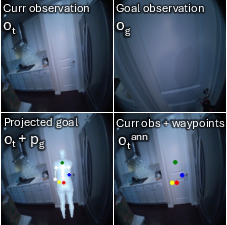
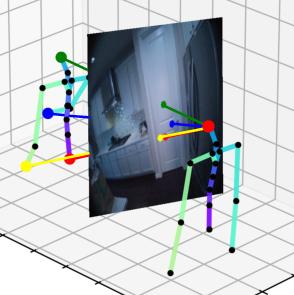
- Waypoints (the simple goals): The authors use four 2D dots placed on the current camera frame—one each for pelvis, head, left hand, and right hand. These dots are easy to understand and easy to adjust. They tell the agent where key body parts should go soon.
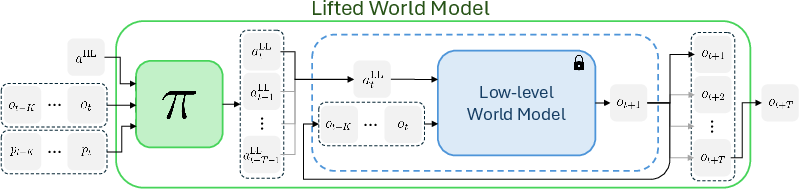
- The policy (the translator): A small model learns to turn those waypoints into a short sequence of detailed joint movements. If the waypoints are missing (e.g., a hand is off-screen), it learns to guess sensible motions from context.
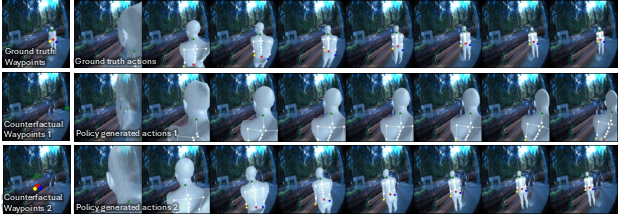
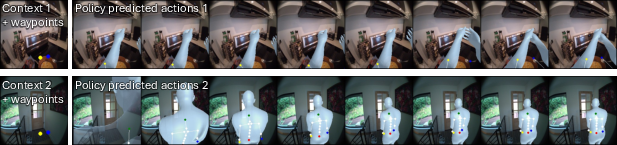
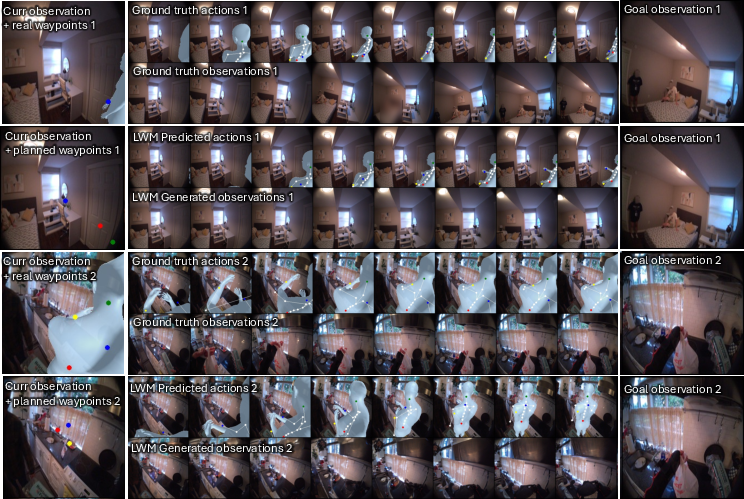
- Lifted World Model (LWM): They combine the translator (policy) with the existing world model (the simulator). Now you can give one high-level action (the waypoints), the translator turns it into joint moves, and the simulator predicts the future views. This “lifts” control from complicated joint space to simple waypoint space—no changes needed to the original world model.
- Planning with CEM (Cross-Entropy Method): Planning means trying different possible actions in your head and picking the best one. CEM is like: 1) Try many options, 2) Keep the best few, 3) Use them to pick better options next time, 4) Repeat. Searching over many tiny joint values is slow and gets harder as the number of joints grows. Searching over just a few dots on the image (the waypoints) is much easier and faster.
- Data and setup: They use PEVA (a strong world model) and the Nymeria dataset of first-person videos with body motion data. Their policy is a relatively small model that learns short-term motions like walking, reaching, and grasping.
What they found (key results)
- Waypoints beat goal images: Showing the model a “goal picture” did not help much because, in first-person video, your body is often not visible (you rarely see your own torso and legs). Waypoints, however, are drawn on the current view and directly say “move this joint here,” which works much better.
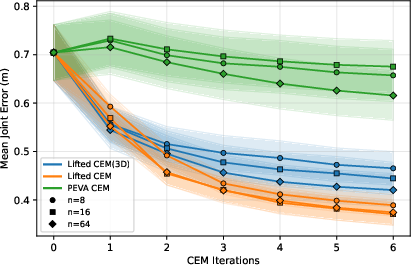
- Planning is far better and cheaper in waypoint space:
- When planning directly in joint space, results improved only a little.
- When planning with waypoints (the Lifted World Model), results were 3.8× better (measured by how close the final pose was to the target pose).
- It also needed less compute and scaled better to longer tasks.
- Works even when some joints aren’t visible: The policy learned to infer reasonable motions for joints off-screen, thanks to training with masked (missing) waypoints.
- 2D is enough: Adding depth (making waypoints 3D) helped only a tiny bit and actually made search harder because it increased complexity. Simple 2D waypoints were nearly as good and easier to plan with.
- Generalizes to new places: The method still worked in environments not seen during training.
Why this matters: Together, these results show that a simple, visual, low-dimensional control signal (waypoints) can unlock strong planning from complex world models without expensive, fragile low-level search.
Why it matters (implications and impact)
- Easier control of complex bodies: This approach lets people (or other programs) control human-like agents using a few intuitive dots instead of dozens of joint numbers. That’s more user-friendly and more robust.
- Faster, stronger planning: By searching over simple waypoints, planners can find better solutions with less compute—important for real-time use in robotics, AR/VR, or assistive systems.
- A reusable recipe: You don’t need to rebuild or retrain your big world model. You can “lift” it by adding a small translator policy on top, making advanced models more practical as they grow.
- Broad potential: Although demonstrated on a human-like agent, the idea—replace hard low-level control with simple, meaningful high-level actions—could apply to many robots and embodied AI systems.
In short, the paper shows that controlling complex agents becomes much more practical when you give them simple, visual goals (waypoints) and let a small translator handle the details. This makes planning not only easier and faster, but also more accurate.
Knowledge Gaps
Knowledge gaps, limitations, and open questions
Below is a single, concrete list of what remains missing, uncertain, or unexplored, framed to guide future research:
- High-level action space coverage: Only four 2D waypoints (pelvis, head, left/right hands) are used; there is no explicit control of head/eye orientation or torso orientation, which can strongly affect egocentric observations and planning stability.
- Out-of-view goals: Waypoints cannot specify goals fully outside the current field of view; off-screen or allocentric goals (e.g., memory/map-anchored targets) are not supported.
- Limited high-level planning horizon: Experiments fix the high-level horizon to L=1 and the policy to T=8, leaving multi-step high-level planning, receding-horizon MPC, and closed-loop replanning with feedback untested.
- Dependence on goal images for planning cost: CEM uses a perceptual distance to the goal observation (), despite evidence that is a weak pose signal; better cost functions (pose-aware, object/semantic-aware, task-specific) are not explored.
- Cost-function mismatch: The paper notes a mismatch between perceptual distance and MJE; systematic design/evaluation of physically grounded, pose- or task-aligned costs remains open.
- Privileged supervision for waypoint labels: Training relies on ground-truth future poses and known camera calibration to project 3D to 2D; robustness to calibration errors and training without mocap/privileged labels is unstudied.
- Uncertainty-aware planning: Neither the policy nor the world model’s uncertainty is modeled in planning; risk-sensitive objectives and uncertainty propagation are absent.
- Scalability to richer embodiments: The approach is only evaluated on an upper-body model (15 joints, 48 dims); applicability to full-body control (legs, feet contacts), dexterous hands/fingers, and non-humanoid robots is untested.
- Interaction physics and object state: Planning ignores contact dynamics and object state changes; success is not measured on manipulation outcomes (e.g., grasp stability, door opening), only MJE.
- Generalization beyond Nymeria: Robustness to different sensors/cameras, lighting, occlusion, and broader domain shifts is only lightly probed; systematic cross-dataset or real-world deployment evaluation is absent.
- Sensitivity to waypoint errors: Although qualitative counterfactuals are shown, no quantitative analysis of sensitivity to waypoint noise, occlusion, or systematic bias (e.g., depth ambiguity) is provided.
- 3D waypoints underperform in search: Depth makes search harder (12 vs. 8 dims) and degrades planning efficiency; strategies to infer or regularize depth (e.g., monocular depth priors, object-relative frames) are not explored.
- Alternative high-level action spaces: Other abstractions (keyframe poses, object-relative goals, spatial affordances, language) are not compared; how to pick action spaces that balance expressivity, interpretability, and searchability is open.
- Search algorithms: CEM is the sole planner; gradient-based methods through differentiable models, MPPI, MCTS, and learned high-level value functions or Q-functions are untested.
- Joint training: The world model is frozen and the policy is trained separately; end-to-end fine-tuning to align the policy, world model, and planning objective is unexamined.
- Compute profiling: Claims of compute efficiency lack wall-clock benchmarks; scaling with larger models, longer horizons, and higher sampling budgets is not measured.
- Closed-loop control and latency: Results are offline with no real-time closed-loop evaluation; robustness to latency, sensor noise, and disturbances is unknown.
- Kinematic/dynamic constraints and safety: No explicit enforcement of joint limits, self-collision, ground contacts, or obstacle avoidance; integrating biomechanical/physics constraints into planning remains open.
- Multi-agent and dynamic scenes: Planning with moving people/objects or crowded environments is not addressed.
- Head motion and observation drift: Without explicit head orientation control, camera motion may degrade planning; the impact on long rollouts is not quantified.
- Compounding model error: Long-horizon rollouts (beyond T=8 per action and L>1) and error accumulation are not thoroughly analyzed.
- Learned priors over waypoint distributions: The planner uses a Gaussian prior; learning data-driven priors or constraints (e.g., control barrier functions) to keep search in feasible regions is unexplored.
- Structured waypoint masking and selection: Masking is random during training; strategies for which waypoints to set at test time (active selection) and how to handle persistent occlusions are not studied.
- Planner–policy interactions: The policy sometimes ignores outlier waypoints; failure cases where search exploits policy blind spots (adversarial waypoints) are not investigated.
- Human-in-the-loop usability: Manual specification of waypoints is suggested but not evaluated for user accuracy, effort, and reliability in practical settings.
- Baseline coverage: There is no comparison to hierarchical RL methods, egocentric motion generators adapted to goal reaching, or differentiable planners integrated with world models/policies.
- Numerical stability in pose integration: Sensitivity to FK integration errors, rotation representations (e.g., Euler singularities), and drift is not reported.
- Memory and mapping: The approach lacks a persistent scene memory or SLAM; using episodic or spatial memory to plan to distant or occluded goals is an open direction.
- Data requirements: The method depends on synchronized egocentric video and mocap; whether self-supervised or pseudo-labeling approaches suffice when mocap is unavailable is untested.
- Ethical and privacy aspects: Using egocentric data raises privacy concerns; dataset biases and the impact on deployment fairness and safety are not discussed.
Practical Applications
Immediate Applications
The paper’s “Lifted World Model” (LWM) provides a practical way to control complex, human-like embodiments by searching over low-dimensional 2D waypoints instead of high-dimensional joint commands, yielding 3.8× better planning accuracy at lower compute. The following applications can be deployed now with appropriate embodiment models, egocentric cameras, and basic calibration.
- Teleoperation via 2D waypoint interfaces — Sector: Robotics (humanoids, mobile manipulators, telepresence); What: Operators click/tap waypoints on a live egocentric video (pelvis/head/hands) to produce realistic joint sequences; Tools/Workflows: “Waypoint Teleop Panel” that overlays clickable targets on the robot’s feed, LWM maps to joint actions, CEM searches in waypoint space for refinement; Assumptions/Dependencies: trained world model for the specific embodiment, accurate camera calibration, stable latency, waypoint in-view constraint.
- Assistive mobile manipulation in homes and hospitals — Sector: Healthcare/Assistive Robotics; What: Caregivers (or users) indicate near-term goals (e.g., “hand here,” “step to there”) with 2D points to guide assistive arms or humanoids for reach-to-grasp, placing, and short-horizon navigation; Tools/Workflows: tablet/AR overlay for setting sparse waypoints; LWM produces kinematically plausible motions; Assumptions/Dependencies: embodiment model trained on similar kinematics, safety interlocks, out-of-view goals not supported by 2D-only waypoints.
- AR-guided task coaching (egocentric overlays) — Sector: Education/Healthcare; What: For rehab or skill learning, the system overlays where the user’s pelvis/head/hands should move next, using egocentric video; Tools/Workflows: AR glasses app that generates 2D waypoints from target poses and visualizes them to guide users; Assumptions/Dependencies: on-device pose tracking or a proxy world model to map goals to feasible motions, camera calibration, privacy-preserving on-device inference when needed.
- Rapid previsualization and blocking for animation and games — Sector: Media/Entertainment/Software; What: Convert annotated 2D waypoints into plausible human motion for quick previz or blocking in first-person scenes; Tools/Workflows: plug-in for DCC tools/game engines where artists sketch end-effector targets over a camera view; LWM outputs short motion clips; Assumptions/Dependencies: trained model matching the skeleton; waypoints must be visible in-frame.
- Data-efficient planning on edge devices — Sector: Robotics/Embedded Systems; What: Use waypoint-space CEM to plan short-horizon actions on-device (8D per step vs 48D), reducing sampling burden and enabling onboard planning; Tools/Workflows: embedded LWM planner with adjustable CEM budget; Assumptions/Dependencies: quantized/optimized policy and world model; compute constraints manageable for diffusion-based models.
- Safer, more natural motion regularization during planning — Sector: Robotics/HRI; What: Use the policy’s kinematic priors to regularize search (avoid unnatural joint angles) while optimizing perceptual costs; Tools/Workflows: “LWM-regularized CEM” in existing planners; Assumptions/Dependencies: policy quality is tied to training data realism; no formal safety guarantees.
- Egocentric human-in-the-loop instruction for robots — Sector: HRI/Industrial; What: Supervisors specify sparse waypoints in the robot’s first-person view to correct or refine behaviors during tasks (e.g., reaching for specific controls, stepping aside); Tools/Workflows: interactive supervisory console, waypoint nudges injected into planner; Assumptions/Dependencies: shared egocentric view, calibration drift monitoring, training on similar task distributions.
- Synthetic motion augmentation for training — Sector: Research/Software; What: Generate realistic short-horizon embodied trajectories from waypoint scripts to augment datasets for downstream policy learning; Tools/Workflows: “Waypoint-to-Motion” data generator that outputs pose/action sequences; Assumptions/Dependencies: coverage limits (2D waypoints cannot model out-of-view goals), distribution shift if target tasks differ.
- Benchmarking hierarchical control — Sector: Academia; What: Provide a reproducible baseline for hierarchical control where high-level waypoints feed a frozen world model via a lightweight policy; Tools/Workflows: open-source LWM training/eval pipeline on Nymeria/PEVA-like setups; Assumptions/Dependencies: availability of egocentric datasets with pose annotations.
- Operator training and skill assessment — Sector: Workforce Training/AR; What: Teach novice operators by overlaying step-by-step waypoints while recording the resulting motion for assessment; Tools/Workflows: training app with LWM-generated guidance and MJE-based progress metrics; Assumptions/Dependencies: consistent camera setup and embodiment mapping; careful UX for clarity and comfort.
Long-Term Applications
These directions require further research, scaling to new embodiments, tighter safety/accuracy guarantees, or integration with additional modalities (depth, language, multi-agent).
- Semi-autonomous household humanoids with waypoint planners — Sector: Consumer Robotics; What: Language planners generate waypoint sequences (“move pelvis here, place right hand there”) that LWM converts to motions for multi-step tasks; Tools/Workflows: LLM→waypoint generator + LWM controller; Assumptions/Dependencies: robust long-horizon chaining, out-of-view goal handling (3D or memory), reliability across novel homes.
- Intuitive control for exoskeletons and advanced prosthetics — Sector: Healthcare/Medical Devices; What: Users indicate intended end-effector goals via simple interfaces (gaze, touch, EMG-derived targets) mapped to joint actuation via LWM; Tools/Workflows: multimodal intent decoder → 2D/3D waypoint targets → LWM actuation; Assumptions/Dependencies: stringent safety, personalized calibration, closed-loop feedback, regulatory approval.
- Remote manipulation in surgery and industry — Sector: Healthcare/Industrial Automation; What: Surgeons/technicians specify near-term instrument/hand waypoints in egocentric views to guide precise maneuvers; Tools/Workflows: verified waypoint planners with haptic feedback and safety monitors; Assumptions/Dependencies: sub-millimeter precision, formal verification, 3D waypoint depth and collision-aware planning.
- Autonomous exploration and USAR (urban search and rescue) — Sector: Public Safety/Defense; What: Humanoid responders use waypoint-space planning to quickly navigate/climb/manipulate in cluttered, unfamiliar environments with limited compute; Tools/Workflows: onboard LWM with uncertainty-aware CEM and risk constraints; Assumptions/Dependencies: robustness to debris/occlusion, integration with mapping and tactile feedback, hardening for noise and damage.
- AR/VR telepresence avatars with low-bandwidth control — Sector: Communications/Media; What: Transmit sparse waypoint commands instead of high-rate joint streams to control embodied avatars in remote environments; Tools/Workflows: “Waypoint codec” for telepresence sessions, LWM-driven local motion synthesis; Assumptions/Dependencies: embodiment matching, temporal consistency, synchronization with speech/gesture.
- Generalizable embodied assistants via cross-embodiment lifting — Sector: Robotics/Software Platforms; What: Train policies that map generic waypoint spaces to multiple embodiments (different humanoids or mobile manipulators), enabling plug-and-play lifting of various world models; Tools/Workflows: “Cross-Embodiment Lifting SDK” with adapters for kinematics and perception; Assumptions/Dependencies: standardized skeletons/URDFs, domain adaptation, sufficient multi-embodiment data.
- Integrated language-to-waypoint planners — Sector: Software/Robotics; What: Compose LLM task planners with waypoint-space search and LWM execution to bridge language intent and low-level control; Tools/Workflows: constraint-aware LLM that outputs waypoints + costs; Assumptions/Dependencies: grounding language to pixel coordinates reliably, commonsense physics priors, hallucination mitigation.
- Workplace safety and compliance audits for humanoids — Sector: Policy/Regulation; What: Use waypoint-level plans as interpretable artifacts for auditing robot intent and kinematic feasibility before execution; Tools/Workflows: “Waypoint Audit Trail” that checks plans against constraints (joint limits, proximity); Assumptions/Dependencies: accepted standards for waypoint semantics, certified monitors linking waypoints to executed trajectories.
- Cinematics and game AI with egocentric realism — Sector: Media/Entertainment; What: First-person characters that navigate and interact realistically by planning in waypoint space with scene-aware policies; Tools/Workflows: toolchains that generate waypoint scripts from level semantics and cinematic beats; Assumptions/Dependencies: robust policy conditioning on diverse scenes, scalable to crowds and long horizons.
- Human-robot collaboration with shared egocentric views — Sector: Manufacturing/Logistics; What: Workers and robots co-edit waypoint plans on shared headcam views to coordinate tasks (e.g., handovers, tool placement); Tools/Workflows: collaborative AR planners, waypoint locking and validation; Assumptions/Dependencies: precise calibration across agents, collision-aware planning, enterprise safety protocols.
Common Assumptions and Dependencies Across Applications
- Embodiment-specific world model: The LWM depends on a trained world model (e.g., PEVA) matched to the agent’s kinematics; porting to new robots/humans needs data and re-training/adaptation.
- Egocentric camera and calibration: Waypoints are defined in the current view; robust camera intrinsics/extrinsics and drift correction are required.
- In-view waypoint constraint: 2D waypoints cannot directly specify goals fully outside the current image; 3D waypoint extensions or memory modules are needed for long-range tasks.
- Compute and latency: Diffusion-based policies/world models can be heavy; optimization (quantization, fewer denoising steps) is needed for real-time on edge hardware.
- Safety and verification: Policies regularize toward plausible motions but lack formal safety guarantees; safety layers (constraints, monitors) are necessary in critical domains.
- Domain shift and generalization: While the paper shows generalization to unseen environments, broader deployment requires robust adaptation to lighting, clutter, attire, and novel tasks.
- Head orientation and perception: Current setup does not explicitly control head orientation; viewpoint changes can affect observation prediction and should be addressed for consistent planning.
- Search budget and cost functions: CEM is more efficient in waypoint space but still sampling-based; fast surrogate objectives and better perceptual/pose-aligned costs improve reliability.
Glossary
- 3D positional embeddings: Positional encodings that include three-dimensional spatial information to help models preserve geometry across space and time. "Additional 3D positional embeddings are added to tokens to preserve spatial as well as temporal ordering before processing with a vision transformer."
- Autoregressive sampling: A generation process where each new output is produced conditioned on previously generated outputs in sequence. "Then the low-level world model autoregressively samples a sequence of new observations, one for each low-level action, appending each to the observation context for the next step."
- Camera matrix: The projection matrix that maps 3D points in camera coordinates to 2D image coordinates. "which are then projected into the image plane with the camera matrix "
- Cross-Entropy Method (CEM): A stochastic optimization and planning algorithm that iteratively samples, evaluates, and refines a distribution over actions to minimize a cost. "search-based methods like the Cross-Entropy Method (CEM)~\cite{rubinstein199789crossentropymethodcem} scale poorly in action dimensionality"
- DINOv3-S: A self-supervised vision backbone (small variant) used to encode images into token embeddings without pooling to preserve spatial detail. "Then, images and are encoded using a DINOv3-S~\cite{simeoni2025dinov3} encoder."
- Diffusion policy: An action-generation model that learns a denoising diffusion process to sample action sequences. "The policy is a diffusion policy that generates actions by denoising in joint action space."
- DreamSIM: A perceptual similarity metric used to measure visual distance between images in planning evaluations. "Across all methods, more samples leads to a lower DreamSIM perceptual distance."
- Egocentric: Referring to observations captured from the agent’s own viewpoint (first-person perspective). "we lift PEVA\cite{bai2025wholebodypeva}, a world model that predicts egocentric observations conditioned on human joint-angle displacements."
- Embodied agent: A model or controller coupled to a physical body (with sensors and actuators) that interacts in the environment. "World models of embodied agents predict future observations conditioned on an action taken by the agent."
- Euler angles: A three-parameter representation of 3D rotations using ordered rotations about coordinate axes. "Euler angles for each joint."
- Forward kinematics: The process of computing joint positions in 3D space from joint angles and link lengths along a kinematic chain. "Non-pelvis joints are defined in the frame of their parent joint, so only angular displacements are needed; their 3D positions are recovered via forward kinematics"
- Homogeneous coordinates: A coordinate system using an extra dimension to represent projections and affine transformations in a linear form. "Homogeneous coordinates and the camera frame transform are omitted for clarity."
- Joint-angle displacements: Changes in joint angles over time that define low-level actions for articulated control. "predicts egocentric observations conditioned on human joint-angle displacements."
- Leaf joint: A terminal joint in a kinematic tree (with no children), such as hands or head in a human model. "each specifying a near-term goal position for a leaf joint (pelvis, head, hands)."
- Lifted World Model (LWM): A composite model where a high-level action is mapped to low-level actions via a policy and rolled out in a (frozen) world model to predict future observations. "The Lifted World Model (LWM) predicts a future observation from image, pose context, and a single high-level action:"
- Mean Joint Error (MJE): A metric measuring the average Euclidean distance between predicted and ground-truth joint positions. "Mean joint error (MJE) is reported in meters."
- Nymeria dataset: A dataset of first-person videos with corresponding full-body motion capture in diverse environments, used for training and evaluation. "We use PEVA~\cite{bai2025wholebodypeva} trained on the Nymeria~\cite{ma2024nymeria} dataset as a low-level world model."
- PEVA: A world model that predicts egocentric observations conditioned on human joint inputs for whole-body control. "We use PEVA~\cite{bai2025wholebodypeva} trained on the Nymeria~\cite{ma2024nymeria} dataset as a low-level world model."
- Perceptual similarity cost function: A cost based on visual similarity between predicted and goal observations used to guide planning. "with a goal observation , perceptual similarity cost function , and a distribution over low-level actions "
- Posterior parietal cortex: A brain region implicated in representing visuospatial goals that are transformed into motor commands. "visuospatial goals in the posterior parietal cortex are translated into joint-level commands by the motor cortex"
- Project Aria: A wearable device platform providing first-person visual data used for egocentric datasets. "Project Aria~\cite{engel2023project} glasses"
- Rotation matrices: Matrix representations of 3D rotations used to convert to/from angle parameterizations. " and transform Euler angles to and from rotation matrices in SO(3)."
- SO(3): The Lie group of all 3D rotation matrices, representing orientations in three dimensions. " and transform Euler angles to and from rotation matrices in SO(3)."
- UNet: A neural network architecture with encoder–decoder and skip connections, here used as the denoising network in diffusion. "The processed tokens are pooled to form context vector , which is used as input to condition the denoising UNet during generation."
- Vision transformer: A transformer-based architecture applied to image tokens for visual representation learning. "Additional 3D positional embeddings are added to tokens to preserve spatial as well as temporal ordering before processing with a vision transformer."
- Waypoint: A 2D point in the current image indicating the projected location of a short-horizon 3D goal for a specific joint. "A waypoint is the 2D projection into the current observation of a near-term 3D goal position for one leaf joint of the embodied agent."
- World model: A model that predicts future sensory observations from current observations and actions, enabling planning and control. "A world model predicts the future observation given an action and a current observation ."
- XSens: A human motion capture system and body model used to represent joint kinematics and poses. "The human-like embodiment is represented using the XSens~\cite{roetenberg2009xsens} model"
Collections
Sign up for free to add this paper to one or more collections.