- The paper shows that self-supervised encoders naturally converge to isotropic Gaussian representations by maximizing entropy on a predictive manifold.
- It reframes the Information Bottleneck objective as a rate-distortion problem, enabling soft clustering of predictive distributions via the CEB framework.
- Empirical results on synthetic and real-world tasks validate that SIGReg effectively enforces high representation entropy and prevents collapse.
Overview of the Framework
The paper "Why Self-Supervised Encoders Want to Be Normal" (2604.27743) offers a rigorous information-theoretic and geometric characterization of representation learning via self-supervised encoders, situated within the Information Bottleneck (IB) paradigm. The central thesis is that the preference for isotropic Gaussian latent representations arises naturally from maximum entropy principles applied to the geometry of the predictive manifold. By reframing the IB objective as a rate-distortion problem—with KL divergence quantifying predictive mismatch—the optimal latent variable W must not simply compress X but perform a soft clustering among the predictive distributions p(Y∣x), which reside within the canonical probability simplex PK.
This geometry directly unifies supervised, semi-supervised, and self-supervised objectives and rationalizes recent empirically successful distributional regularization strategies such as SIGReg. The theoretical linkage between the flat Dirichlet prior (maximal entropy on PK) and the isotropic Gaussian embedding, via a chain of exact transformations, is precise and quantifies the entropy overhead incurred at every stage.
Predictive Manifold and Soft Clustering
The IB methodology formalizes the trade-off between retention of predictive information (I(W;Y)) and compression (I(X;W)), where a latent variable W is constructed to minimize redundancy and maintain predictive power regarding Y. The key insight of the paper is the geometric interpretation: the optimal representation W is always a function of the predictive distribution X0, mapping inputs onto the predictive manifold X1.
At zero distortion (X2), the encoder computes the minimal sufficient statistic, collapsing nuisance variability and achieving the endpoint of the IB curve. For X3, the encoder implements soft clustering in X4, with each latent X5 representing a cluster center in X6. This reflects a stochastic assignment where the decoder is always the conditional mean of X7 over the preimage of X8. The simplex structure ensures invariance to prediction-preserving transformations and bounds the latent dimensionality by X9.
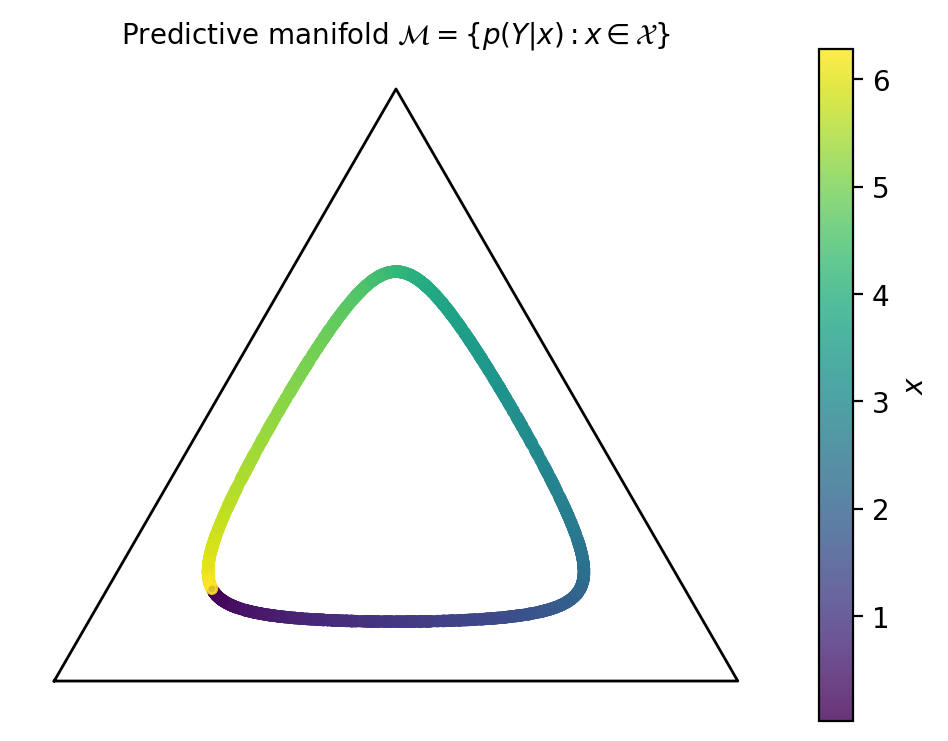
Figure 1: Continuous predictive manifold—p(Y∣x)0 traces a loop through p(Y∣x)1.
A critical contribution is the chain of exact transformations connecting the flat Dirichlet prior (p(Y∣x)2) to an isotropic Gaussian in Euclidean space, thereby explaining the rationale for SIGReg as a Gaussian relaxation of maximum entropy on the simplex. The transformation follows:
- Flat Dirichlet Prior: Maximum entropy distribution on p(Y∣x)3.
- Exponential Parameterization: p(Y∣x)4 i.i.d. p(Y∣x)5 random variables, normalized to yield Dirichlet samples.
- Gaussian Embedding: Each exponential is constructed from the sum of squares of two independent standard normals, giving p(Y∣x)6 i.i.d. p(Y∣x)7.
The phase entropy overhead p(Y∣x)8 nats is strictly non-diminishing and affects rate accounting but not achievable prediction. SIGReg, fitted via the Cramér–Wold theorem and the Epps–Pulley test, matches the encoder’s marginal to p(Y∣x)9 robustly, enforcing high entropy and preventing collapse.
Practical Losses: CEB and Distributional Regularization
The paper employs the Conditional Entropy Bottleneck (CEB) decomposition for practical estimation, rewriting the IB Lagrangian as conditional rate PK0 plus total rate PK1. This allows analytical estimation in supervised settings via minibatch marginals, while in semi-supervised or self-supervised settings, SIGReg serves as the regularizer on unlabeled data.
- Supervised Case: Encoder trained for sufficiency using class-conditional marginals.
- Semi-Supervised Case: CEB conditional rate applied to labeled data, SIGReg penalizes collapse for all data.
- Self-Supervised Case: View-prediction proxy replaces conditional rate, SIGReg regularizes all data.
Empirical Demonstration
The paper empirically validates the framework through synthetic and real-world experiments:
- Continuous Toy Problem: For PK2 a continuous angle, PK3 traces a loop in PK4. Sweeping PK5 demonstrates the progressive recovery of predictive structure, with rate-distortion curves quantifying trade-offs.
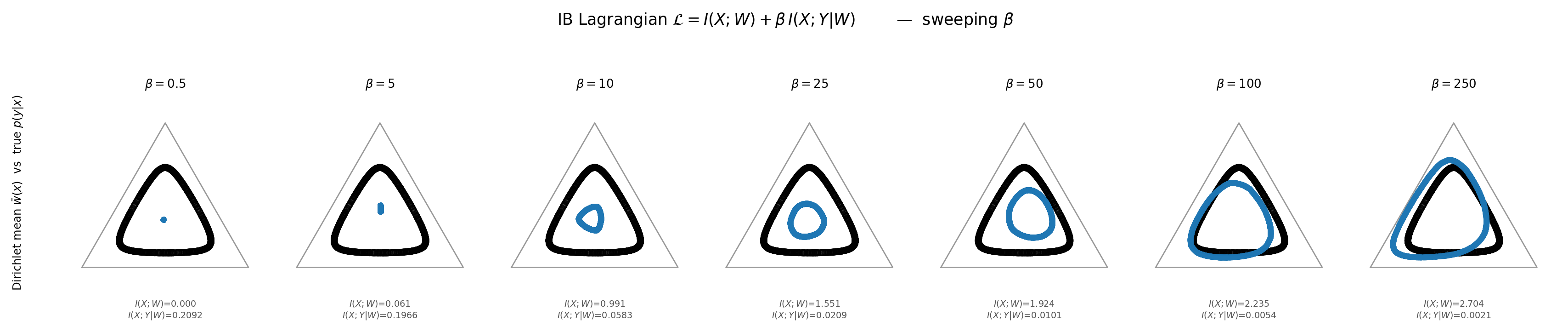
Figure 2: Dirichlet means vs. ground-truth predictive distributions for increasing PK6.
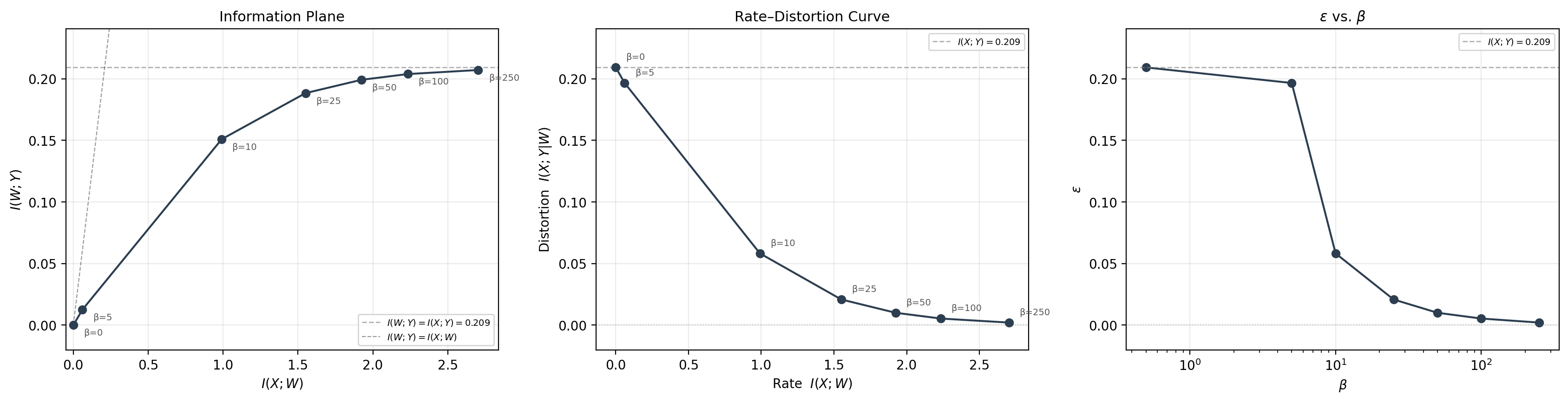
Figure 3: Information plane, rate-distortion curve, and PK7 for the continuous experiment.
- Discrete Toy Problem: For PK8, 10 predictive clusters are embedded. CEB estimation matches ground-truth clusters, with accuracy saturating as PK9 reaches the number of classes and rate converging to PK0.
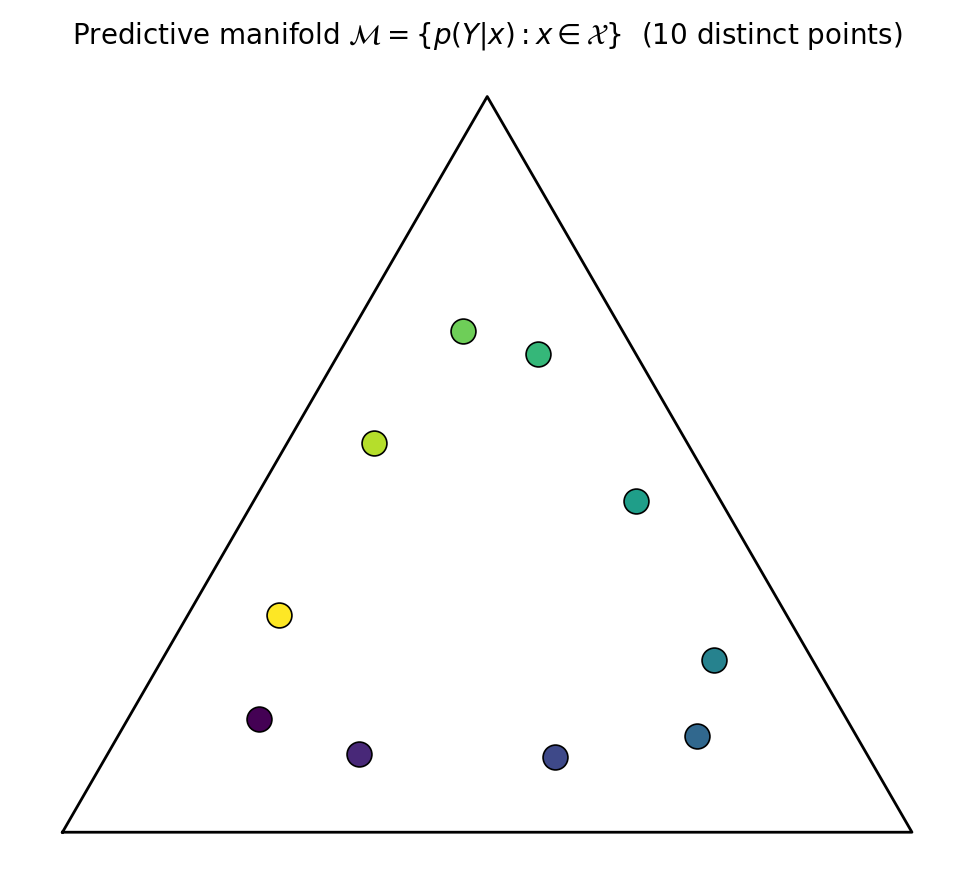
Figure 4: Ten distinct PK1 points on the simplex loop, composing the discrete predictive manifold.
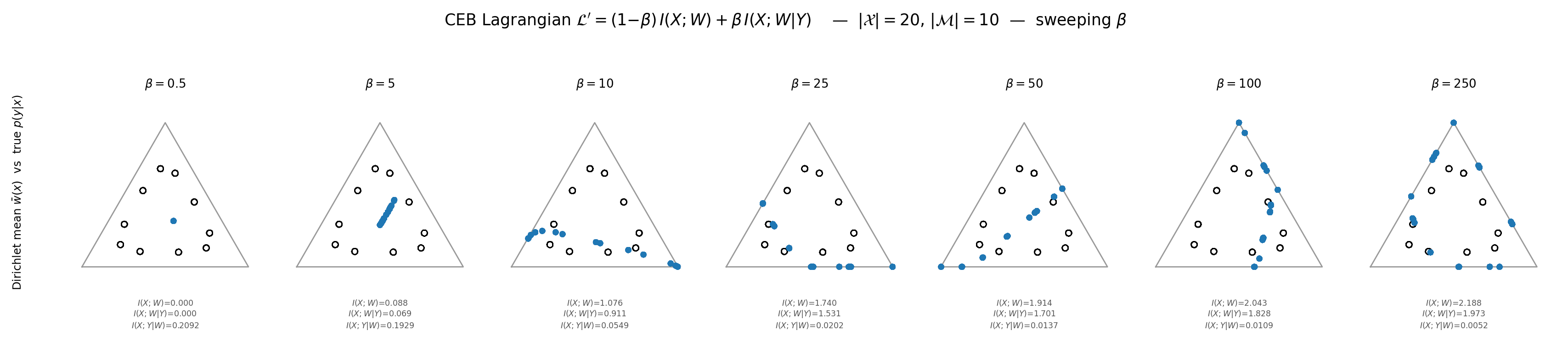
Figure 5: Dirichlet means versus ground-truth for increasing PK2 in the discrete CEB experiment.
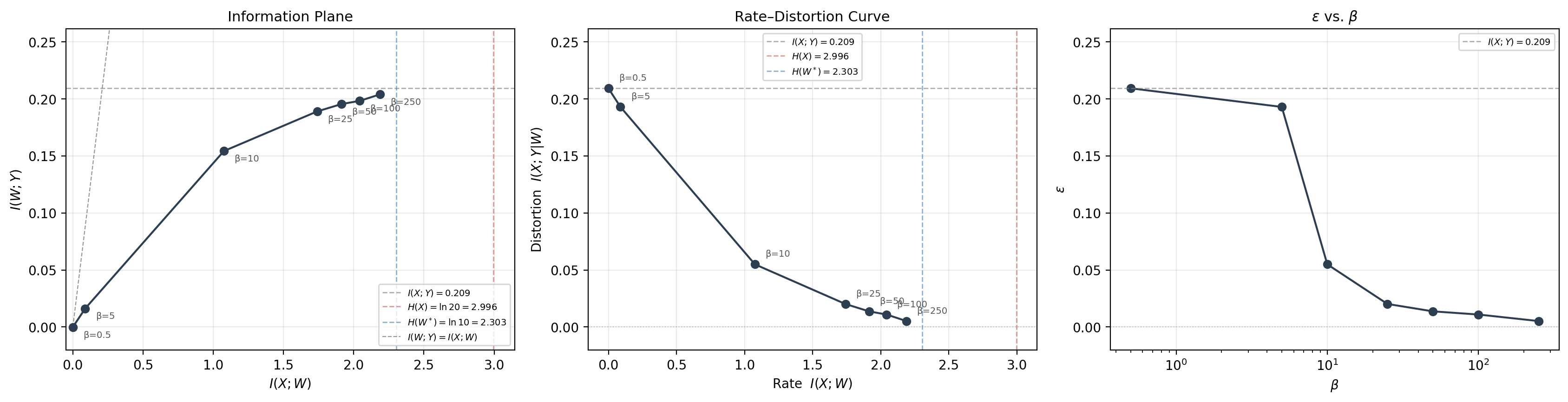
Figure 6: Information plane, rate-distortion curve, and distortion for discrete CEB with dashed lines for PK3 and PK4.
- FashionMNIST: Comparison between VIB and non-parametric CEB estimation on the simplex. CEB achieves higher accuracy at lower rate; empirical sweep over PK5 verifies phase transition and validates theoretical predictions.
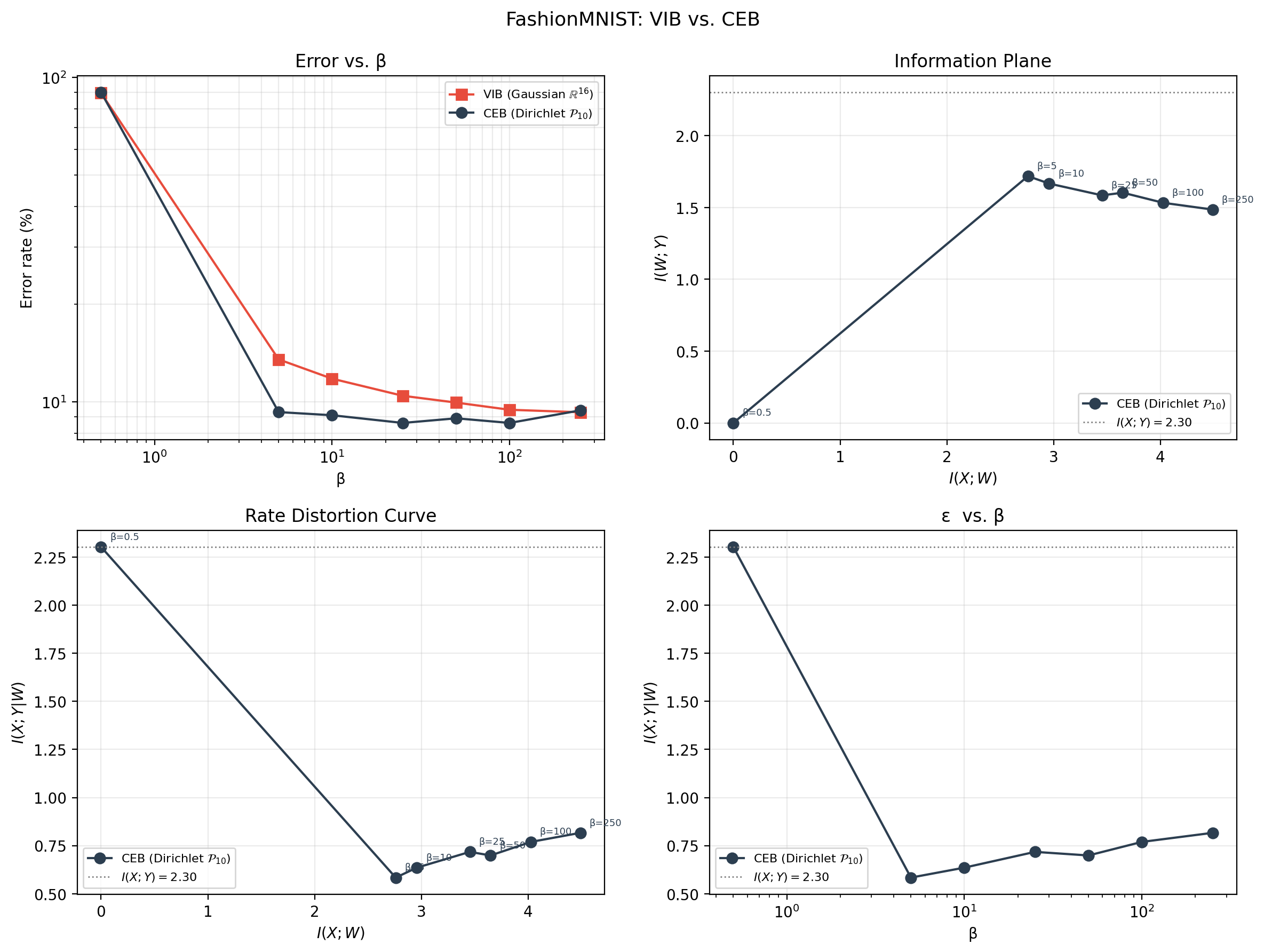
Figure 7: VIB (Gaussian, PK6) vs. CEB (Dirichlet, PK7) on FashionMNIST—error rate, information plane, and rate-distortion curves.
- Ablation on Simplex Dimension PK8: Demonstrates that accuracy saturates at PK9, with predictive benefit plateauing while distortion continues to decrease as I(W;Y)0 increases.
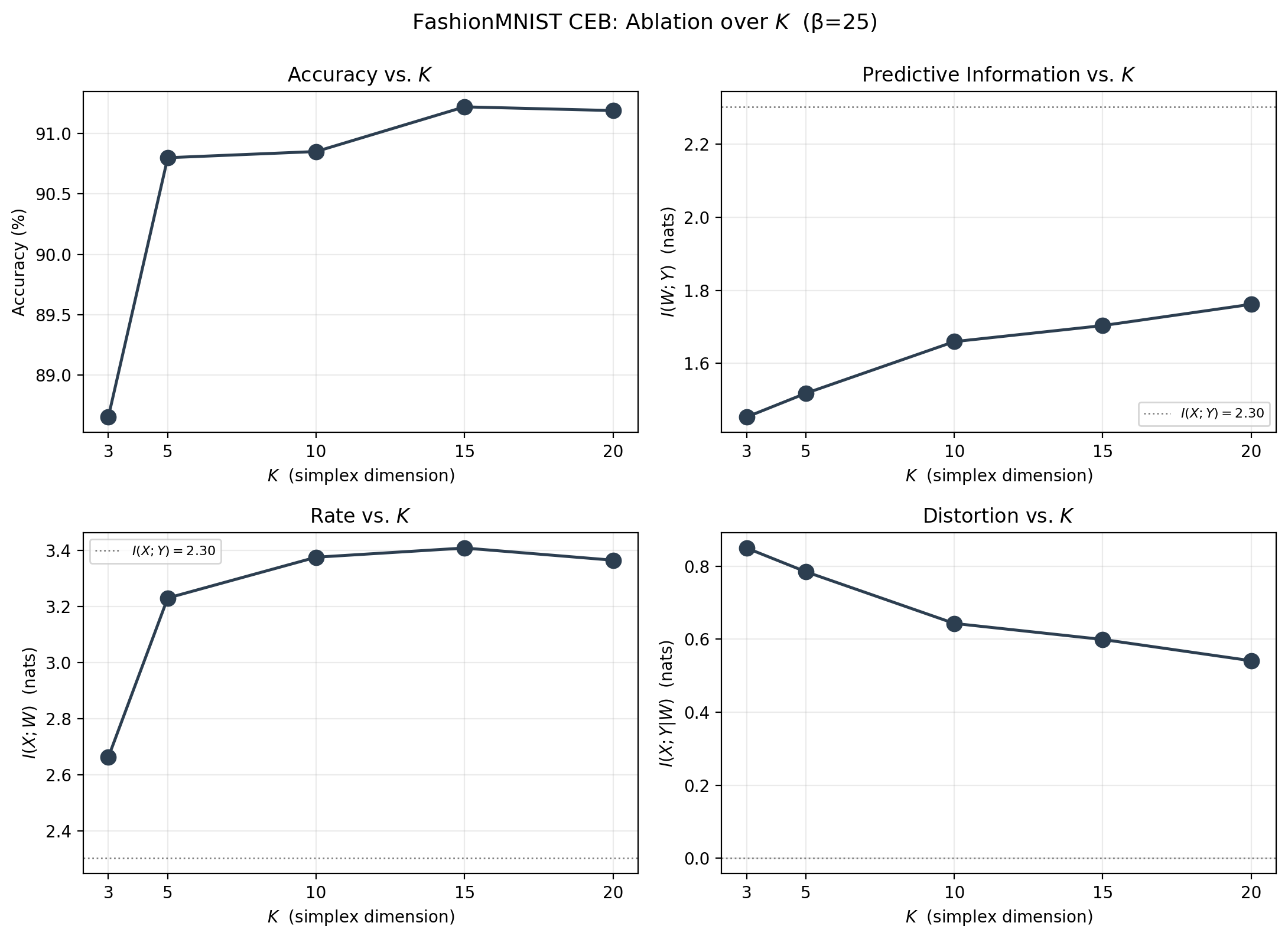
Figure 8: CEB ablation over simplex dimension I(W;Y)1 at I(W;Y)2; accuracy saturates at I(W;Y)3.
Implications and Future Directions
The framework establishes a geometric and information-theoretic foundation for distributional regularization in less-supervised learning, providing clarity on the circumstances under which latent normality is preferable and the precise entropy overheads incurred. Practically, it supports robust training with high-entropy embeddings, prevents collapse, and enables task-agnostic encoder regularization. The analysis also delineates the structural role of the simplex dimension I(W;Y)4 as the sole parameter governing predictive capacity.
Future research directions include:
- Operational strengthening of continuous-I(W;Y)5 covering number bounds.
- Empirical evaluation of the exponential parameterization as a near-exact alternative to the Gaussian with diminishing overhead.
- Scaling minibatch-marginal estimators to higher dimensions and larger datasets for non-parametric mutual information estimation.
Conclusion
This paper develops a rigorous geometric perspective on the Information Bottleneck for encoder-decoder networks, identifying why self-supervised encoders gravitate toward isotropic Gaussian representations as a relaxation of maximum entropy on the predictive manifold. The Dirichlet-to-Gaussian chain provides a theoretical footing for SIGReg, while the CEB decomposition enables principled non-parametric encoder losses across varying supervision regimes. The results unify supervised and less-supervised approaches, explain regularization strategies, and empirically validate the geometric theory behind representation collapse and entropy-regularized learning.