Exploring Sparse Matrix Multiplication Kernels on the Cerebras CS-3
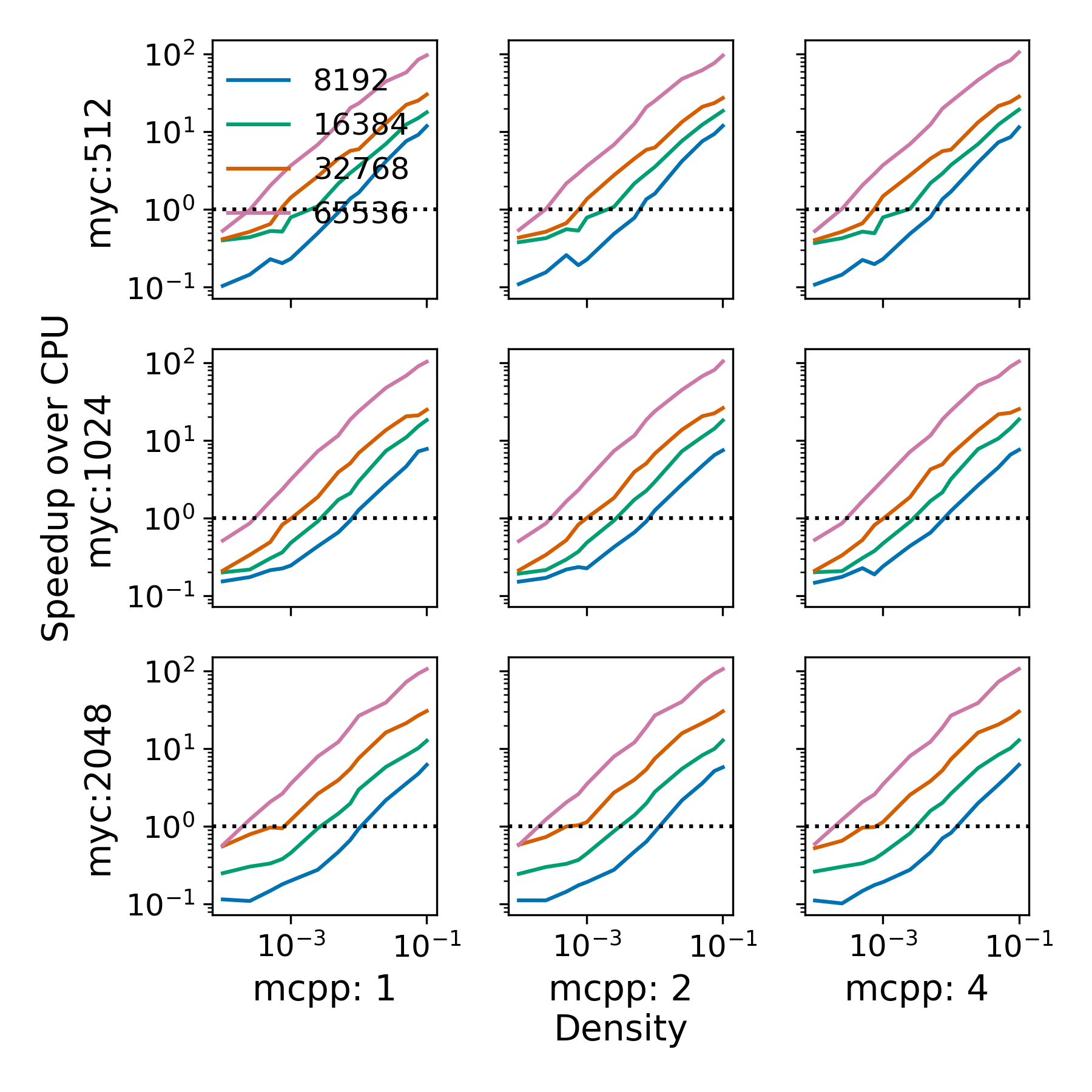
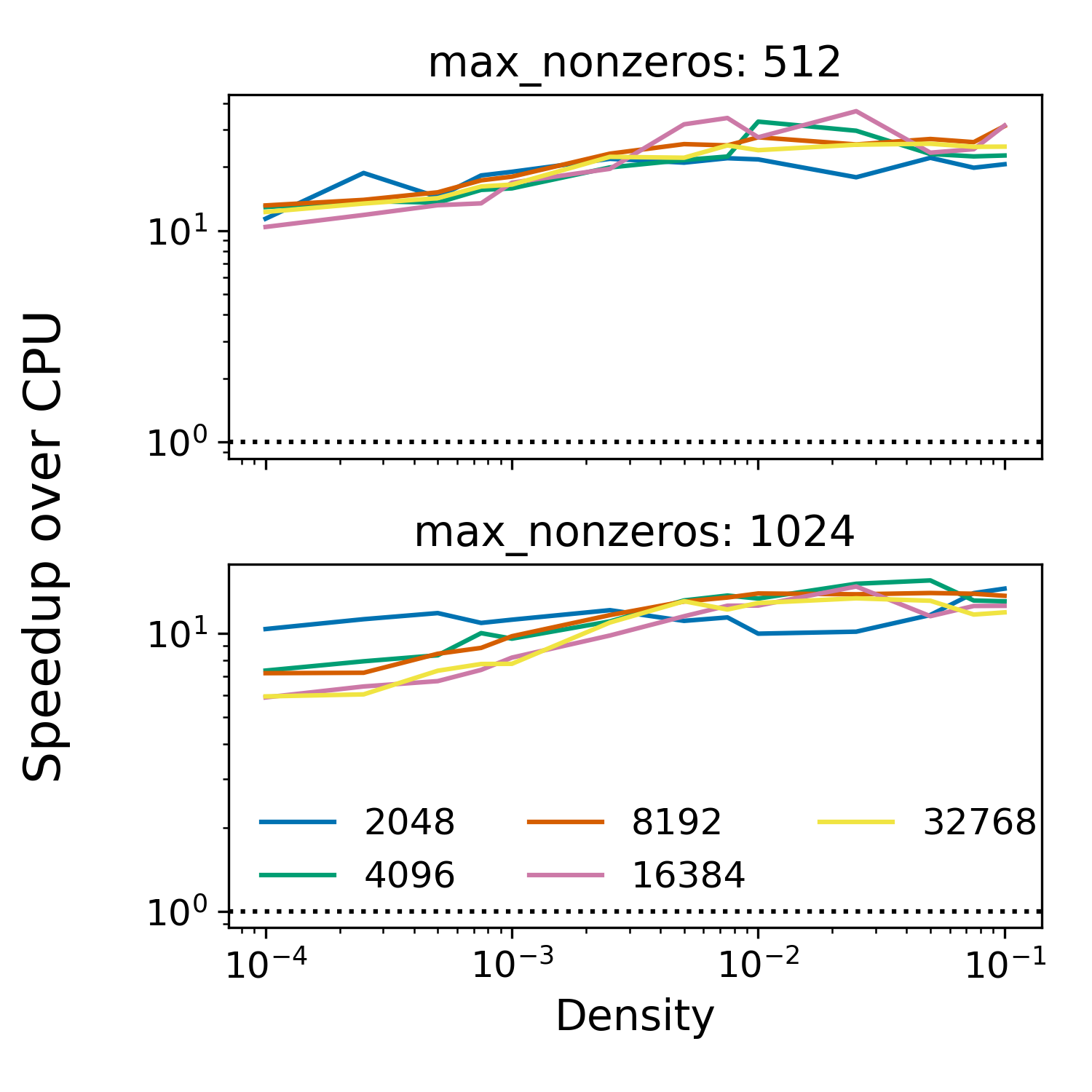
Abstract: In recent years, novel AI accelerators have emerged as promising alternatives to GPU for AI model training and inference tasks. One such accelerator, the Cerebras CS-3, achieves strong performance on large model training as well as scientific applications like molecular dynamics simulations. While dense compute workloads have been thoroughly explored for the CS-3, its potential for sparse workloads has not been fully examined. Applications requiring sparse linear algebra kernels, such as GNNs, linear solvers, and recommendation systems, could achieve good performance on a dataflow accelerator like the CS-3. In this work, we explore two key sparse linear algebra kernels, sparse-dense matrix multiplication (SpMM) and sampled dense-dense matrix multiplication (SDDMM), on the Cerebras CS-3. We propose low-level CS-3 kernel designs for these operations and optimize our designs to improve I/O performance, memory footprint, and scalability to large matrices. Our evaluation examines memory footprint and SpMM/SDDMM speedup relative to CPU. The evaluation suggests that the CS-3 can outperform CPU by 100$\times$ for SpMM with 90\% sparse matrices with performance improving as sparse matrix dimensionality increases. SDDMM on CS-3 can outperform CPU 20$\times$ for 90\% sparse matrices. We additionally find that as sparsity increases to beyond 99\%, the CS-3 suffers from performance degradation that makes it slower than CPU for SpMM.
Paper Prompts
Sign up for free to create and run prompts on this paper using GPT-5.
Top Community Prompts
Explain it Like I'm 14
Overview
This paper looks at how well a very large AI chip, the Cerebras CS-3, can run two kinds of “sparse” math that show up in many modern tasks like graph neural networks (GNNs) and recommendation systems. “Sparse” means most entries in a big table of numbers are zero, so you want to skip the zeros and only do work where there are real values. The authors design custom programs for the CS-3 to run these sparse operations quickly and test how fast they are compared to a regular CPU.
Key questions the paper asks
- Can the Cerebras CS-3 run two important sparse math operations—SpMM and SDDMM—much faster than a CPU?
- How should we organize the data and the work on the chip so it uses its hardware well and doesn’t waste time moving data around?
- What happens to speed when the matrices get larger or when they become very sparse (almost all zeros)?
How they did it (in simple terms)
First, some quick definitions using everyday language:
- Dense vs. sparse: Imagine a giant spreadsheet. Dense means most cells are filled; sparse means most cells are empty. In sparse math, we try not to touch empty cells at all.
- SpMM (Sparse × Dense): Multiply a sparse matrix A by a dense matrix H to get Y. You only multiply where A isn’t zero.
- SDDMM (Sampled Dense × Dense): Multiply two dense matrices B and C, but only “sample” the results where a sparse matrix A says to look. It’s like computing only the entries that matter.
About the Cerebras CS-3:
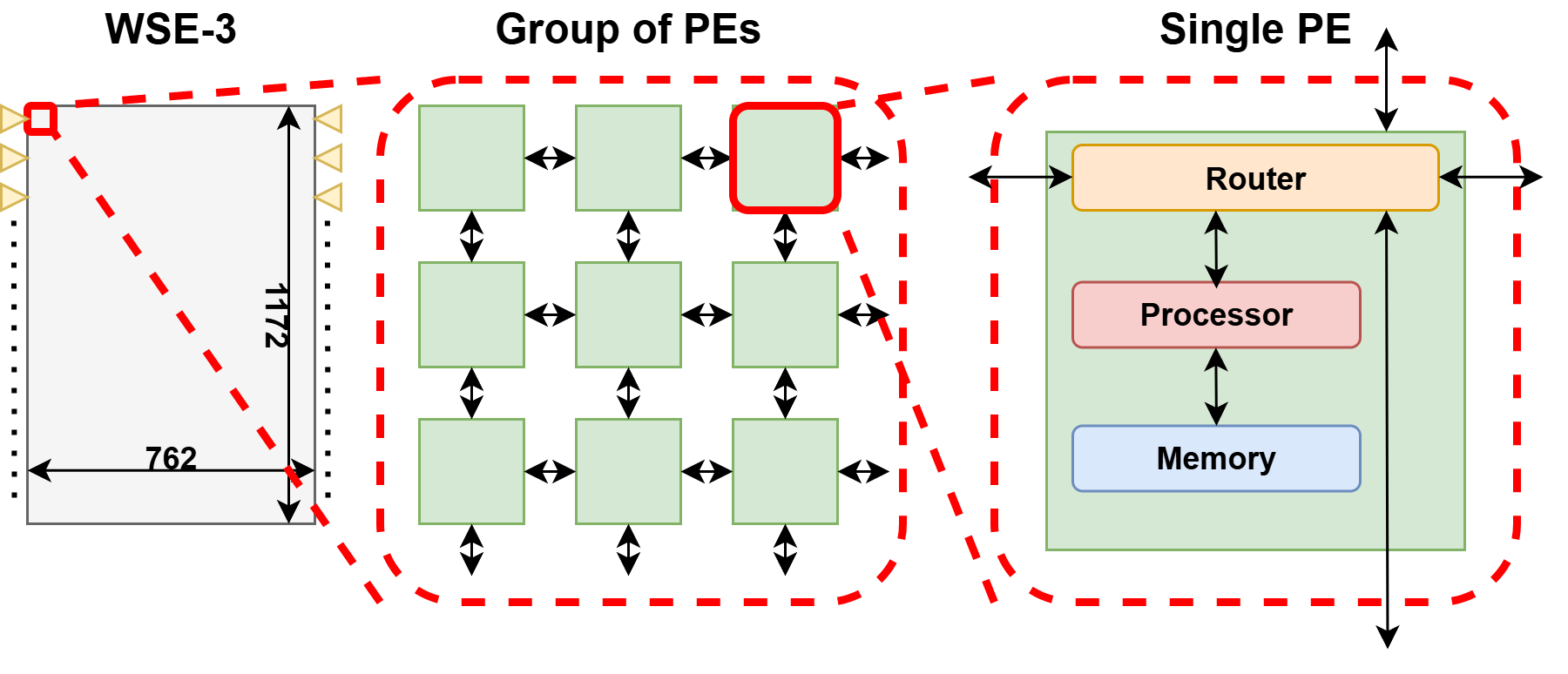
- Think of the CS-3 as a city made of nearly 900,000 tiny calculators (called processing elements, or PEs) arranged in a grid, each with its own small memory. They pass data to their neighbors very fast, like letters moving between houses on the same block.
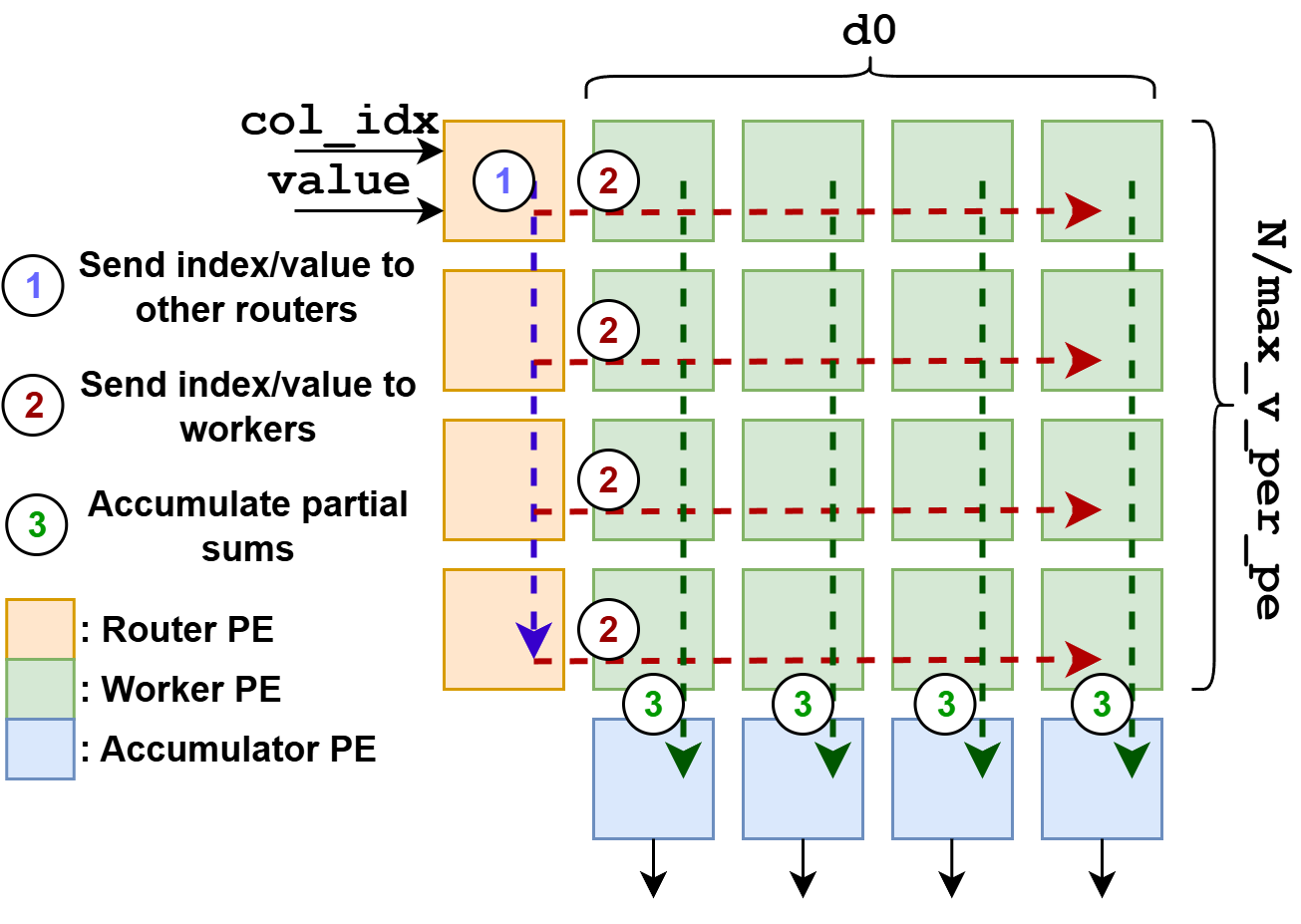
- The authors use a low-level language called CSL to tell different PEs to act as:
- “Routers” (traffic directors sending data to the right place),
- “Workers” (doing the multiplications and additions),
- “Accumulators” (collecting and storing results before sending them back).
What they built and improved:
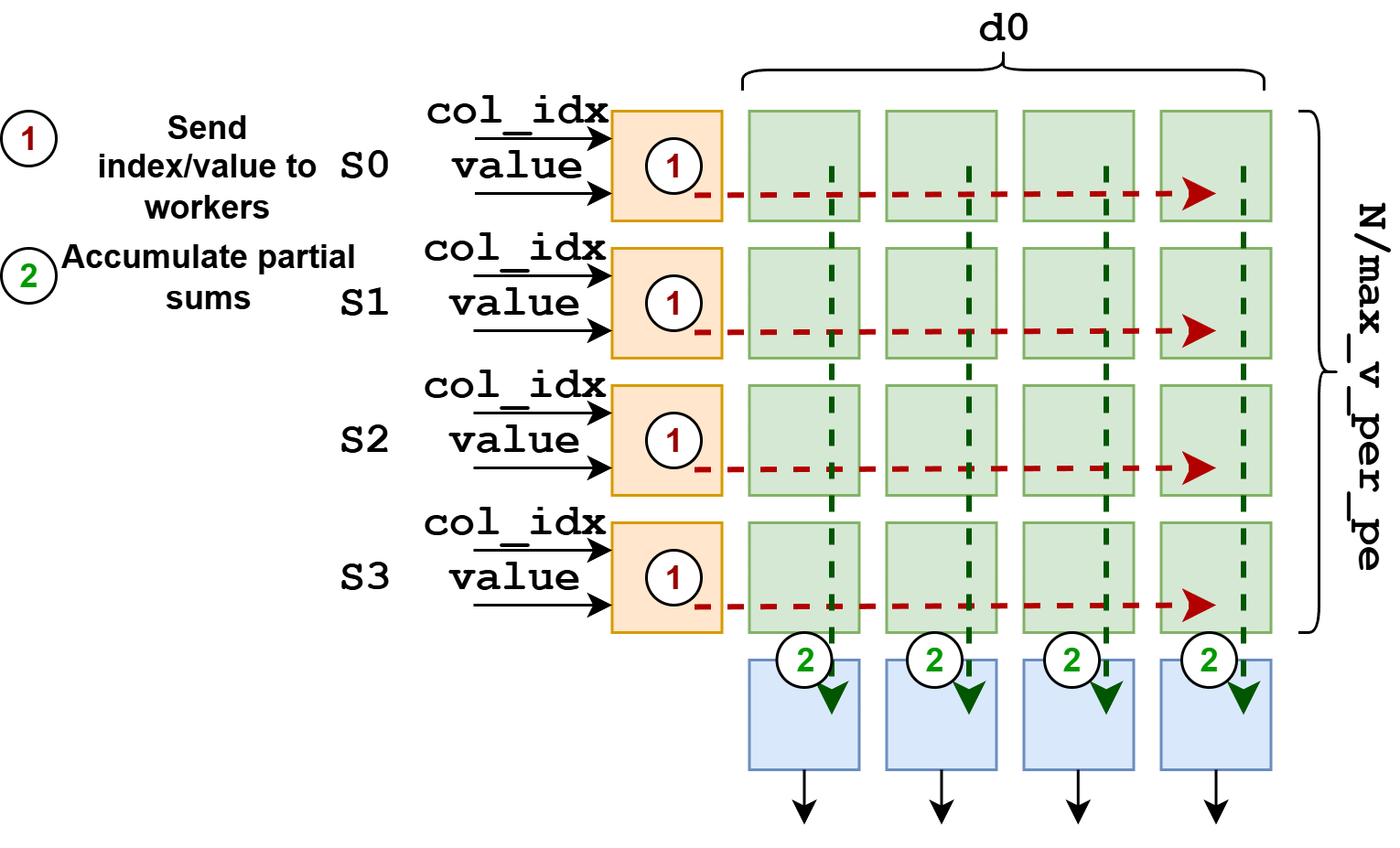
- Initial SpMM design: The host computer streams the important parts of A (the non-zero positions and their values) into the “top-left corner” router, which forwards them to the right workers. Workers multiply and add to build chunks of the result Y; accumulators then send Y back to the host.
- Problem found: Sending all data through one corner creates a “traffic jam,” limiting how fast data can enter the chip.
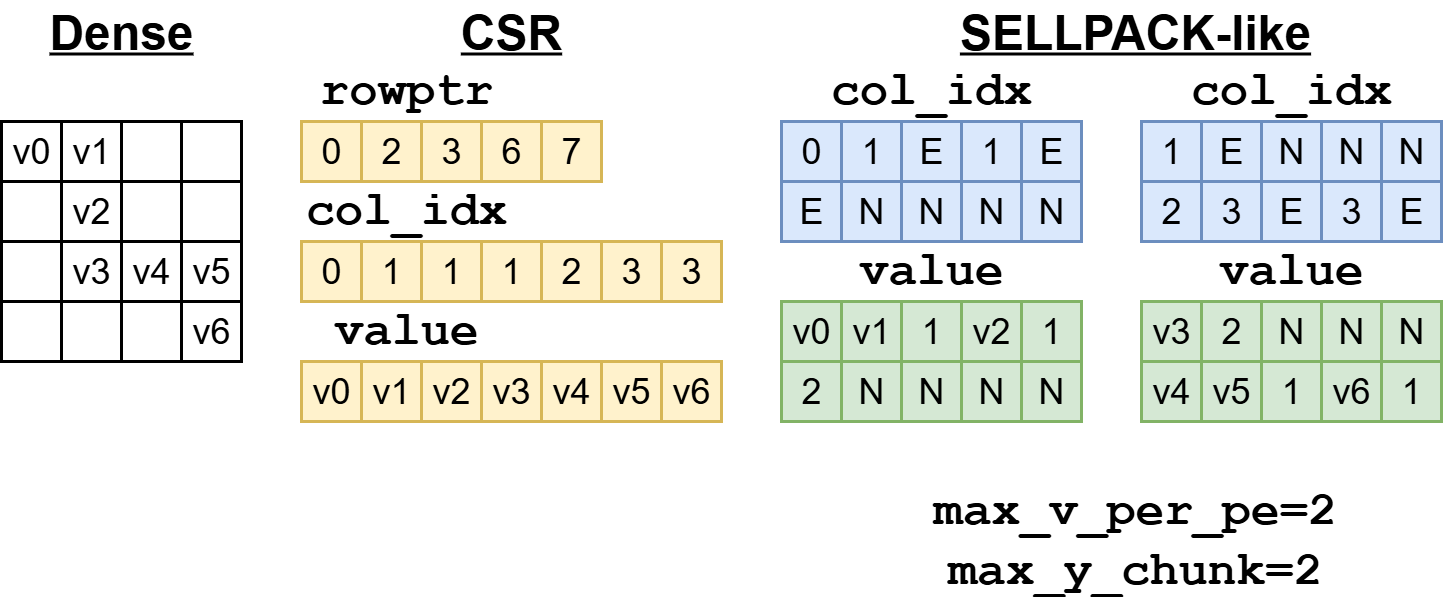
- Better data format for A (SELLPACK-like): They reorganized the sparse matrix into chunks so each chunk can be sent straight to the right router, not just through the corner. This lets them use many input lanes at once, speeding up transfers into the chip. They added markers to signal the end of a row and padding to keep streams aligned.
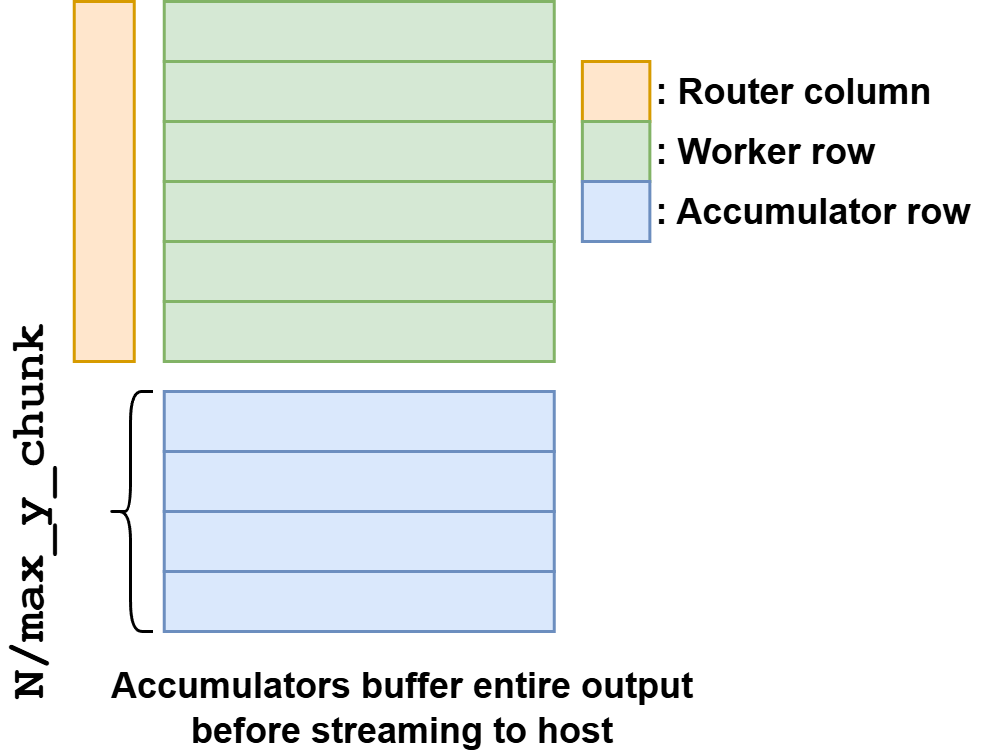
- Reducing waiting time (serialization): Instead of sending a chunk in and immediately waiting to send the result back, they buffered more results on the chip using multiple rows of accumulators. That way, the chip keeps working while output is sent later, improving overlap between computing and data movement.
For SDDMM:
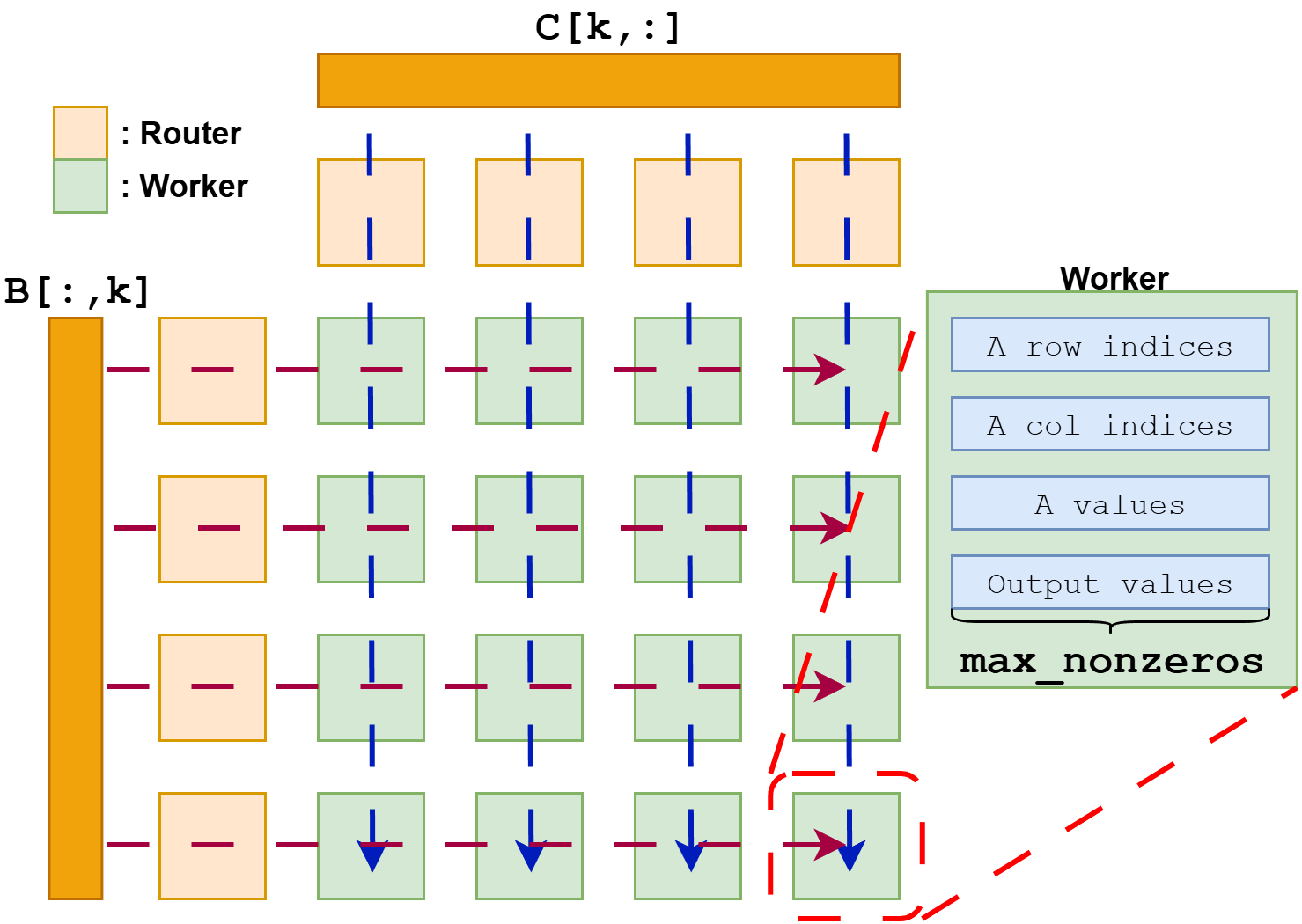
- They placed routers along two edges of the chip, streaming columns of B from the west and rows of C from the north. These flow across the grid like two crossing waves.
- Workers store small tiles of the sparse pattern A and compute only where A has a non-zero. This avoids doing unnecessary math.
Main findings and why they matter
Here are the key results from tests on random matrices of different sizes and densities:
- SpMM can be extremely fast on the CS-3:
- Up to about 100× faster than a CPU when the matrix has around 90% zeros (10% filled) and is large.
- Performance generally gets better as the matrices get bigger and not too sparse, because there’s more useful work to keep the chip busy.
- SDDMM is also much faster:
- Often about 10× to 20× faster than a CPU across many tests.
- But there’s a catch with ultra-sparse data:
- When matrices are “hyper-sparse” (more than 99% zeros), the CS-3 slows down and can even be worse than a CPU for SpMM. That’s because sending tiny pieces of data to and from the chip becomes the main cost, and there isn’t enough computation to hide that cost.
- About memory formats:
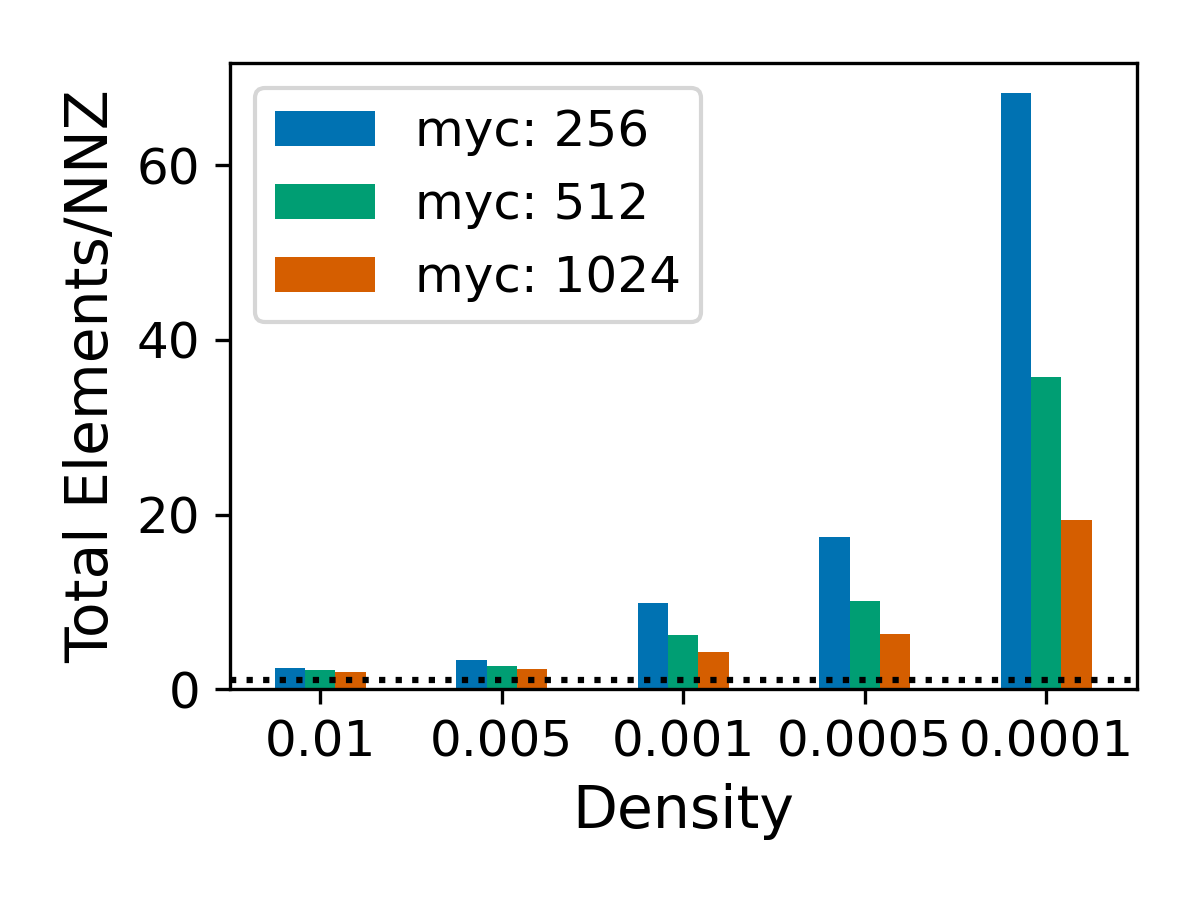
- Their special SELLPACK-like format lets them use more input lanes at once (good for speed) but can take more space than a classic sparse format (CSR), especially when the data is extremely sparse (because of padding and row-end markers).
- Even then, it still uses far less space than storing everything as a dense matrix, and it enables much higher data input bandwidth, which is critical for performance on the CS-3.
What this means and what could come next
- For tasks like GNNs, recommendation systems, and scientific computing where matrices are large but not ultra-sparse, the CS-3 can be a powerful engine for sparse math, delivering big speedups over CPUs.
- For ultra-sparse cases, the bottleneck is moving small amounts of data quickly. Future work could:
- Design kernels that better handle hyper-sparse patterns,
- Try other sparse storage formats that balance space and speed,
- Fuse steps (like dense multiply + SDDMM + SpMM) so less data has to move on and off the chip.
In short, the CS-3 shows strong promise for speeding up important sparse operations, especially on large problems that still have enough non-zero work to do. With smarter data layouts and combined operations, even tougher, hyper-sparse problems might be sped up in the future.
Knowledge Gaps
Knowledge gaps, limitations, and open questions
Below is a concise list of unresolved issues, missing evaluations, and open questions that future work could address:
- Real-world matrices and graph distributions: Results rely on synthetic random sparsity; evaluate on real graphs (e.g., Cora, PubMed, Arxiv, Products, SuiteSparse) with power-law degree distributions, community structure, and block patterns to assess load imbalance, locality, and performance robustness.
- Comparative baselines: Only CPU baselines are provided; add empirical comparisons against state-of-the-art GPU libraries (e.g., cuSPARSE, Sputnik, DTC, FastSpMM), IPUs, and FPGAs to substantiate claims (especially for hyper-sparse regimes where the paper asserts GPU can be faster).
- End-to-end GNN evaluation: Integrate SpMM/SDDMM into full GCN/GAT pipelines (forward and backward) to measure training/inference throughput, memory usage, and convergence impact; quantify benefits/overheads when stacking multiple layers and multi-head attention.
- Sparse-format conversion overheads: The SELLPACK-like format improves I/O channel utilization but its conversion cost (time and memory) from CSR/COO is unmeasured; quantify preprocessing latency, peak host memory, and amortization across epochs/iterations.
- Format generality and adaptivity: Explore additional and hybrid formats (SELL-C-σ, BCSR, HYB, CSC, block-sparse, delta-encoded indices, RLE for END_ROW) and auto-tune format/parameters per matrix to balance footprint, I/O, and compute.
- Extreme-sparsity footprint inflation: At very low densities (e.g., 0.01%), SELLPACK-like uses 20–80× more space than CSR; investigate mechanisms to reduce NULL padding and END_ROW overhead (e.g., event-driven routing, compressed headers, variable-length streams, selective N–S forwarding).
- Host–device transfer serialization: SDKRuntime serializes copies; despite multi-accumulator buffering, H2D copies remain serialized. Assess alternative runtime strategies (multiple streams, per-stream double buffering, overlapping H2D/D2H, custom DMA scheduling) and quantify achievable GB/s per I/O channel.
- I/O channel scaling: The number of I/O channels used and scaling efficiency with additional channels are not reported; measure throughput vs. channel count, west/east edge utilization, router contention, and backpressure effects.
- Load balancing under skew: Current mapping assigns work by fixed column-index ranges; evaluate and mitigate imbalance for skewed nnz distributions (e.g., high-degree hubs) via nnz-aware partitioning, dynamic scheduling, or work-stealing across rows/columns.
- Alternative decompositions: While 1.5D/2.5D schemes are mentioned, only 1.5D-like streaming is implemented; prototype 2D/2.5D variants (e.g., partial replication of H) and quantify memory/communication trade-offs on CS-3.
- Scaling to larger N and 64-bit indices: Performance results stop at N ≤ 65,536; extend to N ≥ 262,144 (and millions) to study index width (32- vs 64-bit), router/accumulator state growth, and on-chip memory pressure.
- Rectangular and batched SpMM: The kernels largely assume square A; evaluate K×N by N×D cases (K ≠ N), batched SpMM/SDDMM, and how routing/accumulation logic generalizes.
- Precision and data type exploration: Experiments use FP32; assess BF16/FP16 (and mixed-precision) for values to reduce bandwidth and increase PE throughput, and analyze impact on accuracy/stability.
- Numerical stability and reproducibility: North-to-south reduction order may affect floating-point summation; quantify numerical error vs. CPU/GPU baselines and provide reproducibility guarantees (or compensated summation options).
- SDDMM design space coverage: Only a 64×64 tile and limited max_nonzeros are explored; study sensitivity to tile size, mnz, routing patterns, and larger d (e.g., multi-head attention), as well as irregular sparsity patterns.
- Kernel fusion opportunities: Fusion of GEMM–SDDMM–SpMM is identified but not implemented; quantify end-to-end benefits (reduced D2H/H2D traffic, better PE utilization) and propose concrete fused mappings.
- Energy and cost efficiency: No power or energy-per-op measurements; compare performance-per-watt against CPU/GPU to contextualize CS-3 benefits.
- PE-level profiling and roofline analysis: Lack of detailed profiling (PE occupancy, local memory bandwidth, router congestion, FIFO utilization); provide a roofline or traffic analysis to pinpoint compute vs. I/O limits and guide optimizations.
- Dynamic sparsity and time-varying graphs: Conversion and streaming costs when A or sparsity masks change across iterations (common in training/pruning) are unmeasured; evaluate amortization strategies and incremental updates.
- Software stack integration: Sparse tensors are unsupported in CSTorch; outline a path to high-level API/compiler support, automatic placement/routing for sparse kernels, and maintainability relative to hand-written CSL.
- Multi-kernel co-location: The paper notes mcpp insensitivity could enable co-location, but does not quantify multi-SpMM/SDDMM concurrency on-wafer, interference, and scheduling strategies.
- Reproducibility and code availability: Only pseudo-code is provided; release complete kernels, parameter settings, and scripts to replicate results and enable community validation.
Practical Applications
Immediate Applications
The following opportunities can be executed now with access to Cerebras CS-3 hardware and the CSL toolchain, leveraging the paper’s CS-3 SpMM and SDDMM kernels and their optimizations (SELLPACK-like format, multi-I/O streaming, multi-accumulator buffering):
- Software/AI infrastructure: CS-3 sparse math kernels for model pipelines
- What: Package the presented SpMM and SDDMM CSL kernels into a reusable library (e.g., “CS-3 SparseOps”) for integration into custom ML pipelines.
- Sector(s): Software, AI infrastructure.
- Tools/products/workflows:
- A CSL-based library exposing SpMM (CSR/SELLPACK-like) and SDDMM (COO) with conversion utilities from CSR/COO to the SELLPACK-like streams.
- A runtime wrapper for Python (PyTorch/DGL/PyG) providing custom ops that call the CSL kernels and handle streaming to/from CS-3 using the multi-accumulator approach.
- A density-aware operator selector that routes workloads to CPU vs CS-3 based on sparsity and matrix size.
- Assumptions/dependencies:
- Access to CS-3 and SDK (CS SDK v1.4); developer capacity for CSL integration.
- Performance advantages hold best for moderate sparsity (e.g., 90% sparse); degradation at hyper-sparsity (>99%).
- Current CSTorch lacks native sparse tensor support; requires custom integration.
- Pruned DNN pipelines with moderate sparsity
- What: Offload sparse layers (SpMM-heavy) of pruned models (50–90% sparsity) to CS-3 for training/inference acceleration.
- Sector(s): Software/AI, cloud ML services, edge-to-cloud model serving (datacenter side).
- Tools/products/workflows:
- Export sparse weight matrices in CSR and convert to SELLPACK-like streams.
- Batch chunking tuned via max_y_chunk and max_v_per_pe to fit PE local memory and maximize I/O throughput.
- CI pipeline step to evaluate per-layer density and select CS-3 vs CPU execution path.
- Assumptions/dependencies:
- Sparsity within the sweet spot (<99%); weights stored/converted efficiently.
- End-to-end pipeline can tolerate additional format conversion steps.
- GAT-like operators: SDDMM acceleration for attention scores
- What: Accelerate the SDDMM step (Y = A ⊙ (B C)) in GAT-style layers where d is small (e.g., 1–2), achieving up to ~20× CPU speedups.
- Sector(s): Recommender systems, fraud detection, knowledge graphs, social analytics.
- Tools/products/workflows:
- Tile A into per-worker COO tiles with bounded max_nonzeros (mnz) to minimize D2H copies.
- Integrate SDDMM as a plugin op in an existing GNN stack; optionally prefetch/fuse with subsequent SpMM if feasible in the pipeline.
- Assumptions/dependencies:
- Memory traffic is managed; pick mnz conservatively (e.g., 512) to reduce device-to-host transfer overhead.
- Host-device I/O bandwidth and runtime serialization behavior are mitigated via multi-accumulator buffering.
- Density-aware workload routing in heterogeneous clusters
- What: Deploy a simple scheduler that routes sparse kernels to CS-3 vs CPU based on matrix size and density thresholds observed in the paper (e.g., route to CS-3 for large matrices at ~10% density; keep hyper-sparse on CPU).
- Sector(s): Cloud/HPC operations, MLOps.
- Tools/products/workflows:
- A profiling agent that estimates density and nnz distribution before execution.
- Routing policies informed by measured break-even points (e.g., speedups drop past 99% sparsity).
- Assumptions/dependencies:
- Reliable density estimates; data is stationary enough for pre-routing to be valid.
- Availability of CS-3 instances and job queue integration.
- Academic benchmarking and curriculum modules
- What: Use the kernels and findings to create reproducible labs and benchmarks on wafer-scale dataflow hardware for sparse kernels.
- Sector(s): Academia, education.
- Tools/products/workflows:
- Teaching labs on dataflow mappings (1.5D/2.5D), PE-level task programming, and sparse format impacts.
- Benchmark suites with synthetic matrices and real graph subsets to test scaling of SpMM/SDDMM and I/O configurations.
- Assumptions/dependencies:
- CS-3 access for course or shared-user HPC allocations.
- Curated datasets that fit on device with selected max_y_chunk and mnz settings.
- Procurement and facility planning insights
- What: Inform HPC/enterprise procurement about when wafer-scale engines complement CPU/GPU for sparse workloads.
- Sector(s): Public sector HPC centers, enterprise IT.
- Tools/products/workflows:
- Policy briefs or internal guidelines: choose CS-3 for moderately sparse, large matrices; revert to CPU/GPU for hyper-sparse or small matrices.
- Assumptions/dependencies:
- Local workload portfolio includes moderate-sparsity use cases.
- Organizational capability to maintain CSL-based kernels.
- Indirect daily-life impact via faster/cheaper model serving
- What: Improve back-end performance (and potentially energy) for services using moderately sparse models (e.g., recommender reranking, graph-based personalization).
- Sector(s): E-commerce, media, social platforms.
- Tools/products/workflows:
- Batch reranking jobs offloaded to CS-3; batch windows sized to maximize I/O throughput.
- Assumptions/dependencies:
- Most real graph adjacencies are hyper-sparse; benefits are larger for sparse-weight (pruned) components or denser subgraphs.
Long-Term Applications
These opportunities require additional research/engineering to handle hyper-sparsity, fuse kernels to cut I/O, improve toolchains, or extend hardware/software support.
- Full GNN pipeline on CS-3 with kernel fusion
- What: Fuse GEMM, SDDMM, and SpMM to reduce host–device transfers and exploit on-chip data reuse for end-to-end GNN layers (e.g., GAT, GCN).
- Sector(s): AI platforms for social graphs, knowledge graphs, bioinformatics.
- Tools/products/workflows:
- A fused CSL operator library; compiler support to tile/route fused ops across PEs.
- On-the-fly format transformations on-device to minimize off-chip traffic.
- Assumptions/dependencies:
- CSL/runtime support for deeper pipelining; improved SDK to relax memory-copy serialization.
- Robust strategies for hyper-sparse patterns and load balancing across PEs.
- Hyper-sparse optimizations for real-world graphs
- What: New sparse formats and scheduling strategies tailored to >99% sparsity, reducing SELLPACK-like padding and END_ROW signaling overhead.
- Sector(s): Graph analytics, fraud detection, cybersecurity, power grid analytics, scientific computing.
- Tools/products/workflows:
- Adaptive data layouts (e.g., block-COO/CSR hybrids, run-length encoded edge streams) with router-aware placement.
- Dynamic nonzero scheduling to improve utilization and tame communication overhead.
- Assumptions/dependencies:
- New formats integrated with CSL kernels; possibly compiler/runtime support for irregular streaming.
- Deeper analysis of real nnz distributions and their temporal locality.
- Sparse attention and block-sparse LLMs on dataflow accelerators
- What: Accelerate sparse-attention patterns in transformers (block-sparse, structured pruning) by adapting CS-3 SDDMM/SpMM to attention kernels.
- Sector(s): AI/LLMs, NLP, multimodal systems.
- Tools/products/workflows:
- Attention-specific sparse formats amenable to multi-I/O streaming.
- Integration into Cerebras’ training stacks; compiler awareness of sparse attention graphs.
- Assumptions/dependencies:
- Stable sparse patterns or pruned structures to amortize format conversion.
- Validation vs GPUs on accuracy/throughput; framework support.
- Sparse linear solvers on CS-3 (iterative methods)
- What: Map CG/GMRES and preconditioners using SpMM-like primitives onto CS-3 for PDEs, EDA, and scientific simulations.
- Sector(s): Energy (grid simulation), EDA, aerospace, materials science.
- Tools/products/workflows:
- Solver kernels with streaming of matrix blocks, preconditioner data, and vector updates; data-driven scheduling to reduce idle PEs.
- Mixed-precision variants and domain-specific block structures to improve density and utilization.
- Assumptions/dependencies:
- Methods to overcome hyper-sparsity-induced I/O overhead.
- Preconditioner design that increases effective density without excessive fill-in.
- Real-time streaming graph analytics
- What: Continuous ingestion of edge streams into router PEs and near-real-time computation (e.g., incremental PageRank-like updates framed as SpMM variants).
- Sector(s): Security ops, fraud monitoring, telecommunications.
- Tools/products/workflows:
- Streaming interfaces to feed SELLPACK-like or compressed edge batches; PE-local state that aggregates updates over windows.
- Robust backpressure control and prioritization to maintain latency SLOs.
- Assumptions/dependencies:
- Runtime support for streaming and PE scheduling; fault tolerance for long-running pipelines.
- Algorithms designed to map efficiently to dataflow with minimal D2H traffic.
- Framework-level sparse support in CSTorch and compilers
- What: Native sparse tensor support in CS-3 high-level stacks (CSTorch), enabling broad developer adoption without CSL expertise.
- Sector(s): Software/AI developer ecosystem.
- Tools/products/workflows:
- Compiler passes that choose data layouts (CSR/SELLPACK-like) and I/O tiling parameters automatically (max_y_chunk, max_v_per_pe, mnz).
- Autotuners for density/shape-driven placement and I/O channel usage.
- Assumptions/dependencies:
- Cerebras toolchain evolution; IR/hardware support for sparse routing and buffering.
- Energy-efficient datacenter operations with density-aware placement
- What: Reduce energy per task by placing moderately sparse workloads on wafer-scale engines that minimize off-chip transfers.
- Sector(s): Cloud, hyperscalers, sustainability programs.
- Tools/products/workflows:
- Cluster schedulers leveraging energy/perf models calibrated for sparsity and size.
- Reporting dashboards connecting density metrics to energy outcomes.
- Assumptions/dependencies:
- Empirical energy measurements on CS-3 for sparse kernels (not reported in the paper).
- Accurate modeling for workload diversity and contention.
- Training and workforce development for dataflow sparse programming
- What: Courses and certifications in CSL and dataflow mapping of sparse ops, reducing the skill barrier to deploying on CS-3.
- Sector(s): Academia, enterprise training.
- Tools/products/workflows:
- Open-source training modules, code labs, and challenge problems using the paper’s kernels as exemplars.
- Assumptions/dependencies:
- Access to shared CS-3 time; community resources and documentation.
Notes on cross-cutting assumptions and risks:
- Results are measured against a CPU baseline; GPU comparisons are not provided.
- Experiments used synthetic matrices (N up to 65,536 for performance curves); real-world performance may differ due to irregularities and distribution skew.
- Performance strongly depends on host–device I/O (multi-I/O channels, runtime serialization) and PE local memory limits (46 KB), which constrain max_y_chunk and mnz.
- SELLPACK-like format inflates footprint and I/O at hyper-sparsity; format innovation is a key dependency for broader applicability to real graphs.
Glossary
- 1.5D decomposition: A distributed matrix multiplication strategy where one matrix is partially replicated to reduce communication. "Without replicating matrix , our preliminary implementation described above corresponds to a 1.5D decomposition, in which is conceptually replicated only along processor columns during streaming, while is not replicated."
- 2.5D decomposition: A distributed matrix multiplication strategy that increases replication to further reduce communication. "Replicating across sub-grids of PEs introduces an additional replication dimension, resulting in a 2.5D decomposition."
- Accumulator PE: A processing element that gathers partial results and streams outputs back to the host. "Accumulator PEs receive max_y_chunk rows of from the last row of worker PEs."
- Back-pressure: Congestion in a network that slows data flow due to downstream bottlenecks. "Compared to the initial SpMM design, the design in Fig.~\ref{fig:nnz_pad_spmm} eliminates the need for north-south communication from the top-left router to other routers. This can reduce back-pressure on the PE grid as well as improve host-device communication bandwidth."
- Cerebras CS-3: A wafer-scale AI accelerator from Cerebras Systems used for high-throughput computation. "One such accelerator, the Cerebras CS-3, achieves strong performance on large model training as well as scientific applications like molecular dynamics simulations."
- Cerebras Graph Compiler: The toolchain that places and routes models onto the CS wafer based on a high-level definition. "With the Cerebras Graph Compiler, models defined in a high-level programming interface, such as CSTorch (the Cerebras wrapper for PyTorch), are placed and routed on the wafer."
- COO format: Coordinate sparse matrix format that stores entries as (row, column, value) tuples. "A is stored in a COO format"
- Compressed Sparse Row (CSR): A sparse matrix storage format that compresses rows via index pointers and column-value lists. "In CSR format, the space required to store the graphs is significantly reduced (last column compared to the second-to-last column of Table~\ref{tab:ch5-graphs})."
- CSL: The low-level programming language for the CS-3 enabling task-based PE programming and routing. "CSL is the low-level programming interface for the CS-3."
- CSTorch: Cerebras’ wrapper for PyTorch used to define models for CS execution. "With the Cerebras Graph Compiler, models defined in a high-level programming interface, such as CSTorch (the Cerebras wrapper for PyTorch), are placed and routed on the wafer."
- Dataflow architecture: A compute architecture where operations are mapped to hardware and data moves directly between units. "the CS-3 and RDU are dataflow architectures, where computation is mapped to physical compute units and results from one compute unit are directly fed to the next unit via high-speed on-chip interconnects"
- Dataflow execution: Computation organized as data streams flowing through spatially arranged processing elements. "While both FPGAs and Cerebras systems are spatial architectures with dataflow execution, they have fundamental differences"
- Device-to-host streaming memory copy: Asynchronous data transfer from the accelerator back to the host. "After issuing the host-to-device streaming memory copy, the host issues a device-to-host streaming memory copy to receive max_y_chunk rows of ."
- End-of-row marker (END_ROW): A sentinel used to denote the end of nonzeros for a row in streamed sparse data. "the host attaches an END_ROW character at the end of each stream of column indices and values to indicate that the nonzeros for a row of is complete."
- FIFO (First-In, First-Out) buffer: A queue structure that outputs data in the order received. "Internally, accumulator PEs use a CS-3 FIFO buffer to asynchronously receive/send elements."
- GEMM: General matrix-matrix multiplication, the dense baseline for many linear algebra operations. "While less studied than dense-dense or sparse-sparse kernels (such as GEMM and SpGEMM), SpMM has recently received increased consideration"
- Graph Attention Network (GAT): A neural network architecture using attention mechanisms on graph edges. "Sampled Dense-Dense Matrix Multiplication (SDDMM) is commonly used in graph attention networks (GAT) to compute attention scores of nodes only where an edge exists between a source node and a destination node."
- Graph Neural Network (GNN): Neural networks that operate on graph-structured data. "SpMM, or sparse-dense matrix multiplication, is a fundamental sparse linear algebra routine common in GNNs"
- Host-device communication bandwidth: The throughput for data transfer between CPU (host) and accelerator (device). "The initial SpMM design suffers from sub-optimal host-device communication bandwidth."
- Host-to-device streaming memory copy: Asynchronous data transfer from the host to the accelerator. "After issuing the host-to-device streaming memory copy, the host issues a device-to-host streaming memory copy to receive max_y_chunk rows of ."
- Hyper-sparse: Extremely sparse matrices with very few nonzeros relative to size. "As matrices become hyper-sparse, the CS-3 suffers from high host-device communication overhead relative to computation"
- I/O channel: Physical interface used to stream data into and out of the wafer. "The left-most rectangle represents the full chip, with I/O channels along the west and east edges (yellow triangles) and 762 1172 processing elements (PEs)."
- Load balancing: Distributing work evenly across processing elements to avoid idle time and bottlenecks. "One important aspect to consider is load balancing across PEs, both to increase system utilization and reduce synchronization costs."
- Memory coalescing: Aligning memory accesses so that multiple reads/writes can be combined for efficiency. "Overall, these papers propose techniques aimed at improving memory coalescing, decreasing warp divergence (through load balancing), improving data locality for better reuse, and leveraging tensor cores on GPU."
- Multiple-Instruction-Multiple-Data (MIMD): An architecture where many units execute independent instruction streams on different data. "the Graphcore IPU is composed of 1472 parallel compute units that can execute their own instruction stream (Multiple-Instruction-Multiple-Data architecture)"
- On-wafer network: High-bandwidth interconnect fabric on the wafer connecting PEs. "CS can be considered a distributed system on a chip, with hundreds of thousands of cores connected via a high-bandwidth on-wafer network."
- Pipeline parallelism: Overlapping stages of computation to improve throughput. "This is due to a few factors: 1) lower density does not provide enough work to fully utilize the wafer PEs, 2) lower density has a higher relative overhead of streaming data to and from device, and 3) the degree of pipeline parallelism is more limited with less nonzeros."
- Processing Element (PE): The fundamental compute unit on the wafer with local memory and routing. "The Cerebras CS-3, or Wafer-Scale Engine 3 (WSE-3), is a wafer-scale chip composed of nearly 900,000 processing elements (PEs)."
- Router PE: A PE configured to route and filter incoming data to worker PEs. "Router PEs serve as a buffer and pre-processor for incoming wavelets."
- SDKRuntime library: The runtime library used to launch CSL programs and manage data transfers. "The CS-3 SDKRuntime library, which is used to run CSL programs on the host, serializes memory copy calls"
- Sampled Dense-Dense Matrix Multiplication (SDDMM): Computes selected elements of a dense product guided by a sparsity pattern. "SDDMM, or sampled dense-dense matrix multiplication, is a kernel used in graph attention networks"
- SELLPACK-like format: A SELL-inspired sparse storage layout tailored to the CS-3 design for balanced streaming. "From left to right, Fig.~\ref{fig:storage_formats} illustrates the dense format, the CSR format, and a Sliced Ellpack-inspired (``SELLPACK-like'') format."
- Sliced ELLPACK (SELL): A GPU-friendly sparse format that slices rows and zero-pads within chunks for regularized access. "Sliced Ellpack (SELL) \citep{cusparse} is a state-of-the-art storage format for sparse matrix kernels on GPU."
- SIMD: Single-instruction, multiple-data; an execution model applying one instruction to many data elements in lockstep. "While GPUs can enable massive SIMD parallelism across many cores"
- Sparse General Matrix-Matrix Multiplication (SpGEMM): Multiplication of two sparse matrices. "While less studied than dense-dense or sparse-sparse kernels (such as GEMM and SpGEMM), SpMM has recently received increased consideration"
- Sparse-dense matrix multiplication (SpMM): Multiplication of a sparse matrix with a dense matrix. "SpMM, or sparse-dense matrix multiplication, is a fundamental sparse linear algebra routine common in GNNs"
- Wafer-Scale Engine 3 (WSE-3): The wafer-scale chip used in CS-3, integrating hundreds of thousands of PEs and memory. "The Cerebras Wafer-Scale Engine 3 (WSE-3, or CS-3 for short) high-level architecture overview."
- Wavelet: A 32-bit data packet in CSL that triggers PE tasks upon arrival. "CSL uses a task-based programming model, where PEs perform tasks and tasks are executed when data packets, called wavelets, arrive to the PE."
- Warp divergence: Performance loss on GPUs when threads within a warp take different execution paths. "Overall, these papers propose techniques aimed at improving memory coalescing, decreasing warp divergence (through load balancing), improving data locality for better reuse, and leveraging tensor cores on GPU."
- Worker PE: A PE that performs the multiply-accumulate operations on streamed data to produce partial results. "Worker PEs perform multiplication and accumulation to generate partial results of ."
Collections
Sign up for free to add this paper to one or more collections.