Nearly-Tight Bounds for Zonotope Containment and Beyond
Published 5 May 2026 in cs.DS and math.MG | (2605.04183v1)
Abstract: We investigate the convex-body containment problem $\max{s >0 : s Z \subseteq Q}$, where the outer body $Q \subseteq \mathbb Rd$ is described by a membership oracle and the inner body $Z \subseteq \mathbb Rd$ is a zonotope. Our main result is a sampling-based $O(\sqrt{d})$-approximation algorithm for this problem that almost matches the lower bound of $Ω(\sqrt{d/\log d})$ by Khot and Naor in the oracle model. Assuming zonotopes can be sparsified by a linear number of generators, which is referred to as Talagrand conjecture, our approach attains the optimal approximation factor of $Θ(\sqrt{d/\log d})$. Our second main result is a proof of Talagrand's conjecture for $Δ$-modular zonotopes whenever $Δ$ is constant. Those zonotopes are of the form $Z = { Wx \colon | x|_\infty \leq 1}$ where the non-zero $d \times d$ sub-determinants of $W$ are between $1$ and $Δ$. This result establishes a connection between zonoid sparsification and spectral sparsification of Batson, Spielman and Srivastava. We complement these results with a universal $Ω(\sqrt{d/\log d})$ lower bound holding for all zonotopes. Finally, we consider containment problems $\max{s >0 : s K \subseteq Q}$, for general convex bodies $K \subseteq \mathbb Rd$. A result of Naszódi on approximating $K \subseteq \mathbb Rd$ by a polytope implies a $Θ(d/\log d)$ approximation algorithm in polynomial time. We show the tightness of this approximation factor in the oracle model via a reduction to the circumradius computation. Our lower bound holds for centrally symmetric convex sets, implying that Barvinok's optimal $O(\sqrt{d})$-approximation of a centrally symmetric convex body by a polytope with a polynomial number of vertices cannot be computed in polynomial time.
The paper introduces nearly-tight randomized algorithms achieving an O(√d) approximation for zonotope containment in high dimensions.
It leverages Talagrand’s sparsification theorem and spectral methods to improve approximations for Δ-modular zonotopes.
The work establishes universal lower bounds in the oracle model, delineating limits for approximating general convex bodies.
Nearly-Tight Bounds for Zonotope Containment: Technical Summary and Implications
The paper "Nearly-Tight Bounds for Zonotope Containment and Beyond" (2605.04183) addresses the fundamental algorithmic challenge of determining the largest scaling s such that sZ⊆Q, where Z is a zonotope and Q a convex body accessible via a membership oracle in high-dimensional settings. The analysis leads to nearly-tight approximation algorithms and lower bounds for the containment problem and its extensions to general convex bodies.
The Zonotope Containment Problem
The central problem is formalized as: max{s>0:sZ⊆Q},
where Z⊆Rd is a zonotope generated by W∈Rd×n and Q⊆Rd is a convex body with membership oracle access. Zonotopes, being Minkowski sums of line segments, represent a broad class of convex polytopes with rich geometric structure and are prevalent in control theory, complexity, and convex geometry.
This containment problem resides in the oracle model, which restricts algorithmic access to convex bodies to membership queries, making it challenging to design efficient algorithms, especially in high dimensions.
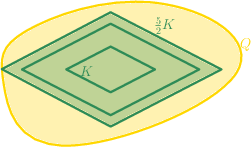
Figure 1: Illustration of the containment scaling problem for a zonotope within a general convex body Q.
Approximation Algorithms and Theoretical Guarantees
The paper’s primary contribution is a randomized polynomial-time approximation algorithm achieving an O(d)-factor for the gap-containment decision problem for zonotopes. The algorithm uses Talagrand's zonotope sparsification theorem to sparsify the number of generators, enabling efficient probabilistic identification of points violating containment:
For general zonotopes, Talagrand’s theorem enables approximation to within a factor sZ⊆Q0.
If the unresolved Talagrand conjecture on linear sparsification holds, or for specific zonotope classes where linear sparsification can be achieved, the approximation refines to sZ⊆Q1, which matches known lower bounds up to constants.
Sampling from the sparsified representation, the algorithm efficiently detects points that would violate containment if sZ⊆Q2, leveraging high-probability anti-concentration results on the image of hypercube vertices under sZ⊆Q3.
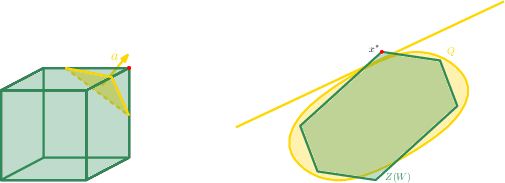
Figure 2: Schematic of the randomized containment-testing algorithm: a vertex sZ⊆Q4 of the zonotope outside sZ⊆Q5 has a preimage sZ⊆Q6 in the hypercube, separated from preimages of points in sZ⊆Q7; random sampling in the hypercube discovers such violations with high probability.
sZ⊆Q8-Modular Zonotopes and Sparsification
For sZ⊆Q9-modular zonotopes—those whose non-singular Z0 minors are bounded in determinant magnitude by Z1—the paper proves Talagrand’s conjecture, showing that linear sparsification is possible and can be accomplished in randomized polynomial time. Thus, for these special zonotopes, the containment approximation scales as Z2. This leverages the spectral sparsification result of Batson, Spielman, and Srivastava and properties of Z3-modular generator matrices.
Universal Lower Bounds and Tightness
A universal lower bound is shown: for all zonotopes, no polynomial-time algorithm (even randomized) can approximate the containment problem up to better than Z4 in the oracle model. This is established by a reduction to the volume ratio of polytopal approximations and deep results from convex geometry, confirming the near-optimality of the presented algorithms under current complexity-theoretic assumptions.
General Convex Bodies: Beyond Zonotopes
For general convex bodies Z5, prior work shows that containment can only be approximated within a factor Z6 in polynomial time by sampling random points and constructing polytopal approximations. The paper proves this is optimal even for symmetric convex bodies, leveraging hardness results related to circumradius computation and volumetric approximation. As a consequence, existential results about polytopal approximations (e.g., Barvinok's Z7-vertex polytopes) are shown to be intractable in the oracle model.
Key Results at a Glance
Problem Setting
Achievable Approx. Factor
Lower Bound
Constructive?
General Zonotopes, Oracle Model
Z8
Z9
Yes (randomized polynomial)
Zonotopes w/ Linear Sparsification
Q0
Q1
Yes (via Talagrand + sampling)
Q2-Modular Zonotopes (constant Q3)
Q4
Q5
Yes (via spectral techniques)
General Convex Bodies, Oracle Model
Q6
Q7
Yes (randomized sampling)
Centrally Symmetric Bodies (existence)
Q8
Q9
No (not computable in polytime)
Implications and Theoretical Impact
The findings delimit the achievable guarantees for high-dimensional containment testing in the oracle model. In geometric optimization, these results unify and sharpen the understanding of how combinatorial structure (zonotope sparsification) and volumetric properties constrain algorithmic performance.
For applications in control, computational geometry, optimization (especially norm approximation and neural network verification), the work provides not only improved algorithms but also establishes sharp impossibility results—showing that better algorithmic bounds would require breakthroughs in combinatorial sparsification or a refutation of standard complexity-theoretic beliefs.
Future Directions
Algorithmic Zonotope Sparsification: Practical algorithms matching the sparsification of Talagrand’s conjecture would yield optimal containment approximations.
Connections to Spectral Methods: Further leveraging spectral sparsification in more general polytope classes could bridge gaps between existential results and efficient algorithms.
Complexity Separations: Understanding the gap between existential and algorithmic approximations for convex bodies remains open, especially in different computational models.
Conclusion
This work rigorously characterizes the computational limits of zonotope containment problems in the high-dimensional oracle model, providing both optimal algorithms for structured zonotopes and nearly-matching lower bounds for all zonotopes and more general convex bodies. The results clarify the role of structure and dimensionality in geometric optimization and chart a precise boundary between tractability and hardness in containment problems involving convex geometry.