- The paper introduces a Feynman-Kac framework that explicitly characterizes bias in diffusion-based posterior sampling algorithms.
- It reveals that DPS under-samples high-uncertainty regions and proposes correction strategies using auxiliary drift control and early guidance stopping.
- The study connects spectral bias structure with reward sensitivity, providing actionable insights for designing robust score-based generative models.
Diffusion-Based Posterior Sampling: A Feynman-Kac Analysis of Bias and Stability
Overview
This paper develops a rigorous framework for the analysis of diffusion-based posterior sampling (DPS) algorithms, particularly emphasizing their bias and numerical stability properties when solving inverse problems. Leveraging the classical Feynman-Kac formula, the authors provide an explicit characterization of the bias inherent in commonly used DPS algorithms—even when access to exact prior scores is assumed—and analyze the impact of practical guidance strategies on stability and sampling distribution. The contributions address key theoretical gaps regarding DPS bias, variance control, and guidance-induced instabilities, with direct implications for algorithm design and correction procedures in score-based generative models.
Background and Motivation
Diffusion models and score-based generative models have become fundamental tools for image and signal generation, as well as posterior inference in inverse problems. Their adaptability pivots on the availability of a learned score function ∇logρt, permitting application across a wide array of downstream tasks. The inverse problem setting, typically requiring samples from a posterior μy(x)∝eRy(x)ρ∗(x) conditioned on measurements or rewards, challenges direct computation due to the intractability of the posterior score in general.
DPS [chung2023diffusion] is a heuristic approach that substitutes the complex log-likelihood score ∇xtlogp(y∣xt) with a reward gradient evaluated at the Tweedie posterior mean x^0(xt), facilitating plug-and-play guidance. While empirically effective and widely adopted, DPS samples are not true posterior draws and their theoretical behavior—including bias, regions of over/under-sampling, and sensitivity to guidance heuristics—has remained unexplored.
Feynman-Kac Based Bias Characterization
The paper’s central advance is a path-based analytical framework, using the Feynman-Kac representation, that explicitly characterizes the bias between the DPS-induced sampling distribution and the true posterior. The authors construct a surrogate path between the posterior and a standard Gaussian, allowing the derivation of a parabolic PDE whose reaction term quantifies the accumulated bias. The ratio of DPS samples to the true posterior admits a path expectation formulation:
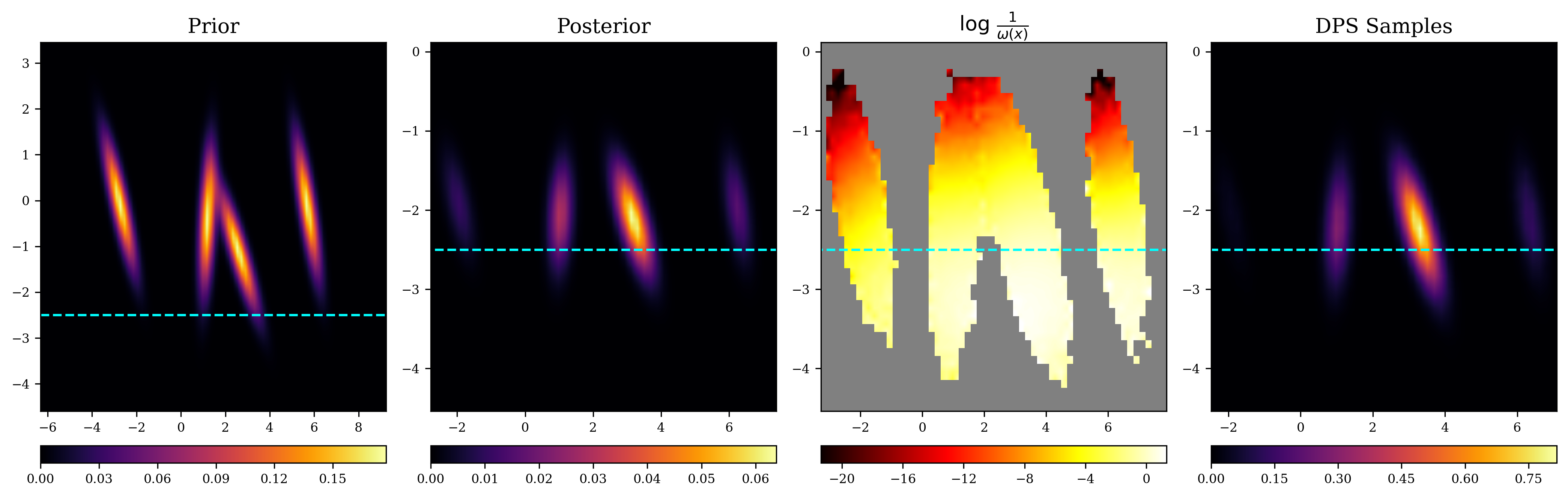
Figure 1: Comparison between the true posterior and DPS samples for a Gaussian mixture prior and a linear measurement constraint.
For DPS, this correction reduces to an Ornstein-Uhlenbeck (OU) path expectation involving the data conditional covariance and reward curvature. The explicit Radon-Nikodym multiplicative correction, expressible via score networks and Tweedie identities, reveals that DPS under-samples regions where posterior uncertainty and reward gradients align, and over-samples complementary regions. Empirical visualizations validate the theoretical predictions—DPS misses extremal modes and can bias towards certain measurement directions.
Variance and Bias Reduction: STSL and Drift Control
The spectral structure of DPS bias is shown to be largest where the data manifold exhibits high uncertainty along directions that are sensitive to the reward. To mitigate this, the paper examines the addition of auxiliary potential drift ∇U to the SDE, which drives samples towards low-uncertainty regions, reducing spatial variation in the DPS reaction term. The choice U(t,x)=tr(Σt(x)) recovers the STSL bias-reduction scheme [rout2024rbmodulationtrainingfreepersonalizationdiffusion], linking empirically successful variance reduction techniques to theoretically justified correction of the output distribution.
The authors identify the theoretical possibility of an optimal potential U∗ that cancels the DPS bias exactly, though computation is intractable; practical variants approximate this through neural drift-control methods [driftlite, guo2026conditional].
Numerical Instability and Early Guidance Stopping
DPS discretizations experience instability in low-temperature regimes—critical for enforcing hard measurement constraints in image inversion—due to explicit forward-Euler integration of the guidance vector field. As the trajectory nears the data manifold, guidance weights escalate and induce oscillatory artifacts, with the stability criterion inevitably violated for unsquared residual-based rewards. The paper provides a geometric and analytic explanation for these oscillations, showing they are unavoidable and cannot be addressed by tuning step sizes.
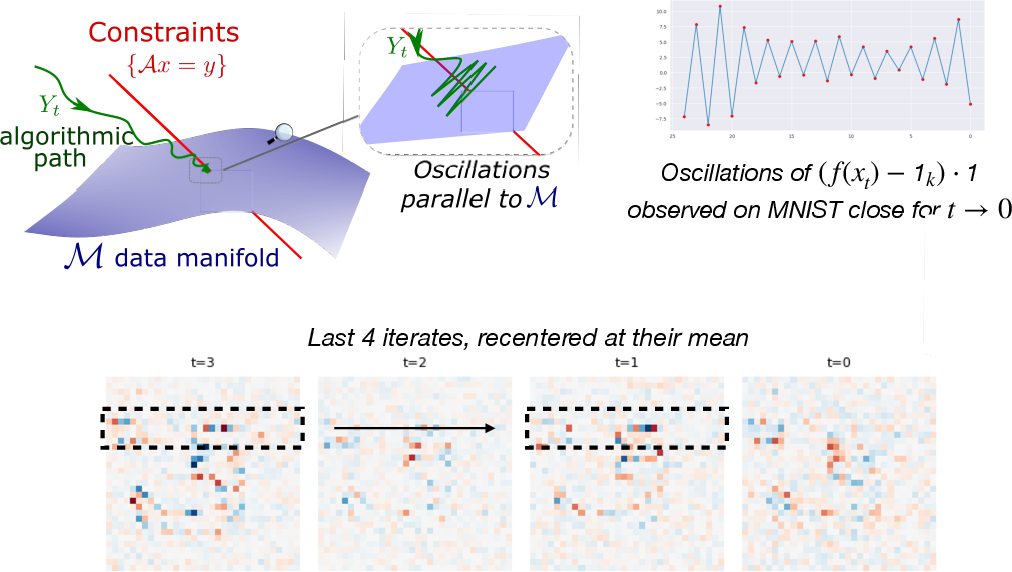
Figure 2: Depiction of instability and oscillation as DPS guidance increases near the measurement constraint; oscillatory behavior emerges in pixel space for MNIST posterior sampling.
Early guidance stopping, where guidance is terminated after a specified time and the drift reverts to the score alone, is established as a principled correction. The output of DPS with early stopping is characterized as an appropriately weighted prior, with explicit path-dependent correction terms.
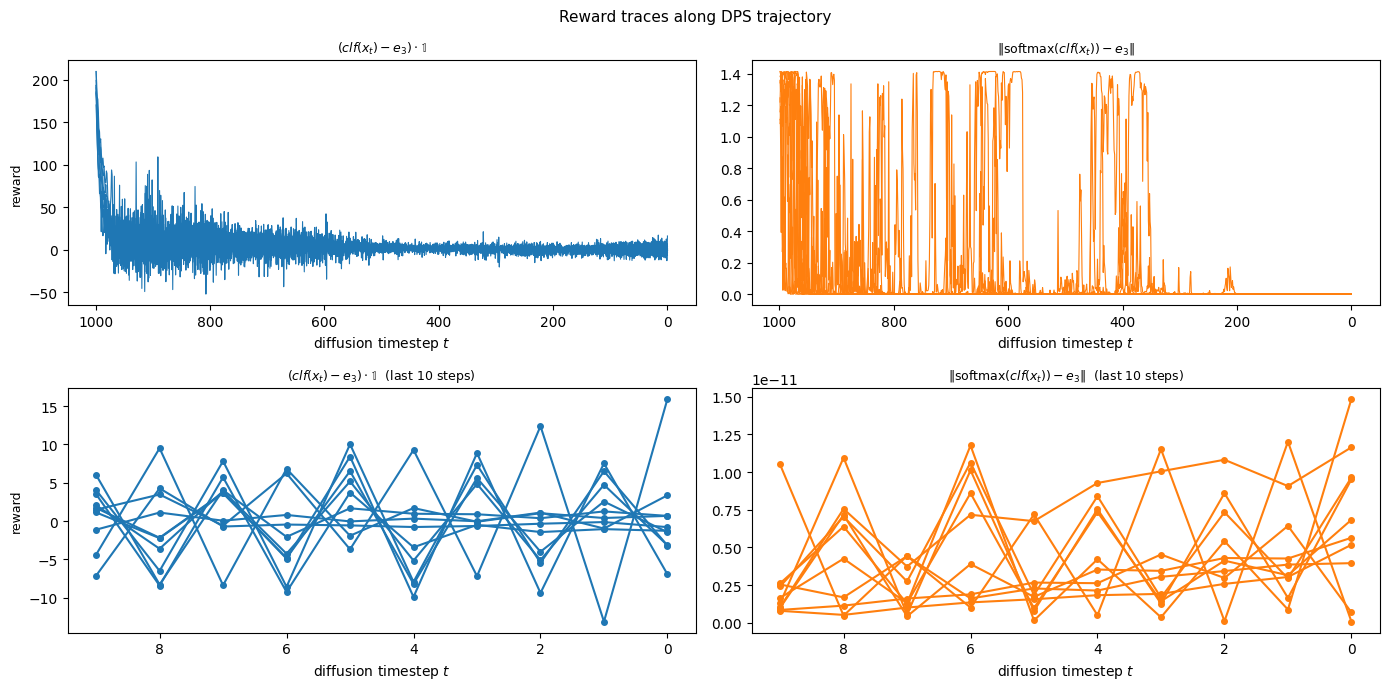
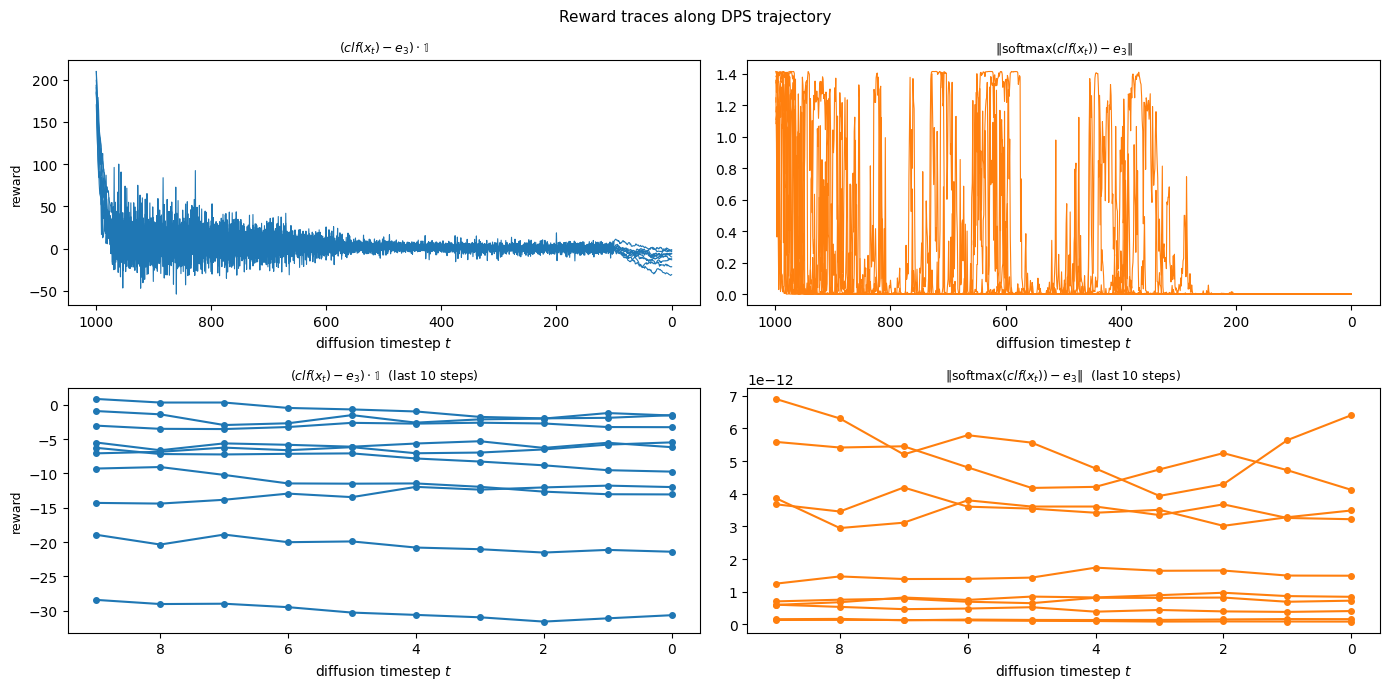
Figure 3: Projected discrepancy and reward trajectories for MNIST posterior sampling, highlighting oscillations induced by constant guidance and their suppression via early guidance stopping.
Implications and Future Directions
This paper’s explicit bias formulas set a new standard for theoretical understanding of diffusion-based posterior samplers. The Feynman-Kac analysis grounds empirical phenomena (over-/under-sampling, instability) in mathematically precise terms, enabling principled design of bias and variance reduction corrections. The link between spectral bias structure and reward sensitivity directly informs algorithmic modulation (e.g., STSL, neural drift-control), opening the door for plug-and-play inference leveraging reward curvature-adaptive guidance.
Numerical instability analysis identifies geometric inevitability of oscillations in standard discretizations near hard constraints, providing justification for heuristic early stopping and motivating development of alternative implicit guidance integration methods.
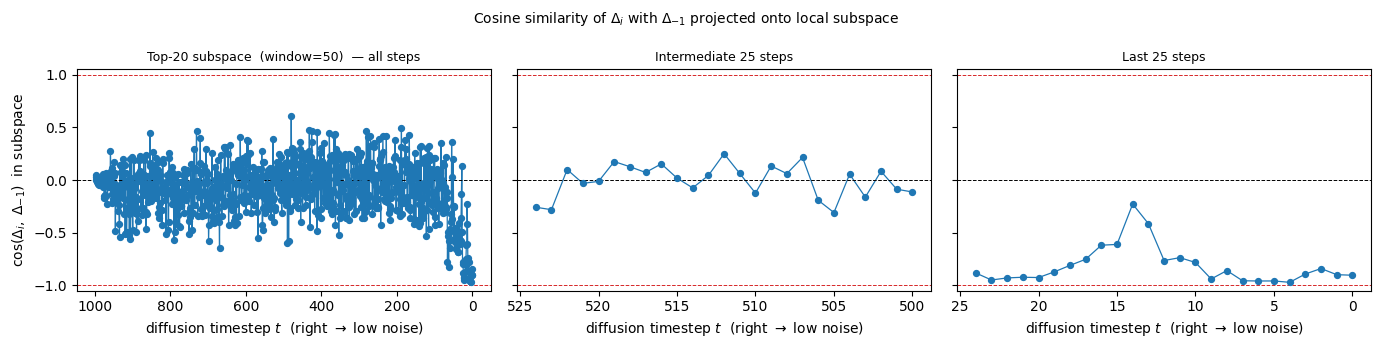
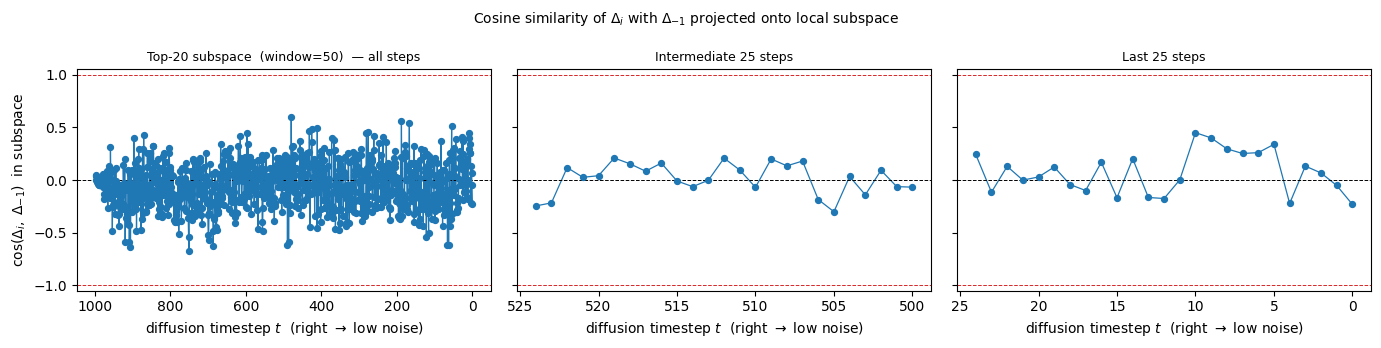
Figure 4: Step-to-step alignment plots—oscillation patterns are observed for constant guidance and suppressed when early stopping is used, confirming theoretical instability predictions.
Conclusion
The paper provides a rigorous pathwise analysis of bias and stability in diffusion-based posterior sampling algorithms, leveraging Feynman-Kac representations to derive explicit correction formulas and to analyze variance-reduction strategies and guidance-induced instabilities. The results clarify the structure and origins of DPS bias, explain the theoretical basis for existing and novel correctives, and provide actionable guidance for robust and principled algorithm design. Future work may extend these concepts to more general measurement models, richer data manifolds, and adaptive neural guidance schemes, with strong implications for the practical deployment of score-based generative models in scientific inverse problems.
References
- "Diffusion-Based Posterior Sampling: A Feynman-Kac Analysis of Bias and Stability" (2605.06538)
- "Diffusion Posterior Sampling for General Inverse Problems" [chung2023diffusion]
- "RB-Modulation: Training-Free Personalization using Stochastic Optimal Control" [rout2024rbmodulationtrainingfreepersonalizationdiffusion]
- "DriftLite: Lightweight Drift Control for Inference-Time Scaling of Diffusion Models" [driftlite]
- "Conditional Diffusion Guidance under Hard Constraint: A Stochastic Analysis Approach" [guo2026conditional]

