- The paper introduces MIE, a framework that integrates neural, cognitive, and behavioral levels into a unified equilibrium for interacting agents.
- It employs hierarchical state-space modeling and contraction mapping to rigorously analyze stability and convergence in adaptive systems.
- Demonstrated applications include human-autonomous vehicle interaction, brain-machine interfaces, and computational psychiatry to guide multimodal design.
A Theory of Multilevel Interactive Equilibrium in NeuroAI: An Expert Analysis
Introduction and Motivation
This work formulates a general theory of interaction in adaptive multi-agent intelligence, blending game-theoretic formalism with neurobiological and artificial intelligence perspectives. Departing from classical Nash-style equilibrium—where strategies are chosen by perfectly rational agents under complete information—the proposed Multilevel Interactive Equilibrium (MIE) constructs equilibrium as an emergent property of coupled neural, cognitive, and behavioral processes in interacting agents. The authors unify human, artificial, and hybrid systems under this schema, arguing that observed strategies are underpinned by deeper layers of inference and adaptation. The MIE framework is rigorously developed via hierarchical state-space modeling, providing new tools for explaining stability and pathologies in complex neuro-AI ecosystems.
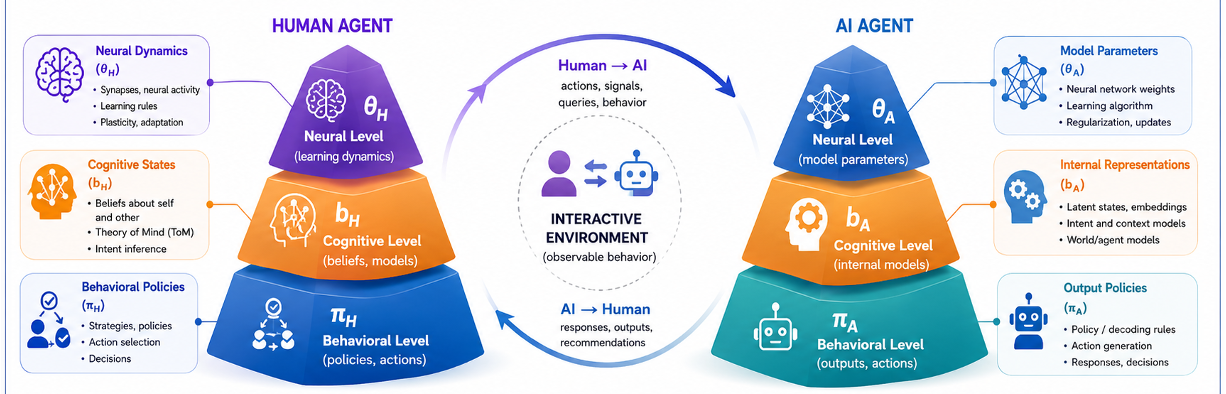
Figure 1: Schematic of the MIE pyramid, capturing interaction across neural, cognitive, and behavioral strata between agents.
The authors introduce a multilevel pyramid state-space for each agent, with:
- Neural Level (θti): Encodes algorithmic or synaptic parameterization.
- Cognitive Level (bti): Represents internal beliefs, latent models, or intent inference.
- Behavioral Level (πti): Determines observable policies conditioned on state and beliefs.
The macrostate of an agent i is xti=(θti,bti,πti), and the jointly evolving dynamic is captured by an operator Φ that updates neural, cognitive, and behavioral layers synchronously, with mutual coupling both within agents (cross-level) and across agents (cross-agent).
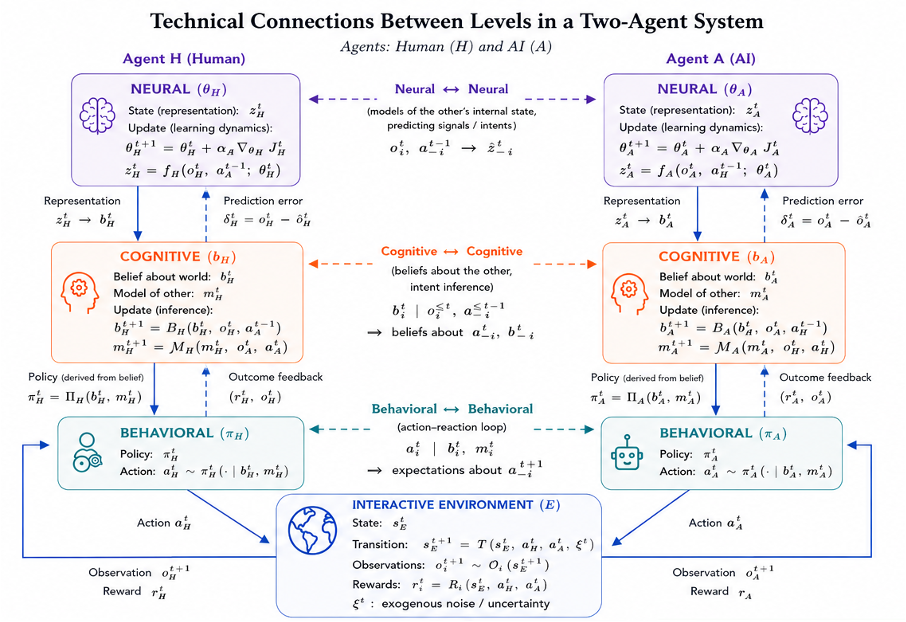
Figure 2: Mathematical abstraction of multilevel agent state, update operators, and inter-agent coupling via environment and mutual inference.
Equilibrium Concepts
- Neural Equilibrium: Stationarity of neural learning dynamics.
- Cognitive Equilibrium: Fixed-point consistency of belief updates given observed interactions.
- Behavioral Equilibrium: Best-response optimality, given stabilized lower levels.
- MIE: Joint satisfaction of all three, i.e., a coupled fixed point of learning, inference, and execution dynamics.
The MIE condition is a nontrivial generalization of Nash equilibrium, requiring mutual stabilization in the three-level product space. The existence, uniqueness, and stability are analyzed under contraction mappings and mean-field approximations, with explicit fixed-point and local stability criteria via the Jacobian spectral radius.
Applications
Human-Autonomous Vehicle Interaction
Bidirectional adaptation between human cognition and autonomous control algorithms is elegantly recast as a two-agent dynamic game, each modeled within the MIE structure. Stable, predictable traffic patterns (e.g., human merging behavior and vehicle yielding) are characterized as emergent MIEs, highlighting the necessity of aligning adaptation rates and belief modeling between humans and AI for system-level safety and trust.
Brain-Machine Interfaces (BMI)
Co-adaptive BMI systems are formalized as two-agent multilevel games wherein neural adaptation, decoder learning, and mutual intent estimation drive convergence toward MIE. Instabilities and inefficiencies are rigorously explained as failures of synchronization in cross-level adaptation, providing statistical justifications for empirical findings—e.g., that slowness in decoder adaptation can benefit convergence and user learning.
Human-LLM Interaction
Conversational dynamics with LLMs—contextual prompt design and intent alignment—are mapped to a coupled dynamical system where both prompt specificity and LLM interpretation co-adapt through feedback, as illustrated in the toy model:
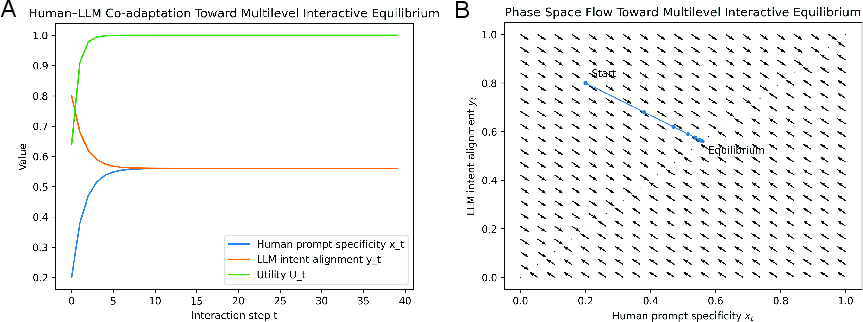
Figure 3: Coupled human-LLM adaptation trajectories; prompt specificity and LLM alignment converge toward the MIE diagonal, maximizing utility.
Stable, high-utility dialog arises at a multilevel equilibrium; suboptimality and misunderstanding (e.g., hallucinations) correspond to failures of cognitive or behavioral stabilization.
Computational Psychiatry
Psychiatric disorders are reconceptualized as disruptions or maladaptive attractors in the multilevel equilibrium landscape. The framework offers mechanistic taxonomies: e.g., depression as a negative cognitive–behavioral MIE, schizophrenia as unstable cognitive dynamics, and anxiety as stable but biased belief equilibria. The implications for treatment and personalized psychiatry are structurally linked to targeted perturbations of specific equilibrium strata.
Empirical Estimation of MIE
The authors propose comprehensive experimental and computational methodologies for quantifying proximity to MIE in real-world data:
- Neural: Manifold learning and stationarity detection on population codes; cross-brain trajectory synchronization using CCA/PLS.
- Cognitive: State-space modeling and Bayesian filtering to infer latent beliefs, with explicit perturbation probes to estimate model depth and reasoning order.
- Behavioral: Empirical convergence of action-frequency policies, best-response gap analysis.
- Joint: Hierarchical state-space models and EM/variational inference to track all levels; explicit distance-to-equilibrium metrics aggregating across modes.
Robustness of MIE is validated through perturbation experiments, offering direct empirical tests of theoretical predictions.
Theoretical Implications, Limitations, and Future Directions
The MIE paradigm advances a foundational generalization of equilibrium for interacting intelligent systems, integrating rapid advances in MARL, computational neuroscience, and human-AI co-adaptation. Open questions include:
- Existence and Multiplicity: Conditions for unique, stable MIE; relation to classical fixed-point theory and Bayesian equilibrium in multi-agent systems.
- Timescale Interaction: Emergence of stable equilibria under heterogeneous adaptation rates and asynchronous updates.
- Latent Variable Identifiability: Robust inference of cognitive and neural states from behavioral observation.
- Group-level MIE: Extension to population and network settings; emergent phenomena in large-scale AI-human collectives.
- Digital Twins and Interventions: Application of full-observability MARL for in silico causal discovery and intervention design.
The framework has the potential to unify diagnostic and systems-level design principles across neuroscience, machine learning, robotics, and psychiatric medicine.
Conclusion
The multilevel interactive equilibrium framework systematically redefines equilibrium in adaptive intelligence, anchoring stability not merely in observable strategies but in the conjugate evolution of neural substrates, internal beliefs, and policy adaptation. Its mathematical rigor and extensiveness position it as a versatile model for analyzing, estimating, and engineering robust interaction in hybrid neuro-AI systems. This provides a principled pathway for both diagnosing failure modes (in clinical or technical contexts) and designing interventions to achieve desirable interactive stability and mutual predictability. The theoretical and empirical avenues opened by this work promise rich cross-pollination between neurobiology, artificial intelligence, and computational social science.
Reference:
"A Theory of Multilevel Interactive Equilibrium in NeuroAI" (2605.10505)

