- The paper demonstrates that minimal engagement (25 videos) increases on-topic content by 38–44.5% on the For You Page.
- It introduces innovative mobile auditing and account cloning techniques to causally assess the effects of implicit (skip) and explicit ('Not Interested') signals.
- The study reveals that explicit negative feedback more effectively resets personalization, yet content relapses when users resume topical engagement.
Investigating User Control in TikTok's Algorithmic Feed
Introduction
This paper addresses a crucial question in contemporary recommendation systems: to what extent do users exert agency over the content delivered by TikTok's highly influential For You Page (FYP)? By departing from web-based auditing and enabling sophisticated, controlled experimentation on the mobile application—where most user engagement occurs—the authors perform a comprehensive assessment of how both implicit and explicit user actions shape subsequent recommendations. The research contributes novel mobile auditing and account cloning methodologies, producing actionable insights on the nuanced levers of control in TikTok's recommendation infrastructure.
Methodological Innovations
The experimental design is characterized by an emulated, large-scale deployment of sock-puppet accounts on Android emulators, coupled with advanced reverse-engineering of mobile network traffic and API manipulation. To systematically probe the causal effects of user signals, the authors introduce an account cloning pipeline wherein behavioral history is replicated at the protocol level, creating counterfactual “twins” for downstream experimentation.
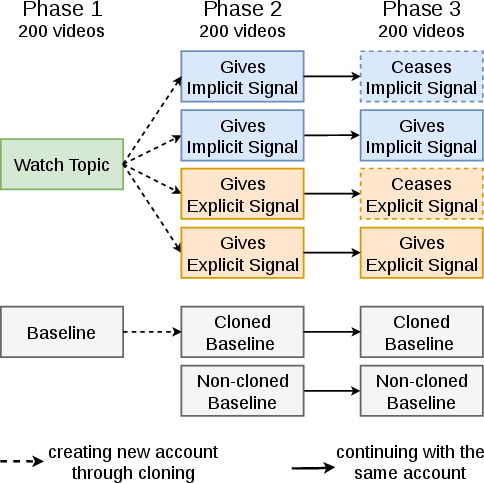
Figure 1: Steps for investigating user agency on TikTok, utilizing parallelized emulated accounts to structurally separate experimental phases and treatments.
This framework enables synchronized, statistically significant measurements of algorithmic responsiveness to both implicit (e.g., skip, watch-time) and explicit (e.g., "Not Interested" feedback) interventions. Three topical domains—cooking, fitness, and sports betting—are selected as testbeds due to varying prevalence and content risks.
Account Cloning Efficacy
Cloning fidelity is validated by a network-only feed-fetching protocol to avoid confounds from behavioral signals, comparing topic prevalence between original and cloned accounts post-personalization. Results confirm that the cloning process yields indistinguishable FYP personalization distributions relative to the original and statistically separate from naive baselines.
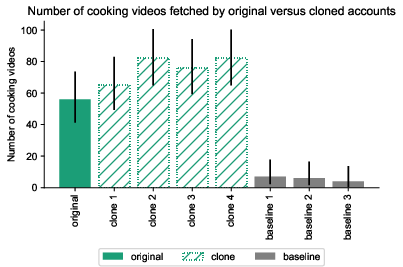
Figure 2: Account cloning transfers personalization effectively, confirmed by overlapping confidence intervals for target content prevalence between original and clones.
This methodological advance is foundational for isolating the effects of subsequent interventions, enabling causal inference unattainable in traditional field audits.
Dynamics of Personalization and De-Personalization
Initial Personalization
All topics exhibit rapid and substantial personalization following minimal demonstrations of interest: after viewing 25 topical videos, 44.5% of subsequent FYP content in both cooking and sports betting, and 38% in fitness, were topically relevant. Baseline accounts (no seeding) reveal much lower prevalence (8.5% in cooking, 1.5% in fitness/sports betting), providing a strong contrast and evidence for the sensitivity of TikTok's model to brief engagement episodes.
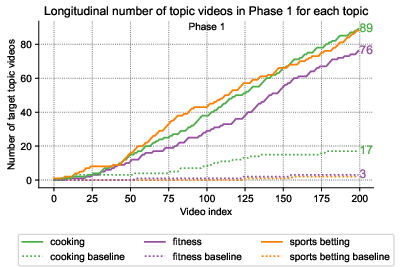
Figure 3: Personalization levels across three target topics, demonstrating rapid and high-magnitude content tailoring by the FYP algorithm post-seeding.
Effects of Negative Signaling
Both implicit (skip) and explicit ("Not Interested") negative feedback mechanisms reduce on-topic content in the FYP, though with sharply different efficacy. Explicit signals narrow topic prevalence to as low as 4.75%—down 84.4% from positive-watching—effectively returning the feed to non-personalized baseline levels. Implicit signaling achieves a 47.5% decrease (to 16%), less than explicit but still substantial.

Figure 4: Explicit signaling (“Not Interested”) sharply suppresses on-topic prevalence, near baseline, while implicit skip signals have measurable but less drastic effect. Statistical significance of reduction marked.
However, the comparative advantage of explicit over implicit signaling is not fully consistent across all topics or runs, with certain conditions evidencing parity in effectiveness.
Relapse and Persistence of Personalization
A marked vulnerability is identified: when negative signals cease and user behavior returns to topical engagement (the “relapse” tests), the FYP commonly reverts to serving elevated levels of previously unwanted content. The effect is pronounced for implicit negative feedback—five out of five "cooking" experiments, and four out of five "fitness", relapsed—indicating the algorithm's strong tendency to interpret resumed attention as a reversal of preference. Even explicit signals exhibit relapse (two cases each for cooking/fitness, one for sports betting), indicating incomplete user control.
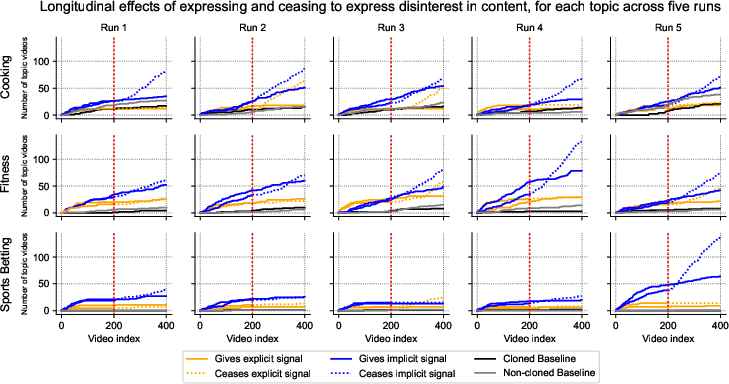
Figure 5: Topic video prevalence trajectories across experimental runs and phases, with relapse spikes evident post-cessation of negative signaling.
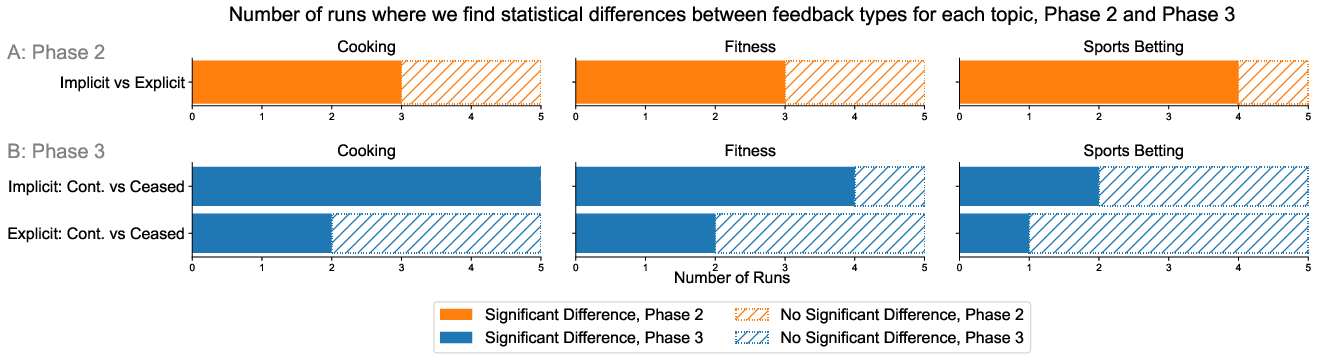
Figure 6: Frequency of statistically significant differences and relapse effects per topic, across signaling strategies and phases, highlighting persistence vulnerabilities.
Implications and Theoretical Context
The findings robustly demonstrate that TikTok’s recommendation algorithm weights both implicit and explicit user feedback in measurable degrees when tuning FYP composition. However, the algorithm frequently “forgives” previous negative feedback upon resumed engagement, reflecting a behavioral plasticity that may undermine long-term user control—particularly problematic in domains prone to sensitive or harmful content (e.g., gambling, body image). The explicit feedback mechanism, while more potent, is unintuitively buried in the interface, likely limiting its practical uptake by real users.
Practically, this suggests that users seeking to de-personalize or correct their FYP experience must not only locate and utilize nontrivial controls, but must exercise persistent avoidance, as periodic engagement can rapidly undo their efforts. Theoretically, these phenomena highlight the tension between engagement-maximization objectives in modern recommender systems and user autonomy, raising important questions for algorithmic transparency, policy, and digital well-being.
Future Directions
Audit frameworks that bridge the methodological gap between technical reproducibility (using controlled emulation and protocol-level cloning) and ecological validity (mirroring real-world heterogeneous user behavior) represent a promising direction for future platform accountability research. Additionally, further work is warranted to assess the evolving robustness of negative feedback mechanisms, especially as recommender systems iterate in response to regulatory and societal pressure.
In AI research, these results underscore the broader challenge of encoding user-centric objectives (such as withdrawal of interest or the avoidance of filter bubbles) within opaque and engagement-driven personalization architectures. End-to-end explainability, real-time feedback analytics, and user-facing interface redesign may be necessary to reconcile algorithmic optimization with meaningful user agency.
Conclusion
Through sophisticated experimentation on the TikTok mobile app, this paper delivers a nuanced quantification of user agency in content personalization. Both explicit and implicit negative feedback reduce unwanted content prevalence, but explicit signaling (currently relegated to obscure UI locations) is notably more effective. Critically, the FYP algorithm exhibits a persistent tendency to “relapse” in content delivery when user behavior shifts, weakening the long-term protective efficacy of negative feedback. These results have direct implications for the design of recommender systems, the transparency of content algorithms, and the autonomy of end-users in adversarial media environments (2605.10690).