Complex methods in the asymptotics of Möbius energy integrals of helix curves
Abstract: The Möbius energy of a curve is a topic of interest to physical knot theorists, harmonic analysts, and geometric analysts. The Gateaux derivative indicates its variation is dependent on curvature and torsion, leading us to consider the family of helix curves, where the ratio of torsion to curvature is a constant proportional to the pitch. We fix a helix, and study the coiling in both directions: as the helix unravels to a straight line, and as it coils infinitely tight. Specifically, we study the arclength-rescaled Möbius energy density, which emerges as a naturally tractable quantity under the Möbius energy's chord-arc comparison of inverse-square laws. The asymptotics of the uncoiling helix, corresponding to an energy decay, can be proven with a short estimate. However, the asymptotics of the helix as it coils infinitely tight, blowing up the energy, is a much more involved calculation. Our strategy for proving the asymptotics, initially reminiscent of the work by Kim-Kusner, begins with a meromorphic extension of the integrand. However, proving the asymptotic equivalence is fundamentally distinct because our integrand has infinitely many poles. Much of the underlying mathematical phenomena becomes apparent only upon rigorous proof. keywords: Möbius energy, helix, complex asymptotics, knot energies, physical knot theory, curves


Paper Prompts
Sign up for free to create and run prompts on this paper using GPT-5.
Top Community Prompts
Explain it Like I'm 14
What Is This Paper About?
This paper studies how a special “energy” of a curve, called the Möbius energy, behaves for a helix (think of the shape of a spring). The author looks at what happens to the helix’s energy per unit length when the helix:
- Uncoils and becomes more like a straight line
- Coils tighter and tighter
The big takeaway: the paper finds simple formulas that describe how this energy changes in these two extreme cases and shows a new way—using complex numbers—to compute and understand that behavior.
What Questions Does the Paper Ask?
In plain terms, the paper asks:
- If you take a helix and change its “pitch” (how stretched or tight the spring is), how does the Möbius energy per unit length change?
- What happens to that energy when the helix becomes very stretched out (uncoils)?
- What happens when the helix becomes extremely tight?
Here, the pitch is a single number that measures how steep the helix is: large means the helix is stretched (almost straight), small means it’s tightly wound.
How Did the Author Study This?
The author focuses on the energy density (energy per unit length) at a point on the helix and rescales it into a function that depends only on the pitch . Then they do two things:
- For large (uncoiling): use a direct estimate to show shrinks like .
- For small (tight coiling): use complex analysis, which treats functions on the complex plane (numbers that have both real and imaginary parts), to turn a hard integral into a sum that can be analyzed.
Here’s the everyday-language version of the complex-analysis approach:
- Extend the integrand to complex numbers: Think of the original energy formula like a landscape. Extending it to complex numbers lets you see hidden structure—like where the landscape has “spikes” (called poles).
- Contour integration and residues: Instead of walking across the whole landscape (integrating directly), the author walks around its boundary (a contour) and adds up the contributions from each spike (the residues). This turns the integral into a sum.
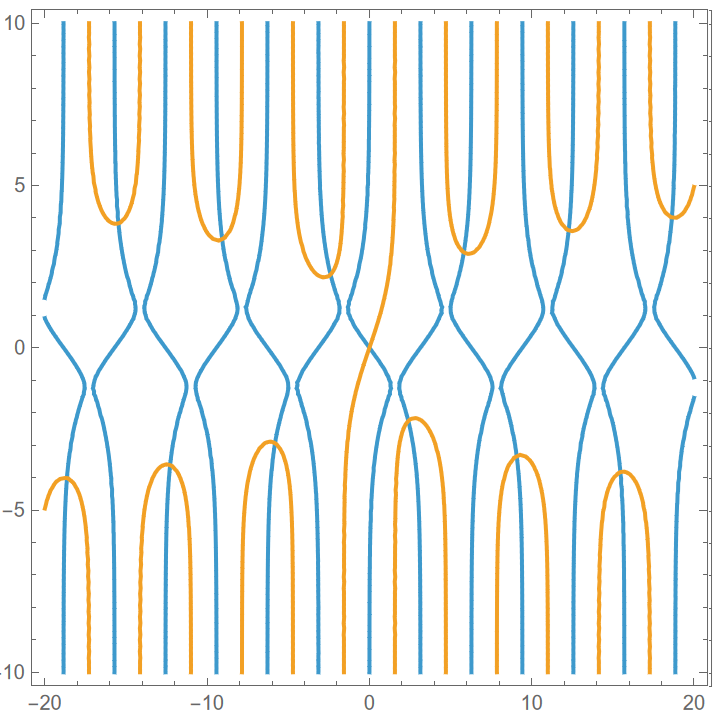
- Locate the spikes (poles): The spikes occur where a certain equation is true. That equation boils down to solving in the complex plane. You can’t solve this exactly, but the paper proves there is exactly one solution in each vertical strip (so you can list them one by one).
- Approximate the spike locations: The author gives a clean approximation for each solution:
- $w_k(\rho) = 2\pi k + 2i\,\arcsinh(k\pi \rho)$
- This captures: real part near multiples of , imaginary part growing with $\arcsinh(\cdot)$.
- Sum their contributions: Using these approximations, the author evaluates the sum (with a classical tool called Euler–Maclaurin summation) to get the energy’s behavior for small .
- Justify the approximation: Two key tools make the approximation rigorous:
- Rouché’s theorem: ensures each true solution is close to the approximate one.
- A “transfer theorem”: ensures that if two complex sums are asymptotically equal, then their imaginary parts (what actually matters in the residue sum here) are also asymptotically equal, provided some simple sign and angle conditions hold.
Why complex numbers? Because they make the “sum of spike effects” idea precise and computable, even when there are infinitely many spikes.
What Did They Find, and Why Is It Important?
Main results:
- As the helix uncoils ():
- Meaning: the energy per unit length drops quickly as the spring straightens.
- As the helix coils very tightly ():
- Meaning: the energy per unit length grows fast—faster than by a logarithmic factor—when the spring is made extremely tight.
- is strictly decreasing in : there is no “best” pitch where the energy density peaks or dips; it just steadily decreases as you uncoil.
Why this matters:
- Möbius energy is used to understand knots and how “tangled” or “tight” a curve is. It’s designed so that self-intersections are very costly, and it’s unchanged by simple rescalings and moves.
- Helices show up in nature and engineering (DNA, springs, cables). Knowing precisely how energy scales with tightness helps predict how parts of a longer curve that look helical will influence the total energy and how an “uncoiling” process changes that energy.
- The complex-analysis method developed here handles infinitely many poles (spikes), which is technically challenging and useful for other problems where similar sums appear.
A helpful intuition for the tight-coiling result: when is small, many terms in the residue sum contribute significantly—roughly up to . Adding “about ” many terms that behave like $1/k$ produces a logarithm, which explains the factor, and the overall scaling brings in the in the denominator.
What Could This Lead To?
- Better understanding of how local “coiled” parts of a curve affect the total Möbius energy, which is relevant for knot untangling and energy-minimizing shapes.
- A toolbox (meromorphic extension, residue summation with infinitely many poles, careful zero-location, and transfer theorems) that can be adapted to other geometric energies and to problems involving exponential polynomials like mixed with algebraic terms.
- Insight into when and how energy-minimizing flows (like “gradient descent” on curves) will prefer uncoiling helical segments, potentially informing algorithms for simplifying knots without cutting them.
In short, the paper gives precise formulas for how the Möbius energy density of a helix changes with its tightness and introduces a robust complex-analytic approach that can help tackle other tough problems in geometric analysis and knot theory.
Knowledge Gaps
Below is a concise list of knowledge gaps, limitations, and open questions that remain after this paper. Each point is framed to be concrete and actionable for future work.
- Higher-order asymptotics: Determine full asymptotic expansions of I(ρ) as ρ→0 and as ρ→∞, including the next terms beyond the leading order and explicit remainder estimates (e.g., I(ρ) = (log(1/ρ))/ρ + c0/ρ + o(1/ρ) as ρ→0; I(ρ) = c2/ρ2 + c4/ρ4 + o(ρ-4) as ρ→∞).
- Two-sided bounds at small ρ: Establish explicit, uniform two-sided inequalities c1 log(1/ρ)/ρ ≤ I(ρ) ≤ c2 log(1/ρ)/ρ for all sufficiently small ρ, with computable constants c1,c2.
- Uniform-in-ρ approximations: Develop a single approximation for I(ρ) valid uniformly on (0,∞), with quantified error (e.g., via matched asymptotic expansions or uniform Euler–Maclaurin), to bridge the small- and large-ρ regimes.
- Refined zero localization: Derive higher-order asymptotics for the roots z_k(ρ) of E_ρ (real and imaginary parts) with explicit expansions and uniform-in-k error bounds; establish separation and counting-function estimates for zeros in the upper half-plane.
- Explicit constants in Rouché-type bounds: Make the constant C and ρ-range explicit in the estimate |z_k(ρ) − w_k(ρ)| ≤ C ρ arcsinh(kπρ)/sqrt((kπρ)2+1), and assess optimality.
- General (j,p)-O’Hara energies: Extend the analysis to E{j,p} for other (j,p), including identifying when the helix energy density remains finite and obtaining the corresponding asymptotics in ρ.
- Variable radius and scaling: Generalize from unit-radius helices H_ρ(t)=(e{it},ρt) to helices of arbitrary radius R, derive the R-dependence of I(ρ,R), and characterize asymptotics in joint limits (ρ→0 or ∞ with R fixed or varying).
- Finite-length helices: Quantify the Möbius energy of truncated helices as functions of length L and ρ, including double-scaling limits (e.g., L→∞, ρ→0 with Lρ fixed), and identify boundary-layer contributions.
- Stability and perturbations: Develop a perturbative theory for curves that are small C2 (or analytic) perturbations of a helix over an interval; relate the local helical parameter ρ(s) to local energy-density variations and produce quantitative energy-decay estimates for “uncoiling” deformations of general curves.
- Transfer Theorem generality: Relax the absolute convergence and sign/non-tangency hypotheses in the Transfer Theorem to handle conditionally convergent series or mixed-sign terms; identify minimal sufficient conditions and explore extensions beyond series (e.g., integrals or transforms).
- Alternative contour strategies: Investigate other contour choices or complex-analytic decompositions that yield simpler residue computations or sharper remainder control, and prove contour-independence with explicit bounds for the tails and arc contributions.
- Real-variable derivation: Provide a purely real-analytic proof of the ρ→0 asymptotic (avoiding residues), isolating the dominant contribution of the chord–arc comparison and clarifying the mechanism producing the logarithmic factor.
- Functional properties of I(ρ): Determine convexity/concavity (e.g., sign of I''(ρ)), analyticity in ρ, and possible log-convexity; quantify regularity to support optimization or interpolation across ρ.
- Ambient-geometry generalization: Extend the analysis to helices embedded in Rn (n>3) and to conformally related spaces (e.g., S3), examining how ambient geometry and conformal invariance alter the energy density and its asymptotics.
- Relation to curvature and torsion: Express the leading asymptotics in terms of curvature κ and torsion τ (not just τ/κ=ρ), and investigate to what extent a local formula for energy density can be derived for curves with slowly varying κ(s), τ(s).
- Exponential–polynomial zero theory: Develop general zero-distribution results for mixed exponential–polynomial equations like ρ2 z2 + 4 sin2(z/2)=0 that provide uniform-in-parameter (ρ) existence, uniqueness, and asymptotic descriptions, beyond the case-by-case X-Principle arguments.
- Pathological limit characterization: Give a geometric/measure-theoretic description of the limiting object as ρ→0 (infinitely tight coil) and identify where, in the integral, the divergence concentrates (e.g., quantify near-turn interactions).
- Numerical verification and algorithms: Implement robust numerical schemes to evaluate I(ρ) for moderate ρ, compute residues via accurate root-finding for E_ρ, and benchmark the asymptotic constants and error terms.
- Connections to knot families: Explore whether the complex-analytic framework here can sharpen asymptotics for torus knots or other families (e.g., large p,q limits), and reconcile with recent results on multiplicity of critical points by establishing asymptotic regimes and possible bifurcations.
Practical Applications
Immediate Applications
Below are actionable, near-term uses that can be deployed with modest engineering or scholarly effort, leveraging the paper’s asymptotic results, residue-series formulation, and proof techniques.
- Helix energy density estimator for simulations
- Sectors: software (simulation/graphics/CAE), academia
- Use case: Replace costly pairwise-interaction computations in rope/cable simulators and geometric PDE flows with a fast, pitch-based surrogate for local self-repulsion using the closed-form asymptotics I(ρ) ≈ π/(3ρ2) for large ρ and I(ρ) ≈ (log(1/ρ))/ρ for small ρ (up to constants).
- Tools/products/workflows: A lightweight library function I_hat(ρ) with error-controlled regimes; integration into physics engines as a regularizer to discourage overly tight coiling; automated profiling to switch between large-/small-ρ estimates.
- Assumptions/dependencies: Möbius energy is geometric, not a physical material energy; mapping to mechanical stress requires calibration. Validity is best for subarcs well-approximated by helices and slender, smooth filaments without thickness or frictional contact.
- Heuristic uncoiling operations in knot untangling and curve-regularization flows
- Sectors: computational topology, computer-aided design
- Use case: Identify subarcs with nearly constant torsion-to-curvature ratio (helical signature) and locally increase pitch to guarantee energy decrease (monotonicity of I(ρ)); use as a descent heuristic in optimization pipelines for “energy-simplifying” curve design.
- Tools/products/workflows: Feature detector for helical segments via curvature/torsion ratio; local editing operator that increases ρ where safe; hybrid gradient descent augmented with rule-based uncoiling.
- Assumptions/dependencies: Applies to non-self-intersecting curves with sufficiently smooth geometry; global topological changes are still constrained by nonlocal interactions; performance depends on accurate helical segment detection.
- Fast benchmarks and sanity checks for Möbius-energy codes
- Sectors: academia, scientific software
- Use case: Validate numerical integrators or discretizations of Mӧbius energy using the helix test case with known scaling: I(ρ) ~ 1/ρ2 (uncoiling limit) and I(ρ) ~ (log(1/ρ))/ρ (tight-coiling limit).
- Tools/products/workflows: Unit tests covering extreme-ρ regimes; regression testing across integrator tolerances; automated detection of asymptotic slopes in log-log plots.
- Assumptions/dependencies: Comparisons should use rescaled energy density (as in the paper), not the divergent full energy of infinite helices; for finite segments, ensure truncations are consistent with the paper’s remarks.
- Teaching modules on complex asymptotics with infinitely many poles
- Sectors: education (advanced complex analysis, asymptotics), academia
- Use case: Classroom exemplars for contour selection when residues are infinite in number; demonstration of meromorphic continuation, residue summation, and the role of Rouché’s theorem with uniform-in-index error bounds.
- Tools/products/workflows: Lecture notes, problem sets, and code notebooks reproducing the residue-series representation and the Euler–Maclaurin summation for the approximate series.
- Assumptions/dependencies: Requires students familiar with complex analysis and special functions (sinc, arcsinh, sech).
- Methodological template for solving transcendental eigenvalue problems
- Sectors: applied math, electromagnetics, acoustics
- Use case: Apply the “X-Principle” (crossing lemma) and the paper’s bounding strategy to locate/uniquely count solutions of equations like sin z = iρz (and close relatives) that appear in waveguide dispersion or membrane resonance problems.
- Tools/products/workflows: A proof-pattern checklist for uniqueness in vertical strips; bounds derived from auxiliary functions (e.g., u sech u) to control critical points and monotonicity.
- Assumptions/dependencies: Transferability depends on structural similarity (trigonometric–polynomial hybrid exponentials) and availability of comparable monotonicity and boundary data.
- Rule-of-thumb design guardrails against tight coiling
- Sectors: electronics packaging, consumer hardware, CAD
- Use case: Introduce a simple “coil tightness” risk metric proportional to (log(1/ρ))/ρ to flag excessive coiling in cable harness layouts or product packaging that could increase self-interaction risk.
- Tools/products/workflows: CAD plug-ins that compute approximate local ρ along cable paths and raise warnings when small-ρ thresholds are exceeded; design-time lint rules.
- Assumptions/dependencies: Surrogate is geometric; physical durability still follows material and thickness-specific minimum bend radius standards; requires mapping from curve pitch to manufacturable routing constraints.
Long-Term Applications
These opportunities require further research, integration with domain physics, or scaling up of the paper’s techniques and error controls.
- Energy-minimizing knot untangling with certified nonlocal surrogates
- Sectors: computational geometry, robotics (manipulation of deformable objects)
- Use case: Build global untangling algorithms guided by Möbius-energy descent, using helix-aware local moves and the residue-series representation to approximate gradients where feasible. For robot manipulation, plan “uncoiling-first” trajectories that reduce self-interaction energy before tighter maneuvers.
- Tools/products/workflows: Hybrid solvers combining discrete moves (Reidemeister-like) with smooth flows; vision-based detection of helical substructures; certified step-size rules from monotonicity.
- Assumptions/dependencies: Requires integration of thickness, contact/friction, and actuation limits; ensuring topology preservation in physical settings; robust real-time estimation of torsion/curvature from sensor data.
- Polymer and DNA supercoiling models with calibrated nonlocal geometric repulsion
- Sectors: biotechnology, materials science
- Use case: Use the helix energy-density scaling as a nonlocal self-avoidance component in coarse-grained models of supercoiled DNA or polymer filaments; predict thresholds where tightening becomes energetically prohibitive and guide enzymatic or mechanical uncoiling strategies.
- Tools/products/workflows: Multiscale simulators coupling Möbius-like energies to elastic bending/torsion and steric thickness; parameter inference to reconcile geometric energy with experimental observables (force–extension, cyclization probabilities).
- Assumptions/dependencies: Must incorporate finite thickness, solvent effects, and specific interaction potentials; Möbius energy alone is not a physical energy and needs empirical calibration.
- Design optimization of helical devices minimizing self-interaction surrogates
- Sectors: medical devices (stents, catheters), mechanical design (springs, coils)
- Use case: Penalize geometries with small pitch using (log(1/ρ))/ρ-type surrogates to avoid regimes prone to self-contact, kinking, or field concentration (in EM coils); co-optimize with mechanical/EM objectives.
- Tools/products/workflows: Multi-physics optimization frameworks with geometric energy penalties; CAD-integrated evaluators for local ρ along parts.
- Assumptions/dependencies: Requires mapping between geometric surrogate and device-specific performance metrics; incorporate constraints like minimum bend radius and material yield.
- Robust libraries for zeros of exponential-polynomial equations with guarantees
- Sectors: photonics, acoustics, structural dynamics, control
- Use case: Generalize the paper’s existence/uniqueness framework, Rouché-based error bounds, and “X-Principle” to deliver certified root-finders for equations of the form P(z) + Σ c_j e{λ_j z} = 0 in specified half-strips. Applicable to dispersion relations, resonance spectra, and delay-differential characteristic equations.
- Tools/products/workflows: Open-source numerical library offering strip-wise counting, initializers w_k(ρ)-type approximants, and uniform-in-index error controls; diagnostics for sign/non-tangency conditions akin to the Transfer Theorem.
- Assumptions/dependencies: Needs problem-specific bounding functions and strip decomposition; performance depends on availability of good approximants and uniform derivative bounds.
- Transfer Theorem–inspired pipelines for complex-to-real asymptotic validation
- Sectors: applied math, signal processing
- Use case: Institutionalize a methodology where complex asymptotic equivalence is provably transferred to physically meaningful real or imaginary parts under sign and non-tangency conditions, aiding derivations in nonlocal operators, spectral sums, and response functions.
- Tools/products/workflows: A verification toolkit to check series absolute convergence, sign coherence, and non-tangency; symbolic–numeric proof assistants to automate the transfer step.
- Assumptions/dependencies: Requires series representations with uniform control; fields with sign-structured modal contributions benefit most (e.g., dissipative spectra).
- Standards and policy guidance for safe coiling practices (informational)
- Sectors: industrial safety, medical procedures, telecommunications cabling
- Use case: Inform guidelines that discourage excessively small pitch in storage/handling of flexible filaments (cables, tubing, sutures), using geometric energy blow-up behavior as a qualitative risk indicator for self-contact and damage.
- Tools/products/workflows: White papers and best-practice notes linking pitch thresholds to existing minimum bend radius rules; training materials for technicians.
- Assumptions/dependencies: Adoption requires empirical correlation between geometric surrogate and failure modes; standards bodies typically require material- and diameter-specific evidence.
- Curriculum and research training on advanced contour methods with infinite poles
- Sectors: higher education, research training
- Use case: Develop graduate mini-courses and workshops centered on the paper’s contour construction, handling of infinitely many poles, and Euler–Maclaurin bridging from series to asymptotics; train students in blending harmonic analysis with geometric-analytic estimates.
- Tools/products/workflows: Modular learning packs with proofs, visualizations, and coding exercises; cross-disciplinary seminars with applications to wave phenomena and spectral theory.
- Assumptions/dependencies: Requires faculty expertise in complex analysis and nonlocal operators; benefits from computational visualization support.
Notes on cross-cutting assumptions and dependencies:
- The Möbius energy is a geometric, scale-invariant functional designed for simple closed curves; practical systems have finite thickness, material constitutive laws, and self-contact/friction, which must be modeled for predictive fidelity.
- The paper’s central results are asymptotic (ρ → 0, ρ → ∞) and concern an infinite helix’s rescaled energy density; finite, truncated helices require careful treatment (as noted) and may introduce boundary effects.
- The residue-series approach with infinitely many poles relies on specific contour choices and uniform error bounds; generalization to other problems requires analogous structural properties.
- The Transfer Theorem’s use demands absolutely convergent series with sign and non-tangency conditions that may not hold universally without additional problem-specific verification.
Glossary
- Absolute continuity: A property of functionals ensuring small changes in input lead to small changes in the functional, often used with lower-semicontinuity in variational problems. "By the absolute continuity of the M\"obius energy (see Eq. 1.6 in \cite{freedman1994mobius}), the truncation need not be symmetric, as was the case in this remark."
- Arclength element: The infinitesimal length along a curve, used to reparametrize or scale integrals on curves. "The arclength element is the constant ."
- Arclength-rescaled M\"obius energy density: The Möbius energy density multiplied by the arclength factor to isolate specific scaling behavior. "Specifically, we study the arclength-rescaled M\"obius energy density, which emerges as a naturally tractable quantity under the M\"obius energy's chord-arc comparison of inverse-square laws."
- arcsinh: The inverse hyperbolic sine function, often appearing in complex-analytic parameterizations. "Recall that $\arcsinh u = \int_0^u \frac{dt}{\sqrt{1+t^2} = \log( u + \sqrt{u^2 + 1})$"
- Asymptotic equivalence: A relation indicating two sequences or functions approach each other in a precise sense as a parameter tends to a limit. "We briefly establish our conventions for asymptotics. The fundamental relationship we work with is asymptotic equivalence."
- Binormal: In the Frenet frame of a space curve, the unit vector orthogonal to both the tangent and normal vectors. "the M\"obius gradient is liable to be large when difference vectors are close to the binormal "
- Cauchy integral formula: A central result in complex analysis expressing values of holomorphic functions via contour integrals. "A natural idea is to extend to the meromorphic function and calculate via a complex contour and the Cauchy integral formula."
- Cauchy method of majorants: A technique to prove analyticity by bounding series with a dominating, known-convergent series. "Recently in \cite{blatt20}, Blatt applies the Cauchy method of majorants to yield the very strong result that if is a critical point of the M\"obius energy, then is real-analytic."
- Cauchy principal value: A method for assigning values to certain improper integrals that would otherwise be undefined. "So while variations of the M\"obius energy require the Cauchy principal value, we need not concern ourselves with truncations."
- Chord-arc comparison: Comparing integrands using distances along a curve (arc) versus straight-line chords to regularize singularities. "which emerges as a naturally tractable quantity under the M\"obius energy's chord-arc comparison of inverse-square laws."
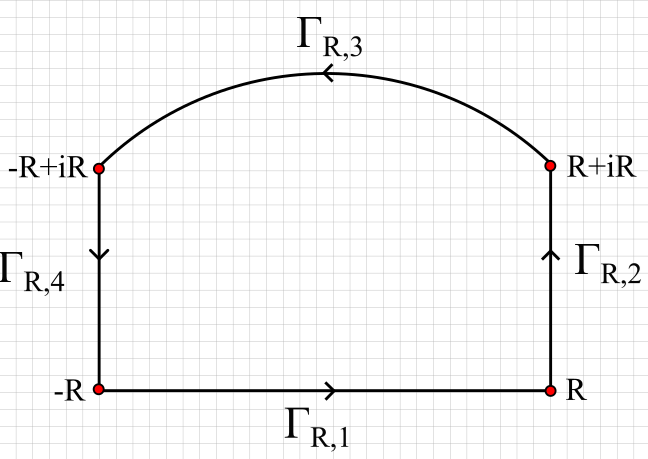
- Contour (complex): An oriented path in the complex plane used for evaluating integrals via complex analysis. "we needed to apply a less-than-obvious family of contours, as depicted in Fig. \ref{Gamma_R},"
- Curvature: A measure of how sharply a curve bends at a point. "the Gateaux derivative indicates its variation is dependent on curvature and torsion"
- Euclidean similarities: Transformations composed of rotations, translations, and uniform scalings that preserve shape up to scale. "First of all, the M\"obius energy is now invariant under Euclidean similarities."
- Euler–Maclaurin summation: A formula connecting sums and integrals to estimate series asymptotically. "we can calculate the asymptotics directly with a classical Euler-Maclaurin summation"
- Exponential polynomial: A function composed of polynomials and exponentials whose zeros often exhibit complex patterns. "Nonzero poles of are in bijective correspondence with nonzero roots of the exponential polynomial"
- Extrinsic Euclidean distance: The straight-line distance in Euclidean space, contrasted with distance measured along a curve. "Since the extrinsic Euclidean distance minimizes the intrinsic distance on "
- Frenet frame: An orthonormal triad (tangent, normal, binormal) describing local geometric properties of a space curve. "and denotes the Frenet frame."
- Gateaux derivative: A directional derivative of a functional, generalizing gradients to infinite-dimensional settings. "the authors calculate the Gateaux derivative of the M\"obius energy at "
- Gradient descent: An iterative optimization method moving along negative gradients to decrease an energy or loss. "Therefore, the gradient descent precludes changes in knot type via transverse strand crossing."
- Helix: A space curve with constant slope around an axis, here with constant ratio of torsion to curvature. "Specifically, a helix of pitch (we will henceforth instead use the word ``pitch" to refer to ) is parametrized by in ."
- Holomorphic function: A complex-differentiable function on an open set in the complex plane. "the entire holomorphic function ."
- Hurwitz theorem: A result describing the behavior of zeros of converging sequences of holomorphic functions. "The Hurwitz theorem gives a very rough description of the roots"
- Intrinsic distance: The distance measured along a curve between two points on it. "where denotes the intrinsic distance along ."
- Lipschitz derivative: A derivative that satisfies a global Lipschitz condition, implying controlled variation. "That is, is with Lipschitz derivative."
- Lower-semicontinuity: A property ensuring the limit inferior of functionals along converging sequences is at least the functional of the limit, vital in variational problems. "Of course, this is exactly what lower-semicontinuity of the M\"obius energy predicts."
- Meromorphic extension: Extending a function to a larger domain as a meromorphic function (holomorphic except for isolated poles). "Our strategy for proving the asymptotics, initially reminiscent of the work by Kim-Kusner, begins with a meromorphic extension of the integrand."
- M\"obius energy: A knot energy functional comparing chord and arc distances; finite for simple closed curves and infinite at self-intersections. "The M\"obius energy is defined to be ."
- Nonlocal differential operator: An operator whose value at a point depends on values of a function over an extended region, not just infinitesimal neighborhoods. "This is the only analyticity result of a nonlocal differential operator to the author's knowledge."
- Prime knot types: Knot types that cannot be decomposed as nontrivial connected sums, analogous to prime numbers under addition-like operations. "Another central result of Freedman-He-Wang is that prime knot types have M\"obius-minimizing parametrizations."
- Projection onto the orthogonal plane: Mapping a vector onto the plane perpendicular to a given direction. "Here, denotes projection onto the plane orthogonal to the tangent "
- Real-analytic: Infinitely differentiable with power series expansions converging to the function locally. "then is real-analytic."
- Reidemeister-I move: A basic local move in knot diagrams adding or removing a twist, preserving knot type. "simultaneously performing Reidemeister-I moves"
- Residue (complex analysis): The coefficient of in the Laurent series of a function around an isolated singularity; used to evaluate integrals via contours. "I(\rho) &= 2\pi i \sum\limits_{\Imz z > 0} \text{Res}(M_\rho,z)."
- Ritt's theorem: A uniqueness result about factorizations of exponential polynomials. "By Ritt's theorem, this factorization into irreducible exponential polynomials is unique."
- Sobolev space (fractional): Function spaces incorporating derivatives in an sense, extended to fractional orders. "Blatt shows that is equivalent to the condition is in the fractional Sobolev space $H^{\frac{3}{2}(I,R^n)$"
- sinc function: The function $\sinc(t)=\sin t / t$, common in analysis and signal processing. "Recall the definition $\sinc(t) \coloneq \frac{\sin t}{t}$"
- Torsion: A measure of how a space curve twists out of the osculating plane. "Notably, the torsion in both cases."
- Torus knot: A knot that lies on the surface of a torus and winds around it in a specified pattern. "their work on the M\"obius energy of torus knots "
- Transfer Theorem: A result transferring asymptotic equivalence of complex series to their imaginary parts under sign and non-tangency conditions. "we set up and prove the following transfer theorem:"
- Upper half-plane: The subset of the complex plane with positive imaginary part, frequently used in contour integration. "which will engulf all of the upper-half of the complex plane."
Collections
Sign up for free to add this paper to one or more collections.