- The paper demonstrates that gravitationally induced Wigner rotation produces measurable phase differences in a Mach-Zehnder interferometer.
- The methodology employs geometric optics and tetrad formalism to track photon polarization along null geodesics in a Kerr spacetime.
- The design provides a formal estimator for the specific angular momentum with a relative error of 10⁻⁶, highlighting potential in quantum metrology.
Summary of "The role of Wigner rotation in estimating the specific angular momentum of a Kerr spacetime"
Introduction and Theoretical Context
This paper investigates the effect of polarization rotation—specifically the Wigner rotation—on photon propagation in the Kerr metric, with a focus on estimating the specific angular momentum parameter (a) of the spacetime. The authors employ a Mach-Zehnder geodesic interferometer, with photon arms traced by null geodesics, leveraging quantum optics concepts to explore gravitational signatures on polarization. The approach builds on the geometric optics approximation and the tetrad formalism, utilizing the WKB method to model the photon as a localized qubit whose polarization evolution is tracked through parallel transport in curved spacetime.
The fundamental interplay between quantum mechanics and general relativity underlies this approach, as photons are ideal probes given their null geodesic propagation. The paper emphasizes two distinct relativistic effects manifesting in interferometric visibility: gravitationally induced time delay and polarization (Wigner) rotation, both relevant for precision metrology in gravitational contexts and potential applications in quantum communication.
Kerr Metric, Null Geodesics, and Polarization Transport
The analysis begins with a detailed exposition of the Kerr metric and its null geodesics, specified via an affine parameterization. Principal null geodesics, confined to constant polar angles, serve as tractable probes for the interferometric setup. Photon propagation along these geodesics is described via adapted tetrads, aligning local reference frames with the trajectory. The polarization state, encoded in the Jones vector, evolves under local Lorentz transformations, with the Wigner rotation generated by the spin-1 connection. The resulting transport equations capture the gravitational phase acquired by the quantum state.
Geodesic Interferometer Construction
The Mach-Zehnder geodesic interferometer is defined with arms corresponding to geodesic segments between four radial coordinates. After photon emission and beamsplitter interaction at r2, the photon is split across two paths—one towards r1 (lower radial coordinate), the other towards r3 (higher). Reflected states are recombined at r4, facilitating measurement. The calculation of the recombination coordinate utilizes geodesic solutions for azimuthal and radial motion.
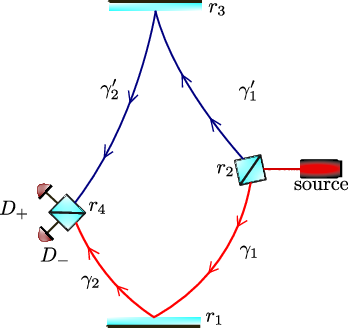
Figure 1: Schematic of the geodesic interferometer showing photon propagation and recombination paths along null geodesics.
Analytical Results: Phase Differences and Wigner Rotation
The interferometer allows for the computation of two phase differences:
- Arrival time phase shift Δϑτ: Caused by gravitational time dilation, with magnitude on the order of 10−16 for a 1 m2 interferometer near Earth's surface at THz frequencies.
- Wigner phase difference Δϑ: Stemmed from polarization rotation, typically several orders weaker (down to 10−30 for 1 m separation), but can be amplified to r20 by extending arms to km scales.
These effects manifest as distinct signatures in the detection probabilities at the output ports of the interferometer. Analytical expansions in the slow rotation (r21) and weak field (r22) approximations are provided for both phase components.
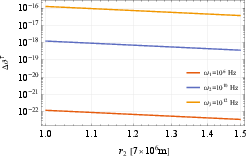
Figure 2: Arrival time-related phase difference r23 as a function of photon source position and frequency for different interferometer parameters.
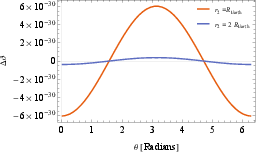
Figure 3: Wigner phase rotation r24 as a function of angular coordinate r25 for interferometer separations and photon source locations.
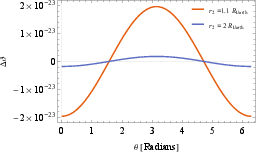
Figure 4: Amplified Wigner phase rotation r26 for larger radial separations (r27 m), increasing the measurable magnitude near Earth.
Detection Probability, Visibility, and Estimation Protocol
The probability for detecting the photon at an output port depends harmonically on both r28 and r29, modulated by the interferometric visibility. The visibility decreases exponentially with increasing r10 (for fixed spectral width and central frequency) and is further modulated by the Wigner phase. Neglecting gravitational coupling simplifies the result to classical expected values.
The paper presents a formal estimator for the specific angular momentum r11 derived from the detection probability. For typical experimental parameters (mirrors separated by 800 km, error in probability r12), the achievable relative error in r13 is r14. Uncertainty analysis leverages standard propagation techniques, highlighting the tradeoff between arm separation and detection precision.
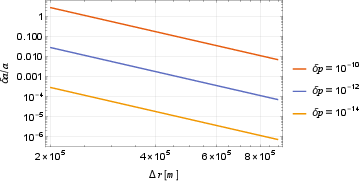
Figure 5: Relative error r15 in the estimator for specific angular momentum as a function of interferometer arm length, for various probability uncertainties.
Implications and Perspectives
The formalism unifies interferometric phase shifts arising from both gravitational time delay and polarization rotation, showing their joint imprint on quantum detection probabilities. The results underscore that photon-based quantum interferometry in curved spacetime is sensitive—albeit weakly—to rotational gravitational effects parameterized by r16. In metrological contexts, the methodology provides a systematic way to estimate angular momentum in rotating spacetimes. Beyond immediate applications, such setups could be adapted for astrophysical environments or satellite-based quantum networks, where sensitivities to frame dragging, gravitomagnetic phenomena (Skrotskii effect), and relativistic polarization effects warrant further exploration.
Conclusion
This work rigorously demonstrates the role of Wigner rotation in photon polarization as a witness of Kerr spacetime properties, provides analytical and numerical estimates of the corresponding phase shifts, and presents a quantum interferometric setup capable of extracting the specific angular momentum parameter with quantifiable precision. The approach is valid in weak field and slow rotation limits, offers explicit error analysis, and serves as a foundation for probing gravitationally induced quantum effects in future experiments.