- The paper develops a unified theory to quantize electromagnetic quasinormal modes in various open nanophotonic structures.
- It establishes rigorous boundary conditions and a system-bath formalism that directly connects device geometry with quantum interaction strengths.
- The framework yields numerical expressions for decay rates and interaction kernels, enabling ab initio simulation of realistic quantum photonic circuits.
Quasinormal Mode Quantization for Complex Lightguiding Nanostructures
This paper develops a general theory for quantizing electromagnetic quasinormal modes (QNMs) in open nanophotonic structures, particularly those relevant for quantum technologies: coupled cavities, waveguide-connected resonators, devices near interfaces, and complex integrated photonic circuits. By formulating rigorous boundary conditions and providing a unified system-bath framework, the theory connects modal parameters to physical quantum interaction strengths and non-Markovian system-bath correlations, facilitating ab initio modeling of open quantum dynamics in realistic devices.
Motivation and Background
Integrated quantum photonic technologies frequently require coupling quantum emitters (QEs)—atoms, molecules, or quantum dots—to resonator modes within complex nanostructures. Applications range from quantum information transfer to scalable on-chip communication networks. Previous models typically utilize orthonormal cavity mode expansions, appending losses and coupling heuristically, which disconnects device geometry from core quantum dissipative processes. Conversely, QNMs, as solutions to the lossy, open-boundary-value problem for Maxwell's equations, naturally encode the spatial and spectral features essential for understanding open system dynamics—even for lossy or structured environments.
However, prior QNM quantization frameworks were limited to homogeneous backgrounds and a single class of structures, lacking generality for multi-cavity, waveguide-connected, or surface-coupled environments. This work establishes a general theoretical and computational toolbox for addressing these settings.
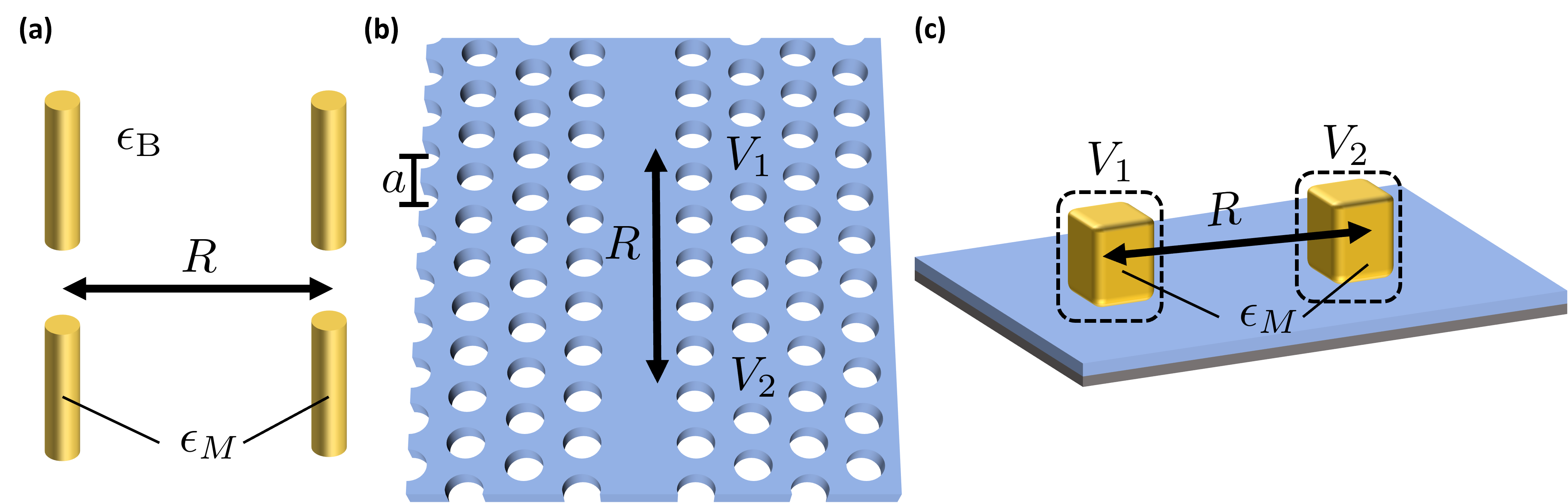
Figure 1: Various couplings of QNM cavities: (a) metal dimer in homogeneous background, (b) cavities side-coupled to a photonic crystal waveguide, (c) nanoparticles near a planar interface.
A central advance of this work is the derivation of a general boundary condition integral for Maxwell’s equations in arbitrary, potentially inhomogeneous, dissipative media. This integral succinctly encapsulates the radiation or confinement requirements for the field in different configurations. It is rigorously reduced to familiar limits:
- Closed cavities follow conventional zero-tangential-field boundary conditions.
- Homogeneous backgrounds yield the Silver-Müller radiation condition in 3D, with analogous forms in 1D/2D, determining outgoing fields.
- Waveguides require that far-field regions support only propagating modes set by the local waveguide modal basis.
The method flexibly accommodates combinations—e.g., a cavity near a surface supporting both propagating and evanescent (surface-bound) power flow. The geometric decomposition enables device-specific field quantization procedures tailored to, e.g., planar substrates with surface plasmon polaritons versus multiport networks.

Figure 2: (a) Closed cavity (no flux through boundary); (b)-(d) Field configurations and boundary conditions for 1D, 2D, and 3D open systems.

Figure 3: (a) Forward/backward waveguide modes; (b) Cavity evanescently coupled to a waveguide—boundary integral is over the exterior cylindrical surface.
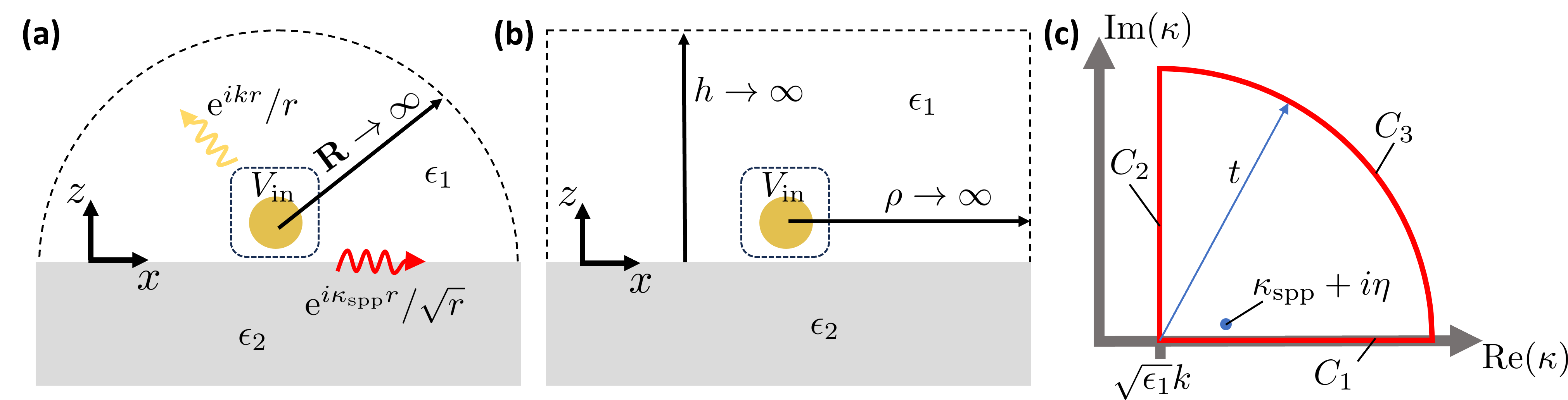
Figure 4: (a) Cavity near planar interface—semispherical/cylindrical boundary separates outgoing and surface-bound contributions; (c) contour for evaluating surface plasmon pole term.
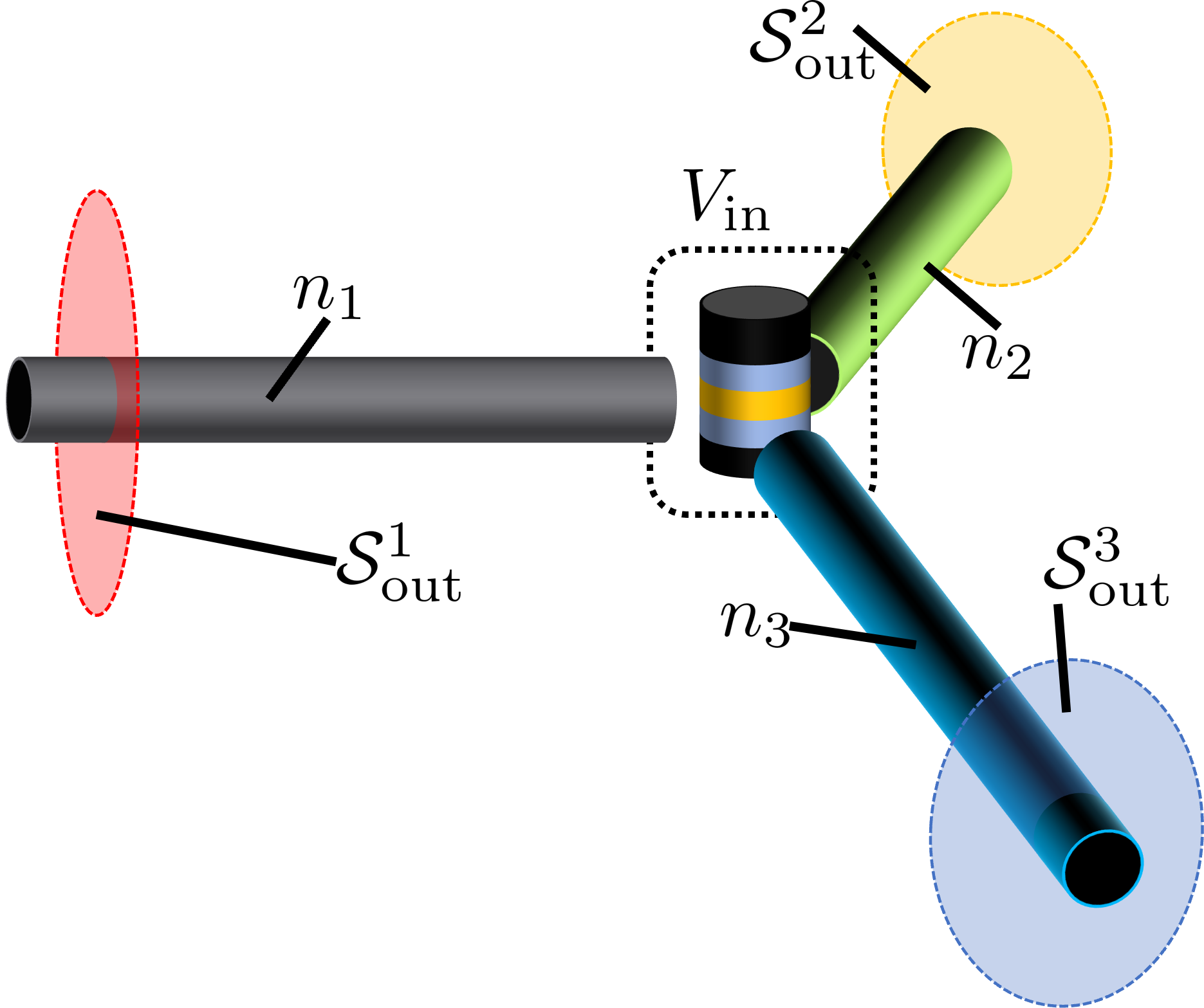
Figure 5: Multiport example with three distinct waveguides, supporting independent boundary relation for each emission direction.
Multi-Cavity QNM Quantization
The electromagnetic field is formally decomposed via QNM expansions localized to individual cavities, regularized beyond the passive resonator region by a Dyson-integral-based construction involving the background medium's Green's function. These mode fields are then promoted to operators via projection from the canonical bosonic field operators, yielding QNM creation/annihilation operators with nontrivial (nearcommuting) relationships governed by the spatial overlap and connection profile (encoded in a separation parameter). When cavities are spatially separated (the separation parameter Piμjν is large), the QNM operators for distinct cavities asymptotically commute, allowing Fock state structure for individual resonators.
Crucially, this quantization naturally identifies a non-bosonic bath, comprising propagating modes in the background, with which all QNMs are coupled—a unifying feature for describing system-bath interactions beyond Markovian/perturbative treatments.
Quantum System-Bath Hamiltonian
The system Hamiltonian takes the canonical system-bath form:
- System: QNM operators with (complex) eigenfrequencies and loss terms grounded in electromagnetic structure.
- Bath: Operators for propagating modes in the environment, generally non-bosonic due to orthogonality/projector structure.
- Coupling: Explicitly constructed via overlaps between QNM fields and background modes (via Green's function projection), rigorously calculable from simulation or analytic modal expansions.
This framework readily integrates quantum emitters (e.g., TLSs) coupled to the QNMs and/or directly to the bath, with coupling strengths expressed in terms of QNM field values at emitter locations.
System-Bath Correlation Functions and Non-Markovian Dynamics
The formalism is extended by delivering explicit expressions for the system-bath correlation functions governing open quantum dynamics. These incorporate:
- Full time delays from photon propagation between cavities,
- Bath-mediated effective interactions between spatially separate QNMs or QEs,
- Nontrivial temporal and spatial structure of the bath, enabling simulation beyond the weak-coupling or Markovian limit.
These correlation functions can be directly injected into advanced dynamical solvers such as TCL, HEOM, or Feynman-Vernon path integrals.
Numerical and Physical Implications
All decay rates, coupling strengths, and bath-mediated interaction kernels are given by explicit, numerically accessible modal overlaps and path-dependent quantities—significantly strengthening the connection between device geometry, electromagnetic structure, and quantum dissipative dynamics.
The cavity separation parameter offers an explicit, geometry- and loss-dependent exponential measure for the strength of inter-cavity coupling mediated by the background, scaling as exp(−Piμjν), with Piμjν depending on the minimum QNM loss, inter-cavity optical path, and the geometric efficiency of connecting structures.
Key technical claims include:
- The non-bosonic nature of the bath, which must be accounted for in realistic modeling of propagation and decoherence across waveguide-coupled architectures.
- The exponential suppression of inter-cavity modal overlap as a function of path length, rendering the theory scalable to large quantum photonic networks with high locality.
- That all input parameters (frequencies, fields, couplings) can be computed from Maxwell solutions and surface integrals, allowing for first-principles device modeling.
Conclusions and Future Directions
The presented formalism provides a unified and rigorous construction for quantizing QNMs in arbitrary lightguiding nanostructures. This enables, for the first time, the ab initio derivation of quantum dynamics and dissipative couplings in realistic multi-cavity, waveguide, and surface-coupled photonic devices directly from Maxwell eigenmode calculations.
Practical implications for quantum device engineering include:
- Device-specific dissipative and coherent coupling rates, critical for optimizing photonic quantum networks.
- Non-Markovian, time-delayed interaction kernels, necessary for accurately describing entanglement transfer and feedback in macroscopic networks.
- Ab initio simulation capability for open quantum system evolution—enabling the systematic design, optimization, and scaling of integrated quantum photonic circuits.
Potential future developments include extending the theory to fully account for ultra-strong coupling regimes, complex nonlinearities, and multi-level or collective emitter ensembles, as well as implementation into quantum trajectory or stochastic simulation frameworks for large-scale device optimization.