- The paper introduces FM4PDE, a flow-matching framework that unifies forward simulation and inverse recovery from sparse observations.
- It employs adaptive guidance in deterministic, stochastic, and hybrid schemes, achieving optimal error contraction and efficient sampling.
- Experimental results show FM4PDE outperforms diffusion-based and operator learning methods in accuracy and speed under minimal data conditions.
Guided Flow Matching for Forward and Inverse PDEs with Sparse Observations: Algorithm and Theory
Framework Overview and Methodology
The paper "Guided Flow Matching for Forward and Inverse PDE Problems with Sparse Observations: Algorithm and Theory" (2605.25509) introduces FM4PDE, a generative PDE solver unifying forward simulation and inverse recovery under extreme data sparsity. FM4PDE leverages flow matching—a generative paradigm where a learned neural ODE transports a noise distribution to the distribution of PDE solutions—to model the joint law of PDE coefficients (or initial states) and their corresponding solutions (or final states). During inference, the sampling trajectory is guided by a composite loss that enforces both agreement with sparse observations and conformity to the PDE residual. FM4PDE supports deterministic, stochastic, and hybrid sampling procedures, each with distinct theoretical and numerical properties.
The framework consists of a two-phase process: a training phase and an inference (sampling) phase. During training, a neural flow-matching model is optimized on paired data consisting of PDE coefficients (or initial conditions) and associated solution fields. At inference, the model is held fixed, and the generation of samples is steered by observation and PDE constraint guidance—allowing both classical forward and challenging inverse problems to be addressed with minimal and partial observations.
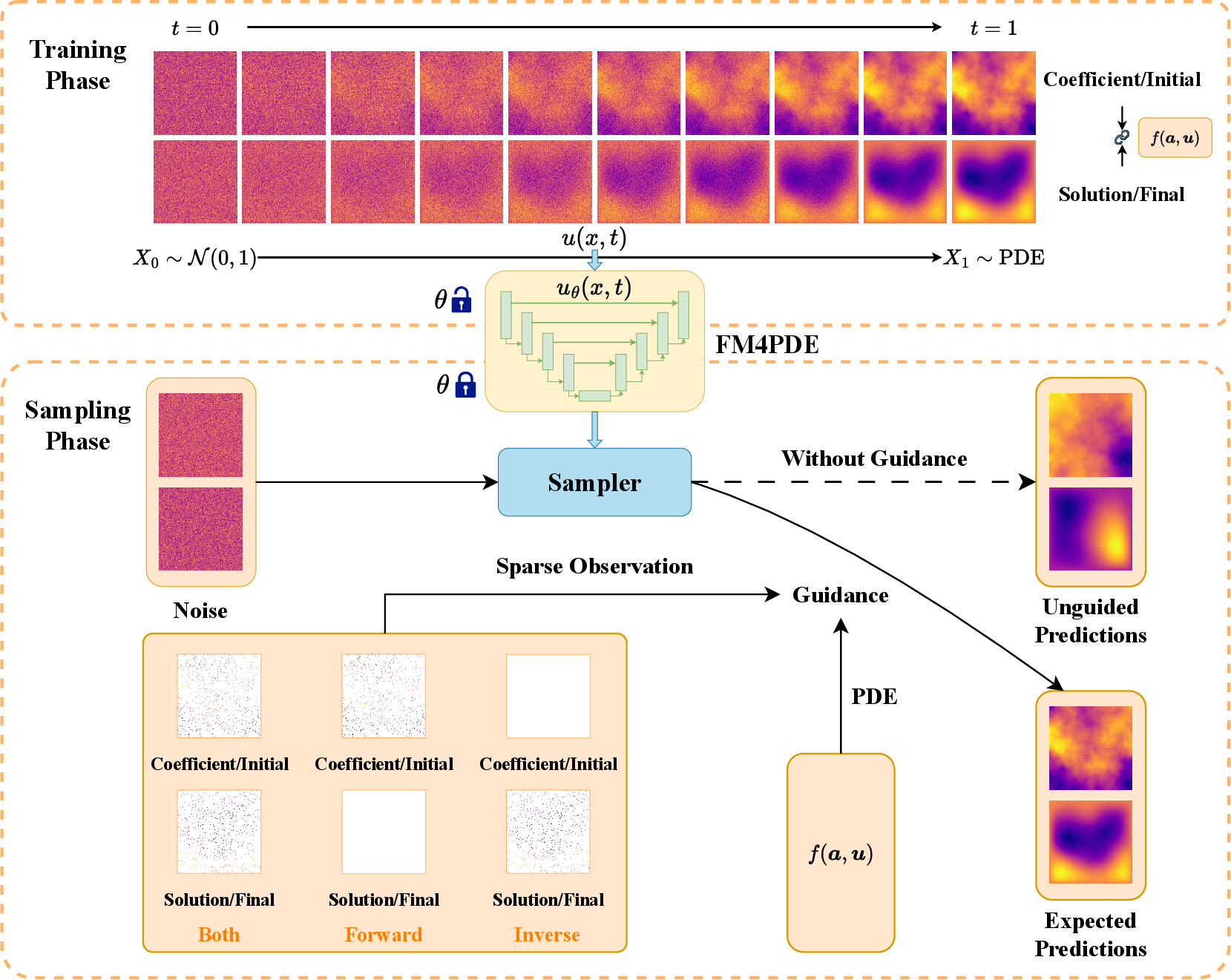
Figure 1: FM4PDE framework: Phase I trains on paired PDE coefficient-solution data, and Phase II performs guided sampling for inference.
Theoretical Contributions
The paper provides rigorous analysis of the FM4PDE sampling strategies. For the deterministic guided optimizer, under a coercivity and dissipativity structure, the authors prove bounded sampling trajectories and logarithmic complexity (in error tolerance) with phase-wise contraction by adaptively controlling the guidance strength bt. Specifically, the contraction factor yields loss decay proportional to ϵ2μ, with an iteration complexity of O(log(1/ε)) to reach error ε.
For the stochastic sampler, FM4PDE introduces guidance coefficients that adapt with the sampling noise level. Under a dissipative velocity field, the method attains uniform moment bounds and a polynomial complexity in target error, removing the unbounded bias incurred by simpler constant-guidance approaches. Theoretical lower bounds demonstrate that non-adaptive guidance induces irreducible error floors, validating the necessity for adaptivity.
A hybrid scheme is also formulated: an initial deterministic phase exploits fast contraction, then switches to stochastic sampling for improved robustness and exploration in the low-noise regime. Overall algorithmic complexity is proven to be O(ε−2log(1/ε)).
Experimental Evaluation
Empirical experiments are performed across a broad spectrum of canonical PDEs: static problems (Darcy flow, Poisson, Helmholtz) and dynamic problems (Navier–Stokes, Burgers, reaction-diffusion, shallow water), for both forward and inverse configurations. Data regimes considered range from fully observed to extremely sparse measurements (as low as 500 points in high-dimensional settings). FM4PDE demonstrates strong numerical performance: accuracy in both reconstructing global fields and inferring unobserved parameters matches or outperforms operator learning frameworks (FNO, DeepONet) and recent generative diffusion-based solvers, but with markedly faster inference due to more efficient flow-based sampling.
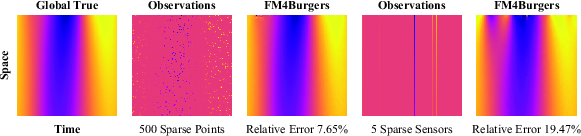
Figure 2: FM4PDE reconstructs full temporal evolution of Burgers' equation under two sparse observation patterns.
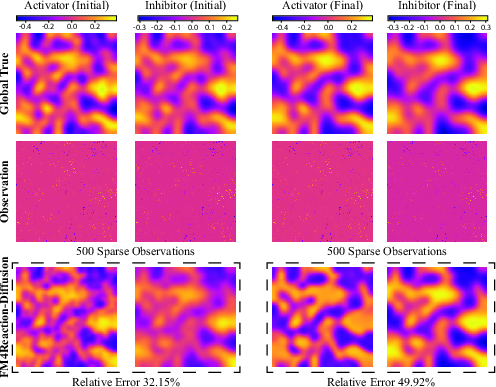
Figure 3: Reaction-diffusion PDE solution field is accurately recovered from 500 sparse measurements.
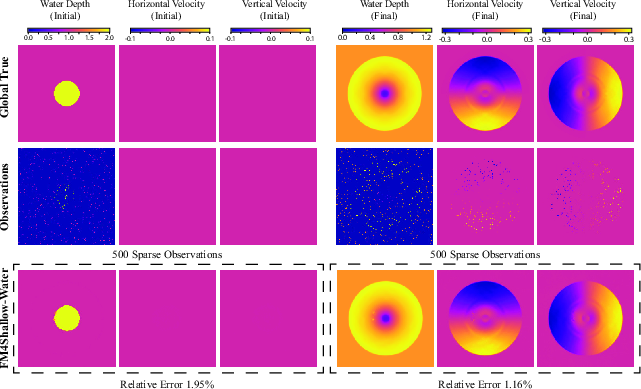
Figure 4: FM4PDE reconstructs shallow-water equation states from sparse observations.
Sampling cost comparisons indicate the proposed framework is substantially more efficient computationally than DiffusionPDE.
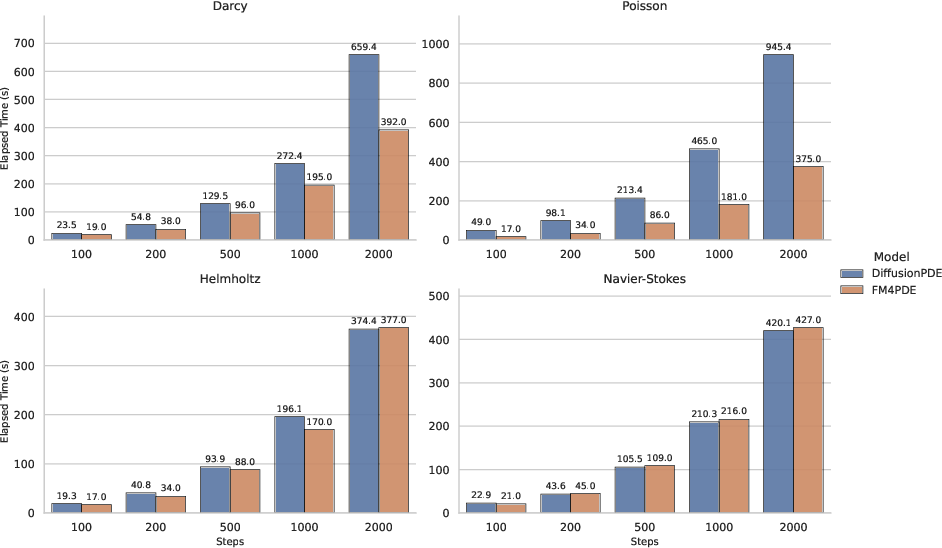
Figure 5: Sampling time comparison for forward problems—FM4PDE is faster than DiffusionPDE across multiple equations.
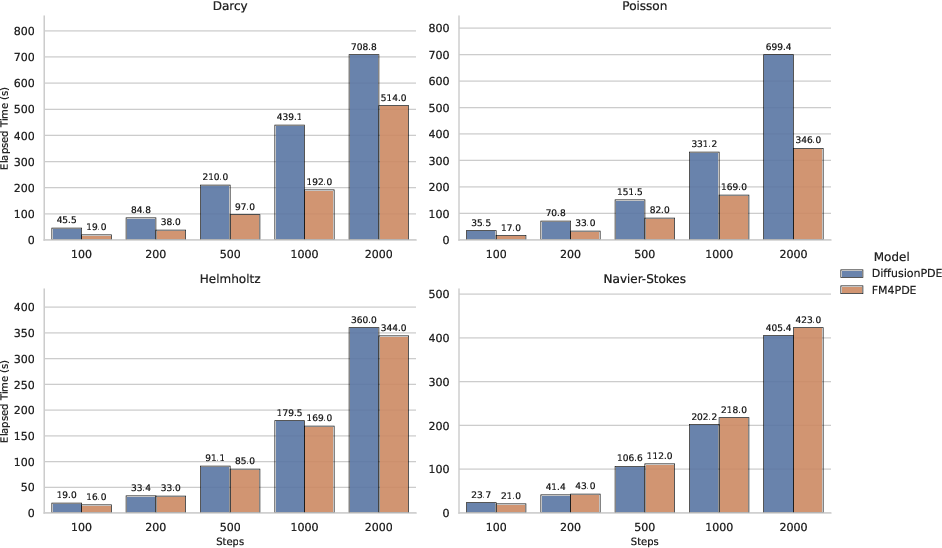
Figure 6: Inverse problem sampling time comparison—FM4PDE outperforms DiffusionPDE.
The analysis of step size and sampling strategy further reveals that finer discretizations improve reconstruction quality. Furthermore, the hybrid deterministic-to-stochastic schedule achieves optimal error and efficiency; purely stochastic or reverse-order mixed strategies are consistently suboptimal.
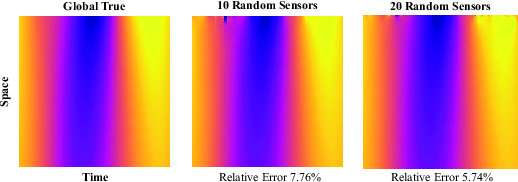
Figure 7: Burgers equation reconstruction quality improves with increased time-segment observations.
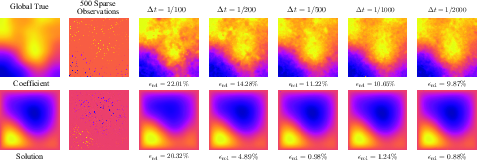
Figure 8: Reconstruction accuracy for Poisson equation increases with finer sampling steps.
Strong Numerical Results and Claims
- FM4PDE achieves low relative error in both forward and inverse problem scenarios, e.g., reconstructing solution fields from sparse coefficients or vice versa, often outperforming operator learning methods and generative diffusion models.
- For full observation, FM4PDE achieves relative errors of 0.32% (Navier–Stokes, forward), 1.33% (Darcy, forward), and competitive inverse performance despite minimal information.
- In sparse observation tests (500 points), FM4PDE recovers global fields with 1–3% error in forward tasks, compared to 13–15% for diffusion-based baselines, and maintains advantage for inverse problems.
- Sampling times are lower than diffusion-based generative approaches by a substantial factor across all tasks.
- Theoretical convergence rates are rigorously established and match practical observed behavior.
Implications and Outlook
The results validate flow matching as a competitive generative modeling paradigm for physically-constrained scientific data, providing both precise field reconstruction and markedly improved computational speed compared to diffusion-based approaches. The separation of training and inference—where general solution priors are learned independently of downstream measurements—enables rapid conditional sampling for both classical PDE solving and challenging inverse recovery without retraining.
Theoretically, the analysis offers convergence and moment bounds under physically motivated structures, bridging generative learning, scientific computing, and error theory. The explicit demonstration that constant guidance cannot avoid positive lower bounds on sampling error underscores the necessity of adaptive guidance.
Looking ahead, future research directions include:
- Extending FM4PDE to handle temporally resolved dynamics natively (beyond initial/final state pairing),
- Integrating learned priors with more complex observation and noise models,
- Automating adaptive hyperparameter selection,
- Scaling to high-dimensional multiphysics systems and real-world sensor modalities,
- Further exploring the interplay of flow-matching generative priors with physics-informed fine-tuning.
Conclusion
FM4PDE provides a theoretically principled and practically efficient method for generative solution and parameter reconstruction in PDE-governed systems with sparse data. Its combination of flow-matching dynamics, adaptive guidance, and physics-aware loss constraints constitutes a significant advance in the scientific machine learning toolkit for both forward modeling and inverse inference under real-world observation constraints.