- The paper introduces a robust dissipative quantum algorithm that prepares thermal states for frustrated spin systems via engineered quantum channels.
- It presents classical simulations and experimental results showing size-independent mixing times and effective thermalization even with circuits exceeding 1000 two-qubit gates.
- Key findings include linear scaling of circuit depth with temperature for AFHM and accelerated thermalization in AFIM's ice regime, highlighting practical quantum simulation advantages.
Preparing Thermal States of Frustrated Quantum Spin Systems Using 139 Qubits
Introduction and Motivation
The simulation of quantum many-body systems at finite temperature is a critical open problem in condensed matter, chemistry, and high-energy physics, where classical computational techniques frequently fail—especially for regimes governed by strong correlations and geometric frustration. This breakdown is most pronounced in systems with the quantum Monte Carlo (QMC) sign problem, which renders many relevant models (e.g., the antiferromagnetic Heisenberg model on the kagome lattice) intractable via stochastic approaches. The emergence of programmable digital quantum computers has provoked significant interest in alternative protocols for thermal state preparation.
This work leverages dissipative quantum algorithms for thermalization, focusing on the transverse-field antiferromagnetic Ising model (AFIM) and the antiferromagnetic Heisenberg model (AFHM) on kagome lattices. The AFHM, central in the study of quantum spin liquids, is inaccessible to QMC below a threshold temperature due to exponentially decaying signal-to-noise. The AFIM, which retains geometric frustration but remains sign-problem free, is used for benchmarking scalability and accuracy.
Dissipative Quantum Gibbs Sampling Protocol
Thermal state preparation is performed using the dissipative algorithm introduced in Ref. [Ding:2025ulc], which relies on repeated applications of a quantum channel Φ engineered to have the Gibbs state ρS(β) as its unique fixed point, up to systematically improvable error. The algorithm partitions NS qubits into system and NE environment registers. Environment qubits are initialized from the desired temperature, interact with system qubits via two-qubit random Pauli couplings, and are consistently measured and reset, implementing explicit dissipation.

Figure 1: Schematic of the dissipative thermal state preparation process, including reset cycles and system-environment couplings.
The protocol, critically, requires no prior structural knowledge of the system Hamiltonian. It avoids deep circuits associated with imaginary time evolution, phase estimation, or adiabatic approaches, and exhibits inherent robustness to device noise. The channel's convergence is governed by the mixing time τmix; polynomial scaling in NS and β is rigorously established only for high-temperature and weakly interacting regimes, but not analytically for frustrated lattices.
Classical Simulation Results and Mixing Time Scaling
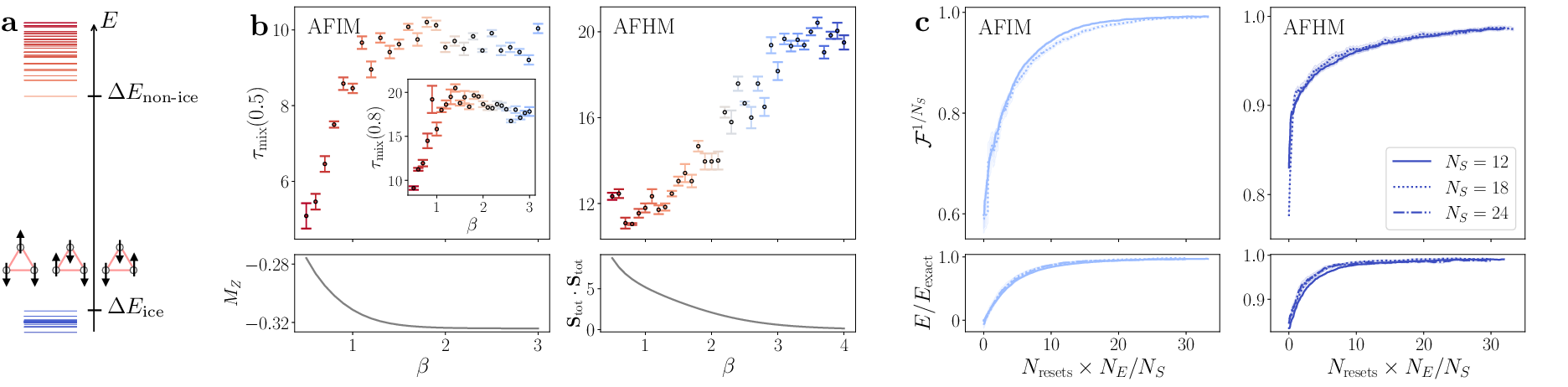
To probe scalability, the quantum channel is simulated classically for AFIM and AFHM on kagome lattices up to NS=24. The AFIM spectrum is characterized by an exponentially large ice manifold separated from excited states by a substantial gap. Mixing time analyses confirm:
Jump operator connectivity analysis shows thermalization bottlenecks stem from weak transitions between ice and non-ice sectors in AFIM, or lack of ρS(β)0 symmetry-preserving jumps in AFHM, which are necessary for efficiency in low-energy singlet-dominated regimes.
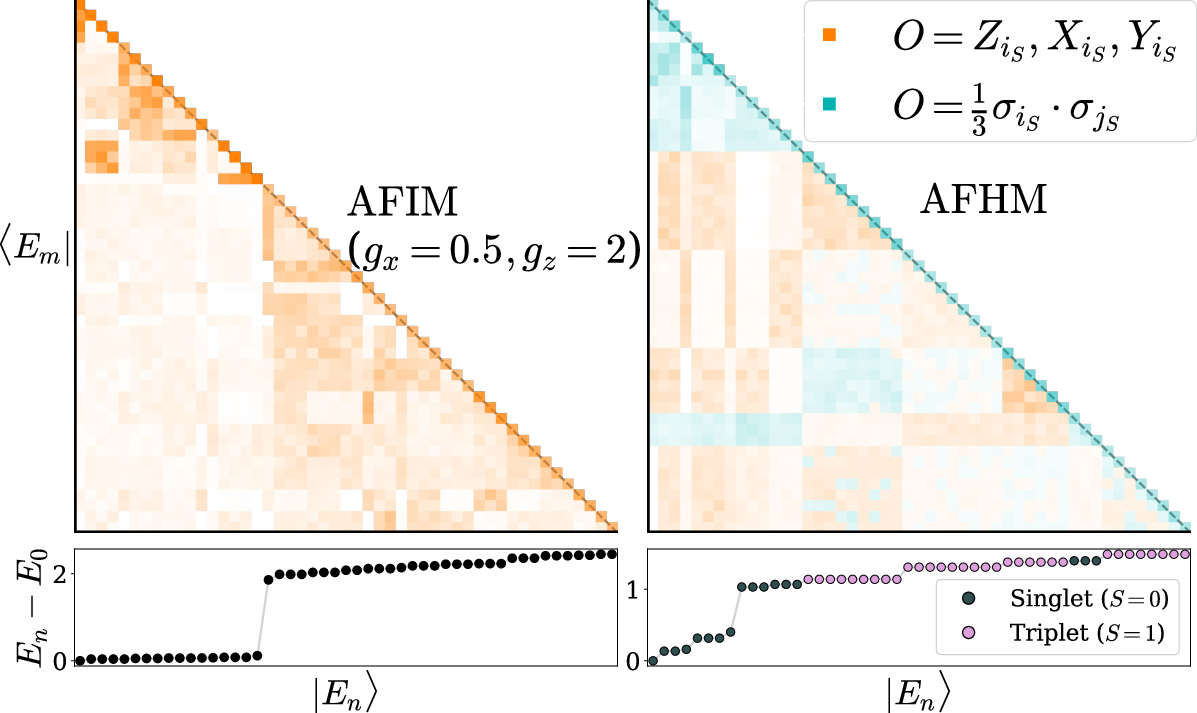
Figure 3: Jump operator connectivity matrix between low-energy eigenstates of AFIM and AFHM, demonstrating bottleneck structure and necessity of symmetry-adapted couplings.
Experimental Quantum Computer Implementation
The protocol was executed on IBM's superconducting quantum processors, preparing AFIM thermal states on kagome lattices up to ρS(β)1, coupled to ρS(β)2 environment qubits. Circuits were optimized for depth, leveraging heavy-hex connectivity and custom Trotterization routines.
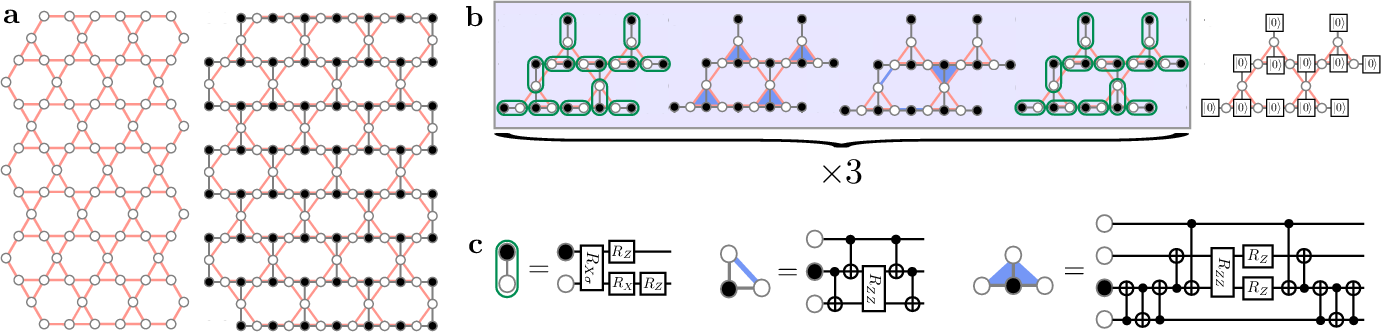
Figure 4: Embedding of kagome lattice and circuit structure on IBM's heavy-hex topology, including Trotter step layout.
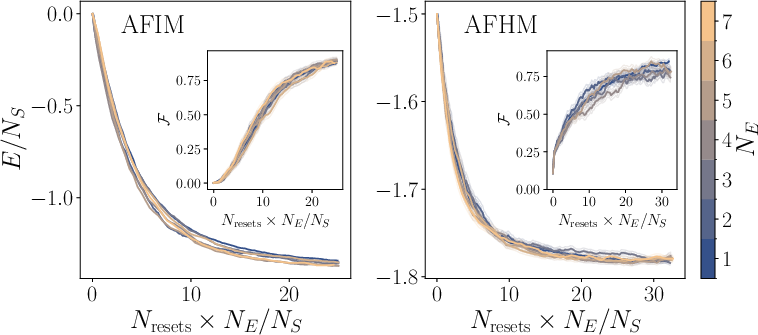
Measured energy densities as a function of reset cycles, bath temperature, and environment density show:
- Convergence to robust, temperature-dependent steady states—even with substantial circuit depths (ρS(β)3 two-qubit gates)—confirming the protocol's noise-resilience.
- Deviations from ideal thermal distributions scale with mixing time and environment density, aligning with theoretical bounds derived for depolarizing noise. Bulk observables (magnetization, connected triangle correlators) retain qualitative temperature sensitivity expected from QMC.
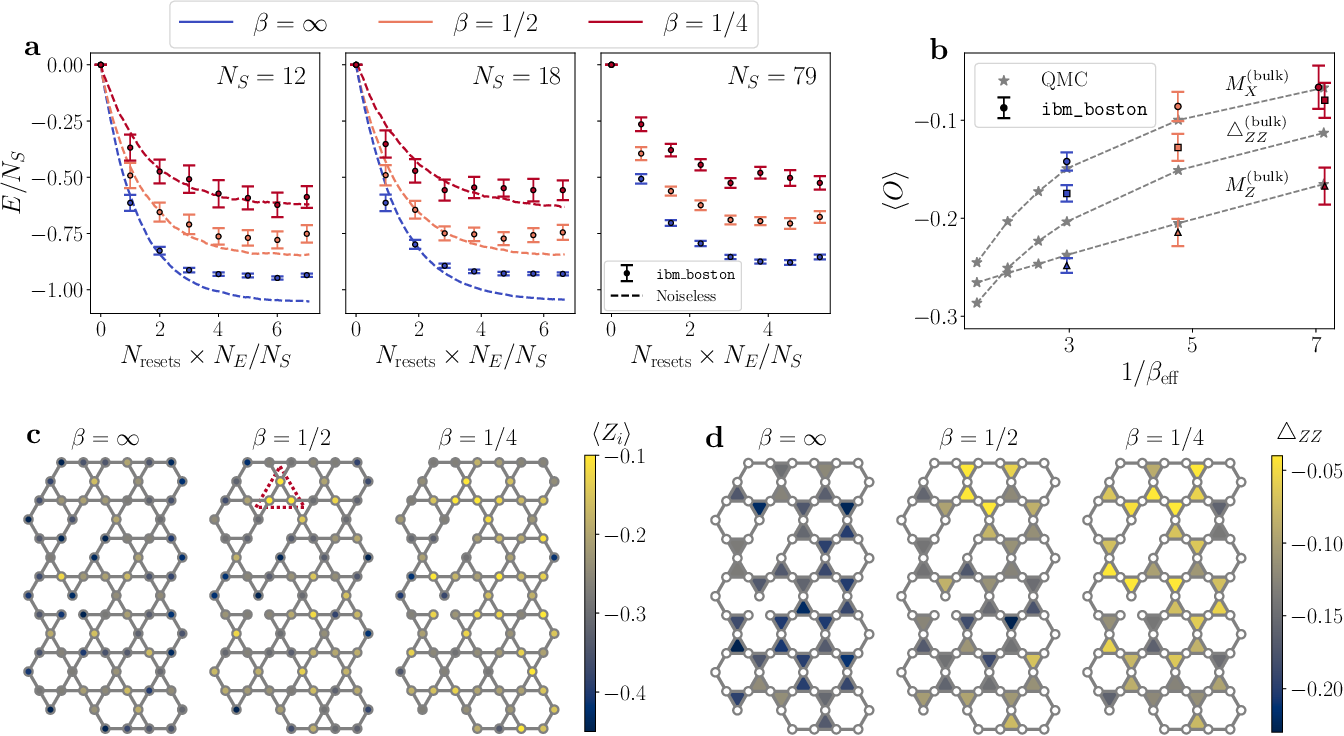
Figure 5: Steady-state energy densities, site-resolved magnetization, and triangle correlators for AFIM on ρS(β)4, compared to QMC.
Spatial inhomogeneities appear in systems with reduced environment density or hot environment qubits due to imperfect resets, which have analyzable effects on local temperature.
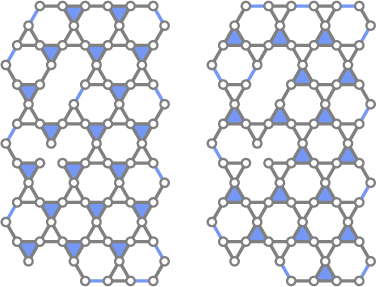
Figure 6: Partitioning and pairing of system and environment qubits for optimal circuit design and fast mixing on the ρS(β)5 lattice.
Numerical and Empirical Results
Strong empirical results are:
Implications and Future Directions
The observed rapid mixing and noise robustness of the dissipative protocol for frustrated models suggest practical quantum simulation utility in regimes intractable to classical methods. If size-independent mixing persists asymptotically, an exponential quantum runtime advantage is achievable for models with severe sign problems (e.g., AFHM at low NS2).
Key practical implications include:
- Extensive scaling of environment qubits (NS3) simultaneously improves mixing and noise resilience; resource-efficient layouts are now feasible on state-of-the-art devices (~139 qubits).
- States prepared by this protocol provide a foundation for simulating non-equilibrium dynamics in frustrated systems, potentially unlocking quantum advantage for both dynamical and equilibrium observables.
- Achieving global thermal equilibrium at ultra-low temperatures will ultimately necessitate fault-tolerant hardware and improved mid-circuit reset fidelity.
Theoretically, future research should examine whether rapid mixing is generic for strongly frustrated systems, probe the interplay between many-body entanglement and channel convergence, and explore quantum spin liquid phases beyond current classical reach.
Conclusion
This study establishes engineered dissipation as a scalable, robust algorithm for quantum thermal state preparation in frustrated spin models. Classical and quantum computer experiments demonstrate that mixing time remains constant with system size up to NS4, and that noise-induced steady states preserve nontrivial thermal signatures on quantum hardware even in circuits exceeding 1000 gates. These results point toward regimes where quantum devices, using extensive environment coupling, may outperform classical methods in accessing equilibrium and dynamical properties of strongly correlated, geometrically frustrated quantum matter.