- The paper presents a novel lattice model showing that quantized Hall conductivity emerges in gapless chiral semimetals.
- It employs nonequilibrium Green's function simulations in a six-terminal Hall bar to capture the crossover from quantum to classical transport.
- The results imply that topological quantization can occur without a full bulk gap, broadening the scope for QAH materials and device applications.
Introduction and Motivation
The paper "Quantum anomalous Hall effect in chiral semimetals" (2605.27826) introduces a theoretical framework for the realization of the quantum anomalous Hall (QAH) effect in chiral semimetals—systems where conduction and valence bands are gapless, touching at the Fermi level. Traditionally, QAH phases are confined to Chern insulators with gapped bulk spectra. The recent extension to ferromagnetic metals provided a precedent, motivating exploration of the semimetallic regime. The authors construct a minimal lattice model to investigate topologically quantized Hall conductivity in the presence of finite longitudinal (semimetallic) conduction, challenging conventional notions that a bulk gap is a necessary condition for robust QAH transport.
The system is modeled via a two-band tight-binding Hamiltonian on a square lattice incorporating nearest- and next-nearest-neighbor hoppings with Pauli matrices. The resulting Bloch Hamiltonian exhibits electron-hole symmetry, generating four Dirac cones at high-symmetry points, with conduction and valence bands touching at X and Y. The band structure is symmetric about E=0, and the nanoribbon geometry exposes boundary-localized states with chiral propagation.
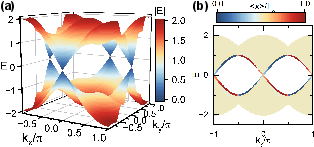
Figure 1: Band structures of the chiral semimetal model and nanoribbon, showing gapless cones and boundary-localized chiral states.
These spectral features set the stage for QAH transport in the absence of a full gap, as boundary states persist at zero energy.
The authors use nonequilibrium Green's function methodology in a six-terminal Hall bar geometry, simulating realistic device dimensions with dephasing via Büttiker virtual leads. This captures the crossover from quantum to classical transport regimes, essential for experimental relevance due to finite phase coherence lengths.
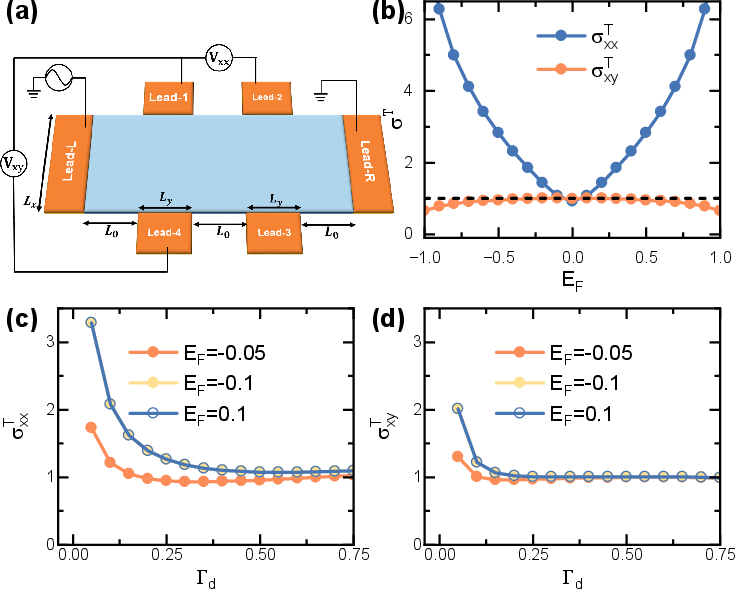
Figure 2: Six-terminal Hall bar schematic, with calculated σxx and σxy versus Fermi energy and dephasing strength.
Numerical results demonstrate:
- Quantized Hall conductivity (σxy=e2/h) near EF=0 across a significant energy window, robust to dephasing.
- Finite longitudinal conductivity (σxx) increasing linearly with ∣EF∣, manifesting semimetallic characteristics distinct from insulators.
- Requirement for dephasing: Hall conductivity is only quantized in the presence of sufficient dephasing; pure ballistic (phase-coherent) transport fails to produce the classical local resistivity tensor, deviating from ideal QAH plateaus.
The simultaneous presence of quantized σxy and nonzero Y0 represents a topological transport regime fundamentally different from the conventional QAH insulator, enabling Hall quantization without suppressing bulk conduction.
Microscopic Mechanism of QAH Quantization
Quantization originates from uncompensated Berry curvature contributions within the Brillouin zone. Two massive Dirac cones at Y1 and Y2 dominate the Berry curvature integral, yielding integer Chern numbers, while the gapless cones at Y3 and Y4 generate momentum-dependent (d-wave) altermagnetic mass terms with sign-alternating Berry curvature that integrate to zero.
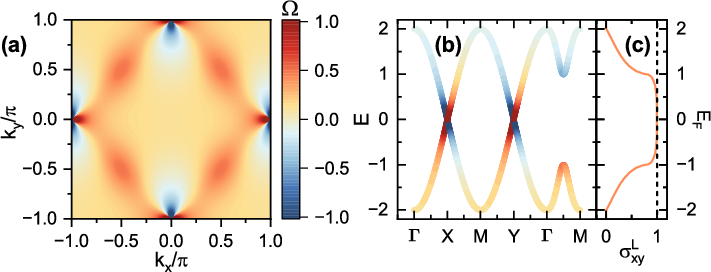
Figure 3: Berry curvature distribution, band structure with curvature encoding, and integrated Hall conductivity.
The integrity of Hall quantization is preserved across the semimetallic energy window, with Berry-curvature cancellation at gapless points preventing interference with the QAH plateau. This analysis elucidates why a bulk gap is not strictly necessary for topological quantization in this model.
Introducing a uniform mass term transitions the system into a conventional QAH insulator, gapping Y5 and Y6 cones. The transport and response characteristics evolve:
- In the insulating regime:
- Y7 remains quantized
- Y8 vanishes in the gap
- Chiral edge states are exponentially localized
- Transition details:
- The Berry-curvature integral remains dominated by Y9 and E=00 across the transition
- E=01 and E=02 remain inert under gap formation due to symmetry and curvature cancellation
- The spatial profile of equilibrium current demonstrates increasing edge localization as gap grows
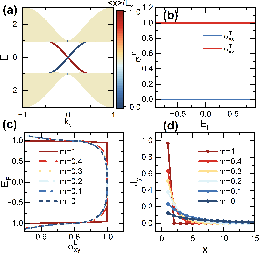
Figure 4: Insulating QAH nanoribbon band structure, conductivity profiles, Hall plateau continuity, and spatial decay of equilibrium current.
This analysis underscores that the quantized Hall response is intrinsic to the topological structure of the band manifold and not contingent on full gap formation, although a gap modifies the spatial attenuation and dissipation properties of edge currents.
Device Geometry and Robustness
The paper’s Appendix surveys size dependence:
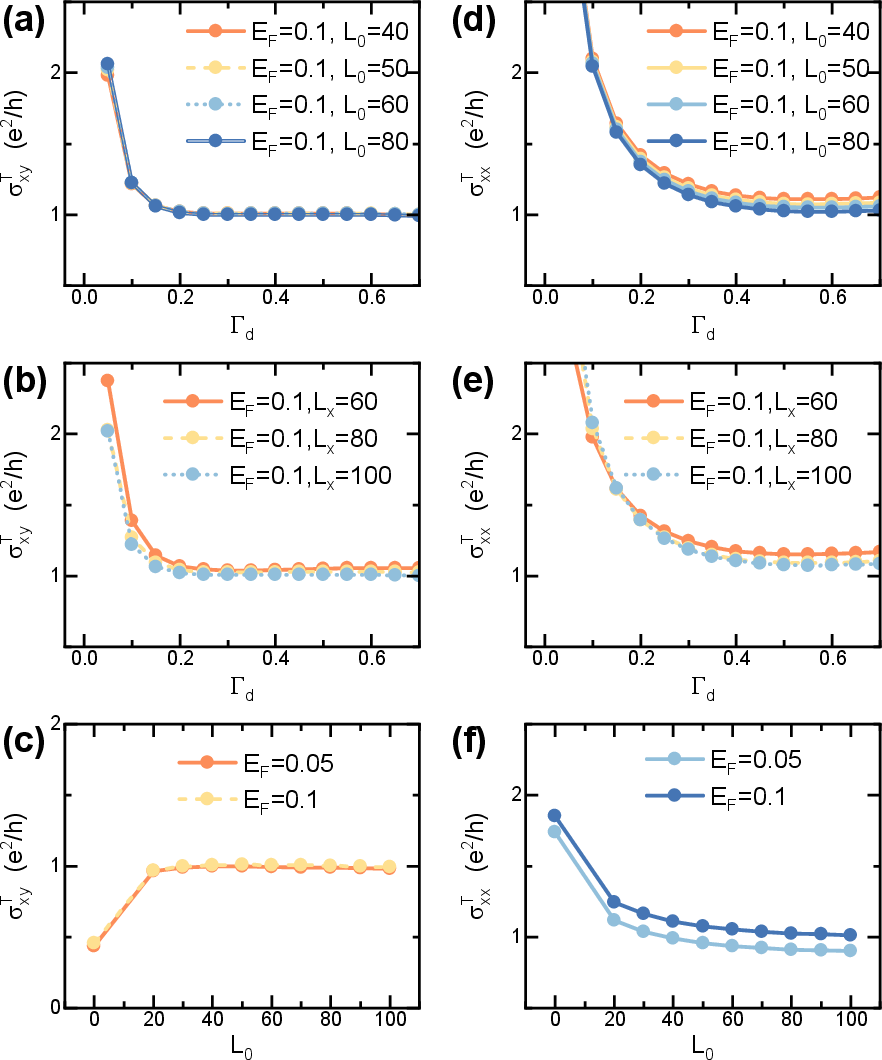
Figure 5: Hall and longitudinal conductivities versus dephasing strength and geometry variables (E=03, E=04), evidencing topological robustness of E=05.
The Hall conductivity remains quantized and insensitive to device geometry within topological protection, while E=06 exhibits size-dependent variation tied to non-topological (bulk) transport properties.
Implications and Future Directions
- Materials: The findings expand the roster of QAH candidates to ferromagnetic semimetals, which often exhibit greater abundance and higher Curie temperatures than insulators, facilitating topological transport in less finely tuned materials.
- Device Physics: Practical QAH quantization is achievable over wider Fermi-energy windows, operable under temperature-tuned dephasing. Devices leveraging dual-channel behavior (robust Hall quantization and tunable longitudinal conduction) can exploit these effects for sensing, logic, and novel topological circuit architectures.
- Fundamental Physics: The results clarify that a full bulk gap is not categorically necessary for topological quantization, redefining the boundary of QAH regimes and advocating broader exploration in gapless correlated systems. The distinction between edge and bulk dissipation remains salient, and further investigation into hybrid transport regimes and dissipation mechanisms is warranted.
Conclusion
This paper rigorously demonstrates that chiral semimetals can support a quantized QAH effect, combining topological Hall conduction with semimetallic longitudinal transport. The quantization mechanism is rooted in Berry curvature topology and persists across the semimetal-insulator transition, robust against device geometry and dephasing. Theoretical and practical implications prompt reconsideration of the necessity of a bulk gap for topological phases and suggest expanded experimental and device potential in the topological quantum electronics landscape.