- The paper introduces a mesh-free, reduced-order simulation framework using RKPM to model hyperelastic deformable bodies.
- The paper demonstrates efficient skinning weight computation via eigenanalysis of the elastic energy Hessian, reducing errors and training time.
- The paper validates its approach through standard beam tests and complex object simulations, showcasing improved physical fidelity and material-awareness.
Particle-Based Reduced-Order Simulation via RKPM Skinning Eigenmodes
Introduction and Motivation
The paper "FreeForm: Reduced-Order Deformable Simulation from Particle-Based Skinning Eigenmodes" (2605.29318) introduces a mesh-free, reduced-order approach for simulation of hyperelastic deformable bodies. Addressing the operational and representational constraints of mesh-based classical FEM and neural field-based methods, this work leverages the Reproducing Kernel Particle Method (RKPM) to construct particle-based spatial discretizations that are particularly suited for modern representations like Gaussian splats and neural fields. The RKPM-based formulation enables efficient and accurate computation of expressive skinning weights by eigenanalyzing the elastic energy Hessian, facilitating reduced-order simulation that preserves physical fidelity while accommodating arbitrary shapes and heterogeneous materials.
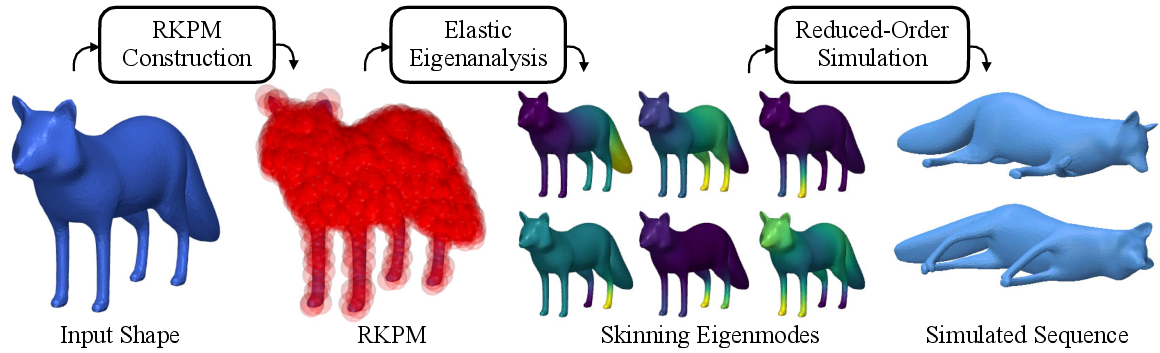
Figure 1: Overview of the proposed method, illustrating RKPM particle construction, eigenanalysis for skinning weights derivation, and reduced-order runtime simulation.
Prior reduced-order simulation methods largely rely on mesh-based representations, which constrain applicability to well-triangulated domains and are operationally limited when confronted with novel shape modalities (e.g., Gaussian splats, neural fields). Particle-based methods such as MPM and SPH offer mesh-free simulation capabilities and adaptability to topological changes. However, they exhibit adverse sensitivity to spatial and temporal discretization, manifesting as numerical fracture or conditioning breakdowns under large strain or co-dimensional particle configurations.
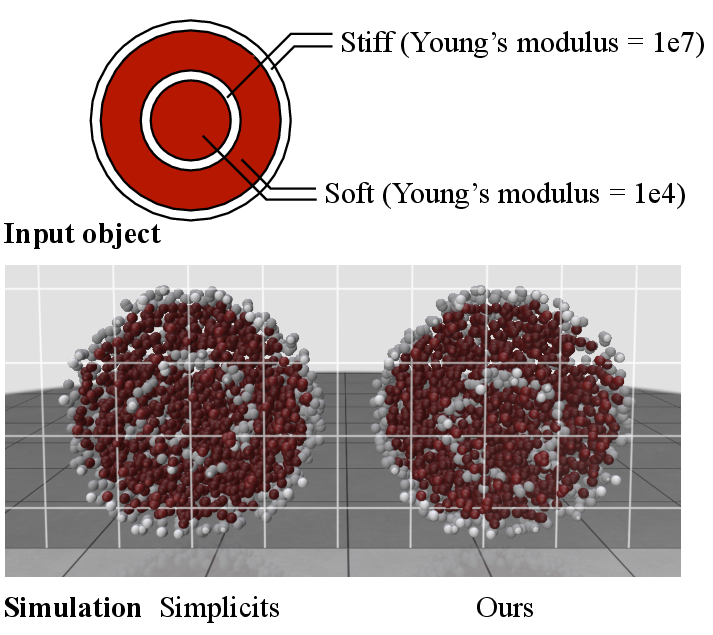
Recent mesh-free reduced-order methods, such as Simplicits, employ neural fields to generate skinning weights. This requires slow per-object training with iterative optimization and offers limited accuracy, particularly in capturing material-driven deformation for heterogeneous domains. The RKPM framework not only bypasses such optimization bottlenecks but also enables analytical treatment of the underlying elastic energy, facilitating direct eigenanalysis for basis function computation.
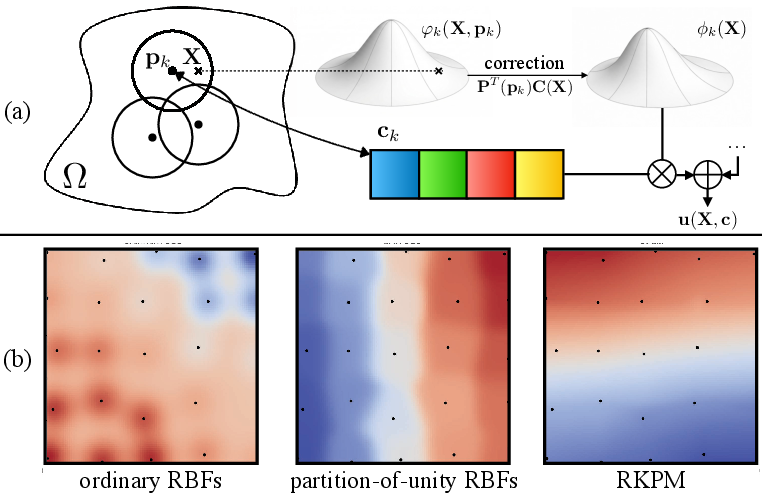
Figure 2: RKPM interpolation mechanics and eigenmode comparison; RKPM yields smooth, physically PLA-consistent modes superior to RBF and partition-of-unity RBF bases.
Methodology: RKPM Skinning Eigenmode Construction
The simulation pipeline comprises two phases: (i) RKPM particle construction and basis function definition, and (ii) eigenmode extraction via Hessian analysis for skinning weight computation.
- RKPM Parameterization: The domain is discretized using equidistantly sampled RKPM kernel centers. Each basis function incorporates corrected radial kernels to ensure polynomial reproduction up to first degree. The resulting shape functions are explicitly constructed, circumventing mesh triangulation.
- Skinning Weight Eigenanalysis: The elastic energy function—typically Neo-Hookean—defines a Hessian matrix with respect to nodal displacements. Analytical expressions are derived for the Hessian, enabling efficient assembly and subsequent extraction of optimal skinning modes through solution of a generalized eigenvalue problem.
- Simulation: The affine skinning transformations, modulated by RKPM weights, are used for implicit time-stepping of deformation dynamics. Orthogonality and well-conditioning of the mass matrix are ensured via exact constraints in the eigenanalysis stage.
Standard Beam Test
The method is validated against classical beam bending and twisting scenarios. Compared to gold-standard FEM and contemporary mesh-free approaches (Simplicits, MPM, SPH), RKPM-based simulation consistently yields reduced mean squared error (MSE) in predicted deformations, with accuracy scaling favorably as the number of skinning modes increases.
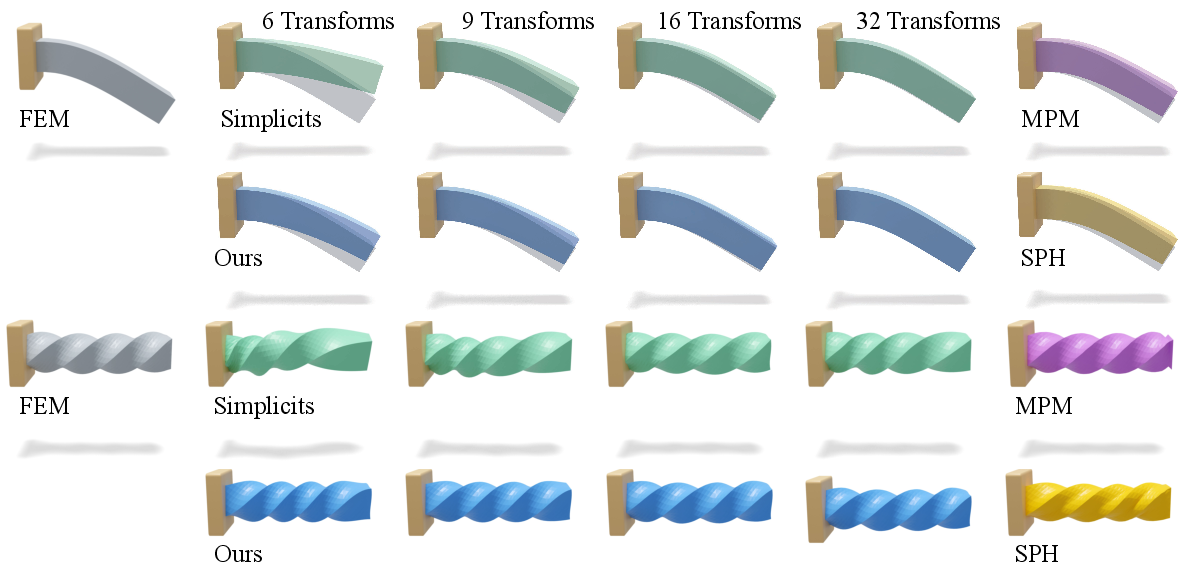
Figure 3: Visual overlay of simulation results for cantilever beam bending; RKPM-based results closely track the FEM reference deformation.
Generalization to Complex Objects
RKPM-based reduced-order simulation is tested on heterogeneous shape repositories (Thingi10K and Simready datasets). For multiple boundary conditions, results demonstrate improved physical plausibility and significantly lowered error metrics compared to Simplicits, concurrently achieving a ~40x reduction in training time for skinning weight generation.
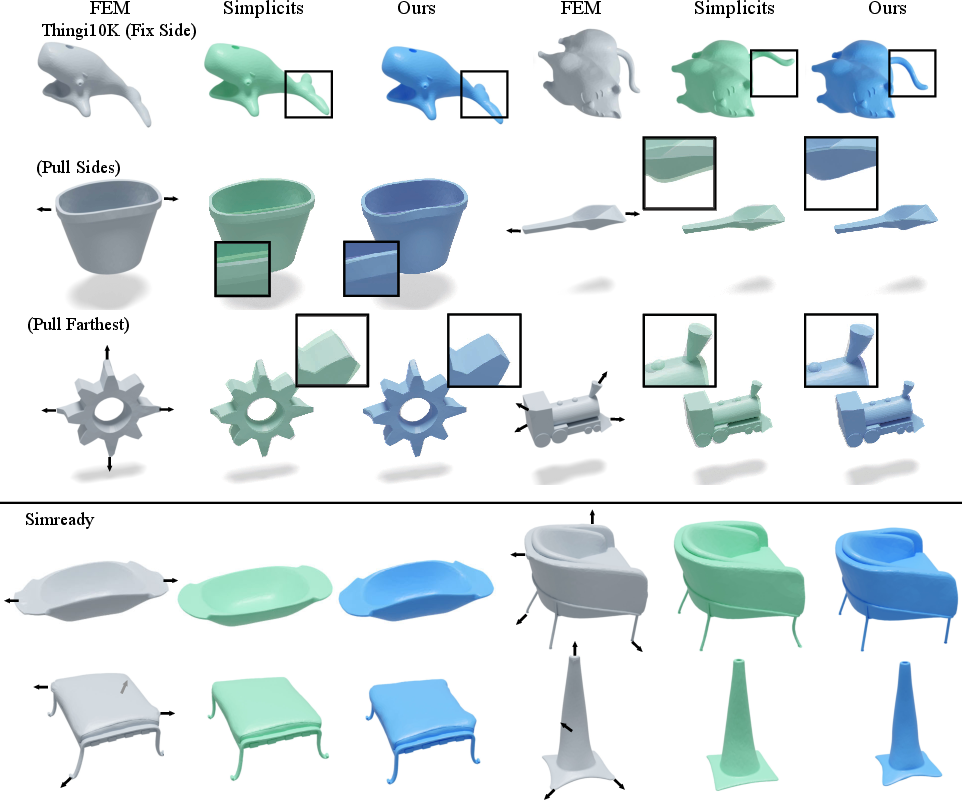
Figure 4: Simulation comparison on dataset objects under various boundary conditions; RKPM-based method exhibits improved convergence to FEM results across object categories.
Robustness and Efficiency
The method demonstrates manifold advantages:
Stress Visualization and Physical Analysis
RKPM-based simulation affords detailed mechanical analysis. Principal stress distributions on deformed objects (e.g., twisted beams) are visualized, enabling identification of stress concentrations and validation of physical behaviors.
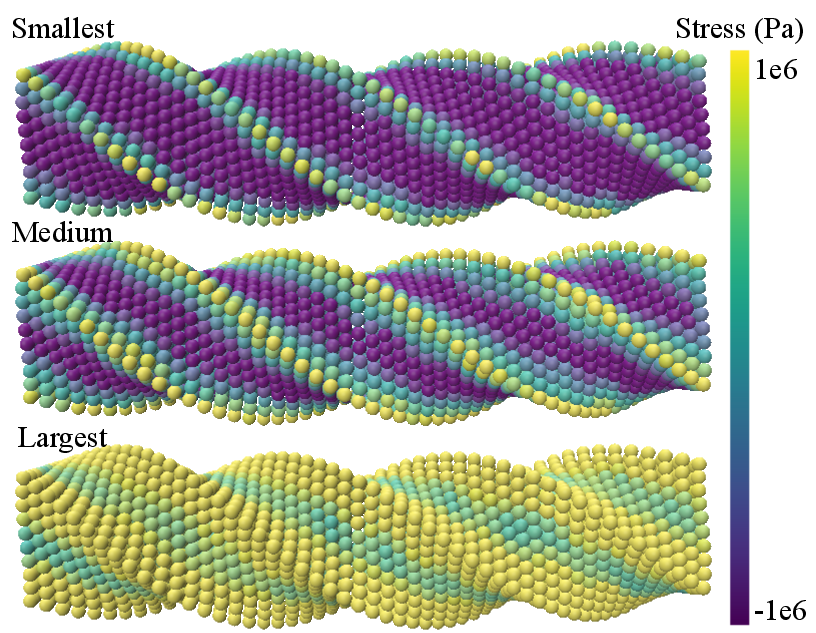
Figure 6: Principal stress distribution on twisted beam, revealing intra-object stress gradients.
Practical and Theoretical Implications
The RKPM-based approach substantially broadens the applicability of reduced-order simulation, providing tools suited to mesh-free and neural representations prevalent in modern robotics, graphics, and scientific domains. The method’s material-aware eigenspaces promise utility in real-time simulation, interactive robotics, and physical scene understanding. The direct eigenmode extraction avails both efficiency and rigor, obviating the need for iterative per-shape training workflows.
Fundamentally, this work reinforces the utility of explicit polynomial-reproducing kernel constructions in mesh-free elastodynamics, unlocking practical simulation for arbitrary, potentially non-manifold representations. Integration with downstream tasks such as robot interaction and physics-based editing of neural fields becomes more tractable.
Future Directions
Key remaining challenges include capturing high-frequency deformation details, modeling nonlinear contact dynamics, and adaptive basis selection for evolving topologies. Advances in adaptive kernel sampling, nonlinear basis enrichment, and hybrid particle-field techniques are anticipated. Extending the RKPM eigenspace approach to accommodate dynamic topology and contact, as well as coupling with differentiable physics pipelines, could further bridge simulation and learning-driven AI applications.
Conclusion
The paper provides a principled, efficient, and accurate mesh-free reduced-order simulation framework based on RKPM skinning eigenmodes, outperforming neural field and classical mesh-free baselines in error and training time, and enabling robust simulation for heterogeneous, arbitrarily-represented elastic bodies. The approach is well-poised for integration with emerging shape representations and robotics workflows.