A proof of an identity for the critical exponents of jamming
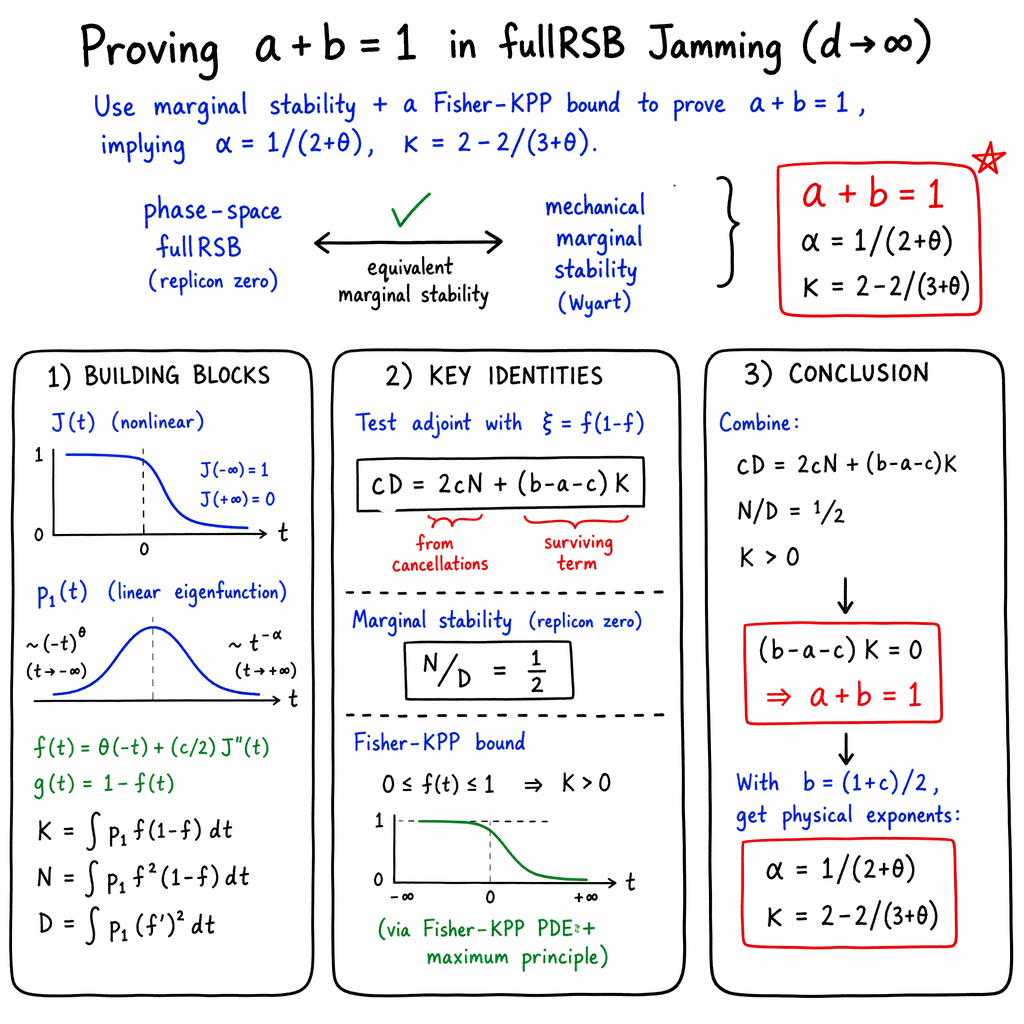
Abstract: Within the full replica-symmetry-breaking (fullRSB) solution of dense hard spheres in infinite dimension, Charbonneau, Kurchan, Parisi, Urbani, and Zamponi (CKPUZ; J.Stat.Mech.P10009, 2014) introduced three critical exponents $a$, $b$, $c$ governing the matching region of the fullRSB profile near the jamming transition. These exponents satisfy two scaling relations. The first, $b=(1+c)/2$, was established analytically by the diffusion-drift balance in the scaling ansatz. The second, $a+b=1$, was observed numerically to arbitrary precision but could not be proven. The exponents $a,b,c$ of the scaling fullRSB ansatz are related to the physical exponents $α, θ, κ$ that control the gap, force, and overlap distributions by the relations $α=a/b$, $θ=(c-a)/(b-c)$, $κ=c+1$. Crucially, the relation $a+b=1$ yields the scaling relations $α=1/(2+θ)$ and $κ=2-2/(3+θ)$ predicted on independent grounds by the mechanical-marginal-stability arguments of Wyart and collaborators. Here, we give an analytic proof of the identity $a+b=1$ from the scaling fullRSB equations. The proof was obtained through interaction with Claude (Sonnet 4.6 and Opus 4.7) and verified by us.
Paper Prompts
Sign up for free to create and run prompts on this paper using GPT-5.
Top Community Prompts
Explain it Like I'm 14
A kid-friendly guide to “A proof of an identity for the critical exponents of jamming”
What is this paper about?
Imagine trying to squeeze a lot of marbles into a box. At first they can still move a bit, but if you keep adding more, there’s a point where they get stuck and the whole pile becomes rigid. That point is called “jamming.” Near jamming, many things (like how close marbles are, or how strong the forces between them are) follow neat power laws, meaning they change in a very regular “curve” described by special numbers called critical exponents.
This paper proves a simple but powerful rule connecting some of those exponents. The rule had been seen in computer experiments but hadn’t been proven exactly. The authors show that two exponents, called and , must satisfy . From this, they also recover two famous relations for the “physical” exponents that describe gaps, forces, and motion in jammed materials.
What were the main questions?
In everyday words, the authors wanted to answer:
- Does the math that describes how particles behave right at the edge of jamming force the simple rule to be true?
- If yes, does that rule automatically produce the same predictions that engineers and physicists get from thinking about how force networks in a jammed material barely hold together (called “mechanical marginal stability”)?
- Can we be sure we’re using the physically correct solution among many possible mathematical ones?
How did they try to answer these questions?
The authors studied an idealized version of many particles (like spheres) in a very high number of dimensions. That sounds odd, but it makes the math cleaner and gives accurate predictions for real systems. Here’s the idea in everyday terms:
- They focused on the “matching region” close to jamming, where the behavior on the “loose” side and the “stuck” side meet.
- In this region, the theory reduces to a pair of equations for two functions, and . You can think of as a “shape” function describing how the system changes across the matching region, and as a “weight” that acts a bit like a probability.
- They used a classic math trick: multiply one equation by a carefully chosen “test function” and integrate (add up) across all . This is like choosing just the right lens to reveal a hidden pattern. That produced an algebraic identity relating three integrals (, , ) and the exponents , , .
- They combined that new identity with a known “marginal stability” condition (a precise balance that must hold at jamming) to isolate .
- To finish, they needed to show . For that, they introduced an auxiliary function and proved it stays between 0 and 1 using a well-known “reaction–diffusion” equation (a Fisher–KPP type equation, which is the same kind used to model things like the spread of a population). A maximum principle for this equation guarantees , which implies is indeed positive.
- Putting it all together: since , the only way can be zero is if .
The authors also explain that they used AI tools to help explore the equations and refine the proof, and then carefully checked and corrected the details themselves.
What did they find, and why does it matter?
- The core result is a clean, exact proof that .
- Combined with another known relation, , this gives .
- These relations translate directly into results for the “physical” exponents that describe real, measurable things:
- Gap exponent:
- Overlap exponent (related to motion):
- These match independent predictions based on “mechanical marginal stability” (the idea that jammed materials sit exactly at the edge of mechanical stability). That’s important because it ties together two viewpoints:
- “Phase-space marginality” from a complex statistical physics calculation
- “Mechanical marginality” from thinking about how forces balance in the packed material
In short, the paper proves a missing link that shows both viewpoints agree about the critical exponents that control jamming.
Why is this important?
- It strengthens our understanding of jamming, which shows up in many places: piles of grains, foams, emulsions, and even in how glassy materials behave.
- It confirms that different theories (one statistical, one mechanical) make the same predictions for key exponents. That gives scientists confidence that they’re on the right track.
- It provides clear targets for experiments and simulations to test how universal these exponents are across different materials.
- It also showcases how advanced math and carefully chosen “test functions,” plus tools from the study of diffusion and growth (Fisher–KPP equations), can solve tricky problems in physics.
- Finally, it’s a nice example of human–AI collaboration helping to find and polish a rigorous proof.
Key takeaways
- Near the jamming point, material behavior follows power laws with specific exponents.
- The paper proves the simple identity , previously only observed numerically.
- This identity leads directly to the physical scaling laws and .
- The result bridges two big ideas about stability in jammed systems and confirms their predictions agree.
Knowledge Gaps
Knowledge gaps, limitations, and open questions
Below is a concise, actionable list of what remains missing, uncertain, or unexplored based on the paper’s results and stated scope.
Mathematical rigor and existence/uniqueness
- Rigorous existence and uniqueness of the fullRSB profile for hard spheres in the setting: extend SK-model results (Talagrand, Panchenko) to Eqs. (116a–c) for hard spheres, including well-posedness and construction of , .
- Justification of the matching-region scaling ansatz: derive the scaling form in Eq. (scaling) as a controlled asymptotic expansion of Eqs. (116a–c), with explicit error bounds on the terms.
- Existence of the scaling limit : establish compactness and convergence (e.g., via parabolic regularity and uniform-in- bounds) guaranteeing that the Fisher–KPP flow produces the no-node branch in the scaling regime.
- Uniqueness and monotonicity of the eigenvalue map : prove that for each the eigenvalue problem for admits a unique admissible (with ), and show that the marginal-stability condition selects a unique .
- Rigorous treatment at : formulate the distributional calculus (Heaviside and delta terms) underpinning cancellations and the regularity of and ; provide a complete proof that boundary-layer effects do not generate additional terms.
- Spectral theory of the linear operator for : characterize the spectrum (ground state vs. excited states with nodes), orthogonality relations, and coercivity properties needed to control integrals such as , , .
Scope, robustness, and generalizations
- Robustness of under model perturbations: test whether the identity persists for soft spheres, finite temperature, polydispersity, non-spherical particles, or frictional contacts; derive the modified ODEs/PDEs and check if the test-function method still yields an exact constraint.
- Finite-dimensional corrections: develop a $1/d$ expansion or other finite- approaches to assess how and the Wyart relations are modified at large but finite ; quantify leading corrections.
- Converse “mechanics → fullRSB” derivation: starting from mechanical marginal stability (Wyart-type arguments), derive the fullRSB flow and scaling equations in to close the conceptual loop beyond exponent-level equivalence.
- Smoothing of hard-sphere interactions: replace by a smooth approximation and analyze the limit as smoothing vanishes; determine whether the algebraic identity and maximum-principle arguments survive.
- Extension to other disordered systems: test whether the identity and proof strategy extend to related mean-field glassy models (e.g., constraint satisfaction, spin glasses with hard constraints) in which Heaviside-like nonlinearities or Boolean structure appear.
Fisher–KPP and PDE-level details
- Maximum principle under unbounded drift: provide a fully rigorous proof that the Fisher–KPP equation with -dependent drift and unbounded domain preserves , including boundary conditions at and technical assumptions on and its derivatives.
- Quantitative bounds from the Fisher–KPP flow: derive explicit uniform-in- decay bounds for , , (and hence , , ) to justify super-exponential decay used for integrability of , , .
- Uniqueness/stability of the no-node branch: analyze bifurcations and stability of the discrete family of ODE solutions , proving that the (no-node) branch is uniquely selected by the fullRSB flow.
Integral identities, constants, and constructive outcomes
- Determination of without numerics: develop analytic bounds or a variational principle to compute (and thus ) from , possibly using additional test functions or comparison inequalities.
- Systematic generation of further exact identities: explore alternative test functions in the weak form (Lemma weak) to extract additional algebraic constraints among , , and integrals of , , potentially yielding new exact relations among exponents.
- Sign and magnitude of for excited modes: prove (and determine its sign) for higher-node eigenfunctions of ; clarify the physical interpretation (if any) of these modes and whether they could constrain other observables.
Physical interpretation and validation
- Beyond exponents: connect the identity to additional observables (e.g., vibrational density of states, contact network statistics) to test whether similar exact constraints emerge from the fullRSB–mechanics bridge.
- Finite- and experimental tests: propose measurable proxies (e.g., force/gap statistics, MSD scaling) to test indirectly via and in simulations/experiments and quantify deviations from predictions.
- Gardner regime and protocol dependence near jamming: analyze whether the identity holds across the Gardner phase and under different preparation protocols, and identify conditions under which the scaling exponents and relations might change.
Reproducibility and numerics
- Independent numerical confirmation: provide open, high-precision solvers for and , with error bars for , , , and a robust verification pipeline for ; test sensitivity to discretization, boundary truncation, and fitting ranges.
- Asymptotic expansions for and : derive higher-order asymptotic series at to improve numerical boundary conditions and reduce systematic errors in integral estimates.
Practical Applications
Immediate Applications
Below are concrete, deployable uses that leverage the paper’s proven scaling identity (and thus , ) and its methods (scaling fullRSB equations, algebraic/test-function identity, Fisher–KPP framework).
- Sector: Materials/Manufacturing (granular handling, powders, emulsions)
- Granular-process diagnostics and calibration
- Use the small-force tail exponent measured from force-sensor arrays or photoelastic techniques in hoppers/silos to infer and via the now-rigorous relations; validate DEM simulations and tune process parameters (feed rates, vibration amplitude) to reduce clogging risk.
- Tools/products: add-on analytics in DEM engines (e.g., LIGGGHTS, YADE) that compute tails and automatically back out for calibration reports.
- Dependencies/assumptions: frictionless hard-sphere universality approximates real powders; accurate measurement of small-force tails; negligible cohesion/electrostatics or corrected for.
- Predictive maintenance for hoppers/silos
- Real-time “jamming proximity” indicators using in-silo pressure/force data to estimate and predict changes in divergence () and rigidity growth () as throughput/pressure changes.
- Workflow: ingest sensor streams → fit tail of → compute → trigger alarms/control actions.
- Dependencies/assumptions: steady operation near quasi-static jamming; sensor coverage and noise handling.
- Sector: Soft Robotics and Adaptive Devices
- Calibration of jamming grippers and granular dampers
- Map actuation pressure to rigidity using to set control setpoints for grasp stability vs. compliance.
- Tools: calibration curves and firmware modules that translate pressure targets into predicted stiffness changes.
- Dependencies/assumptions: media approximate frictionless or lightly frictional spheres; low humidity/cohesion.
- Sector: Academic Research/Teaching
- Reproducible benchmarks for jamming exponents
- Use the proven to cross-check experimental and numerical determinations of , , in 2D/3D; standardize reporting and error budgets.
- Products: lab protocols for measuring and near jamming; benchmark datasets.
- Dependencies/assumptions: universality across dimensions is approximate; careful finite-size and friction corrections.
- Methodological transfer to glassy systems
- Apply the paper’s test-function/weak-form approach and Fisher–KPP maximum-principle technique to other fullRSB models (spin glasses, constraint satisfaction) to derive identities and bounds.
- Dependencies/assumptions: availability of analogous PDE/ODE structures; marginal-stability conditions identifiable.
- Sector: Software/Tools
- Open computational notebooks and libraries
- Package solvers for the scaling ODEs and eigenvalue problems (from the deposited conversation/code) to generate , , and exponents for given inputs; integrate into simulation pipelines.
- Dependencies/assumptions: code completeness and numerical stability; license clarity for reuse.
- Sector: Standards and Metrology
- Measurement standards for jamming exponents
- Draft standard test methods for extracting from force networks and deriving via the proven identities; inform inter-lab comparisons.
- Dependencies/assumptions: consensus on protocols; device calibration and uncertainty models.
Long-Term Applications
These opportunities require further experimental validation (finite-dimensional, frictional, cohesive effects), scaling to complex mixtures, or integration into industrial design and control.
- Sector: Advanced Materials and Metamaterials
- Inverse design of marginally stable architected materials
- Use the equivalence between phase-space and mechanical marginal stability to target materials at the edge of rigidity for high energy absorption, tunable damping, and sensitivity (e.g., impact protection, vibration isolation).
- Tools/products: topology optimization that enforces target exponents or marginality constraints.
- Dependencies/assumptions: extension of scaling relations to designed lattices/composites; manufacturing tolerances.
- Sector: Pharmaceutical Continuous Manufacturing
- Throughput-maximizing, jam-averse feeders and blenders
- Model predictive control that keeps operations in regimes with favorable , balancing flow stability and uniform compaction; real-time adaptation to humidity and formulation changes.
- Products: “Jamming risk controller” modules for feeders/tablet presses.
- Dependencies/assumptions: friction/cohesion corrections; robust, fast estimation of exponents in-line.
- Sector: Additive Manufacturing (powder bed fusion, binder jetting)
- Powder recoating and flow optimization
- Use exponent-informed constitutive laws near jamming to set recoating speeds, layer thickness, and vibration protocols that minimize bed defects and segregation.
- Dependencies/assumptions: validated mapping from exponents to effective rheology; multimodal/polydisperse powders.
- Sector: Energy and Process Engineering
- Slurry and suspension processing (battery electrodes, ceramics)
- Embed jamming scaling into rheological models to predict onsets of plug formation and optimize solids loading and shear profiles.
- Dependencies/assumptions: extension from dry to wet, Brownian/non-Brownian suspensions; binder effects.
- Sector: Geotechnical and Hazard Prediction
- Early warning for granular failure (landslides, fault gouge)
- Infer proximity to marginal jamming from acoustic/force-chain statistics to anticipate failure initiation and creeping transitions.
- Dependencies/assumptions: translatability from ideal spheres to angular grains and cemented soils; field sensor availability.
- Sector: Oil & Gas / Subsurface
- Proppant transport and screenout mitigation
- Incorporate jamming exponents into transport models to choose injection schedules and proppant mixes that reduce clogging.
- Dependencies/assumptions: coupling with fluid turbulence and fracture geometry; particle shape/size distributions.
- Sector: Robotics and Wearables
- Programmable stiffness skins and smart dampers
- Exploit –stiffness scaling to design low-power, rapidly reconfigurable structures that operate near marginality for responsiveness.
- Dependencies/assumptions: stable control near critical regimes; durability of media.
- Sector: Algorithms and Optimization (academia/industry R&D)
- Criticality-aware solvers for CSPs and inference
- Translate the marginal-stability/eigenmode identity approach to diagnose and navigate algorithmic phase transitions (e.g., SAT thresholds), inspiring restarts/schedule heuristics.
- Dependencies/assumptions: existence of analogous RSB structures and marginality conditions in target problems.
- Cross-cutting: Constitutive Modeling Near Jamming
- Augment continuum models (e.g., μ(I) rheology) with exponent-informed closures to capture the onset of rigidity and the statistics of weak contacts, improving predictive capability across sectors above.
- Dependencies/assumptions: systematic validation in 3D with friction, cohesion, polydispersity; efficient parameter identification.
Key Assumptions and Dependencies (common across applications)
- Universality: The proven identity holds in infinite dimensions; its quantitative use in 2D/3D relies on the observed near-universality of exponents across dimensions and on modest friction/cohesion corrections.
- Material specifics: Real powders may be polydisperse, angular, cohesive, or electrostatically active; calibration and correction factors are required.
- Measurement fidelity: Accurate estimation of small-force tails (for ) and near-contact structure (for ) needs sufficient sensor resolution and robust statistical fitting.
- Operating regime: Results pertain to regimes near jamming under quasi-static or slowly driven conditions; far-from-equilibrium or highly inertial regimes need additional modeling.
- Software/tooling: Availability and robustness of numerical solvers for the scaling ODE/PDE and integration with industrial simulation platforms.
Glossary
- Algebraic identity: An equation linking quantities derived through algebraic manipulations, often used to relate integrals or parameters in a proof. "An algebraic identity (Sec.~\ref{sec:fg-origin}, \ref{sec:lemma3}, \ref{sec:proof})."
- Ansatz: An assumed form for a solution that simplifies equations and guides analysis, later validated by consistency. "Within the fullRSB Ansatz~\cite{Parisi,MPV} the calculation reduces"
- Boundary-value problem: A differential equation problem with constraints specified at the boundaries of the domain. "to a non-linear boundary-value problem for an auxiliary function "
- Contact network: The graph of particle contacts in a packing that transmits forces and determines mechanical properties. "the marginal mechanical stability of the contact network at jamming"
- Contact-network Hessian: The second-derivative matrix of the energy (or constraints) of the contact network, governing small perturbations and stability. "the zero-mode-density of the contact-network Hessian"
- Critical exponents: Numbers characterizing power-law scaling of observables near a critical point or transition. "introduced three critical exponents , , "
- Diffusion–drift balance: The balance between diffusive spreading and drift/advection that constrains scaling relations. "diffusion-drift balance in the scaling ansatz"
- Eigenmodes with nodes: Eigenfunctions that have one or more zeros (sign changes), distinguishing excited modes from the ground state. "other eigenmodes with nodes."
- Eigenvalue equation: A linear differential equation whose nontrivial solutions exist only for specific values (eigenvalues) of a parameter. "coupled to a linear eigenvalue equation for a second function "
- Fisher–KPP equation: A reaction–diffusion partial differential equation of Kolmogorov–Petrovsky–Piskunov type, modeling fronts with logistic growth. "satisfies a \emph{Fisher--KPP-type reaction--diffusion equation}"
- Forward-parabolic equation: A parabolic PDE that is well-posed in the forward time direction, featuring positive diffusion. "a forward-parabolic equation with a positive diffusion coefficient"
- Full replica symmetry breaking (fullRSB): A hierarchical phase structure in mean-field glassy systems where replica symmetry is broken at all levels. "full replica-symmetry-breaking (fullRSB) solution"
- Ground-state eigenfunction: The lowest (node-free) eigenfunction of a linear operator, typically positive and associated with the smallest eigenvalue. "positivity of the ground-state eigenfunction ."
- Heaviside step: The step function equal to 1 for negative argument and 0 for positive, used as an indicator. "for the Heaviside step"
- Jamming transition: The transition at which a disordered packing becomes mechanically rigid as density increases. "near the jamming transition"
- Logistic-growth-with-diffusion equation: A PDE combining diffusion with a logistic reaction term modeling growth saturation. "This is the standard logistic-growth-with-diffusion equation"
- Marginal stability: The condition where a system is at the threshold of instability, often signaled by a zero eigenvalue mode. "The identity that expresses marginal stability~\cite[Eq.(199)]{CKPUZ-III} reads"
- Mean-field description: An analytical approach that replaces many-body interactions by averaged effects, yielding tractable “mean” equations. "provides an exact mean-field description of jamming"
- Mean square displacement: The average of the squared displacement of particles over time, measuring cage size or mobility. "The long-time limit of the mean square displacement"
- Matching region: The overlap zone where asymptotic behaviors on different sides are matched using scaled variables. "The matching region between the asymptotic behavior of for positive and negative "
- Ordinary differential equation (ODE): A differential equation involving functions of one variable and their derivatives. "Our main non-linear ODE in the range is :"
- Overlap distributions: Probability distributions of overlaps (similarities) between configurations, central in spin-glass theory. "gap, force, and overlap distributions"
- Parabolic maximum principle: A principle ensuring that solutions to certain parabolic PDEs attain extrema on the boundary or initial time. "the parabolic maximum principle then preserves the bounds"
- Picard–Lindelöf theorem: A theorem guaranteeing local existence and uniqueness of solutions to ODEs with Lipschitz continuous right-hand sides. "the Picard--Lindelöf theorem gives the unique solution "
- Radial distribution function: The pair-correlation function measuring how density varies as a function of distance from a reference particle. "the radial distribution function diverges as "
- Reaction–diffusion equation: A PDE combining diffusion with local reaction kinetics, often producing traveling waves or pattern formation. "a \emph{Fisher--KPP-type reaction--diffusion equation}"
- Replicon: A specific fluctuation mode in replica theory controlling stability; its vanishing signals marginality. "Physically, it corresponds to the vanishing of the replicon, "
- Saddle point: A stationary point of an action or free energy used in variational or mean-field approximations. "phase-space marginal stability of fullRSB (a property of the fullRSB saddle point)"
- Scaling ansatz: An assumed scaling form that captures leading-order behavior near criticality or in matching regions. "the diffusion-drift balance in the scaling ansatz"
- Scaling regime: The limit where variables are rescaled to reveal universal behavior, typically near a transition. "in the appropriate scaling regime near jamming"
- Sherrington–Kirkpatrick model: A paradigmatic mean-field spin-glass model with infinite-range random couplings. "the Sherrington--Kirkpatrick model"
- Spin glass: A disordered magnetic system with frustrated interactions and many metastable states. "distinguishes these equations from the spin-glass case"
Collections
Sign up for free to add this paper to one or more collections.