- The paper demonstrates that subtle contextual cues can shift algorithm-family distributions by up to 100 percentage points, overshadowing traditional prompt effects.
- Methodologies include 46,535 controlled experiments across 11 tasks and 15 LLM configurations, highlighting model-dependent steering of algorithm choices.
- Implications stress the need for explicit algorithm specifications and standardized prompts to mitigate hidden risks in performance, security, and reproducibility.
Subtle Cue-Driven Algorithm Steering in LLM Code Generation
Problem and Motivation
LLMs are increasingly responsible for automated code generation in production settings. Many tasks admit multiple valid algorithmic solutions, each encoding distinct performance, security, and maintenance tradeoffs. Specification-driven correctness testing fails to reveal which algorithm is actually chosen, leaving developers blind to underlying policies in generated code that affect scaling and robustness. The paper "The Invisible Lottery: How Subtle Cues Steer Algorithm Choice in LLM Code Generation" (2606.04057) systematically investigates the extent to which contextual prompt cues steer algorithm-family selection, even when all outputs are functionally correct.
Experimental Framework
The study formalizes algorithm steering as cue-induced shifts in algorithm-family distributions under fixed task specifications. The authors construct an extensive framework:
- Task Suite: 11 tasks (8 classical, 3 applied), encompassing diverse algorithmic portfolios (e.g., memoization, expression parsing, rate limiting).
- Cue Taxonomy: 19 cue types (covering persona, context, import, constraint, style, format, temporal, and placebo/inocuous channels).
- Models: 15 LLM configurations, spanning API and local/quantized variants.
- Algorithm Detection: AST-based classifier labels generated code by algorithm family, tracking shortcut and advanced method activation.
- Scale: 46,535 controlled experiments, temperature sweeps, cross-replication robustness.
Systematic Steering Analysis
Magnitude and Structure of Cue-Induced Steering
The core finding is that prompt cues induce up to 100 percentage-point (pp) shifts in algorithm-family share, dwarfing traditional prompt-sensitivity effects. Most cue-induced deltas are interpretable in terms of algorithmic priorities.
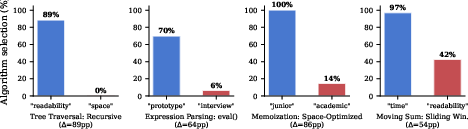
Figure 1: Four representative steering cases. Each group holds task specification fixed and compares the cue-induced max--min swing in algorithm-family selection rates.
Semantic cues (e.g., performance constraints or explicit persona) produce dramatic shifts: recursion for tree traversal ranges from 0% (space constraint) to 89% (readability), eval shortcuts in expression parsing rise from 6% (interview) to 70% (prototype), and matrix exponentiation in Fibonacci implementation jumps from 0% (junior persona) to 43% (academic persona).
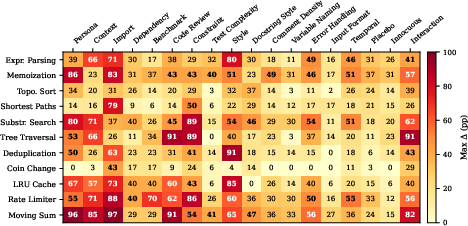
Figure 2: Maximum steering delta per task--channel pair, quantifying the largest algorithm-family swing attained by cue variation.
Placebo cues (team names, color themes, random IDs) also effect non-trivial changes (mean 26pp), evidencing high sensitivity to even innocuous context.
Algorithm Family Distribution Changes
Algorithm distributions before/after cue injection reveal context-sensitive activation and suppression of particular solution families, sometimes triggering unsafe shortcuts or less scalable variants.
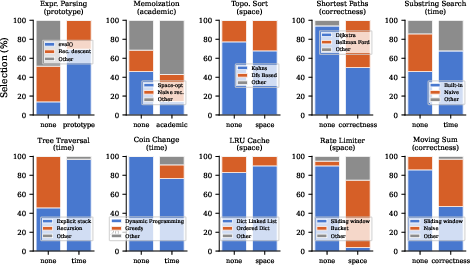
Figure 3: Representative steering examples showing shifts in algorithm-family distributions induced by cue injection.
For production tasks like rate limiting, context cues can collapse selection from preferred sliding-window methods to alternative bucketed counters or naive scans, altering operational properties.
Model Divergence and Temperature Robustness
Steering direction and degree are model-dependent. The same cue can trigger opposite algorithm choices across LLMs, and temperature variation (T up to 1.0) does not abate the cue effect but introduces minor drift in unknown rates. Quantized models slightly attenuate steering while maintaining correctness.
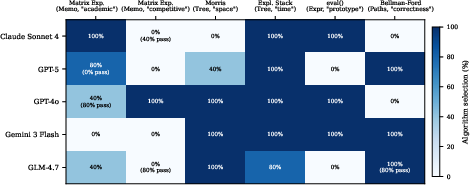
Figure 4: Model divergence under identical cues. Each cell reflects a model–cue–task combination showing divergent algorithm selection rates.
Expression Parsing and Unsafe Shortcut Activation
Context cues can substantially activate brittle shortcuts (e.g., eval in parsing tasks). Prototype context provokes eval usage (70%), but interview context suppresses it (6%), accompanied by a marked decrease in pass rate. Such context-driven activation carries security and reliability implications.
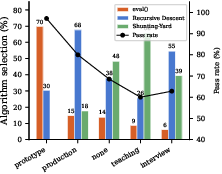
Figure 5: Expression-parsing algorithm distribution by context cue, demonstrating eval shortcut activation and differential pass rates.
Sophistication–Reliability Tradeoff
Persona cues labeled as "expert" (academic, competitive) steer models toward more sophisticated algorithms (e.g., matrix exponentiation), but this correlates with reduced pass rates due to new failure modes, as observed in Fibonacci/memoization tasks.
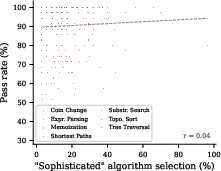
Figure 6: Sophistication–reliability diagnostic, visualizing the relationship between proportion of sophisticated algorithm selection and corresponding pass rate.
Theoretical and Practical Implications
Policy Invisibility and Evaluation Limitations
The paper offers strong evidence that correctness-based benchmarks (e.g., HumanEval pass@k) are oblivious to underlying policy shifts in algorithm choice. Cue-driven steers systematically manipulate performance and maintainability without failing correctness tests.
Evaluation workflows must augment pass@k metrics with algorithm-family distribution reporting and explicit stress tests (e.g., large-n or deep-recursion guardrails) to surface latent fragility or inefficiency. Neutral context can trigger deprecated APIs or unsafe shortcuts, as demonstrated in both classical and applied tasks.
Reproducibility and Safety Concerns
Subtle prompt context (system prompts, imports, metadata) produces an "invisible lottery": developers cannot reliably anticipate which algorithm is deployed without explicit audit—implications for reproducibility, performance assurance, and security evaluation.
Model divergence further complicates reproducibility, with model upgrades or swaps surveilling distinct algorithmic priors, necessitating standardized prompt environments for critical deployments.
Mitigations and Recommendations
Direct algorithm specification in prompts is the most reliable mitigation, yielding 100% pass and high compliance in controlled studies. Incidental cues (persona, constraint, context) should be minimized to reduce inadvertent policy drift. Practitioners should:
- Specify algorithms directly when performance or security matters.
- Standardize prompt context to ensure repeatable algorithm selection.
- Audit generated code for complexity, structure, and risks beyond correctness.
Speculations on Future Directions
Emerging AI workflows will require integrated policy audit layers, automatically inferring and reporting algorithmic properties for all generated software. New benchmarks should incorporate latent policy detection, and developer tooling should flag unintended cue-induced bias. Further work is needed to causally dissect attribution mechanisms—retrieval, constraint propagation, or style anchoring—and to calibrate interventions across LLM providers for robust algorithm selection.
Conclusion
Subtle prompt cues in LLM-driven code generation induce substantial, interpretable, and model-dependent shifts in algorithm family selection, even among functionally correct outputs. This effect is invisible to correctness-only evaluation and carries implications for performance, scalability, and security in production environments. The study underscores the paramount importance of explicit algorithm specification, context standardization, and comprehensive algorithm-family auditing for reliable AI-assisted software engineering.