- The paper presents a unified spatial indexing library that consolidates R-tree, Quad-tree, and KD-tree via a consistent four-parameter C++ template interface.
- It employs innovative bulk-loading, dynamic updates, and a header-only design, ensuring efficient main-memory performance with minimal overhead.
- Empirical evaluations demonstrate that Indexicon matches or outperforms established libraries in query throughput, insertion speed, and scalability across diverse real-world datasets.
Indexicon: Design, Implementation, and Empirical Analysis of a Modern Spatial Indexing Library
Motivation and Positioning
Spatial indexing structures—principally the R-tree, Quad-tree, and KD-tree families—are foundational to GIS, multidimensional search, and spatial analytics. Despite their prominence, the software landscape for spatial indexing is hampered by codebase fragmentation, incomplete API support, and rigidity in architectural adaptation. Existing open-source libraries, such as Boost.Geometry, GEOS, CGAL, PCL, and Nanoflann, tend to specialize in a single index or suffer from deep class hierarchies and non-uniform interfaces, which hinder extensibility, integration, and fair benchmarking.
"Indexicon: A Spatial Indexing Library" (2606.04676) is proposed in response to these deficiencies. Indexicon introduces a cohesive, header-only C++ template library unifying R-tree, Quad-tree (and MX-CIF and Oct-tree variants), and KD-tree indices within a lightweight, dependency-minimal architecture. It enforces uniform APIs for bulk-loading, dynamic maintenance, querying (range and kNN), and statistics collection, facilitating reproducible research, rapid prototyping, and truly apples-to-apples algorithmic evaluation.
Design and Engineering Principles
Unified Architecture
Indexicon's central engineering principle is architectural uniformity. All index types are instantiated via a consistent four-parameter C++ template interface (coordinate type, payload type, dimensionality, node capacity), avoiding nested inheritance and heavy abstraction typical in Boost and CGAL. This flat structure makes Indexicon highly portable and easily embeddable in diverse main-memory data-intensive systems.
Every index variant is provided as a single-file, header-only C++ template, imposing no dependencies outside the C++ standard library. This contrasts with Boost and GEOS, which require understanding of deep, library-specific abstractions, and numerous internal headers—a source of both cognitive and software integration overhead.
Algorithmic Fidelity and Extensibility
Indexicon's implementations faithfully follow state-of-the-art indexing algorithms:
- R-tree: Supports both point and MBB data, with decoupled internal and leaf capacities. The bulk-loading employs a top-down KD-like recursive partitioning; dynamic updates use R*-tree reinsertion and optimal axis splitting via margin minimization; deletions invoke orphan reinsertions.
- Quad-tree/Oct-tree: 2D and 3D variants, supporting multiple splitting strategies (Point-Region geometric midpoint, pseudo-median, longest-axis median). Dynamic coordinate-drift is managed via rerooting, and straddling MBBs are efficiently handled in MX-CIF.
- KD-tree: Supports round-robin, adaptive, and longest-axis splitting, with bucket-leaf termination. Update and deletion strategies maintain spatial partitioning invariants with minimal overhead, but (like traditional KD-trees) do not perform post-hoc rebalancing.
The API is designed for composability—developers can experiment with new split heuristics or query algorithms without navigating library-internal idiosyncrasies.
Main-Memory Orientation
All data structures are optimized for main-memory residency, in line with prevailing hardware and modern OLAP workloads [DBLP:journals/pvldb/LarsonL16]. Indexicon foregoes explicit disk I/O optimizations, in contrast to older disk-oriented codebases (e.g., LibSpatialIndex), allowing focus on low-latency, high-throughput traversal, and efficient cache utilization.
Empirical Evaluation
Indexicon's evaluation is conducted using six diverse real-world datasets, representing point clouds, GPS traces, urban LiDAR, and annotated traffic MBBs, in both 2D and 3D. The library is benchmarked against Boost, GEOS, PCL, and Nanoflann implementations, considering packing/build, dynamic insertion and deletion, and query (range and kNN) costs under uniform workloads.
Key Structural and Empirical Insights
Index Leaf Partitioning
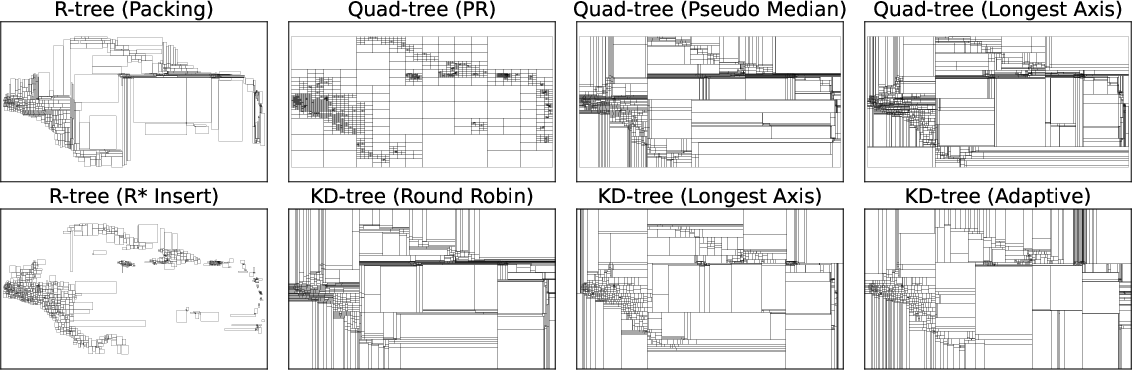
Figure 1: Visualization of MBB partitions for different indexing strategies applied to a 100K-point OSM sample demonstrates Indexicon's versatility across spatial data characteristics.
Indexicon's leaf partitioning is competitive across all indices and splitting heuristics: R-tree bulk-loading yields tightly packed, minimally overlapping leaves; Quad-tree and KD-tree strategies balance fragmentation with query efficacy, adaptable to either uniform or clustered distributions.

Figure 2: Projections of datasets onto two dimensions reveal spatial heterogeneity, informing index construction and query benchmarks.
The empirical study demonstrates that Indexicon either matches or outperforms Boost.Geometry (R-tree), GEOS (Quad-tree/MX-CIF Quad-tree), PCL (Oct-tree), and Nanoflann (KD-tree) across all tested workloads:
- Bulk-loading and Insertion: Indexicon consistently provides lower packing and insertion runtimes than Boost, PCL, or Nanoflann, particularly notable for high-cardinality datasets (e.g., >100M points).
- Query Throughput: For range and kNN queries, Indexicon achieves lower or comparable query latencies; e.g., in 3D MBB, Indexicon's R-tree achieves a 2× speedup over Boost for large-extent queries.
- Deletion Semantics: Although Nanoflann's lazy "tombstone" deletion is faster in isolation, it incurs substantial downstream query overhead; Indexicon's clean bucket-based deletions and compaction avoid this pitfall.
A significant finding is that forced reinsertion parameters, historically tuned for disk-bound systems (e.g., 30% removals during R*-tree update), impose disproportionate costs in modern in-memory regimes, with negligible query improvement—implying practitioners should revisit such heuristics for current hardware.
Bulk-loading and Query Scalability



Figure 3: Comparative analysis of bulk-loading latency highlights Indexicon’s construction efficiency across spatial data.


Figure 4: Range query performance across varying extents, illustrating the scalability of Indexicon relative to established libraries.
Indexicon's bulk-loading and query routines robustly scale with dataset size and query selectivity, and its unified interface permits rigorous, reproducible benchmarking—a major advance over the opaque or inconsistent performance in prior libraries.
Impact of Partitioning Strategies

Figure 5: Effectiveness of alternative KD-tree splitting strategies on query performance underscores Indexicon’s algorithmic flexibility.
Indexicon supports exhaustive partitioning heuristics for Quad-tree and KD-tree variants, revealed as a tangible advantage in tailoring indices for workload or data distribution specifics. For example, longest-axis splits provide optimal bulk-loading performance; adaptive strategies offer marginal query improvement at higher computational cost, informing practical configuration.
Implications and Future Directions
Practical Impact
Indexicon minimizes the technical barrier for algorithm and system researchers working in spatial, spatiotemporal, and multidimensional analytics. By reducing code and interface complexity, it enhances prototyping velocity and comparability for new index structures, query algorithms (e.g., spatial joins, advanced ranking, skyline, or uncertain-range queries), or hardware-optimized dataflows. It natively supports extension to new spatial datatypes (e.g., polygons, polylines). Empirical results suggest reevaluation of conventional tuning heuristics for in-memory operation.
Theoretical Considerations
The standardization provided by Indexicon enables systematic, theory-driven experimental studies—for example, exploring the trade-offs between data-partitioning (R-tree) and space-partitioning (KD-tree, Quad-tree) strategies, or the effects of bulk-loading vs. dynamic updates under high-skew real-world distributions. Its template design enables the exploration of new index variants (e.g., grid-based, learned indices, hybrid spatial access methods [DBLP:journals/csur/GaedeG98], [DBLP:journals/vldb/LiuLZSC25]) that demand compositional flexibility.
Future Developments
- Algorithmic Expansion: Planned additions include 3D MX-CIF, KDB-trees, uniform/adaptive grids, and novel workload- or distribution-aware indices.
- Concurrency: Multi-threaded update/search capability is prioritized to align with emerging hardware and query workloads.
- Query Coverage: Support for intersection/distance joins, as well as workload-aware and hybrid query types, is a development focus.
- Community Evolution: Open-source adoption, combined with an extensible codebase, positions Indexicon as an experimental backbone for spatial indexing research and reproducibility.
Conclusion
Indexicon addresses critical deficits in contemporary spatial indexing libraries by delivering a cohesive, highly extensible, and empirically validated C++ template library tailored to modern main-memory applications. Its consistent outperformance or parity with state-of-the-art open-source alternatives, in conjunction with code simplicity and extensibility, marks it as a new reference point for spatial access method engineering. This work is well-positioned to catalyze experimental research in both algorithmic innovation and workload-driven spatial data management going forward.