- The paper presents a thermodynamic framework for mapping persistent currents in complex, signed directed networks.
- It leverages the signed magnetic Laplacian and cycle fluxes to relate equilibrium transport with quantum interference.
- The study demonstrates phenomena like gauge field effects and Hofstadter butterfly spectra, informing design of quantum transport systems.
Persistent Currents in Signed Directed Networks: A Thermodynamic and Topological Perspective
Introduction
The paper "Persistent currents in signed directed networks" (2606.06716) develops a thermodynamic framework for understanding equilibrium transport and quantum coherence in signed directed networks, extending the classical notion of persistent currents from mesoscopic rings and crystalline lattices to arbitrary network topologies with asymmetric and antagonistic interactions. This approach exploits the interpretation of the signed magnetic Laplacian as an effective Hamiltonian, where edge phases act as discrete gauge fields, enabling a direct mapping of persistent current phenomena into the language of network theory. The work establishes a direct correspondence between network cycle fluxes (holonomies) and thermodynamic response functions, and demonstrates the emergence of quantum-interference-like effects and fractal spectra in complex network environments.
The authors formalize persistent currents in the setting of arbitrary signed directed networks via the signed magnetic Laplacian, L(M), which generalizes the conventional Laplacian operator to accommodate both edge sign and directionality. The assignment of phase factors to edges, forming a discrete gauge field, leads to the Hamiltonian's spectral dependence on gauge-invariant fluxes through network cycles. These fluxes, encoded in the cycle space, represent the holonomies of the discrete gauge connection.
Within a canonical ensemble formalism, the Gibbs density matrix is defined in terms of L(M), and the free energy F=−τ−1lnZ determines the system's equilibrium properties, where the partition function Z depends on the cycle fluxes. Persistent currents are then defined as derivatives of the free energy with respect to these cycle fluxes:
Jcycle=−τ1∇ΨlnZ(Ψ)
where Ψ denotes the vector of cycle holonomies. The resulting currents are divergence-free and naturally decompose onto the independent cycles of the network, a generalization of current conservation in conventional quantum transport.
Cycle Decomposition, Interference, and Response Kernels
The framework reveals that equilibrium persistent currents can be analyzed entirely in the cycle space, with each current linked to a corresponding cycle flux. The structure and interference of these cycle currents are governed by the topology of the network and are modulated by the thermodynamic parameter τ, controlling the transition between localized and delocalized current responses. Specifically, for vanishing τ (high "temperature" or short diffusion time), the response is localized, while for large τ (low "temperature" or long diffusion time), the response is dominated by the ground state.
The expansion of the free energy around zero flux elucidates the system's effective inductive coupling:
F(Ψ)=F(0)+21Ψ⊤K(τ)Ψ+O(Ψ4)
where L(M)0 is the response (or "stiffness") kernel, leading to a linear response relation L(M)1. The matrix L(M)2 serves as an effective inductance tensor, capturing nontrivial geometric and spectral interference between cycles—paralleling mutual inductance in coupled LC circuits. Notably, even when cycles do not share edges, spectral delocalization (nonlocality of eigenvectors) induces effective coupling of their currents.
The authors provide explicit examples of these phenomena, detailing the emergence of periodic, interference-driven current profiles as a function of the global phase variable L(M)3, and visualizing the contributions of different cycle modes and temperatures.
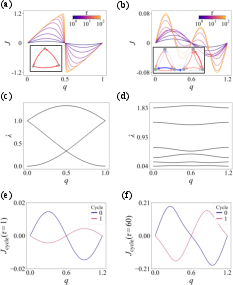
Figure 1: Persistent current profiles and spectra in networks with one and two independent cycles, highlighting loop interference, spectral structure, and the role of the thermodynamic parameter L(M)4.
The Hofstadter Network Construction
An important demonstration of the generality of this formalism is the construction of a "Hofstadter network," a synthetic network whose signed directed structure reproduces the classic Hofstadter butterfly spectrum as a function of the gauge parameter L(M)5. This result highlights that nontrivial quantum magnetic phenomena, previously associated with regular lattices under continuum gauge fields, are naturally expressed through the cycle-flux formalism on arbitrary graph topologies with an appropriately engineered edge phase structure.
The spectrum manifests a fractal, butterfly-like structure as a function of L(M)6, and the global and cycle-resolved persistent currents capture the underlying interplay between topology and gauge field interference. This approach decouples the phenomena from geometric constraints, grounding them purely in the network's cycle space topology.
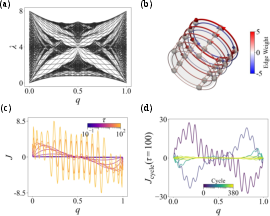
Figure 2: Spectral and current features of the Hofstadter network: (a) butterfly energy spectrum, (b) sample network visualization, (c) global persistent current, and (d) cycle-resolved current components.
Implications and Future Directions
The presented framework has substantial theoretical and practical implications. The formalism draws a precise connection between spectral graph theory, discrete gauge fields, and quantum transport, providing new analytical tools for multiscale characterization of coherence, frustration, and equilibrium interference in networks with antagonistic interactions and directed flows. It supplies a natural language for describing superconducting devices, mesoscopic circuits, synthetic quantum matter, and ultracold-atom platforms where experimental control of gauge phases and network geometry is possible.
Possible extensions include:
- Nonequilibrium generalization: Incorporating external drives, biases, dissipation, or time-dependent gauge fields to study non-equilibrium transport and information flows in networked quantum and classical systems.
- Connections to learning in networks: The authors speculate on the analogy between the driven, adaptive response of coherent networks and learning dynamics in artificial neural networks, suggesting that cycle fluxes and persistent currents could underpin a thermodynamically interpretable learning framework.
- Physical information processing: Future developments may leverage the intrinsic phase-coherent, gauge-sensitive response of networked physical substrates for computing and information processing, blurring the line between analog quantum simulation and functional materials computation.
Conclusion
This paper systematically extends the concept of persistent currents to signed directed networks, integrating spectral, thermodynamic, and topological tools. By identifying gauge-invariant cycle fluxes as the canonical variables for equilibrium transport, it provides a unified framework to explore interference effects, macroscopic coherence, and their interplay with network topology. The Hofstadter network example underscores the capacity of this model to capture fractal quantum phenomena within arbitrary network structures, independent of their embedding in physical space. These results have broad significance for the study and engineering of quantum transport, network theory, and the analysis of phase-coherent systems.