- The paper introduces the FLIGHT benchmark, integrating multi-stage semantic instructions with continuous 6-DoF control to tackle long-horizon UAV navigation challenges.
- It presents a dual-rate asynchronous architecture that decouples high-latency semantic processing from fine-grained, real-time control, enhancing navigational stability.
- Empirical results demonstrate significant gains in success rates and instruction adherence over existing VLN and VLA models, validating the pilot reasoning approach.
Fine-Grained Long-Horizon UAV Navigation: The FLIGHT Benchmark and VLA Architecture
Problem Statement and Limitations in Existing Paradigms
The paper "Think Like a Pilot: Fine-Grained Long-Horizon UAV Navigation" (2606.06836) systematically analyzes the challenges faced by embodied UAV agents executing long-horizon, language-guided missions. Previous Vision-Language Navigation (VLN) benchmarks exhibit coarse, discrete action spaces and lack the representational fidelity to capture continuous flight dynamics. Conversely, existing Vision-Language-Action (VLA) datasets focus on isolated, short-horizon atomic maneuvers and omit multi-stage compositional instructions, thereby failing to reflect the operational complexity of real-world UAV navigation tasks.
These limitations produce two bottlenecks: (a) an inability to maintain coherent task-state and sub-goal alignment over extended flights due to significant context drift in egocentric visual streams, and (b) an inherent mismatch between the computational latency of high-capacity, semantic VLMs and the real-time demands of closed-loop flight control.
Design and Structure of the FLIGHT Benchmark
FLIGHT introduces a comprehensive benchmark for instruction-guided UAV navigation that fuses multi-stage, semantically rich language instructions with densely annotated, continuous 6-DoF control trajectories. There are two primary task structures:
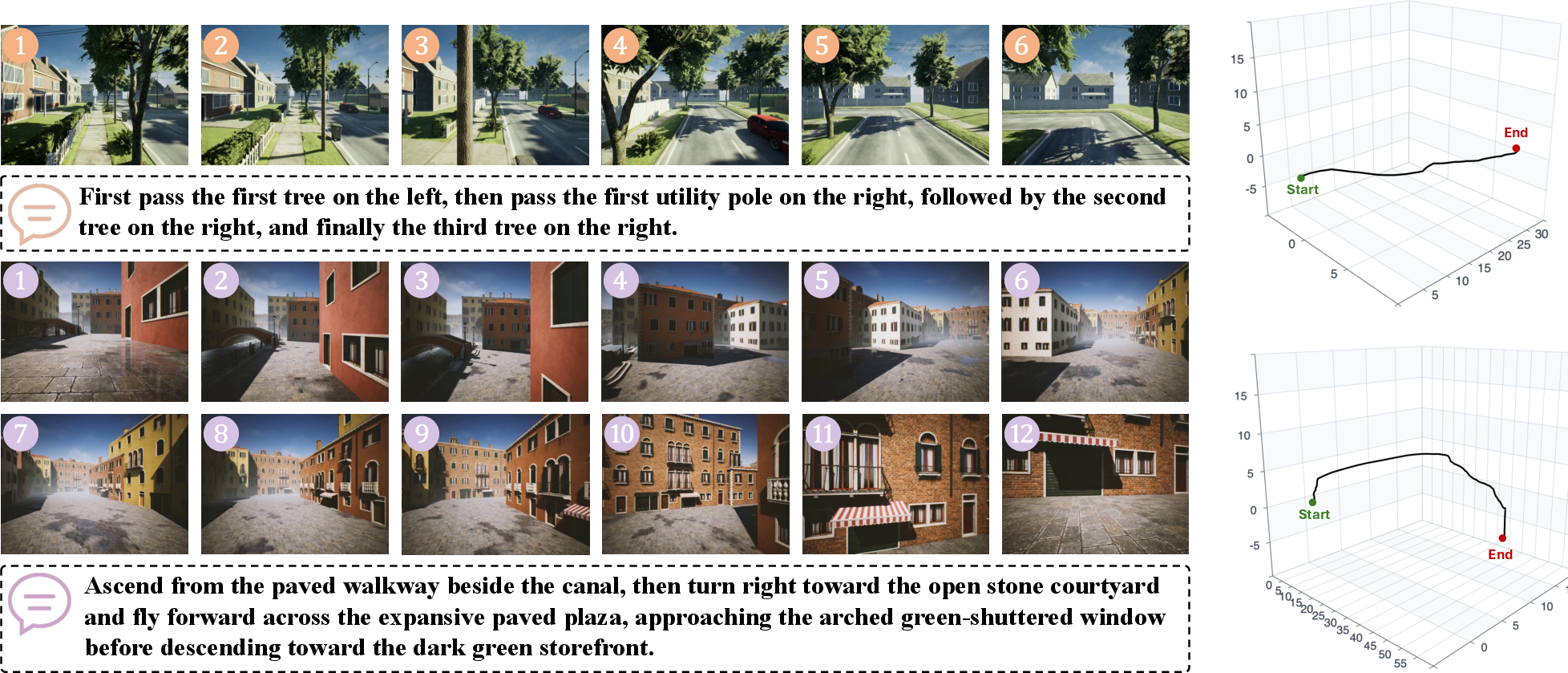
- Long-horizon Flow: Extends the UAV-Flow atomic action paradigm by composing multi-step, semantic instructions requiring compositional hybrid actions—e.g., sequentially traversing objects with varying spatial relations.
- Fine-grained VLN: Densifies referential landmark grounding in instructions and captures tighter action-to-language correspondences, requiring temporally coherent, fine-resolution control that maps closely to real-world UAV requirements.
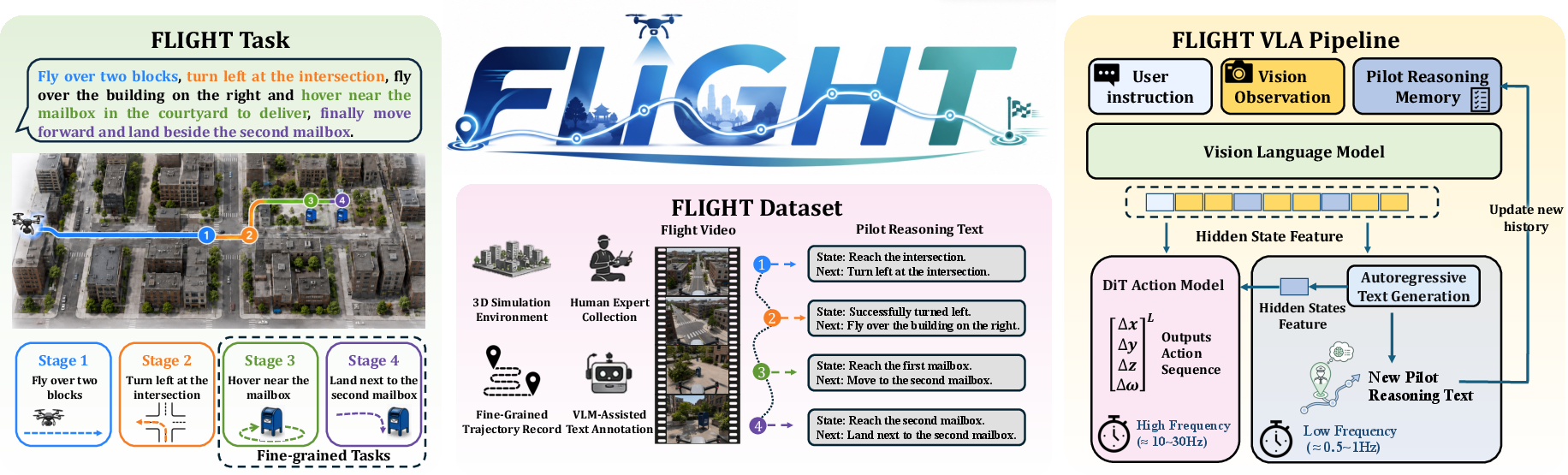
Figure 1: Schematic overview of the FLIGHT benchmark, dataset annotation, and dual-rate VLA framework. The left portion contextualizes the hybrid trajectory semantics; the middle details the annotation with Pilot Reasoning supervision; the right illustrates the asynchronous model architecture.
By addressing both multi-stage composition and dense low-level control, FLIGHT rigorously targets hierarchical policy learning in UAV navigation.
Dataset Collection, Annotation, and Pilot Reasoning Paradigm
The FLIGHT dataset is sourced from high-diversity, photorealistic Unrealzoo-based environments and comprises over 10,000 trajectories with continuous motion commands. Unlike prior works, FLIGHT annotates each temporal segment with task-oriented semantic labels, automatically produced by VLMs and enriched by motion priors from UAV telemetry.
The core innovation is the Pilot Reasoning module: for each segment, a Pilot Reasoning text is generated that explicitly encodes both current task status and near-future action plans at decision junctures, mimicking human cognitive flight reasoning. This signal is derived via oracle-assisted annotation involving both current and next-step task labels, thereby supplying dense, chain-of-thought supervision to learning algorithms.
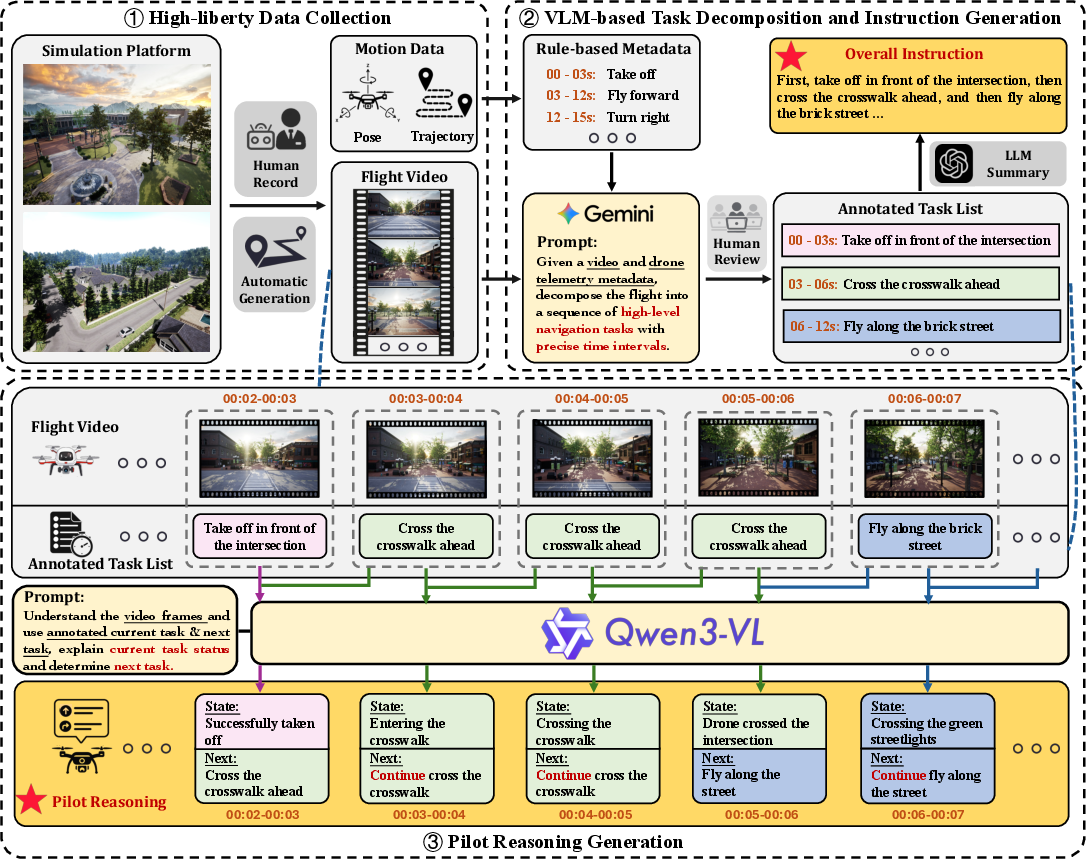
Figure 3: FLIGHT data pipeline: trajectory collection, multimodal VLM-based annotation, and Pilot Reasoning text generation.
This approach enables learned models to align high-level language goals with continuous, temporally grounded flight behaviors while preserving interpretability.
FLIGHT VLA Architecture: Asynchronous Dual-Rate Control
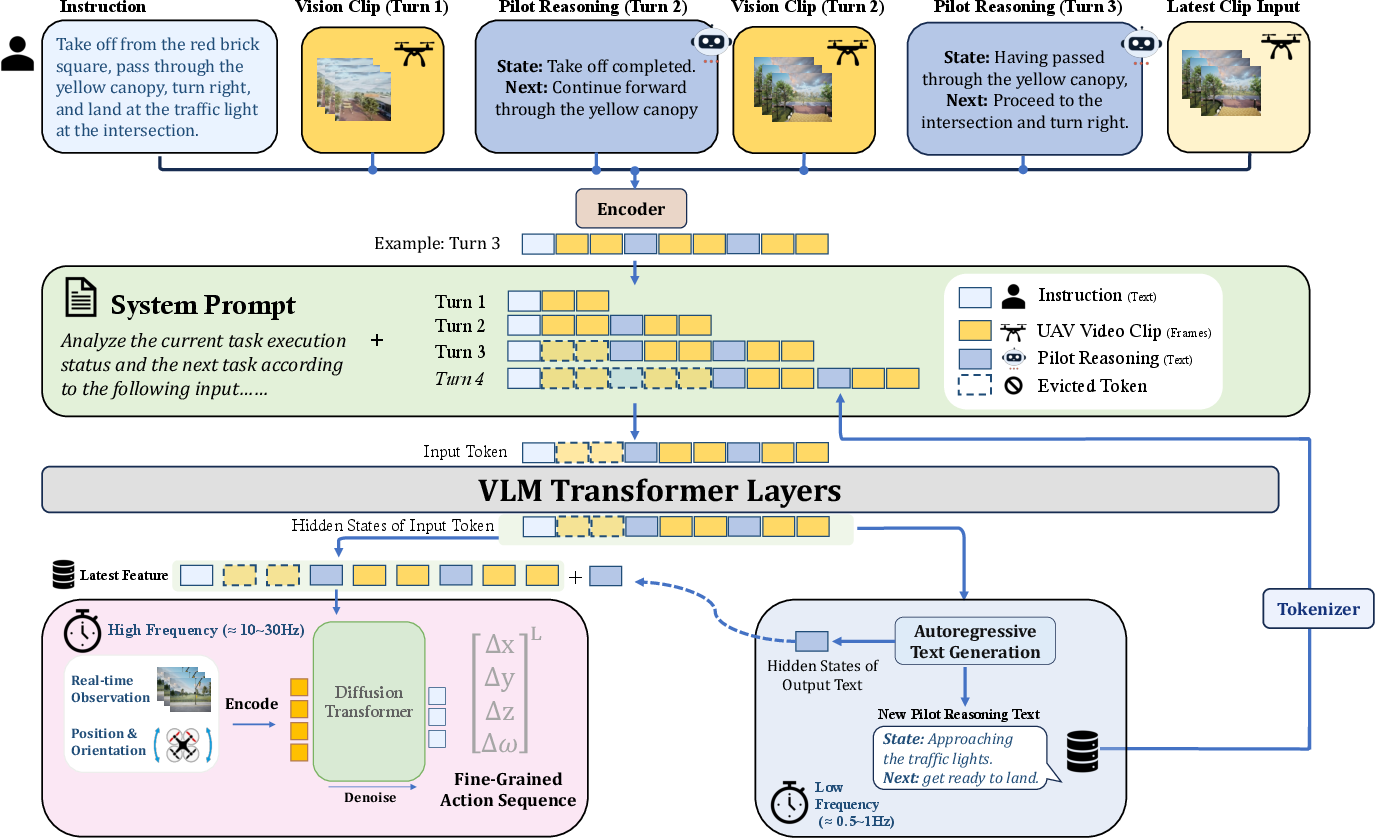
To address temporal-action granularity mismatches, FLIGHT VLA proposes a dual-module asynchronous architecture:
A critical aspect is the latency-aware joint training protocol: during training, the action model is conditioned on VLM features sampled with stochastic temporal offsets, simulating real-world reasoning delays and promoting policy robustness. This yields stable control even under large, variable-latency language reasoning modules.
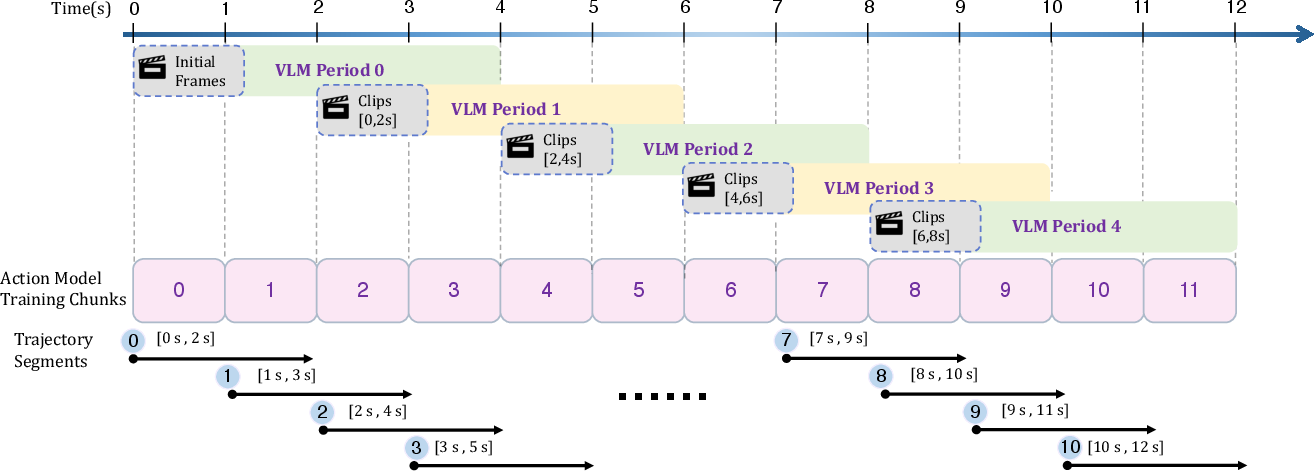
Figure 2: Latency-aware asynchronous training results in temporal robustness of the action model to stale or delayed semantic grounding.
Evaluation, Baselines, and Quantitative Results
FLIGHT establishes a rigorous evaluation on two fronts: closed-loop trajectory completion across entire multi-stage missions and adherence to fine-grained instruction decompositions.
Baselines include structurally-adapted SOTA VLN models (CMA+LAG, NaVid) and representative discrete/continuous VLA models (OpenVLA, MemoryVLA), which are augmented to support UAV-specific action spaces and memory requirements.
Empirical results demonstrate:
These findings establish the necessity and efficacy of (a) asynchronous semantic/motor control and (b) explicit temporal Pilot Reasoning supervision for high-fidelity language-to-trajectory policies.
Implications, Limitations, and Future Directions
Practically, the integration of a streaming reasoning backbone with a diffusion-based action model directly improves the deployability of language-driven UAV agents in real-world, latency-constrained settings. The Pilot Reasoning signal constitutes a strong, interpretable supervisory signal, potentially facilitating robust model-based or reinforcement learning extensions.
Theoretically, the formalization of explicit intermediate reasoning and hierarchical decoupling offers a template for embodied AI across modalities requiring tight coupling of long-horizon semantic memory and low-latency action, including ground vehicles and legged robotics.
However, the scope remains simulation-centric, and extension to multi-UAV/multi-agent realms, dynamic physical constraints, or zero-shot generalization to unseen semantic environments is nontrivial. Future developments may include RL fine-tuning, autonomous error recovery, unifying visual memory architectures (Torne et al., 4 Mar 2026), or open-world reasoning extensions (Intelligence et al., 22 Apr 2025, Zhou et al., 28 May 2025).
Conclusion
FLIGHT and the FLIGHT VLA framework collectively advance the state of language-conditioned UAV navigation by fusing multi-scale grounded instruction-following, chain-of-thought pilot reasoning, and robust asynchronous architecture for long-horizon, fine-grained control. The results reinforce the necessity of explicit intermediate reasoning and dual-rate architectures in aligning high-level semantic understanding with physically plausible, continuous robot policy learning. The benchmark and associated methods set a new standard for evaluation and design of UAV navigation agents under realistic, instruction-guided regimes.