Electron-muon colliders at high energies to discover heavy sterile neutrinos
Published 6 Jun 2026 in hep-ph | (2606.08268v1)
Abstract: We study high-energy charged-lepton-flavor-violating (cLFV) channels in $e- μ+$ scattering to probe heavy sterile neutrinos, which arise naturally in minimal extensions of the Standard Model. For $\sqrt{s} \le 2M_W$, we consider the process $e- μ+ \to e+ μ-$, which is dominated by one-loop box diagrams. We numerically evaluate these diagrams, involving a high-energy extension of the Inami-Lim functions, and find that the amplitudes are strongly suppressed because of their quartic dependence on light-heavy mixing. Using current bounds on active-sterile neutrino mixing, we determine the maximal rates allowed by existing constraints. For $\sqrt{s} > 2M_W$, we analyze the process $e- μ+ \to W+ W-$ and compute the corresponding cross sections in both single-sterile and minimal type-I seesaw scenarios. We find this latter process to be significantly more promising for revealing the presence of heavy sterile neutrinos at $e-μ$ colliders.
The paper demonstrates that high-energy e–μ colliders can probe heavy sterile neutrinos via charged lepton flavor violation with effectively suppressed SM backgrounds.
The methodology uses one-loop box diagrams and tree-level computations to quantify cross sections, showing potential fb-level signals in the W+W– channel.
The results imply that observable signals at future colliders would offer direct evidence for new physics underpinning neutrino mass-generation models.
Electron-Muon Colliders as Probes of Heavy Sterile Neutrinos
Introduction
This paper investigates high-energy electron–muon scattering as a strategy to discover heavy sterile neutrinos via charged lepton flavor violation (cLFV). The authors explore e−μ+ collider channels sensitive to the presence of HNLs, a central concept in neutrino mass-generation models such as type-I seesaw. Emphasis is placed on the e−μ+→e+μ− process mediated by one-loop box diagrams below the W-pair threshold and the e−μ+→W+W− channel above threshold, with quantitative analysis of cross sections under current mixing bounds. Theoretical motivations are grounded in the inability of the Standard Model (SM) to explain observed neutrino masses and the strong suppression of cLFV in minimal SM extensions, establishing any observable signal as evidence of new physics.
Charged-Lepton-Flavor-Violating Processes and Heavy Sterile Neutrinos
Electron-muon colliders provide new sensitivity to cLFV due to the non-identical initial states, connecting directly to lepton mixing parameters. HNLs, gauge-singlet fermions motivated by seesaw models, participate in these processes via virtual exchanges leading to flavor violation. Collider observables include flavor-changing scatterings and non-unitary effects in the charged-current sector.
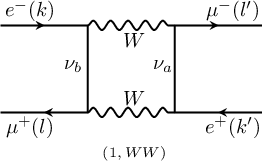
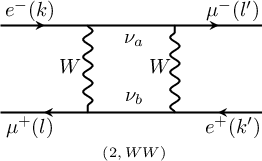
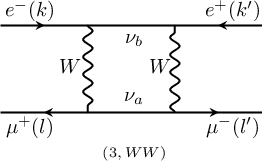
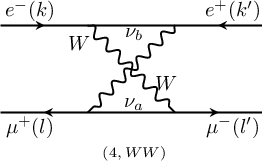
For the process e−μ+→e+μ−, the leading contributions arise from one-loop box diagrams comprising W and Goldstone boson propagators (Figure 1), and the amplitude incorporates heavy–light mixing matrix elements.
Figure 1: The box diagrams for e−μ+→μ−e+ involve WW and Goldstone exchanges, with the mixing structure quartic in heavy-light neutrino parameters.
The numerical evaluations use a high-energy extension of Inami–Lim functions, catering to s≪2MW. The mixing dependence arises via ∣UμNUeN∗∣4, imposing a strong suppression. Cross sections peak at e−μ+→e+μ−0 and e−μ+→e+μ−1 but remain e−μ+→e+μ−2 fb for maximal mixing allowed (e−μ+→e+μ−3), orders of magnitude below SM backgrounds, rendering direct observation impractical with foreseeable collider capabilities.
Off-shell e−μ+→e+μ−4 Production and Backgrounds
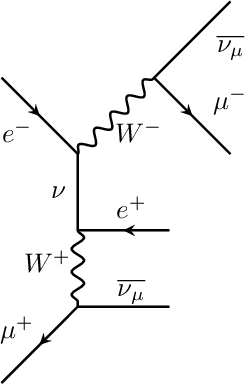
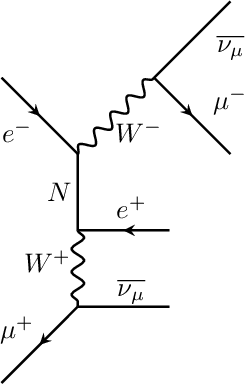
For e−μ+→e+μ−5 but above the flavor-violating threshold, four-body processes mediated by off-shell e−μ+→e+μ−6 bosons are considered. Topologies include both lepton-number conserving and lepton-number-violating diagrams, all contributing to e−μ+→e+μ−7 final states (Figure 2). The neutrinos in the final state lead to substantial background for cLFV searches, with cross sections estimated at e−μ+→e+μ−8 fb.
Figure 2: Feynman diagrams for e−μ+→e+μ−9 via off-shell and on-shell W0 exchanges, covering LNC and LNV channels.
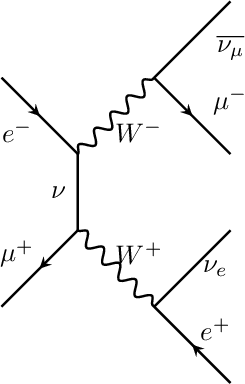
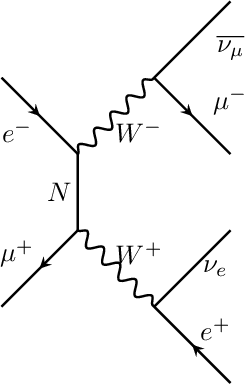
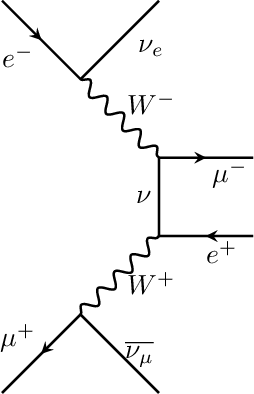
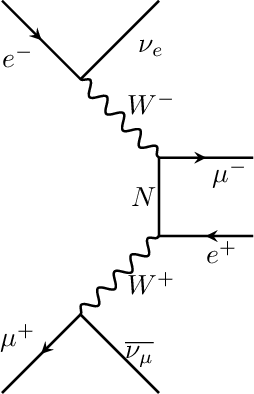
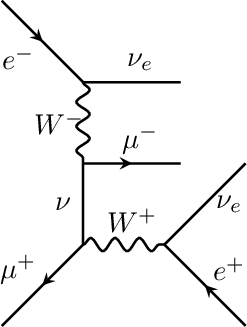
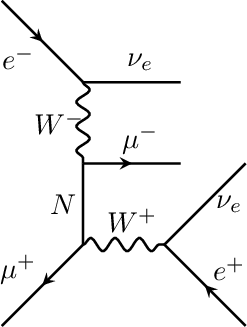
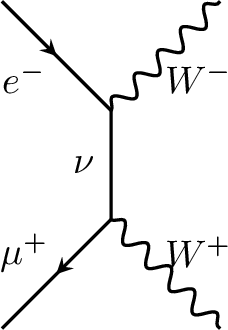
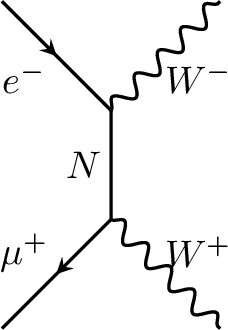
At W2, the on-shell W3 production opens up (Figure 3), mediated by neutrino exchange. The SM prediction is null due to PMNS unitarity, and any observed cross section reflects BSM cLFV.
Figure 3: Neutrino-exchange diagrams mediating W4; SM yields zero due to lepton flavor conservation.
Single Sterile Neutrino Scenario
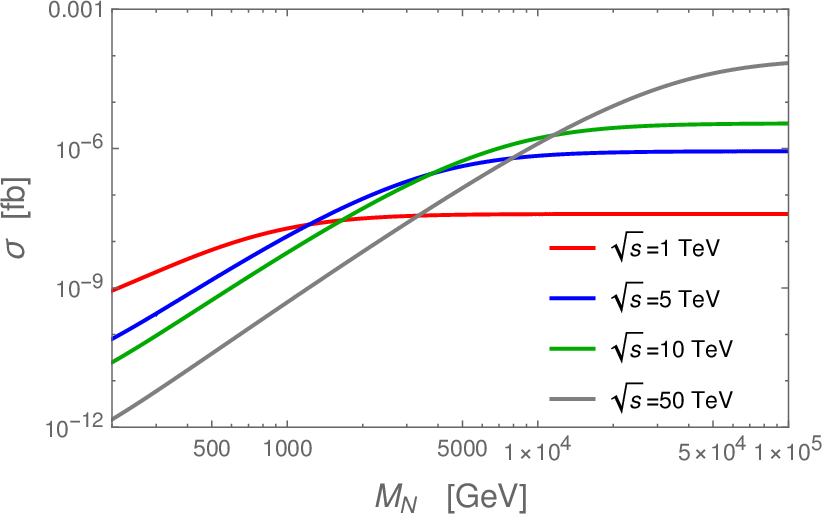
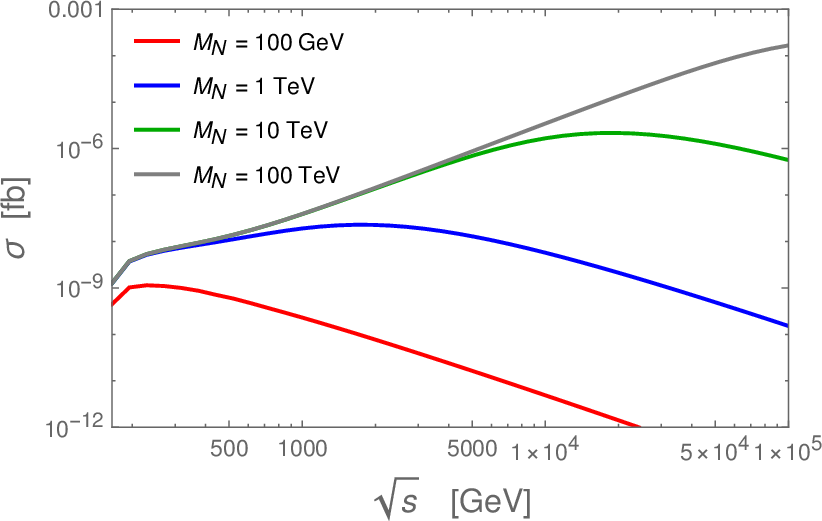
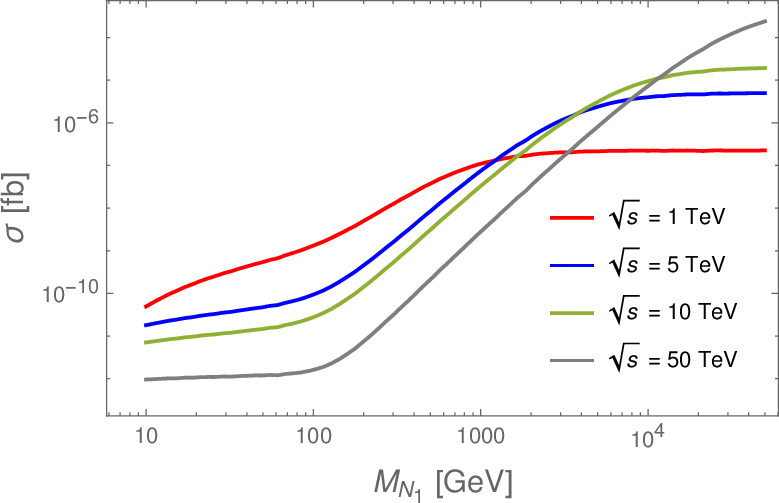
Introducing a single heavy sterile neutrino W5 with mixing W6, the cross section exhibits the following features (Figure 4):
Figure 4: Cross section W7 vs. W8 and W9 for a single sterile neutrino.
For fixed e−μ+→W+W−0, e−μ+→W+W−1 increases with e−μ+→W+W−2 until e−μ+→W+W−3 and saturates.
For fixed e−μ+→W+W−4, e−μ+→W+W−5 increases with e−μ+→W+W−6 up to the threshold then decreases, reflecting perturbative unitarity.
Cross sections reach up to e−μ+→W+W−7 fb for mixing squared e−μ+→W+W−8.
Figure 5 and 8 further quantify mixing bounds and cross section dependence in broader parameter regions.
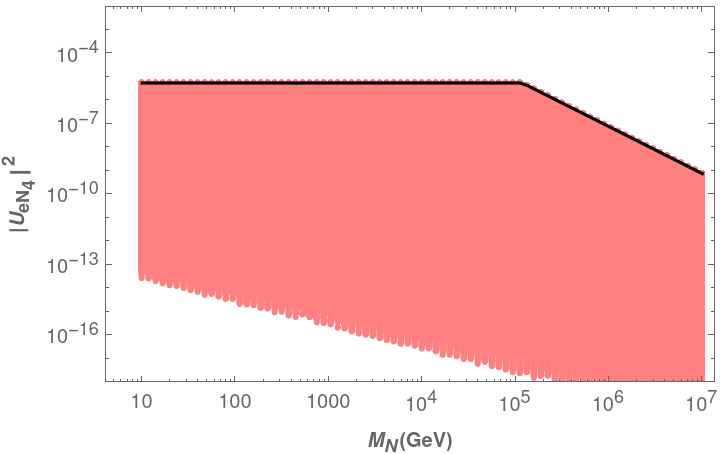
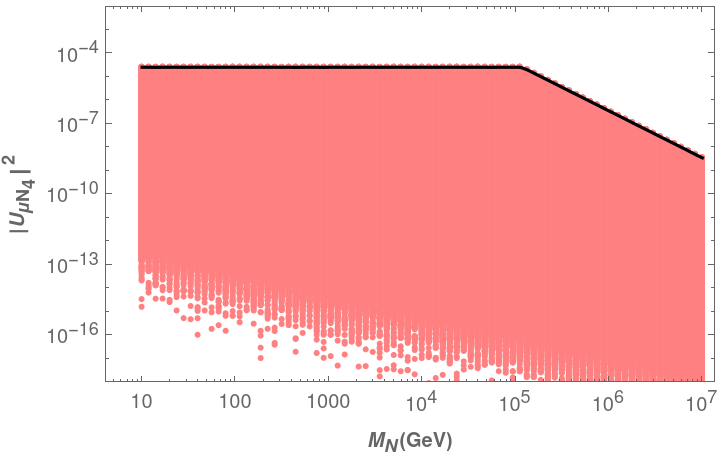
Figure 5: Light–heavy mixing in minimal type-I seesaw as a function of e−μ+→W+W−9, with bounds from PMNS non-unitarity.
Figure 6: e−μ+→e+μ−0 vs. e−μ+→e+μ−1 for varying e−μ+→e+μ−2 in minimal seesaw.
Minimal Type-I Seesaw Scenario
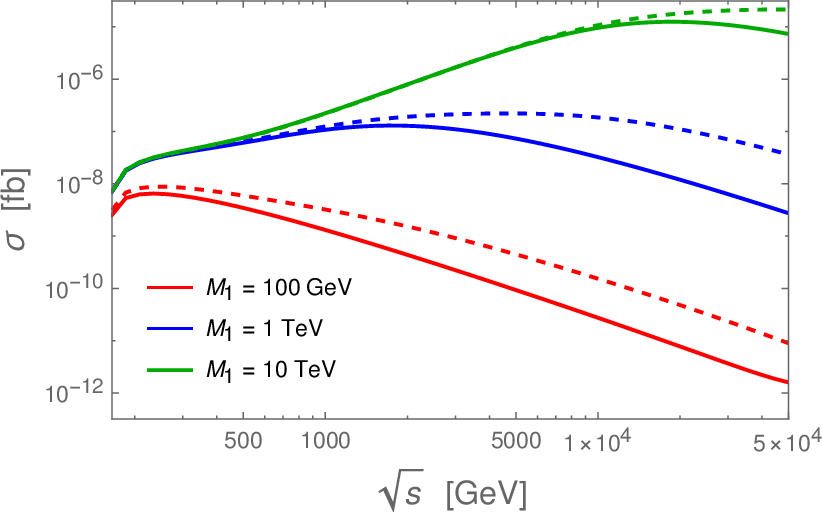
For two degenerate heavy Majorana neutrinos (minimal seesaw), the Casas–Ibarra parametrization enables maximal allowed mixing values consistent with oscillation data and PMNS unitarity constraints. The resulting cross sections, as shown in Figure 7, reflect both the energy and mass dependence for degenerate and hierarchical sterile neutrino scenarios.
Figure 7: Cross section e−μ+→e+μ−3 vs. e−μ+→e+μ−4 for several e−μ+→e+μ−5 values; solid lines for degenerate e−μ+→e+μ−6, dashed for e−μ+→e+μ−7.
Implications and Prospects
The study highlights several technical and phenomenological claims:
SM backgrounds for cLFV are strongly suppressed and any observable signal in e−μ+→e+μ−8 is a clear indicator of new physics.
Cross sections for neutrinoless e−μ+→e+μ−9 final states are quartic in mixing and thus unobservably small under current bounds.
For W0 production, rates can rise to the fb level for maximally allowed mixing and heavy neutrino masses around the TeV scale, which is within the sensitivity range for future high-luminosity colliders.
These results carry direct implications for the sterile neutrino hypothesis, providing a collider-based pathway to test not only cLFV but also the underlying mechanisms for neutrino mass generation. The complementarity between collider searches and intensity-frontier experiments is accentuated, as collider observables directly tune to the flavor structure and mass scale predicted by seesaw models.
Conclusion
The paper establishes that high-energy electron–muon colliders possess unique potential to probe heavy sterile neutrinos via cLFV, specifically in channels inaccessible to the Standard Model. While the W1 channel remains suppressed by mixing powers, the W2 process offers promising cross sections for pertinent ranges of sterile neutrino mass and mixing, especially within minimal type-I seesaw scenarios. Observation of these processes would mark direct evidence for new flavor-violating physics and reinforce collider-based searches as essential probes for sterile neutrino models. Future developments may concentrate on precise luminosity requirements, detector-level backgrounds, and interplay with non-unitarity constraints to refine the discovery potential of W3 colliders.