Fixed-Threshold One-Bit Toeplitz Covariance Estimation under Sparse-Ruler Sampling
Published 9 Jun 2026 in math.ST and cs.IT | (2606.11110v2)
Abstract: We study Toeplitz covariance estimation when fixed-threshold one-bit quantization is combined with deterministic sparse-ruler sampling, so that each observed bit is reused across many lag products. At a nonzero threshold the signs have nonzero mean, and this reuse gives raw sign products a coherent one-vertex variance component governed by weighted row sums; centering removes it and leaves a degenerate sparse-pair statistic. We prove a Gaussian variance contraction theorem for hollow quadratic forms of bounded coordinate transforms, including hard threshold signs: the variance is bounded by the squared correlation operator norm times the squared Frobenius norm of the edge weights, with constants independent of dimension, support size and maximum degree. For the oracle centered sparse-ruler estimator, the leading operator-norm term is (γ0L_1κ{\rm obs}\sqrt{\varphi(Ω)\log d/n}), where (\varphi(Ω)=\sum_{s=1}{d-1}q_s{-1}) is the coverage coefficient of the ruler; pooled marginal calibration from the (n|Ω|) observed bits adds a plug-in term. A spectral-packing lower bound in a known-scale identity-neighborhood submodel shows that this dependence is intrinsic under balanced coverage geometry; in the non-saturated regime where the coverage term dominates, the oracle estimator is minimax rate optimal over this submodel.
The paper introduces a centering technique for fixed-threshold one‐bit quantization that overcomes variance obstruction in Toeplitz covariance estimation.
It establishes a variance contraction theorem for centered hollow quadratic forms, yielding dimension-independent uniform bounds.
The study derives oracle and plug-in operator-norm risk bounds, confirming minimax rate optimality under sparse-ruler sampling with empirical validation.
Fixed-Threshold One-Bit Toeplitz Covariance Estimation under Sparse-Ruler Sampling: Authoritative Summary
Problem Formulation and Motivations
The paper investigates the estimation of Toeplitz covariance matrices from highly compressed measurements: each coordinate undergoes fixed-threshold one-bit quantization, and the spatial sampling is governed by deterministic sparse rulers. This model is applicable to analog-to-digital systems and data pipelines constrained by hardware, such as undithered ADCs and low-precision processors. The combination of fixed nonzero-threshold quantization with sparse coordinate sampling is particularly information-limited, as each observed bit is reused in multiple lag products, yielding intricate dependencies.
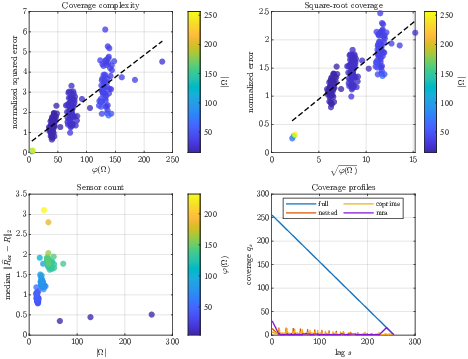
The Toeplitz structure reduces the parameter space dimensionally but complicates aggregation by introducing deterministic lag coverage profiles, represented by qs (number of observed lag-s pairs) and the coverage coefficient φ(Ω)=∑s=1d−1qs−1. The coverage coefficient, rather than simply the number of sensors ∣Ω∣, dominates the variance scaling in estimation.
Obstruction of Deterministic Pair Reuse and Centering
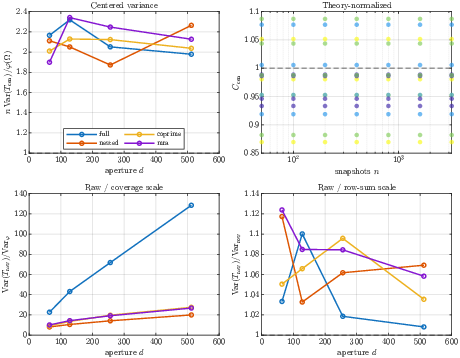
A central technical finding is the vertex-projection obstruction: at nonzero thresholds for the one-bit quantizer, sign outputs have nonzero mean. When the sparse ruler allows each coordinate to be reused in many lag products, raw sign products contain a coherent variance component determined by weighted row sums. This is fundamentally different from edge-Frobenius variance scaling, which dominates in unbiased, independent settings.
To resolve this, the paper advocates centering the sign outputs before constructing lag products. Centered statistics eliminate the vertex-projection term, reducing variance to the sparse-pair (edge-Frobenius) scale governed by φ(Ω). This effect is sharply captured in both theoretical derivations and numerical experiments.
Figure 1: Centering changes the variance scale. Under identity covariance, centered products collapse at the exact φ(Ω)/n scale across deterministic coverage profiles, whereas raw nonzero-threshold products retain the row-sum obstruction.
Gaussian Variance Contraction for Centered Sparse Pairs
A core theoretical contribution is the establishment of a variance contraction theorem for hollow quadratic forms of bounded transforms of Gaussian coordinates (including hard-threshold signs). The variance of quadratic forms is bounded, independent of dimension, by the squared correlation operator norm and the squared Frobenius norm of the edge weights. This uniform bound is crucial for non-asymptotic analysis and allows for robust operator-norm risk guarantees.
This result strengthens related literature on quadratic forms and U-statistics for dependent structures, explicitly exploiting the Toeplitz geometry and Gaussian chaos decomposition to obtain dimension-independent constants.
Oracle Operator-Norm Risk and Coverage Complexity
The paper develops detailed operator-norm risk bounds for both oracle (centered, true scales known) and plug-in (empirically calibrated margins) estimators. For the oracle estimator, the leading risk term is
γ0L1κobsφ(Ω)logd/n
where κobs is the observed-submatrix condition, L1 is the inverse-link derivative bound, and γ0 is the scale. Marginal calibration and nonlinear inverse-link curvature contribute secondary terms, but the coverage coefficient s0 is the rate-determining factor.
Figure 2: Oracle operator-norm rate. The panels show log-log error decay, full-bound normalized errors, per-class slopes in s1, and the relation between leading-term and full-bound normalizations.
Figure 3: Coverage geometry, not sensor count, predicts operator error. The panels compare normalized oracle errors with s2, s3, and s4, and show representative coverage profiles.
Plug-in Calibration and Empirical Verification
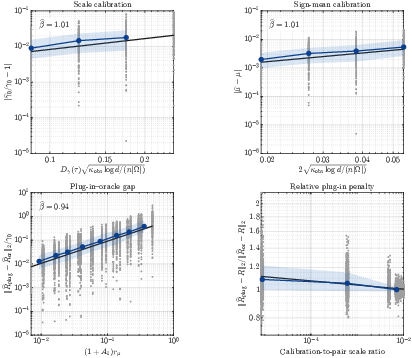
The plug-in estimator replaces unknown marginal calibration parameters with pooled empirical estimates from s5 one-bit signs. In short-memory classes (e.g., Sobolev spectral density, banded Toeplitz), this calibration error remains subordinated to the pair-estimation scale, ensuring minimax rate optimality in practical regimes.
Figure 4: Plug-in calibration rate verification. The plug-in–oracle operator gap is proportional to the short-memory calibration scale s6.
Threshold Sensitivity, Curvature, and Clipping
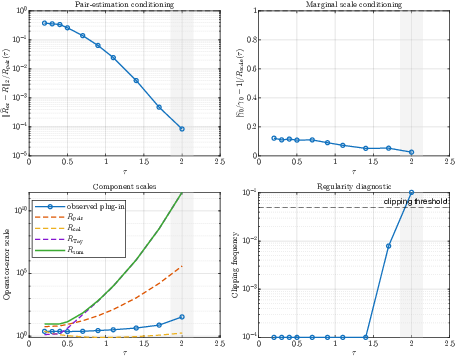
The study also addresses the effect of threshold selection and the nonlinear inversion of the sign-correlation link. The error decomposition isolates the curvature-induced second-order terms and identifies regimes where inverse-link clipping is inactive.
Figure 5: Threshold-conditioning decomposition. The observed plug-in error and the theoretical component scales are plotted, with clipping frequency reported to identify the regular threshold range.
Lower Bounds and Minimax Optimality
A deterministic spectral-packing lower bound in a known-scale identity-neighborhood submodel demonstrates that the coverage coefficient and its scaling with s7 and s8 are intrinsic for balanced ruler designs. The oracle estimator is minimax rate-optimal within non-saturated regimes characterized by s9.
The analysis is extensible to arbitrary Toeplitz and spatial sampling geometries, provided the effective support of coverage is sufficiently spread.
Practical and Theoretical Implications
The work clarifies that deterministic sparse-ruler sampling combined with fixed-threshold one-bit quantization yields precise operator-norm risk scaling governed by coverage complexity. The theoretical guarantees demonstrate that one-bit quantization only incurs constant-factor losses in minimax rate, under balanced coverage geometry.
The variance contraction theorem has broader implications for structured covariance estimation under severe quantization, as well as compressive sensing with deterministic designs. Further extensions may study adaptive thresholds, few-bit quantization, and non-Gaussian elliptical models.
Conclusion
This research rigorously characterizes Toeplitz covariance estimation under deterministic sparse-ruler sampling and fixed-threshold one-bit quantization. By resolving the variance obstruction due to deterministic pair reuse via centering and establishing uniform variance contraction for centered products, the paper provides sharp operator-norm risk bounds matching coverage-intrinsic lower bounds. Empirical and theoretical results together demonstrate minimax rate optimality for the coverage term, with plug-in calibration remaining subdominant under standard spectral classes.
The framework is robust to generalizations in quantizer design, spatial sampling, and spectral structure, and invites further study in long-memory, adaptive threshold, and multi-level quantization regimes.