- The paper reveals that both humans and LLMs exhibit similar causal reasoning error patterns, challenging the traditional view of abstract world models.
- The paper employs a unified experimental framework across 11 everyday scenarios to systematically compare human and machine reasoning under minimal prompt variations.
- The paper’s interpretability analysis shows that content-sensitive attention heads drive shared failure modes, offering insights into robust model evaluation and cognitive modeling.
Reasoning as Pattern Matching: Shared Mechanisms in Human and LLM Everyday Reasoning
Motivation and Background
A pervasive view in cognitive science posits that human everyday reasoning is underpinned by abstract, structured world models encoding causal, compositional, and symbolic representations. In contrast, failures of LLMs—such as brittle generalization or sensitivity to surface prompt changes—are routinely interpreted as indicative of mere pattern-matching, distinct from principled reasoning and world model deployment. This dichotomy implies that humans and LLMs employ fundamentally different cognitive mechanisms. The paper "Reasoning as Pattern Matching: Shared Mechanisms in Human and LLM Everyday Reasoning" (2606.13607) addresses the validity of this dichotomy by systematically comparing the reasoning behaviors and failure modes of humans and LLMs across diverse causal inference tasks.
Experimental Design
The authors construct a unified experimental framework to assess causal reasoning in human participants and 25 diverse LLMs across 11 categories of everyday scenarios, including state changes, spatial relations (egocentric/geocentric, near/far, multi-reference), and both direct and counterfactual causal links.
Each prompt presents a scenario with a BLANK field requiring completion, where two completion options are provided (Figure 1).
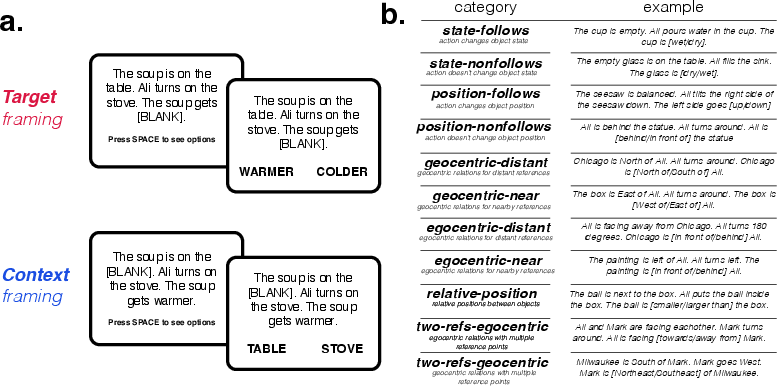
Figure 1: Overview of the evaluation probing human and LLM causal reasoning, depicting the experimental format and summarizing the 11 tested categories.
Humans complete the prompts in a controlled setting; LLM completions are extracted via likelihood scores for each alternative. The evaluation encompasses not only effect (“what happens if…”) but also cause (“what caused…”) framing. Minimal counterfactual variations—prompts differing by a single word—are included to examine fine-grained robustness.
Behavioral Results: Human–LLM Alignment and Errors
The central empirical finding is a high degree of behavioral alignment between humans and LLMs, especially for the best human-aligned models (e.g., gemma-3-27b). Both cohorts exhibit substantial accuracy variance driven by surface-level prompt differences deemed irrelevant under strict world model reasoning. Critically, the best-performing LLMs (e.g., DeepSeek-R1, GPT-5.2) are not those that most closely match human error patterns, indicating a nontrivial dissociation between accuracy and behavioral alignment.
Accuracy is far below ceiling for humans (μ=0.71, σ=0.21), and certain scenario manipulations—like changing a city to a painting in spatial tasks—dramatically degrade both human and LLM performance. Item-level correlations (e.g., r=0.84 for category-level human–gemma-3-27b accuracy) reveal not only shared strengths but also highly similar fail states.
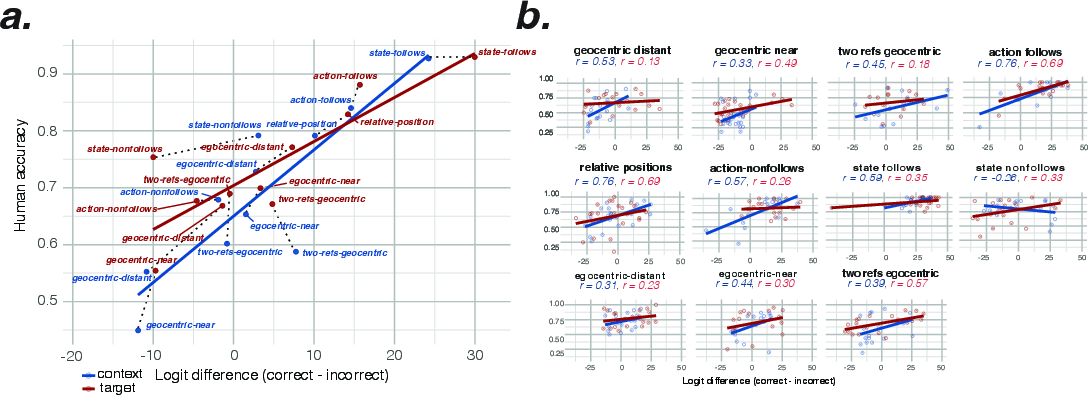
Figure 2: Behavioral results highlighting close alignment between human and LLM accuracy across scenario categories and prompt types.
Minimal counterfactual variations (one-word changes) can flip both human and LLM accuracy from majority-correct to majority-incorrect, clarifying the lack of role-filler independence—a signature of non-compositional, content-sensitive reasoning.
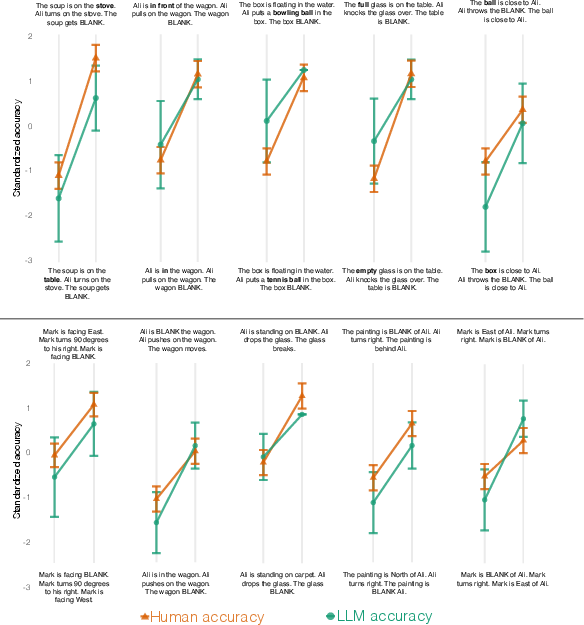
Figure 3: Inconsistencies in human and LLM reasoning across minimal counterfactual prompt pairs, showing similar fail states upon small content changes.
Test-retest data demonstrate that human errors are not mere noise; individuals tend to repeat specific errors across repeated exposure to the same items, supporting the existence of stable, content-sensitive response patterns.
Internal Mechanisms: Interpretability and Causal Circuitry
To probe whether LLMs' pattern-matching behavior is architectural or emergent, the authors conduct mechanistic interpretability analyses targeting attention heads most causally responsible for model predictions, using ablation and activation patching. The circuit-level hypothesis testing distinguishes:
- H1 (World Model): Critical heads track only abstract, causally-relevant relations.
- H2 (Pattern-Matching): Critical heads are highly sensitive to specific prompt content, even if irrelevant to the causal structure.
Activation patching reveals that substituting non-critical content (e.g., replacing “soup” with “rice”) in the prompt drives larger logit changes than swapping structurally critical information, decisively validating H2.
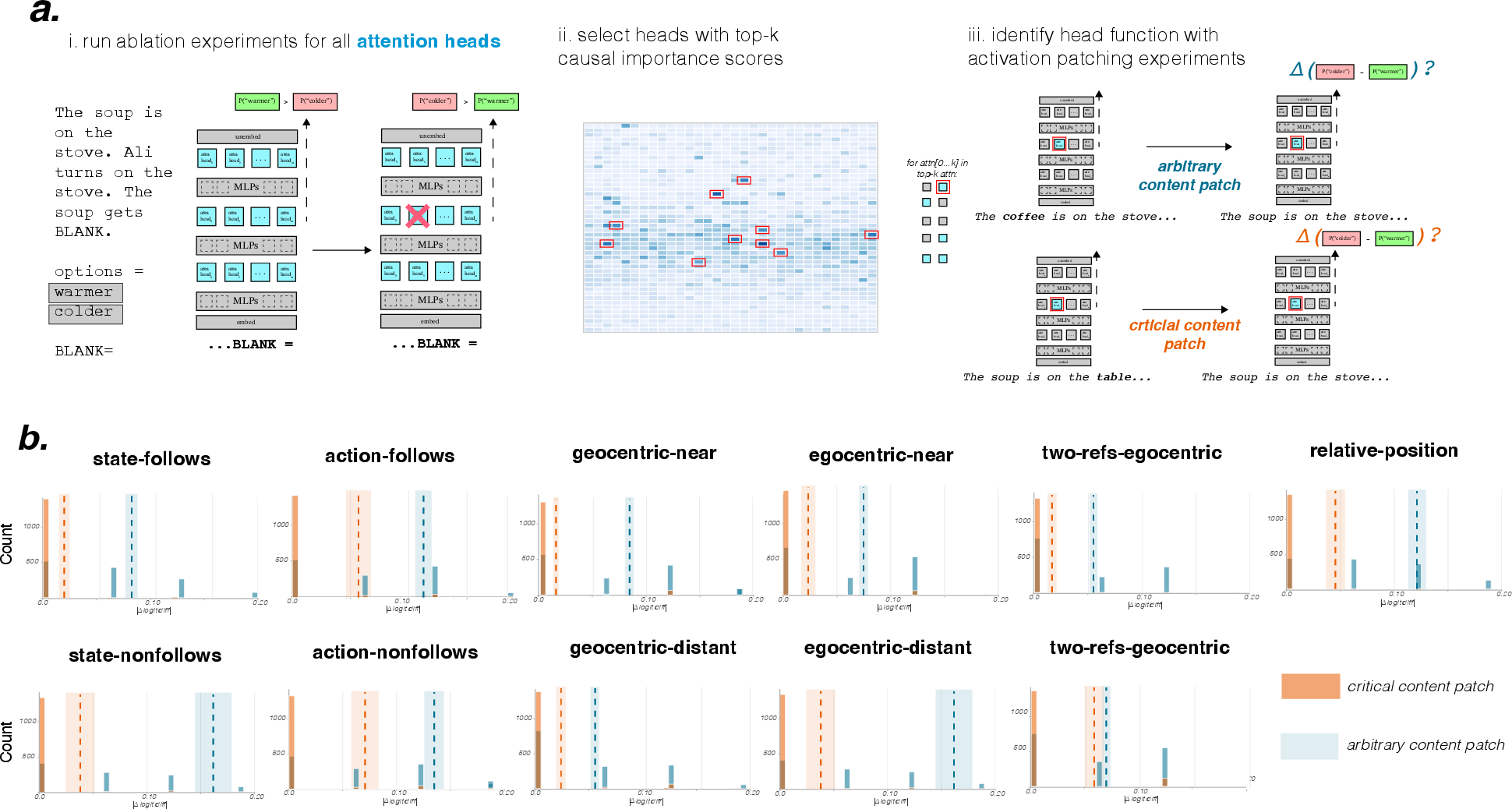
Figure 4: Identification of top-k attention heads by causal importance and demonstration that they are more sensitive to non-critical content substitutions than to causal structure changes.
Furthermore, linear models using entropy-based features from these attention heads robustly predict variance in human response accuracy—including within minimal-difference prompt sets—beyond traditional nuisance predictors like n-gram frequency or small model surprisal.
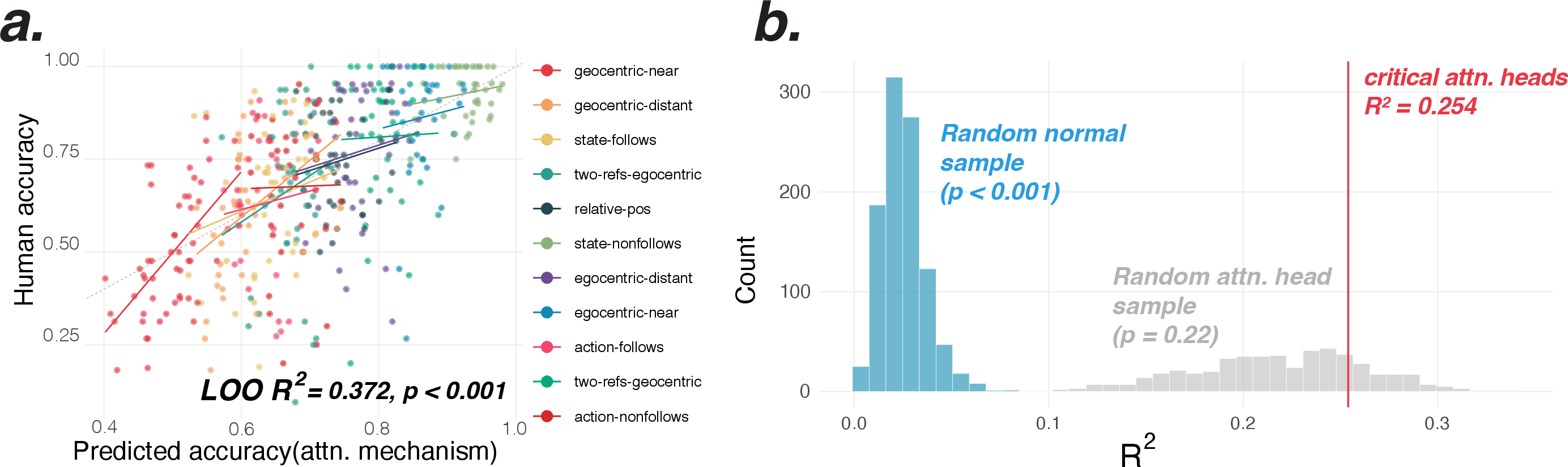
Figure 5: Ground-truth human accuracy versus out-of-sample predictions from linear models using features derived from the top-k causally implicated attention heads.
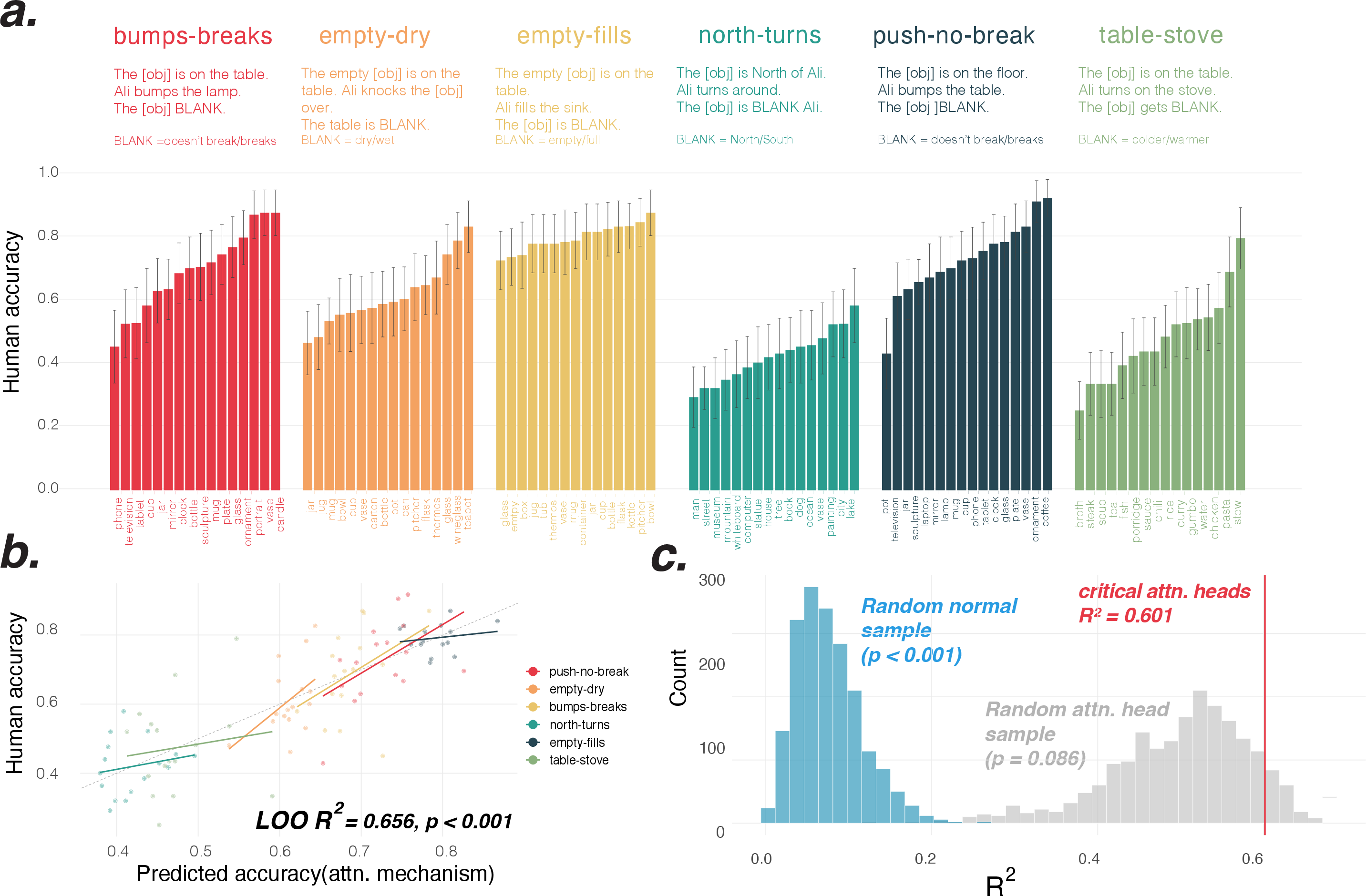
Figure 6: Human accuracy on minimal-difference prompt sets is tightly predicted by activations of content-sensitive, causally implicated attention heads.
Permutation tests confirm that these causally-identified circuits outperform both randomly selected heads and random features, indicating their selectivity in mirroring human error patterns.
Theoretical Implications
These results challenge the strict dichotomy between pattern-matching and abstract world-model-based reasoning, demonstrating:
- Strong empirical alignment: Not only do humans and LLMs achieve similar overall accuracy levels, they fail on the same prompts, and performance is modulated by the same superficial content manipulations.
- Mechanistic overlap: The pattern-matching behavior is not a superficial artifact but is driven by the most causally implicated components of LLMs. Importantly, the internal state of these circuits predicts human error structure.
- Lack of full abstraction: Both systems operate with limited compositionality and role-filler independence; content and context continually modulate the mapping from input to response.
The findings underscore that context and surface content matter for both artificial and biological neural systems. This suggests that pattern matching is a deep property of neural sequence processing, not merely a second-rate substitute for principled model-based reasoning.
Practical and Future Implications for AI
For AI research and application design, these findings have several consequential implications:
- Model evaluation: Aggregate accuracy is insufficient; understanding where and why models deviate from “normative” (world-model-based) reasoning requires attention to aligned error structure.
- Interpretability: Direct circuit-level analysis can reveal model mechanisms predicting both success and systematic failure, guiding targeted interventions or alignment techniques.
- Robustness: Robust generalization requires mechanisms beyond naive abstraction; intentionally incorporating or modulating pattern-matching circuits is crucial for tasks requiring flexible reasoning.
- Human-model comparison: The close mapping between human and LLM errors opens the door for richer cognitive modeling using large neural networks as explicit hypotheses for human reasoning processes.
- Psychological theory: The notion that humans themselves reason via content-sensitive pattern matching, not just principled world model abstraction, may prompt reassessment of cognitive theories in linguistics, philosophy, and AI.
In sum, the convergence between human and LLM reasoning—at both behavioral and mechanistic levels—undercuts the distinction between pattern-matching as a non-reasoning process and classic “reasoning” architectures, reframing how both human cognition and LLM behavior should be interpreted.
Conclusion
This work demonstrates that everyday causal reasoning in humans and LLMs is not fully accounted for by abstract, role-filler-independent world models; instead, both are best characterized as graded, context- and content-sensitive pattern-matching. The attention heads most responsible for LLM decisions encode superficial prompt details, and their activation profiles robustly predict human response patterns, including errors. The findings advocate for a unified account of neural reasoning systems that foregrounds the primacy of content-driven pattern matching across biological and artificial domains, with critical consequences for AI research methodology, cognitive modeling, and our understanding of generalization, abstraction, and reasoning.
(2606.13607)