PaperJury: Due-Process Review for Bounded LaTeX Revision
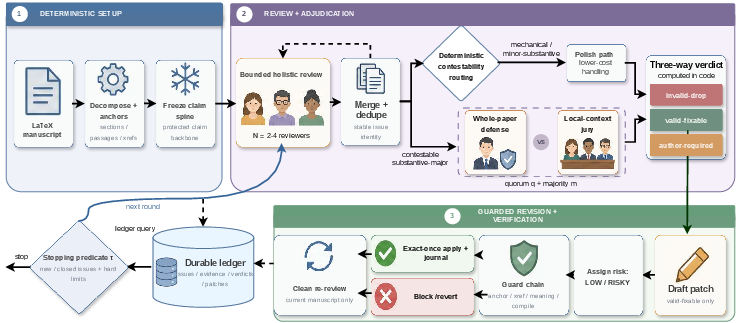
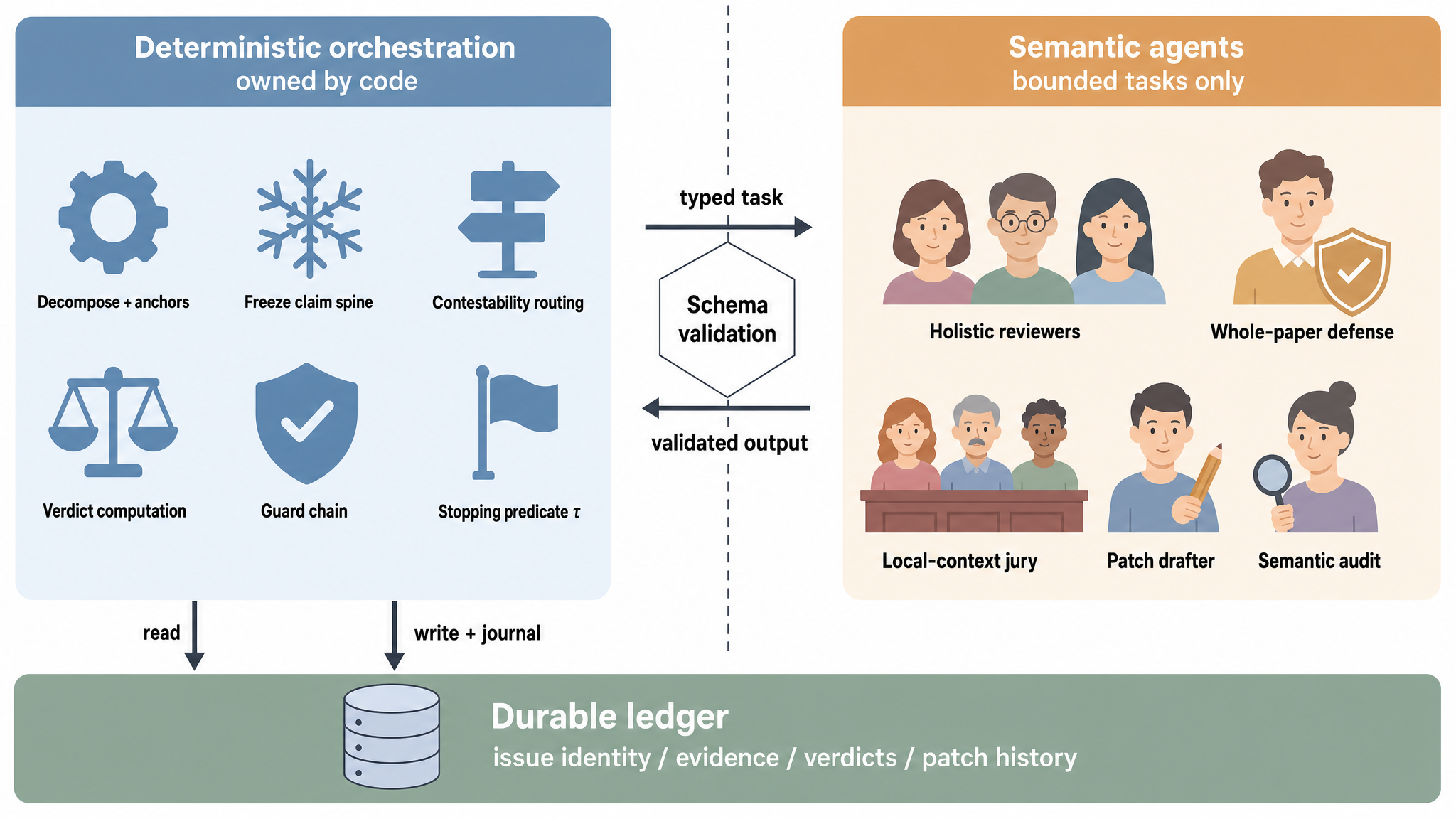
Abstract: Pre-submission hardening of human-authored LaTeX computer science papers differs from drafting assistance because it requires adversarial whole-paper review, explicit no-fix outcomes, and bounded artifact-safe revision. Existing writing assistants, critique generators, and judge-centered loops lack durable issue identity across rounds, deterministic routing from critique to adjudication, and manuscript control that can reject invalid concerns or defer author-dependent ones. We present PaperJury, a closed-loop review-verdict-revise-verify system built on a deterministic-versus-semantic split: deterministic orchestration manages decomposition, a frozen claim spine, a durable ledger, routing, stopping, and exact-once patch application, while semantic agents are limited to bounded review, judgment, and repair. PaperJury combines bounded holistic review, contestability-based routing, a due-process trial, and risk-proportional guard chains for anchor-bounded edits, yielding terminal outcomes of invalid-drop, valid-fixable, and author-required. In a two-arm expert-review evaluation on held-out Vision, natural language processing, and machine learning papers against four baselines, we assess issue quality, verdict and routing quality, edit safety, convergence behavior, and cost, supporting the thesis that load-bearing safety and completion logic should reside in deterministic orchestration rather than model discretion. PaperJury is available at https://github.com/u7079256/paperjury.
Paper Prompts
Sign up for free to create and run prompts on this paper using GPT-5.
Top Community Prompts
Explain it Like I'm 14
Overview: What this paper is about
This paper introduces PaperJury, a tool that helps authors proof‑check and safely improve their LaTeX research papers before they submit them to a conference or journal. Instead of just fixing grammar or making suggestions, PaperJury acts like a careful referee: it looks for serious problems across the whole paper (like claims that aren’t fully supported by the experiments), decides what to do about each problem, and then makes only safe, limited edits—without accidentally changing the main messages of the paper.
Key goals and questions
The authors ask:
- How can we find real, important problems in a paper without wasting time on fake ones?
- How can we decide which problems to fix automatically, which to drop, and which should be left for the human author?
- How can we make sure any automatic edits are safe—meaning they don’t break references, change key claims, or introduce new mistakes?
- Is it better to let AI make the big decisions, or should strict, rule‑based code control the process?
How PaperJury works (in simple terms)
Think of PaperJury as a “mini court system” for your paper, guided by two parts:
- Rule‑based controller (always consistent)
- This is code that follows exact rules and behaves the same way every time.
- It breaks the paper into parts, keeps a stable “logbook” of issues, decides which issues need a full “trial,” and applies edits exactly once.
- It also decides when the system should stop.
- AI readers/writers (smart, but limited)
- These are LLMs that read the paper, spot issues, and suggest fixes.
- They don’t control the workflow; they only do bounded tasks (reviewing, judging with set rules, drafting small edits).
Key ideas and safety checks:
- Frozen claim spine: PaperJury extracts the paper’s main claims (its “backbone”) and locks them. Edits can improve wording or support but can’t quietly change what the paper is claiming.
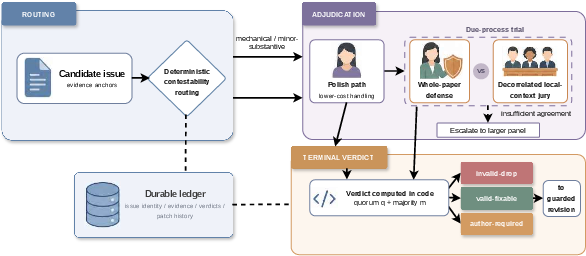
- Due‑process trial: For tricky, important issues, PaperJury runs a structured “mini court.” A “defense” uses whole‑paper context; a separate “jury” looks at local evidence. A verdict is reached by rules, not by one model’s opinion.
- Three possible verdicts:
- Invalid-drop: the complaint is wrong—do nothing.
- Valid-fixable: the issue is real and can be safely auto‑fixed.
- Author-required: the issue is real, but needs author action (like new experiments)—don’t auto‑edit.
- Anchor‑bounded edits: Fixes are tightly limited to the intended spot (like swapping one Lego block without touching the rest).
- Guard chain (safety checks): Before applying any change, PaperJury runs checks for references, meaning drift, LaTeX compiling, and whether a fix is touching too much. Riskier edits get stricter checks.
- Exact‑once patching with a ledger: Every change is recorded and applied only once, so it’s easy to track or revert.
Main findings: What the tests showed
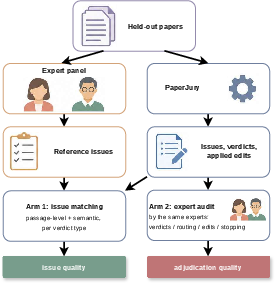
The authors tested PaperJury on real LaTeX papers from computer vision, natural language processing, and machine learning, and compared it to four other approaches (like simple critics, free‑writing rewriters, and “LLM-as-judge” loops).
In plain language, PaperJury:
- Found more real, important problems while avoiding many false alarms.
- Made fewer unsafe edits (it was the safest among systems that actually edit).
- Chose better verdicts (experts agreed with its decisions more often).
- Stopped reliably in about three rounds, without getting stuck going in circles.
- Used time and compute reasonably (not the cheapest, but far from the most expensive).
The authors also removed pieces of PaperJury to see what mattered:
- Without the “mini court” (trial), verdict quality dropped.
- Without the “claim spine” or safety guards, unsafe edits jumped a lot.
- Without bounded review and smart routing, cost went up and overall quality slipped.
Bottom line: putting the “big, load‑bearing” decisions (what to accept, what to fix, when to stop) in the rule‑based controller—and keeping AI focused on reading and drafting—made the system both safer and more reliable.
Why this matters
Good research papers can still hide serious issues that aren’t just typos—contradictions across sections, claims that aren’t backed by results, or edits that quietly change the meaning. PaperJury shows a practical way to:
- Strengthen a paper before submission.
- Avoid risky automatic edits that change key claims or break LaTeX.
- Save authors time by catching real problems and safely fixing the ones that can be fixed.
More broadly, this “due‑process + safety‑first” design could help other AI tools that work with important documents (like legal or medical forms). It suggests a general rule: let strict, predictable code control the workflow and safety, and use AI where it’s best—understanding text and drafting small, checked changes.
The code is available for others to try and build on at: https://github.com/u7079256/paperjury
Knowledge Gaps
Knowledge gaps, limitations, and open questions
Below is a single consolidated list of concrete gaps, limitations, and open questions left unresolved by the paper that future researchers could act on:
- External validity across domains and formats: Generalization beyond LaTeX computer-science manuscripts (e.g., theory-heavy math, systems/HCI, biomedical, social sciences), other authoring formats (Word/Markdown/PDF), multi-file projects with custom macros, and non-English manuscripts is untested.
- Claim spine fidelity: The method for extracting the “frozen claim spine” is not specified or evaluated for precision/recall; its ability to capture implicit claims, mathematical statements, and distributed claims across sections remains unclear.
- Safe handling of numerical content: It is not demonstrated how anchor-bounded edits and guards detect or prevent unsafe changes to numbers in tables/figures or result summaries (without recomputation), and how “result” mutation is programmatically detected.
- Figures, equations, and LaTeX complexity: Guarding and edit-bounding around equations, algorithm floats, complex cross-references, custom environments, and macro-generated text are not characterized; robustness to compile-time idiosyncrasies (BibTeX/biber, glossaries, subfiles) is unknown.
- Risk classification accuracy: The criteria and accuracy for categorizing patches as LOW vs RISKY are unspecified; there is no audit of misclassification rates or their impact on safety, coverage, and cost.
- Guard-chain false positives/negatives: While a 17% guard-block rate is reported, the paper does not quantify how often guards block safe patches (over-conservative) or miss unsafe ones (under-conservative), nor how different guard configurations shift ESVR vs coverage.
- Identity and deduplication in the ledger: Algorithms for durable issue identity, deduplication, and merging semantically similar issues are not described or evaluated; collision and fragmentation rates and their effect on routing and stopping are unknown.
- Deterministic stopping predicate τ: The exact definition, thresholds, and sensitivity of τ are not provided; there is no analysis of premature stopping, oscillations, or failure modes under different τ settings or paper complexities.
- Jury decorrelation mechanism: How “decorrelated local-context jury” independence is enforced (prompting, context isolation, agent diversity) is unspecified; leakage and framing effects between defense and jury are not measured.
- Verdict boundary calibration: The difficult boundary between valid-fixable and author-required drives most errors; no concrete criteria, calibration procedure, or decision aids are provided to improve consistency on this boundary.
- Adversarial robustness: The system’s susceptibility to adversarially written text (e.g., obfuscation, rhetorical misdirection, misleading cross-references) and to strategic “defense” arguments is untested.
- Scalability and cost optimization: Token/runtime costs (≈6.8M tokens and ≈2.5 hours per paper) may be prohibitive at scale; strategies for adaptive budget allocation, early-exit policies, reviewer count tuning, or selective deepening are not explored.
- Model dependence and reproducibility: The paper omits model identities, inference settings (temperature, seeds), and variance across model families; stability across reruns and portability to open-source vs proprietary models are not established.
- Panel-ground truth uncertainty: The expert issue panels as reference standards are not fully specified (panel size, expertise, inter-rater reliability); sensitivity of P_panel/R to alternate panels and the reproducibility of “gold” issues remain open.
- Missing human-in-the-loop evaluation: There is no user study on author experience, trust, cognitive load, or acceptance of verdicts and edits; impacts on writing time, revision quality, and eventual acceptance outcomes are unmeasured.
- Downstream efficacy: The system’s effect on real submission outcomes (e.g., reviewer scores, acceptance rates) and on post-revision error rates is not assessed.
- Baseline coverage: Direct head-to-head comparisons with the most competitive contemporary systems cited in Related Work (e.g., XtraGPT, SWIF2T, TreeReview, multi-agent peer-review frameworks) under matched evaluation harnesses are missing.
- Long-document limits: The bounded holistic review (2–4 reviewers, single pass) may under-cover very long manuscripts; the paper does not test length scaling, memory constraints, or multi-pass/sectional strategies for long-form works.
- Supplementary artifacts: The system does not handle code, data, appendices, or external artifacts; cross-artifact consistency checks (e.g., verifying reported numbers against code logs) remain unaddressed.
- Ethical, privacy, and IP concerns: Risks of uploading confidential drafts to LLMs, ledger data retention, and compliance with double-blind policies and institutional confidentiality requirements are not analyzed.
- Collaboration and concurrency: Exact-once patching and ledger semantics under multi-user concurrent edits (e.g., Git/Overleaf workflows) are not discussed; conflict resolution and merge policies are unspecified.
- Allowing legitimate claim revisions: The frozen claim spine prevents “silent” claim drift but may block warranted reframing; a governed mode for claim-level changes with explicit author consent and stronger review is not provided.
- Contestability routing transparency: The deterministic rules for contestability labeling and routing thresholds are not fully specified; their sensitivity and fairness across issue types/domains are unknown.
- Formal analysis of the trilemma: The precision–recall–cost trilemma is described empirically but lacks a formal framework to optimize budgets, routing thresholds, and guard strengths for target objectives.
- Convergence characterization: Beyond average rounds, there is no analysis of issue birth/closure dynamics, new-issue introduction rates after edits, or conditions guaranteeing convergence vs cycling.
- Generalization across CS subfields: The 12-paper evaluation spans vision/NLP/ML only; applicability to subfields like security, PL, databases, theory, and systems (with different evidence standards) is unknown.
- Non-textual integrity checks: The approach validates compilation and references but does not verify semantic coherence across sections beyond localized audits; whole-paper coherence metrics post-edit are not reported.
- Calibration of q and m (quorum/majority): No sensitivity studies show how jury size, quorum, and majority thresholds affect verdict accuracy, cost, and error profiles.
- Failure taxonomy and diagnostics: The paper reports aggregate metrics (F1, Acc_v, ESVR) but lacks a taxonomy of failure modes (e.g., missed cross-section contradiction, over-zealous surface edits) and diagnostic tools to guide system debugging.
- Public release completeness: The repository is mentioned, but it is unclear whether full prompts, orchestration scripts, guard configurations, and evaluation harnesses (incl. expert audit protocols) are available for exact replication.
- Multilingual and style variation: Robustness to diverse writing styles, heavy use of abbreviations, or non-native English phrasing—and its effect on issue discovery and adjudication—has not been studied.
- Policy compliance and integrity checks: The system does not address plagiarism detection, ethics/IRB compliance, dataset licensing statements, or broader integrity checks often critical in pre-submission hardening.
Practical Applications
Immediate Applications
Below are concrete, deployable use cases that directly leverage PaperJury’s deterministic orchestration, durable ledger, due‑process adjudication, claim spine, anchor‑bounded edits, and guard chains.
Academia and Publishing
- Pre‑submission hardening for LaTeX CS papers (lab and individual author workflows)
- What: Run a CLI/CI pipeline that produces a durable issue ledger, three‑way verdicts (invalid‑drop, valid‑fixable, author‑required), and exact‑once, guard‑verified patches prior to arXiv/journal submission.
- Sector/tools/products: Software/publishing; “PaperJury CLI” as a GitHub Action or Overleaf plug‑in; “Claim Spine View” panel for editors.
- Dependencies/assumptions: Access to competent LLM reviewers; LaTeX projects must compile; authors agree to anchor‑bounded edits; manuscript privacy/compliance guardrails.
- Editorial desk‑check assist for workshops/conferences
- What: Triage incoming LaTeX submissions to separate no‑action items, safe auto‑fixes, and author‑required issues, with a ledgered audit trail for editorial accountability.
- Sector/tools/products: Publishing; integration with OpenReview/HotCRP; “Due‑Process Adjudicator” microservice.
- Dependencies/assumptions: Program chairs willing to adopt machine‑assisted pre‑checks; reviewer policy alignment on machine‑generated fixes.
Software and DevOps Documentation
- Guarded documentation revision in code repos
- What: Apply anchor‑bounded edits to API docs/release notes with a “doc claim spine” (e.g., API guarantees) and exact‑once patching in CI to prevent accidental contract drift.
- Sector/tools/products: Software; “GuardedDoc CI” for Markdown/LaTeX; “API Claim Spine Extractor.”
- Dependencies/assumptions: Docs stored with source; deterministic decomposition of sections/anchors; CI secrets for LLM access; acceptance of three‑way outcomes (some issues escalated).
Education
- Thesis/dissertation and capstone paper hardening
- What: Whole‑document, bounded holistic review for cross‑section contradictions and unsupported claims; safe, reversible edits with a ledger for committee review.
- Sector/tools/products: Education; campus‑hosted “PaperJury@University” with privacy safeguards.
- Dependencies/assumptions: Institutional approval for AI‑assisted editing; LaTeX template compatibility; compute budget control.
Healthcare and Life Sciences (research artifacts)
- Preprint and model card consistency checks (non‑regulated)
- What: Validate that key claims in ML for health manuscripts/model cards are consistent across sections and figures; permit only guard‑passed edits, elevate author‑required items.
- Sector/tools/products: Healthcare research; “Model‑Card Guard” workflow using claim spines for reported metrics.
- Dependencies/assumptions: Not a replacement for regulatory validation; protected health information must be excluded; LaTeX/Markdown structure.
Finance and Compliance (non‑filing drafts)
- Whitepapers and technical disclosures (internal drafts)
- What: Enforce consistency in risk disclosures and metrics through a durable ledger and guard‑verified edits before external release.
- Sector/tools/products: Finance; “Disclosure Ledger” for internal review boards.
- Dependencies/assumptions: Not for official filings without legal sign‑off; secure on‑prem deployment; robust role‑based access.
Policy and Governance (internal memos/guidelines)
- Internal policy draft governance
- What: Apply due‑process triage to policy drafts so that contestable issues are adjudicated and only safely fixable items are auto‑edited.
- Sector/tools/products: Government/NGO; “Policy Due‑Process Assistant.”
- Dependencies/assumptions: Document formats conform to structured markup (LaTeX/Markdown); clear escalation rules for author‑required decisions.
Tools and Platforms
- Overleaf/VS Code extensions exposing safe‑edit workflows
- What: Surface claim spines, anchored diffs, and guard outcomes in‑editor; allow one‑click apply/revert of vetted patches.
- Sector/tools/products: Software tools; “Claim Spine Sidebar,” “Guard Chain Dashboard.”
- Dependencies/assumptions: Editor plug‑in APIs; stable LaTeX AST parsing; user consent for external model calls.
Long‑Term Applications
The following use cases extend PaperJury’s principles beyond LaTeX CS papers and/or require additional research, scaling, or ecosystem change.
Cross‑Format and Cross‑Language Expansion
- Word/Google Docs/HTML support with robust claim extraction
- What: Generalize deterministic decomposition and claim‑spine extraction to rich‑text and web formats; preserve exact‑once patching.
- Sector/tools/products: Office productivity; “GuardedDocs for Word/Docs.”
- Dependencies/assumptions: Reliable cross‑format anchoring; model accuracy on varied layouts/languages; versioning APIs.
- Multilingual scholarly and policy documents
- What: Apply due‑process review in non‑English manuscripts.
- Sector/tools/products: Publishing/policy; localized juror/defense agents.
- Dependencies/assumptions: High‑quality multilingual LLMs; locale‑specific style and legal standards.
Regulated Documentation and Submissions
- Regulatory submission prep (eCTD sections, audit trails)
- What: Use three‑way verdicts to gate which changes are automated vs escalated; maintain ledgered provenance for audits in FDA/EMA workflows.
- Sector/tools/products: Healthcare; “RegDoc Guard” tying guard chains to CFR/ICH checklists.
- Dependencies/assumptions: Formal validation and compliance approval; domain ontologies; human final sign‑off; secure, on‑prem deployment.
- Financial filings and earnings reports
- What: Anchor‑bounded edits with claim spines mapping to material statements; deterministic stopping with executive/legal review.
- Sector/tools/products: Finance; “10‑K/10‑Q Guardrail Suite.”
- Dependencies/assumptions: Regulatory acceptance; integration with disclosure controls; strict change‑control governance.
Multi‑Artifact and System‑of‑Record Governance
- Cross‑document consistency across paper, supplement, code, and website
- What: Maintain a shared claim spine spanning multiple artifacts; verify edits don’t silently desynchronize claims/results.
- Sector/tools/products: Software/science; “Cross‑Artifact Ledger.”
- Dependencies/assumptions: Robust cross‑repo linking; consent to centralized governance; tooling to parse varied artifacts.
- Knowledge‑base and encyclopedia maintenance
- What: Treat each fact as a claim with a spine; anchor‑bounded updates with due‑process trials for contested facts.
- Sector/tools/products: Education/reference; “Claim‑Centric KB Maintainer.”
- Dependencies/assumptions: Provenance metadata, citation retrieval; community arbitration models.
Code‑Aware Documentation and API Governance
- Coupled code+docs updates with contract‑aware spines
- What: Use API signatures/tests as a “code claim spine”; allow doc edits that pass contract checks, escalate risky changes.
- Sector/tools/products: Software/DevOps; “API Contract Guard.”
- Dependencies/assumptions: Stable AST/contract extraction; CI integration with test suites; synchronized versioning.
Safety‑Critical Operational Manuals
- Robotics/energy SOP updates with hazard‑aware guards
- What: Extend guard chains to include safety analysis (e.g., checklists, references to risk assessments) before applying edits.
- Sector/tools/products: Robotics/energy; “Safety Manual Guard.”
- Dependencies/assumptions: Formal hazard models; domain checkers; human safety officer sign‑off; liability frameworks.
Education Platforms and Assessment
- Due‑process writing tutor with escalations to instructors
- What: Provide students with bounded critiques, safe local edits, and a ledger of author‑required items requiring human feedback.
- Sector/tools/products: EdTech/LMS; “Due‑Process Tutor.”
- Dependencies/assumptions: Pedagogical acceptance; anti‑plagiarism integration; tiered privacy controls.
Civic Law and Governance
- Legislative drafting with contestability and auditability
- What: Apply defense/jury adjudication to contested clauses; anchor‑bounded changes with immutable audit trails.
- Sector/tools/products: Civic tech; “Civic Draft Guard.”
- Dependencies/assumptions: Legal/ethical frameworks; public transparency requirements; multi‑stakeholder jury design.
Enterprise AI Orchestration
- Deterministic control for agentic workflows beyond documents
- What: Adopt the ledger, deterministic routing, three‑way verdicts, and exact‑once application to marketing copy, customer comms, or policy updates.
- Sector/tools/products: Cross‑industry; “Agent Orchestrator with Due‑Process.”
- Dependencies/assumptions: Tooling that surfaces intermediate traces; alignment with internal change‑control processes; scalability and observability.
Notes on Core Assumptions Across Applications
- Deterministic decomposition and stable anchoring are feasible for the target format(s).
- Claim‑spine extraction accurately captures material commitments; teams accept a norm that claim‑level changes require explicit escalation.
- LLMs provide reliable, bounded holistic review within cost constraints; domain‑expert supervision remains available for “author‑required” items.
- Privacy, IP, and compliance requirements are satisfied (e.g., on‑prem deployment, data retention policies).
- Organizations adopt three‑way outcomes and deterministic stopping instead of free‑form, model‑driven looping.
Glossary
- ablation table: a results table that reports performance when components are removed or varied to analyze their contribution. "An ablation table announces the best result on a benchmark,"
- adjudication: the decision-making process that determines which issues to accept, reject, or escalate. "The first is adjudication: which complaints to honor, and when to stop."
- agentic workflows: multi-step, tool-using AI processes that autonomously plan and act, emphasizing control over intermediate steps. "the dominant safety surface in agentic workflows lies in the models' intermediate execution traces"
- anchor-bounded diff checks: safeguards that restrict and verify changes to only the targeted anchored text spans. "The guard chain includes anchor-bounded diff checks, cross-reference checks, semantic meaning or edit audits when triggered, compile checks, and application journaling."
- anchor-bounded edits: constrained edits localized to predefined anchors to limit unintended document changes. "risk-proportional guard chains for anchor-bounded edits,"
- anchor drift: movement or misalignment of previously defined text anchors, causing references or guards to mis-target content. "structural failures such as reference breakage, anchor drift, or silent claim mutation remain possible."
- anti-skim checks: automated tests that detect superficial review and prompt deeper rereads for coverage and grounding. "invokes targeted re-read only when deterministic anti-skim checks indicate missed coverage or weak grounding,"
- artifact-safe LaTeX revision: editing procedures that ensure changes do not corrupt the document’s structure, references, or claims. "artifact-safe LaTeX revision with a frozen claim spine, anchor-bounded edits, or orchestrator-controlled apply and revert semantics"
- blast radius: the scope of unintended side effects caused by an edit. "no reliable way to bound its own blast radius,"
- bounded holistic review: whole-paper assessment with explicit limits on reviewers and scope to balance quality, cost, and recall. "PaperJury then runs bounded holistic review with a small set of whole-paper reviewers."
- clean re-review: a fresh, full reread of the updated manuscript that ignores previous model outputs to surface new issues. "After guarded edits, PaperJury performs clean re-review on the current manuscript state"
- closed-loop review-verdict-revise-verify system: an iterative pipeline that cycles through critique, judgment, revision, and validation with controlled stopping. "We present PaperJury, a closed-loop review-verdict-revise-verify system"
- compile-aware validation: checks that ensure LaTeX edits still compile successfully as part of safety gating. "guarded variants use compile-aware validation under orchestrator-controlled apply and revert semantics."
- contestability label: a tag indicating how disputable an issue is, used to route it to the appropriate adjudication path. "assigns each issue a deterministic contestability label and routes it accordingly."
- contestability-based routing: directing issues to different processes based on how contestable or consequential they are. "contestability-based routing,"
- decorrelated local-context jury: a panel that evaluates issues using localized evidence while being separated from prior reviewer framing. "a decorrelated local-context jury evaluates it"
- deterministic decomposition: a reproducible partition of the manuscript into structured units (sections, passages, anchors) before semantic processing. "The pipeline begins with deterministic decomposition through "
- deterministic orchestration: control logic implemented in code that governs state, routing, stopping, and patching consistently across runs. "deterministic orchestration manages decomposition, a frozen claim spine, a durable ledger, routing, stopping, and exact-once patch application,"
- deterministic outer-loop convergence: a guaranteed, rule-based stopping condition for iterative review cycles. "deterministic outer-loop convergence"
- deterministic routing: rule-based, reproducible assignment of issues to adjudication paths rather than relying on model judgment. "deterministic routing from critique to adjudication"
- deterministic-versus-semantic split: architectural separation where deterministic code handles control and safety, while models handle reading and drafting. "built on a deterministic-versus-semantic split:"
- due-process adjudication: a structured, two-sided evaluation process that provides defense and impartial judgment for contested issues. "durable state, due-process adjudication, and deterministic stopping"
- due-process trial: a formal, procedural evaluation of contestable issues with defense and jury components. "contestable issues enter a due-process trial"
- durable issue identity: persistent identifiers that track the same issue across review rounds. "lack durable issue identity across rounds"
- durable ledger: a long-lived record of issues, evidence, verdicts, and edits maintained across iterations. "A durable ledger gives each issue a stable identity across rounds,"
- exact-once patch application: a guarantee that approved edits are applied a single time and not duplicated across runs. "exact-once patch application,"
- execution cap: an upper limit on the number of review rounds to bound cost and runtime. "subject to a five-round execution cap."
- frozen claim spine: an extracted, protected set of core claims that revisions must not alter. "the system first decomposes the manuscript and extracts a frozen claim spine"
- guard chain: a sequenced set of structural and semantic checks that a proposed edit must pass before application. "screened by a risk-proportional guard chain"
- Guardrailed Agent Workflows: workflows for AI agents with safeguards to validate intermediate steps and outputs. "Guardrailed Agent Workflows"
- ledger-query predicate: a deterministic rule evaluated over the ledger state to decide when to stop iterating. "stops when a deterministic ledger-query predicate"
- LLM-as-a-Judge: the use of LLMs to score or decide outcomes, often with known biases. "Studies of LLM-as-a-Judge report systematic scoring and position biases,"
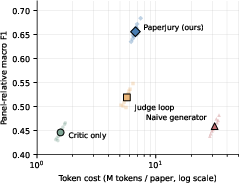
- panel-relative F1: F1 computed relative to an expert panel’s issues, combining precision and recall under that reference. "attains the best panel-relative F1 (0.656, vs.\ 0.519 for the judge-centered loop)"
- paired-bootstrap: a resampling method that pairs observations to estimate confidence bounds on performance differences. "paper-cluster paired-bootstrap 95\% lower bounds"
- precision-recall-cost trilemma: the three-way trade-off between finding more real issues, avoiding false ones, and controlling budget. "under a precision-recall-cost trilemma:"
- risk-proportional guard chains: variable-strength validation pipelines that scale with the assessed risk of a proposed edit. "risk-proportional guard chains for anchor-bounded edits,"
- schema-validated semantic agents: model components whose inputs/outputs conform to predefined schemas to ensure structural correctness. "deterministic orchestration over schema-validated semantic agents"
- silent claim mutation: unintended changes to the meaning or commitments of a claim introduced by edits. "silent claim mutation"
- stopping predicate: a deterministic condition that triggers termination of the review loop without model self-assessment. "deterministic stopping predicate for unattended execution"
- two-arm expert-review evaluation: an experimental design with two complementary expert-based assessment procedures. "We use a two-arm expert-review evaluation on a held-out corpus of LaTeX computer science papers"
- typed, validated workflow: a structured process with explicit types and validations that constrain and check each generation step. "placing generation inside a typed, validated workflow rather than leaving structure and state identity to unconstrained model behavior"
Collections
Sign up for free to add this paper to one or more collections.

