- The paper introduces FMD to mitigate demographic bias in MCI detection, achieving significant performance gains over state-of-the-art models.
- It employs a novel cross-modal fusion strategy that integrates speech, text, and image modalities to capture subtle cognitive impairment cues.
- Adversarial unlearning via gradient reversal enforces demographic invariance, resulting in improved fairness and robust transferability across datasets.
Fair Cognitive Impairment Detection Through Unlearning: Methodology and Impact
Introduction
The paper "Fair Cognitive Impairment Detection Through Unlearning" (2606.18571) addresses persistent demographic bias issues in machine learning-based Mild Cognitive Impairment (MCI) detection via spontaneous speech. The authors focus on the tendency of models to exploit spurious demographic correlations, which create substantial performance disparities across subgroups distinguished by factors such as sex and language. The proposed method, FMD, tackles this challenge through a combination of advanced cross-modal fusion and adversarial unlearning strategies to enforce demographic invariance in learned representations, enabling more equitable and robust MCI diagnosis.
Multimodal Architecture and Cross-Modal Fusion
The FMD framework employs unimodal encoders for speech, text, and image modalities, followed by an innovative cross-modal (CM) fusion module. Unlike prior approaches using late concatenation, the CM fusion leverages cross-attention to align and integrate modalities at a finer granularity. This mechanism enables contextual grounding and dynamic interaction among speech, text, and visual cues, which are critical for capturing subtle cognitive impairment markers that may be expressed distinctly across modalities. The resulting joint embedding facilitates enhanced discrimination of MCI features while minimizing modality-specific biases.
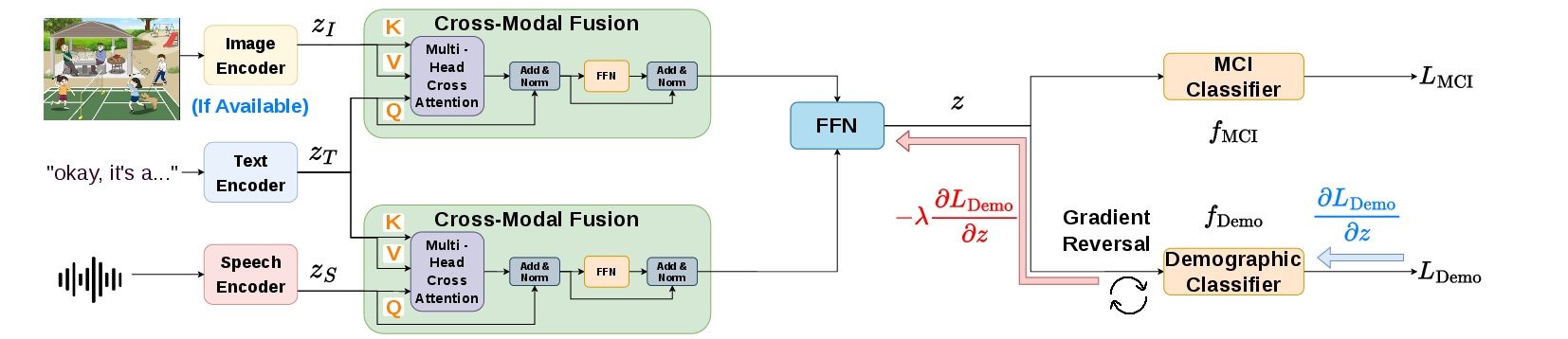
Figure 1: Architecture of FMD, illustrating CM fusion for integrated modality interaction and the UL module for demographic bias removal via gradient reversal.
Demographic Bias Unlearning via Gradient Reversal
Building on the multimodal backbone, the FMD approach embeds an adversarial unlearning (UL) module to eradicate task-irrelevant demographic attributes from shared representations. An auxiliary classifier fDemo is trained to predict demographic labels; critically, its gradients are reversed while updating the encoders, incentivizing the model to encode features that are predictive of MCI but uninformative regarding demographic variables. The UL module employs a curriculum-scheduled gradient reversal coefficient λ, gradually increasing adversarial pressure—optimizing stability and efficacy as task-relevant features mature during training.
This combination yields representations robust to demographic confounders and is theoretically aligned with invariance principles in domain adaptation. The practical implication is a reduced reliance on demographic shortcuts, rectifying known fairness deficiencies in speech-based cognitive assessment models.
Experimental Setup and Baseline Comparison
Evaluations are conducted on two multilingual benchmarks: TAUKADIAL (387 samples, tri-modal inputs) and PREPARE (1,644 samples, bi-modal inputs). The experimental design employs stratified 10-fold cross-validation and comparisons against a range of SOTA models, including Whisper, XLSR, CogniVoice, and debiasing techniques (DFR, KW). Metrics focus on F1 score, worst-group F1 (WG), and performance gap across protected attributes (sex and language).
FMD exhibits strong empirical superiority:
- On TAUKADIAL, FMDLang achieves 92.6 average F1, outperforming CogniVoice's 84.1.
- On PREPARE, FMDSex reaches 60.1 average F1, markedly higher than all baselines.
- Worst-group F1 and fairness gap demonstrate significant improvement, e.g., FMDLang achieves a WG F1 of 90.9 (TAUKADIAL), outstripping baselines by >9 absolute points.
These results indicate that both the CM fusion and UL modules contribute substantively to predictive accuracy and fairness. Ablation studies further validate that removing either component yields notable reductions in performance and subgroup parity.
Robustness and Generalization under Domain Shift
Zero-shot transfer experiments reveal enhanced generalization of FMD under distributional shift. Training on TAUKADIAL and testing on PREPARE, FMDSex achieves 42.3 overall F1 versus CogniVoice's 38.7, alongside reductions in performance gap. Similar trends prevail for PREPARE to TAUKADIAL transfer. These results underscore that demographic unlearning cultivates representations resilient to dataset-specific biases, a critical requirement for clinical deployment across diverse patient populations.
Probing analyses using logistic regression classifiers demonstrate that FMD suppresses demographic information in shared representations. The probe accuracy on sex and language for FMD are 61.7 and 62.3, respectively, compared to CogniVoice's 71.2 and 68.5. Though some residual bias remains, FMD's adversarial methodology consistently narrows the gap toward a theoretically unbiased model.
Implications and Future Directions
The explicit adversarial unlearning enhances not only fairness but also downstream robustness and transferability. Methodologically, CM fusion presents a template for multi-modal clinical inference tasks requiring fine-grained integration. Theoretical implications extend to representation learning, suggesting that adversarial constraint-based approaches can enforce causal feature selection even under severe label confounding.
Future work may focus on more aggressive demographic invariance, employing stronger adversarial probes or integrating causal discovery mechanisms. Extensions to additional protected attributes (e.g., age, education) and larger-scale longitudinal MCI datasets are warranted. Moreover, adaptive curriculum scheduling of the gradient reversal coefficient may further stabilize convergence and bolster fairness.
Conclusion
The FMD framework advances the state-of-the-art in fair MCI detection by synergizing cross-modal fusion with demographic bias unlearning. The approach delivers superior overall performance, reduced subgroup disparity, and enhanced transferability across multilingual datasets. These results provide a principled pathway for reliable and equitable speech-based cognitive assessment, with broad applicability to fairness-critical medical AI systems.