- The paper establishes an empirically validated UX framework for human-AI interaction in business contexts.
- It employs mixed-methods research, including participatory workshops, interviews, and conjoint experiments, to quantify key design criteria.
- Results highlight transparency and accountability as dominant factors influencing user preferences, with clear implications for enterprise AI adoption.
Authoritative Summary of "Human-AI Agent Interaction in a Business Context" (2606.18716)
Context and Motivation
The transition toward agentic AI in enterprise environments has fundamentally reshaped Human-Agent Interaction (HAI). Traditional UX frameworks, designed for tool-based automation, are inadequate for capturing the complexity arising from autonomous, goal-directed agents that undertake context-sensitive actions, provide natural language interfaces, and assume roles previously reserved for humans. This paper systematically addresses the gap in empirically grounded UX principles and criteria for business-critical agentic AI, leveraging a mixed-methods research design to develop, validate, and quantify a domain-specific framework for positive human-AI agent interaction.
Research Design and Methodological Overview
The study employs a rigorously triangulated methodology anchored in:
- Participatory Design Workshops: Direct engagement with domain experts and end users to elicit tacit knowledge and articulable criteria for positive agent interaction.
- Expert Review and Qualitative Meta-Analysis: Systematic aggregation of heterogeneous literature and standards to synthesize eight core UX principles with granular criteria.
- Paper-and-Pencil Survey: In-person surveys with role-specific groupings to prioritize principles and capture independent, standardized responses.
- Semi-Structured In-Depth Interviews: Thematic analysis of contextual factors influencing principle prioritization, employing deductive-inductive coding.
- Choice-Based Conjoint Experiment: Empirical evaluation of causal impacts of individual UX criteria (e.g., transparency, human control) on design preference via AMCEs, analyzed as conditional logistic regression with robustness checks.
Framework Construction and Principle Validation
Eight validated UX principles were identified, clustered with 36 underlying criteria:
- Human Control: Ultimate authority rests with the user, encompassing intervention, override, and disengagement mechanisms; critical decisions require explicit human confirmation.
- Reliability, Safety, Robustness: Accurate outputs without hallucinations, up-to-date sources, risk indicators, audit trails.
- Data Privacy & Governance: Strict privacy protections, robust security standards, role-based access controls, consent management.
- Context Awareness: Agents are role-sensitive, maintain task context, leverage uploaded data, operationalize persistent guidance.
- Transparency & Explainability: Verifiable outputs, clear reasoning, traceability of actions and logic.
- Ecosystem Integration: Seamless access across enterprise systems, complexity abstraction, orchestration of workflows.
- Collaborative Partnership: Orchestrating agents coordinate multi-agent teams, enable addition/removal of agents, preserve oversight.
- Responsiveness & Intuitiveness: Conversational UI, status/progress visibility, basic usability requirements.
Survey results ranked "Human Control" as the most critical, followed by "Reliability, Safety, and Robustness," and "Data Privacy and Governance." Criteria were consistently evaluated in the context of organizational risk, accountability, and workflow integration.
Empirical Quantification: Conjoint Experiment
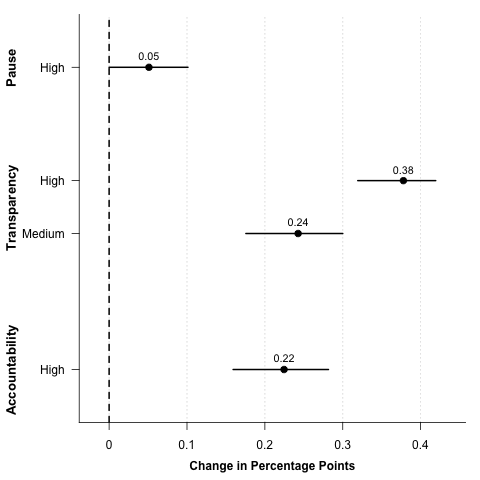
The conjoint experiment explicitly operationalized the "Human Control" principle by manipulating three criteria (stop/pause, transparency, accountability) across 12 prototype screens simulating a logistics scenario. Analysis revealed:
These results indicate transparency exerts the dominant influence on user preference, followed by accountability mechanisms. Robustness checks (Bonferroni correction, fatigue effects, response time exclusion) confirm the stability of transparency and accountability findings.
Theoretical and Practical Implications
Theoretical Extensions
This work advances the HCAI and UX 3.0 paradigms by empirically substantiating domain-specific principles for enterprise agentic AI. It demonstrates the necessity to elevate human control, safety, privacy, and contextual integration from abstract design imperatives to actionable, measurable criteria driving adoption and trust in organizational workflows. The dynamic nature of transparency preferences—adjusting according to task complexity and user experience—challenges monolithic explainability models, advocating graduated transparency and selective detail.
Practical Recommendations
For product development teams targeting agentic AI in business contexts, prioritization should be placed on:
- Implementing transparency via clear task status, next actions, and accessible reasoning with expandable detail.
- Embedding explicit accountability signals, especially for low-confidence outputs.
- Strict enforcement of privacy and governance protocols, role-based access, and consent design.
- Seamless integration into enterprise ecosystems and robust orchestration of workflows.
The empirical evidence supports detailed agent workflows and accountability signals as primary levers to foster trust and positive experience in business-critical settings.
Limitations and Future Directions
Limitations include sample self-selection, potential industry bias, constraint to users experienced with AI agents, and company-specific UI guidelines influencing prototype screens. External validity depends on accurate scenario comprehension. Future research should explore heterogeneous treatment effects across user subgroups, alternative implementation modalities for UX criteria, and expand conjoint analysis to include privacy and governance principles.
Conclusion
This paper establishes an empirically validated, domain-specific framework for UX in human-AI agent interaction within business contexts. Transparency and accountability are quantified as paramount for user preference, with practical implications for agent design and organizational AI adoption. Ongoing research should extend this empirical paradigm to measure heterogeneous effects, test additional principles, and refine prototype-driven UX evaluation for agentic AI in enterprise environments.