Learning User Simulators with Turing Rewards
Abstract: Learning to simulate human users in interactive settings could advance the training of agent assistants, evaluation of personalization systems, research in the social sciences, and more. Existing approaches generally do so by training a LLM to match a single ground truth response, either by maximizing the log probability or by using a similarity reward. We instead propose {Turing-RL}: a Turing-Test-based reinforcement learning approach for training user simulator models. {Turing-RL} uses a discriminative Turing reward with an LLM judge to score how indistinguishable a generated response is from the real user's given the user's history, and the user simulator LLM learns to produce responses indistinguishable from what the user could have said with such rewards. Across two different domains--conversational chat and Reddit forum discussion--we find that {Turing-RL} consistently outperforms baseline methods on both LLM and human evaluation metrics. Our study suggests that optimizing for indistinguishability, rather than response matching, is effective for learning user simulators.
Paper Prompts
Sign up for free to create and run prompts on this paper using GPT-5.
Top Community Prompts
Explain it Like I'm 14
What this paper is about (the big idea)
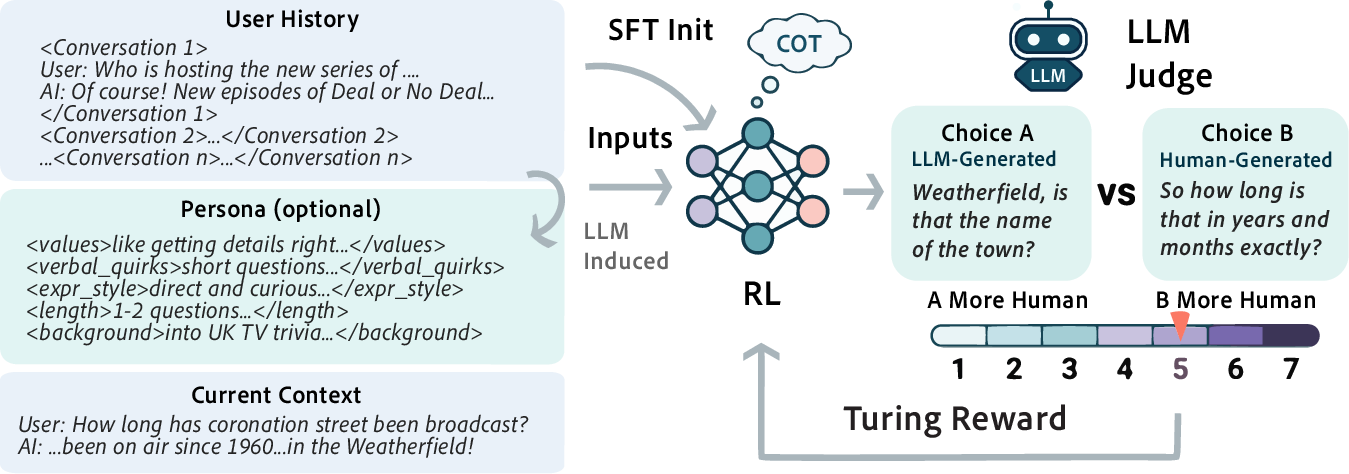
This paper is about teaching AI models to play the role of a human user in conversations—like pretending to be a specific person in a chat or on a forum—so other AIs can practice talking to them. Instead of copying exactly what a person said, the authors train the AI to sound so much like that person that a judge can’t tell the difference. They call their approach Turing-RL because it’s inspired by the Turing Test (a classic “can you tell if it’s a human?” game) and uses reinforcement learning (learning from rewards).
What questions the researchers asked
- Can we train an AI “user simulator” to write replies that are not just similar to a real person’s message, but actually feel indistinguishable from what that person could have said?
- Is optimizing for “human-likeness” better than simply matching the exact words or content of a real reply?
- Will this approach work across different kinds of conversations, like chat sessions and Reddit threads?
- Do both AI judges and human judges think the simulator is convincing?
How they did it (methods in simple terms)
Think of this like a drama class where a student is learning to impersonate a real person:
- Step 1: Learn the part
- The AI is given a “character sheet” for a user made from:
- History: a small pack of that user’s past messages.
- Persona: a short summary of the user’s style and traits, written by another AI after reading the history.
- This helps the simulator learn how the person tends to write and think.
- Step 2: Practice with feedback (the Turing Test style reward)
- For a given conversation, the AI writes a reply in the user’s voice.
- A separate “judge” AI sees two replies: the real human’s and the simulator’s, plus the user’s past messages. The judge scores which one seems more likely to be from the real user.
- The simulator gets a higher reward when the judge can’t tell it apart from the human. This is like practicing a mimicry routine and getting points when the audience is fooled.
- Step 3: Careful scoring to avoid bad habits
- The reward is capped so the model doesn’t chase weird tricks that “game the judge.” This helps prevent reward hacking.
- Step 4: Two training phases
- First, basic training (like memorizing lines): the model learns from examples of real replies and “reasoning traces” (short explanations of why a user might say something).
- Then, reinforcement learning (like rehearsals with a coach): the model tries many responses and improves based on the judge’s scores.
- What they compared against
- A “similarity” approach: reward the model for saying things semantically close to the real reply.
- A “log-probability” approach: reward the model when it assigns high likelihood to the real reply (a fancy way of maximizing “predict the exact message”).
- They checked whether their Turing-style reward beats these.
Where they tested it
- Chat conversations (multi-turn chats between people and assistants).
- Reddit discussions (users posting and replying in threads).
- They used both AI judges and real people to test whether the simulator’s replies were believable.
What they found (main results)
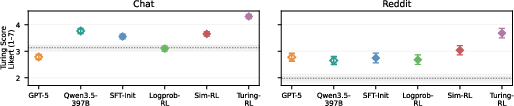
- The Turing-RL method made the simulator’s replies harder to distinguish from real users’ replies than the other methods, in both chat and Reddit.
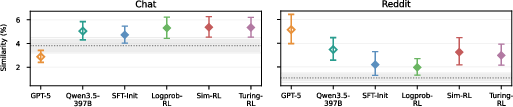
- It didn’t sacrifice content: even though the model wasn’t explicitly told to “match the exact content,” it still stayed about as similar to the real reply as the similarity-focused method.
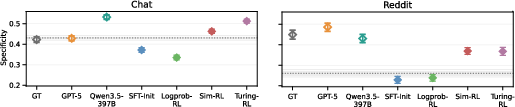
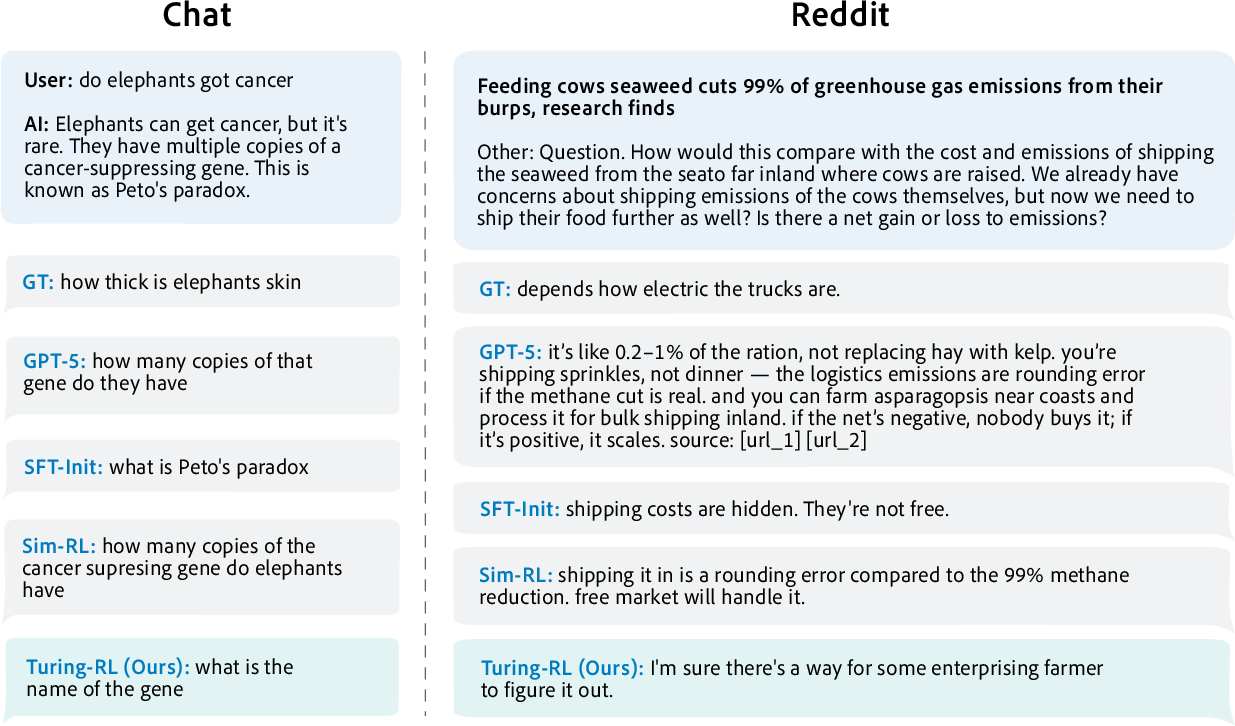
- The replies were more grounded in the actual conversation and better matched the user’s style, not just generic “assistant-like” messages.
- Human judges agreed with the AI judges on the overall direction: the Turing-RL simulator was more convincing than the version trained only with standard methods, especially in chat.
A useful detail: Bigger general-purpose models (like fancy chatbots) didn’t automatically do better at sounding like specific users; they often sounded too formal or assistant-like. Training specifically for “indistinguishability from the person” worked better.
Why this matters
- Training and testing assistants: If we can simulate real users well, we can safely and cheaply train AI assistants to handle many kinds of people and situations.
- Personalization research: Simulators that capture how specific users talk and think can help build systems that adapt to individuals more effectively.
- Social science: Large-scale, realistic user simulators can help researchers explore questions about online behavior without needing to recruit thousands of participants.
Notes, limits, and care
- Limits: They tested on two domains (chat and Reddit) and used a mid-sized base model. The method also relies on an AI judge, which could have its own biases.
- Ethics and safety: A model good at imitating a person could be misused for impersonation or scams. The authors stress using public/consented data and recommend safeguards like watermarking and detectors.
Bottom line
Instead of training a simulator to match exactly what a person said, train it to be indistinguishable from what the person could have said. In tests with both AI and humans, this “Turing-style” reward produced more human-like, context-aware, and user-specific responses—without losing content faithfulness.
Knowledge Gaps
Knowledge gaps, limitations, and open questions
Below is a concise, actionable list of what remains missing, uncertain, or unexplored in the paper.
- Judge dependence and robustness: Sensitivity of Turing-RL performance to the specific training judge (Qwen3.5-397B-A17B) is not quantified. Replicate results with diverse judges (different families/sizes and prompting) and test cross-judge generalization.
- Reward cap effects: The cap at 5/7 to mitigate reward hacking is motivated but not ablated. Vary caps or use soft penalties to quantify trade-offs between human-likeness, reward hacking, and diversity.
- Pairing with ground truth in the judge: The Turing reward compares a model response against a single human reference. Test “unpaired” judges (judge sees only model response + history) or tournament-style multi-candidate comparisons to reduce anchoring on the specific ground truth.
- RL vs preference optimization: Compare GRPO-based Turing-RL with offline preference learning (e.g., DPO on Turing preferences) and reward-model distillation to reduce inference-time judge calls and improve stability.
- Hyperparameter/sample-efficiency ablations: No analysis of group size, number of candidates per step, KL/entropy regularization, or learning-rate schedules on stability and final quality.
- Length penalty impact: The added length penalty may tether outputs to the ground truth and partially reintroduce response-matching. Ablate or replace with non-reference-based controls (e.g., target-length distributions).
- Chain-of-thought (CoT) necessity: CoT is used for SFT and RL but not ablated. Evaluate Turing-RL without CoT, with hidden CoT, or with alternative reasoning formats to assess necessity, leakage, and potential self-justification artifacts.
- Persona induction pipeline: Only limited ablation of persona inductor models is provided. Systematically vary inductor models, prompts, and summarization lengths; assess persona factuality, stability, and bias; and test effects on downstream indistinguishability.
- History length and recency: The block size k is sampled from a small range but its influence is not quantified. Measure performance vs available history length, recency weighting, and history selection strategies (e.g., retrieval vs fixed block).
- Cold-start users: No evaluation when little or no user history is available. Benchmark few-shot and zero-history regimes; explore meta-learning or rapid adaptation.
- Nonstationarity and drift: User interests evolve. Test Turing-RL with time-split histories to measure robustness to temporal drift and the benefits of online or continual adaptation.
- Long-horizon behavior: Evaluation targets single turns (e.g., last comment). Assess coherence and identity stability over multi-turn rollouts and full-thread simulations, including cascading effects on later turns.
- Domain breadth: Only two domains (PRISM chat, Reddit). Evaluate task-oriented dialogue, negotiation, collaborative problem-solving, and other social platforms; test multilingual, multimodal, and code-heavy settings.
- Demographic and cultural generalization: PRISM spans many countries, but no subgroup analysis. Measure performance variance across demographics/cultures and investigate fairness/representation gaps.
- Safety and norm adherence: No toxicity, misinformation, or harmfulness audit. Quantify safety metrics (e.g., Toxicity, harassment, hallucinations) before/after Turing-RL and compare to baselines.
- Impersonation safeguards: The paper notes dual-use risks but does not implement defenses. Evaluate watermarking, provenance metadata, and detector robustness against these simulators.
- Privacy risks: Training conditions on real user histories; privacy leakage and membership inference risks are not assessed. Conduct formal privacy analyses and explore DP or synthetic-history alternatives.
- Human evaluation scope: Human Turing tests are small (100 items/domain, 6 raters/item), binary-choice only, and not from target users. Increase sample sizes, collect graded judgments, measure inter-rater reliability, and include target-user self-assessments.
- Human vs LLM judge disagreement: Disagreement patterns are not analyzed. Characterize where humans and LLM judges diverge, and which criteria (immediate target, goal, style) drive differences.
- Diversity vs blandness: Turing-RL might encourage “safe human-like” genericity. Measure lexical/stylistic diversity and response entropy; probe for mode collapse or homogenization across users.
- Content vs style disentanglement: Gains in Turing score could be style-driven. Decompose improvements across style, stance, persona markers, and factual content; use controlled counterfactuals (same content, different style).
- Out-of-domain and cross-domain transfer: No tests of training on one domain and evaluating on another (e.g., train on Reddit, test on chat). Evaluate cross-domain generalization and adaptation costs.
- Frontier-model scaling: Only an 8B policy is trained. Study scaling laws for the Turing reward (policy size, judge size), including whether gaps widen or shrink at frontier scales.
- Compute and cost efficiency: Training uses a large judge and multiple samples per step; cost/benefit trade-offs are not quantified. Report compute budgets and explore lower-cost approximations (smaller judges, cached rewards, reward-model distillation).
- Reward hacking diagnostics: Reward hacking is mentioned but not systematically measured. Design adversarial probes and auditing protocols to detect judge exploitation and overfitting to judge idiosyncrasies.
- Evaluation without ground-truth pairing: LLM and human evaluations always contrast against the ground truth. Add realism tests where judges must spot the human among multiple plausible candidates without seeing the ground-truth response.
- Counterfactual controllability: It is unclear how well simulators respond to explicit persona edits or hypothetical history changes. Test causal controllability via scripted edits and measure predictable shifts in outputs.
- User-goal modeling: The judge considers “human goal,” but models are not explicitly trained on structured goals. Evaluate whether explicit goal representations or inferred latent states improve specificity and human-likeness.
- Multi-agent population studies: The paper motivates social simulations but does not test population-level dynamics. Assess whether aggregates of simulators reproduce known social phenomena or experimental results.
- Theoretical grounding: The relationship between the discriminative Turing reward and principled objectives (e.g., divergence minimization, GAN-like formulations) is not formalized. Provide theoretical analysis or guarantees for convergence and robustness.
Practical Applications
Practical Applications of “Learning User Simulators with Turing Rewards”
This paper introduces Turing-RL, a reinforcement learning method that trains user-simulator LLMs to be indistinguishable from real users, given a user’s history and optionally an induced persona. The approach uses an LLM judge and a discriminative “Turing reward,” coupled with SFT warm starts, chain-of-thought reasoning, GRPO optimization, and safeguards against reward hacking. Below are concrete applications enabled by the method and findings.
Immediate Applications
Industry
- Customer support and conversational AI QA (software, customer service)
- Use case: Replace heuristic user-mock scripts with Turing-RL simulators to stress-test chatbots across user types, tones, and behaviors. Evaluate grounding, specificity, and human-likeness before deployment.
- Tools/workflows:
- “UserSim harness” that plugs into CI/CD to run nightly regression with LLM-as-judge scoring (Turing score, similarity, specificity).
- Fine-tune a domain-specific simulator via LoRA on historical support logs; induce personas per customer segment.
- Assumptions/dependencies: Access to historical, consented user logs; privacy governance; compute for judge inferences; domain transfer from chat/Reddit to support.
- Synthetic A/B testing for prompt/policy changes (software, product)
- Use case: Pre-screen prompt updates, tool-calling policies, or escalation rules by simulating diverse users and measuring downstream impacts (e.g., resolution rates, tone).
- Tools/workflows:
- Batch prompting with multiple simulators; judge-based metrics to identify regressions.
- Assumptions/dependencies: Judge reliability in target domain; calibration with a small human audit set.
- Safety red-teaming via human-like adversarial users (trust & safety)
- Use case: Generate realistic safety edge cases (baiting, oblique requests, fast-flipping personas) that assistant-style models often miss.
- Tools/workflows:
- Scenario generator that conditions on historical toxicity patterns; integration with moderation pipelines; reward-cap monitoring to avoid reward hacking.
- Assumptions/dependencies: Safety filters; policy-compliant training data; oversight to prevent misuse.
- Personalization evaluation without overfitting to a single ground truth (software, marketing)
- Use case: Evaluate whether an assistant adapts to user voice and preferences by testing against simulators trained on a persona + history, optimizing for indistinguishability rather than exact-match.
- Tools/workflows:
- Persona induction jobs; user-specific simulator bootstrapping; judge-driven “style-fit” dashboards.
- Assumptions/dependencies: Consent for using histories; risk of over-personalization; fairness checks across demographics.
- Data augmentation for dialog systems (software)
- Use case: Create diverse, human-like utterances conditioned on the same context for robustness training, avoiding overfitting to a single ground truth.
- Tools/workflows:
- Controlled sampling with length penalties and persona mixing; deduplication and safety filtering.
- Assumptions/dependencies: Bias and distribution shift monitoring; licensing for synthetic data use.
- Contact center agent training (enterprise training)
- Use case: Role-play with simulators reflecting realistic customer styles and goals; measure trainee responses with LLM judges.
- Tools/workflows:
- Scenario library per vertical (telco, banking, travel); real-time scoring against Turing-style criteria.
- Assumptions/dependencies: Domain adaptation; latency constraints for interactive sessions.
- Community management and moderation stress-testing (platforms)
- Use case: Simulate comment cascades and replies in community contexts (e.g., Reddit-like forums) to evaluate moderation triggers and civility interventions.
- Tools/workflows:
- Thread simulators seeded by historical comment chains; judge scoring of grounding and user-compatibility to detect generic or disallowed content.
- Assumptions/dependencies: Transfer from evaluated Reddit domains; content policy alignment.
Healthcare
- Patient communication simulators for triage/chat (health IT)
- Use case: Test medical chatbots with realistic patient styles (uncertainty, partial info, emotional tone).
- Tools/workflows:
- De-identified patient communication histories; persona induction for condition-specific styles (e.g., chronic disease management).
- Assumptions/dependencies: HIPAA/PHI compliance, clinician review loops, strict safety filters; domain shift from general chat.
- Clinician training and OSCE practice (medical education)
- Use case: Role-play standardized patient dialogues with varied personas; judge groundedness and empathy.
- Tools/workflows:
- Simulator bank per chief complaint; LLM-as-judge rubrics for empathy and specificity.
- Assumptions/dependencies: Medical safety guardrails; expert calibration.
Education
- Student simulators for tutoring system QA (edtech)
- Use case: Evaluate tutors on handling different student personalities, misconceptions, and persistence levels.
- Tools/workflows:
- Persona induction from student forums or coursework reflections; specificity metrics to detect generic feedback.
- Assumptions/dependencies: FERPA/privacy compliance; domain-specific fine-tuning.
- Interview and oral exam practice (edtech, career services)
- Use case: Realistic interviewer simulators with domain/persona-specific prompts; measure candidate grounding in context.
- Tools/workflows:
- Scenario packs (behavioral, technical); judge-based feedback summaries.
- Assumptions/dependencies: Avoiding leakage of proprietary questions; bias checks.
Finance and Regulated Services
- Banking/insurance call-flow testing (finance)
- Use case: Simulate customer intents under compliance constraints; ensure agents route and respond appropriately.
- Tools/workflows:
- Simulator personas linked to typical financial journeys; audit trail with judge scores.
- Assumptions/dependencies: Compliance/legal review; PII redaction; conservative safety defaults.
Academia and R&D
- Testbeds for interactive system research (HCI, NLP)
- Use case: Benchmark personalization or grounding strategies with user-likeness scores; compare rewards (Turing vs similarity vs log-prob).
- Tools/workflows:
- Open-source Turing-RL pipeline (LoRA + GRPO + judge); evaluation harness with alternative judges.
- Assumptions/dependencies: Reproducibility across judges; compute for multi-sample RL.
- Computational social science pilots
- Use case: Replicate small-scale conversational phenomena with user history conditioning; compare to human baselines.
- Tools/workflows:
- Controlled scenario simulators; paired human–LLM evaluation with error analysis.
- Assumptions/dependencies: Careful interpretation; avoid over-claiming external validity.
Daily Life
- Conversation practice for sensitive scenarios (career, counseling role-plays)
- Use case: Practice negotiations, performance reviews, or difficult conversations with configurable personas.
- Tools/workflows:
- Lightweight “role-play mode” with persona selection and guardrails; judge-driven feedback on specificity and tone.
- Assumptions/dependencies: Clear disclaimers; prevent impersonation of real individuals; safety moderation.
Long-Term Applications
Industry and Platforms
- Personalized “digital twin” co-training for assistants (software, consumer)
- Vision: Train assistants against simulators of the actual user (with consent) to adapt style, goals, and preferences, improving long-term alignment.
- Potential products: On-device or private-cloud “TwinSim” that updates from user history; assistant-twin self-play to refine habits and reminders.
- Dependencies: Robust privacy and consent infrastructure, watermarking, misuse detection; strong on-device models; longitudinal calibration.
- Population-scale scenario testing for product and policy changes (platforms)
- Vision: Run simulations across many persona-conditioned users to predict behavioral shifts after UI/policy updates.
- Potential tools: “SimOps” platform that samples diverse behavioral histories and personas; bias/fairness dashboards.
- Dependencies: Representative persona coverage; validation on real rollouts; governance to prevent manipulative design.
- Multi-turn safety and deception robustness (trust & safety)
- Vision: Simulators that capture long-horizon, strategic user behaviors (e.g., multi-step policy evasion).
- Potential tools: Curriculum-trained adversarial simulators; judge ensembles to reduce bias.
- Dependencies: Stronger reward shaping; cross-judge agreement; human-in-the-loop audits.
Healthcare
- Patient “behavioral digital twins” for communication planning (health IT)
- Vision: With consent, simulate patient engagement patterns to tailor outreach and follow-up strategies.
- Potential tools: Care-pathway simulators predicting response likelihoods to different messages.
- Dependencies: Ethical approval, rigorous safety; external validation; integration with EHR workflows.
Education
- Cohort-level simulators for curriculum and policy design (edtech)
- Vision: Simulate classroom interactions to evaluate interventions (feedback cadence, hinting strategies) before deployment.
- Potential tools: Classroom agent simulators with controllable traits and prior histories.
- Dependencies: Reliable transfer to real students; fairness; domain-specific content alignment.
Finance and Markets
- Retail behavior simulators for advisory and compliance (finance)
- Vision: Model communication patterns in advisory contexts to test disclosures, suitability flows, and advice clarity.
- Potential tools: Reg-tech simulators that flag likely misunderstandings; pre-clearance of scripted interactions.
- Dependencies: Regulatory acceptance; audited explainability; bias testing.
Policy and Social Impact
- Policy messaging and public-comment simulations (public sector)
- Vision: Stress-test public communications across personas to anticipate confusion, backlash, or inequities in understanding.
- Potential tools: Persona-stratified simulation panels; judge-scored clarity and trust metrics.
- Dependencies: Democratic legitimacy; careful sampling; human oversight; avoid replacing real stakeholder engagement.
- Social-systems forecasting with agent populations (research–policy interface)
- Vision: Large-scale multi-agent simulations of discourse dynamics to explore counterfactuals (e.g., moderation settings, fact-checking strategies).
- Potential tools: Open-ended agent arenas where simulators interact within platform rules.
- Dependencies: Validation against natural experiments; transparency; limits on inference about real individuals.
Cross-cutting Tooling and Standards
- Turing-judge services and evaluation standards
- Vision: Standardized, audited judge prompts and ensembles; inter-rater reliability across judges and humans.
- Potential tools: “JudgeOps” platform with calibration suites, bias reports, reward-hacking detectors, and length/verbosity regularizers.
- Dependencies: Community benchmarks; governance; periodic human re-validation.
- Watermarking and detection for anti-impersonation
- Vision: Built-in provenance for simulator outputs; detectors tuned to simulator artifacts without harming utility.
- Potential tools: Content watermarking, signature-based detectors; deployment-time provenance checks.
- Dependencies: Adoption across vendors; robustness to paraphrasing and translation.
- Multimodal and tool-integrated simulators (voice, video, tools)
- Vision: Extend beyond text to voice tone, latency patterns, or tool use to better match real interactions (e.g., support sessions with screen-sharing).
- Potential tools: Multimodal personas; tool-use simulators for troubleshooting flows.
- Dependencies: New datasets; privacy and consent; larger, more capable base models.
- Robust reward design and judge diversity
- Vision: Rewards that mitigate judge bias and reward hacking (e.g., caps, multi-criteria, adversarial judges).
- Potential tools: Reward capping libraries, ensemble judges, uncertainty-aware training loops.
- Dependencies: Scalable RL infrastructure; standardized diagnostics; cost optimization.
Key Assumptions and Dependencies Across Applications
- Data and privacy: Access to representative, consented user histories; robust anonymization and governance; adherence to sectoral regulations (HIPAA, FERPA, financial compliance).
- Compute and cost: Strong LLM judges (or ensembles) raise inference costs; need batching, caching, or distilled judges.
- Domain transfer: Results validated on chat and Reddit; other domains require adaptation and re-validation.
- Safety and misuse: Impersonation risk is inherent; require watermarking, content provenance, and detection; clear usage policies and human oversight.
- Judge bias and validity: LLM judges may diverge from human judgments; periodic human audits and cross-judge validation are necessary.
- Engineering maturity: GRPO pipelines, LoRA finetuning, chain-of-thought induction, and reward caps should be productized with monitoring for reward hacking, verbosity, and length drift.
These applications leverage the paper’s core innovations—Turing-based discriminative rewards with LLM judges, history/persona conditioning, GRPO training, and length/verbosity control—to move beyond response matching toward indistinguishability, improving realism and grounding in user simulation.
Glossary
- Ablation study: An experimental analysis where components or inputs are systematically removed to assess their impact. "We use as the default in most of our experiments, and ablate on the choice of (i.e., without the persona) in the ablation study."
- Advantage (in RL): A signal estimating how much better an action is compared to a baseline, used to reduce variance in policy gradients. "We sample 4 candidate responses per training example and compute advantages via within-group normalization."
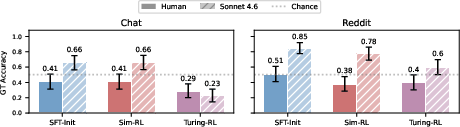
- Binary-choice Turing test: A human evaluation where annotators choose which of two responses is from a real human, testing indistinguishability. "In addition to LLM-as-a-judge evaluation, we also recruit over three hundred human participants from Prolific to perform a binary-choice Turing test: given a target user's history and two candidate responses (one real, one model-generated) in randomized order, annotators select which was written by the real user."
- Chain-of-thought (CoT) reasoning: An approach where models generate intermediate reasoning steps before final answers to improve performance. "An SFT-initialized policy generates multiple candidate responses via chain-of-thought (CoT) reasoning."
- Completion-only loss: A training objective that optimizes only the target completion tokens rather than the full input-output sequence. "The model is trained with LoRA using completion-only loss."
- Context specificity: The degree to which a response is grounded in and tailored to the immediate interaction context. "The judge scores two dimensions: context specificity (how tightly the response engages with the exact local interaction) and user evidence compatibility (how compatible the response is with the target user's observed behavior without unnaturally exposing or inventing evidence), each weighted $0.5$."
- Discriminative Turing reward: A reward signal where a judge scores how likely a model response is human-written, encouraging indistinguishability from real users. "We use a discriminative Turing reward as the training signal."
- Group Relative Policy Optimization (GRPO): A reinforcement learning algorithm that normalizes advantages within sampled groups to stabilize training. "and we train with Group Relative Policy Optimization~\citep[GRPO;] []{shao2024deepseekmath}, after an initial supervised finetuning (SFT) phase on a disjoint subset of the training data."
- Induced persona: A natural-language summary of a user's stable traits extracted from their history to condition generation. "we can also pair the raw behavior history with an induced persona ."
- Length penalty: A regularization term that penalizes outputs that deviate too much from a target length. "We additionally apply length penalty term that penalize responses falling outside a tolerance band around the ground truth length"
- Likert scale: A psychometric scale (e.g., 1–7) used for rating judgments. "The judge rates on a $1$--$7$ Likert scale which response was written by the human,"
- LLM-as-a-judge: An evaluation setup where a LLM assesses and scores system outputs. "We use LLM-as-a-judge to evaluate generated responses along three dimensions described below."
- LoRA (Low-Rank Adaptation): A parameter-efficient fine-tuning method that inserts low-rank adapters into a pretrained model. "All models are initialized from the SFT checkpoint discussed above and trained with LoRA (, ) for 3 epochs \citep{lora, qlora}."
- Log marginal likelihood: The log probability of observed data under a model after marginalizing over latent variables. "This reward roughly maximizes a lower bound on the log marginal likelihood of the ground truth response."
- Log-probability maximization: An objective that increases the likelihood of observed targets under the model. "and log-probability maximization with chain-of-thought adapted from~\cite{gandhi2026dialogue}."
- Ordering bias: A systematic preference arising from the presentation order of options or responses. "In practice, we randomize the ordering of the responses given to the judge to mitigate against ordering bias."
- Paired permutation test: A nonparametric statistical test for comparing paired observations by random shuffling. "We perform target-level paired permutation tests between Turing-RL and the other two models."
- Persona induction: The process of prompting a model to summarize stable user traits from their history. "See Figure~\ref{fig:persona_induction} of the appendix for the prompt used for persona induction."
- Policy (reinforcement learning): The strategy mapping states to action distributions that an RL agent follows. "This discriminative Turing reward is used to train the policy with GRPO."
- Reward cap: An upper limit on reward values to prevent exploitation or instability. "The reward cap at $5$ mitigates against reward hacking:"
- Reward hacking: When a model learns to exploit flaws in the reward signal to get high scores without achieving the true objective. "The reward cap at $5$ mitigates against reward hacking:"
- Semantic similarity: A measure of meaning overlap between texts, often used for evaluation or rewards. "The judge extracts key points from the ground truth, then scores semantic similarity, penalizing extraneous content, wrong perspective, and source copying."
- SFT (Supervised finetuning): Training a pretrained model on labeled input–output pairs to adapt it to a task. "after an initial supervised finetuning (SFT) phase on a disjoint subset of the training data."
- SFT-Init: The model checkpoint obtained after the initial supervised fine-tuning phase used to initialize further training. "We evaluate three models: LLM trained with just supervised finetuning (SFT-Init), RL-training with the similarity reward (Sim-RL), and RL-training with our Turing reward (Turing-RL)."
- Sim-RL: A reinforcement learning baseline that optimizes a similarity-based reward comparing model and ground-truth responses. "We evaluate three models: LLM trained with just supervised finetuning (SFT-Init), RL-training with the similarity reward (Sim-RL), and RL-training with our Turing reward (Turing-RL)."
- Turing Test: A test of machine human-likeness based on whether an evaluator can distinguish machine from human responses. "The classic Turing Test \citep{turing1950computing} operationalizes human-likeness through indistinguishability:"
- Turing-RL: The proposed reinforcement learning approach that trains user simulators using a Turing-style discriminative reward. "We instead propose {Turing-RL}: a Turing-Test-based reinforcement learning approach for training user simulator models."
- User evidence compatibility: How well a response aligns with observed user behavior without inventing or exposing evidence unnaturally. "The judge scores two dimensions: context specificity (how tightly the response engages with the exact local interaction) and user evidence compatibility (how compatible the response is with the target user's observed behavior without unnaturally exposing or inventing evidence), each weighted $0.5$."
- User simulator: A model that generates responses emulating a specific user's behavior or style. "and the user simulator LLM learns to produce responses indistinguishable from what the user could have said with such rewards."
- Within-group normalization: Normalizing advantages among a set of samples from the same prompt to stabilize RL updates. "We sample 4 candidate responses per training example and compute advantages via within-group normalization."
Collections
Sign up for free to add this paper to one or more collections.