- The paper demonstrates that structured internal transfers enable any stationary point of the social welfare function to be implemented as a self-enforcing equilibrium (SETE).
- It introduces formal equilibrium concepts (SETE and M-SETE) that use budget-balanced, peer-to-peer payments to overcome inefficiencies and computational intractability in noncooperative games.
- Empirical evaluations show that internal transfers significantly boost social welfare and reduce exploitability with minimal computational overhead in large-scale polymatrix games.
Introduction
The paper "Equilibrium with Internal Transfers" (2606.20960) proposes a rigorous framework for augmenting noncooperative games with budget-balanced, peer-to-peer internal transfers and offers both non-mediated and mediated equilibrium concepts—Self-Enforcing Transfer Equilibrium (SETE) and Mediated Self-Enforcing Transfer Equilibrium (M-SETE). The primary motivation is to simultaneously address two pervasive limitations of Nash Equilibrium (NE): inefficiency (potentially arbitrarily low social welfare) and computational intractability. The work systematically demonstrates how carefully structured internal transfer mechanisms can support socially optimal or stationary welfare points as equilibria with highly tractable decentralized computation and decentralized learning—without external interventions or loss of independent, product-form play.
Foundations and Model
The central conceptual advance is the augmentation of standard games with a pre-play internal transfers stage. Each player can conditionally commit nonnegative, peer-to-peer payments to others, only executed if the recipients adhere to a prescribed strategy profile. The aggregate payment plan is required to be budget balanced, ensuring global welfare neutrality. The framework formalizes two desiderata for an equilibrium concept:
- Stability: No player has a profitable unilateral action deviation.
- Incentive Compatibility: No player has incentive to withdraw already proposed outgoing payments; transfer outflows are individually rational and do not exceed the loss that could result from recipient deviations.
This leads to the formal definition of the Self-Enforcing Transfer Equilibrium (SETE): a pair (π,p), with a product-form strategy profile π and a vector of transfers p, satisfying precise stability and incentive compatibility constraints. The construction ensures that for polymatrix games, the verification of incentive compatibility decomposes into tractable, pairwise constraints.
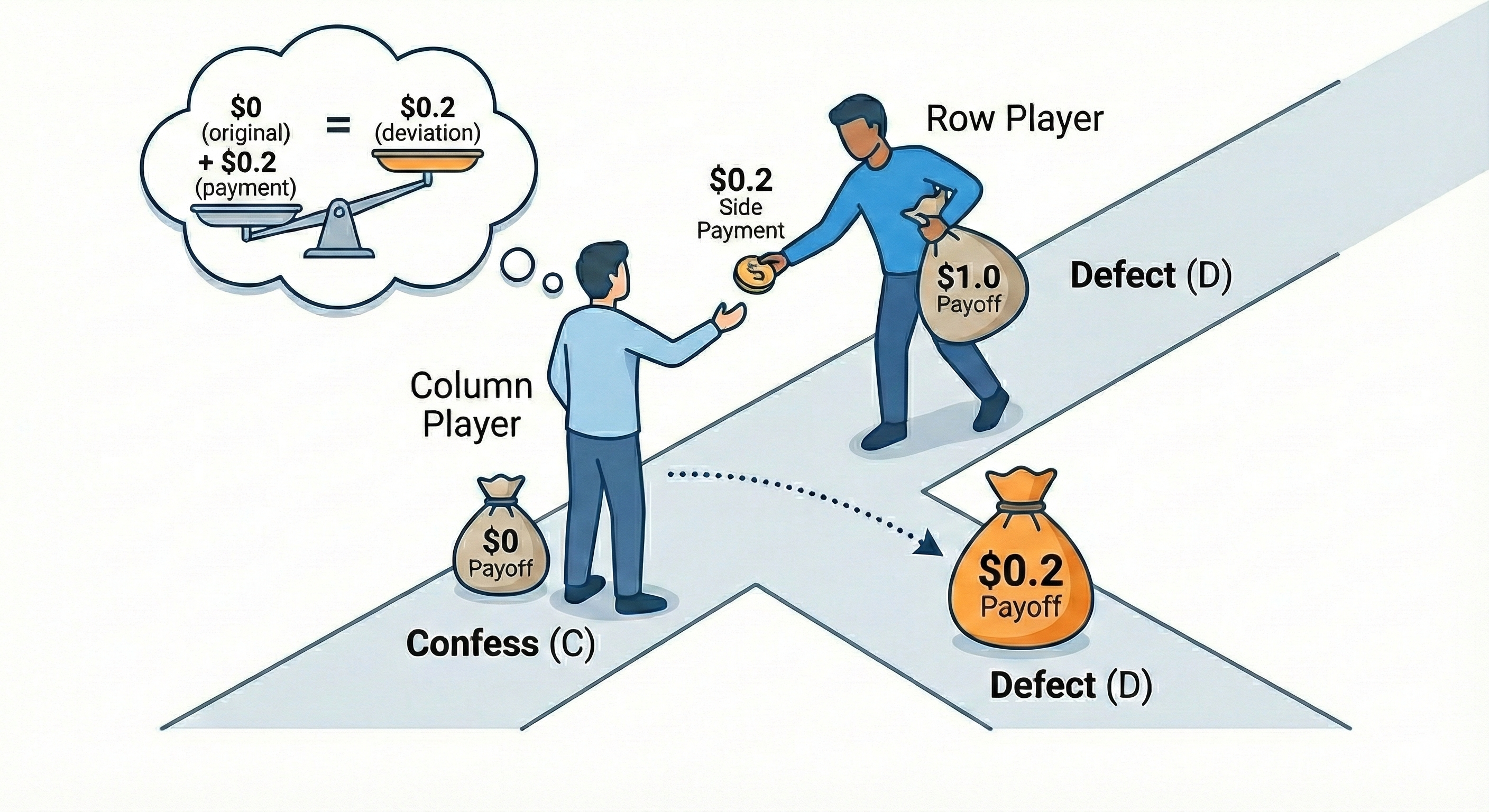
Figure 1: An illustration of how side payments work in Prisoner’s Dilemma—players exchange payments only if counterparties adhere to prescribed cooperative behavior, transforming externalities into incentive compatibility.
An immediate implication is that every NE is a trivial SETE (with zero transfers), but significantly, any stationary point of the social welfare function can also be implemented as a SETE. In polymatrix games, this is shown formally by directly constructing the supporting payment scheme; thus, any social welfare maximum (including those that are not Nash) can be implemented as an equilibrium with strictly independent mixed strategies, and without external subsidies or correlation.
The equilibrium notion is explicitly linked to the agent normal form of the augmented sequential game (commit-pay-transfers, then play actions). It is shown that all SETE outcomes are Nash equilibria of this agent normal form. However, a limitation remains: SETE may not always be a NE in the original extensive-form game due to credible off-path collective deviations (as demonstrated via counterexamples).
To achieve full sequential equilibrium (including off-path credibly, i.e., no player can simultaneously defect in payment and action), the paper introduces Mediated SETE (M-SETE), where both payment schedule and strategies are made binding by a mediator through enforceable contracts. The essential feature here is that each player faces a “take-it-or-leave-it” offer: either participate in the binding mechanism (committing to the schedule and strategy) or be dropped into an adversarial minimax continuation (the pessimistic utility if everyone else colludes in retaliation).
This mechanism grants two remarkable properties:
- Full implementation: Any strategy profile whose welfare exceeds the sum of minimax values (thus, any socially optimal profile and any welfare not worse than the worst NE) can be made a Nash equilibrium of the mediated-augmented game.
- Budget balance is preserved: All transfers/supplements sum to zero, eliminating any requirement of external subsidies or taxation mechanisms.
Computation and Decentralized Learning
A core contribution is that, in polymatrix games, the computation of SETE can be performed efficiently via projected-gradient ascent on the aggregate social welfare function, sidestepping the PPAD-hardness inherent in NE computation. The transfer constraints reduce to independent, pairwise forms, making projection linear in the number of player pairs.
Additionally, a fully decentralized bandit-learning dynamic is constructed, in which each player can, based solely on realized payoffs and payments, independently and efficiently converge to a SETE. The learning rule augments standard gradient ascent by aligning update directions to the (augmented) social welfare potential, and experimentally demonstrates rapid convergence and significant welfare gains.
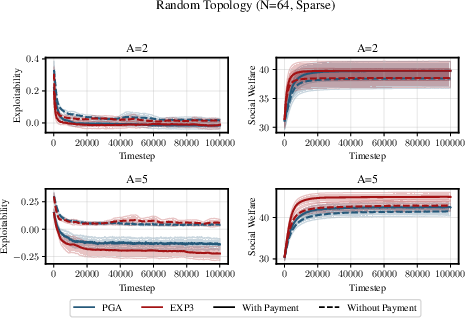
Figure 3: Training curves for various algorithms in a 64-player polymatrix game ("Erdős–Rényi" structure), illustrating faster and higher welfare convergence with payments versus standard no-payment baselines.
Empirical Evaluation
Extensive experiments on synthetic polymatrix games with a variety of graph structures demonstrate:
- Substantially increased social welfare with internal transfers for both gradient-based and no-regret bandit algorithms.
- Significant reduction (often negative) in exploitability, defined as maximum expected net gain from unilateral deviation (including lost payments).
- Very modest computational overhead to maintain the payment plan (not exceeding 5% even in large games).
Theoretical and Practical Implications
The results provide a strong formal foundation for designing fully decentralized, welfare-improving mechanisms that retain key NE properties (independent play, absence of mediators, no need for external incentives). The decoupling of strategy and payment plan offers a robust instrument for real-world systems engineering, as well as large-scale automated market and multiagent settings where budget-balance and autonomy are crucial. The M-SETE mechanism further reveals the theoretical power of credible, binding contracts in “implementing the full range of optimal outcomes with zero external cost,” even in highly competitive, information-limited environments.
Notably, the SETE/M-SETE paradigm avoids both exponential complexity (unlike general endogenous payment rule schemes) and the loss of independence typical of correlated equilibrium frameworks. For polymatrix games, all constraints and computations scale polynomially, enabling practical application to large games.
Future Directions
Potential research avenues include extension to broader classes of graphical games, dynamic games with state, robust learning under heterogenous payment/information constraints, and integration with mechanism design settings with private types and external uncertainties. Open algorithmic questions include pushing complexity reduction for more general game classes and developing efficient, privacy-preserving transfer computation in decentralized settings.
Conclusion
This work rigorously establishes that properly structured, budget-balanced internal transfers are sufficient to support and efficiently compute high-welfare, decentralized equilibria in large games. The mechanisms developed—SETE and M-SETE—demonstrate that the canonical inefficiency and computational limitations of Nash equilibrium can be radically mitigated in real systems through disciplined transfer design, without sacrificing independence or requiring mediators. The equilibrium concepts, computation, and decentralized learning dynamics proposed form a robust substrate for future theory and engineering of incentive-aligned multiagent systems.