VideoAgent: All-in-One Framework for Video Understanding and Editing
Abstract: Video editing has become essential in digital media creation, yet existing automated systems are restricted to short segment processing and domain-specific tasks. They face two critical limitations: i) inability to handle diverse video comprehension and editing operations, and ii) lack of long-video understanding for coherent narrative creation. We propose VideoAgent, an all-in-one agentic framework addressing these challenges through two key innovations. First, we develop automated video shot creation with shot planning agents for coherent narratives and cross-modal retrieval for aligned visual content. Second, we design a multi-agent orchestration framework integrating over thirty specialized editing agents. Intent parsing filters relevant tools while textual-gradient graph optimization assembles complex editing pipelines. Extensive experiments on our newly-proposed VideoEdit benchmark and public datasets demonstrate VideoAgent's superiority over existing multimodal LLMs and agentic systems. VideoAgent achieves 87-95% orchestration success rates while reducing API costs by 60%. Human evaluation across six video categories shows VideoAgent produces professional-quality content approaching human-level performance, with ratings only 4% below human-created videos. We release our code at https://github.com/HKUDS/VideoAgent.

Paper Prompts
Sign up for free to create and run prompts on this paper using GPT-5.
Top Community Prompts
Explain it Like I'm 14
Explaining “VideoAgent: All‑in‑One Framework for Video Understanding and Editing”
What is this paper about?
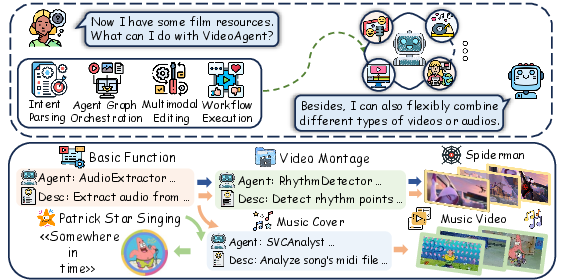
This paper introduces VideoAgent, an AI system that can plan, understand, and edit videos almost like a human video editor. It aims to turn everyday language instructions (like “make a fast-paced montage of basketball highlights synced to the beat”) into finished videos using a coordinated team of specialized AI tools.
1) Big picture: What’s the main purpose?
The main goal is to build a single system that:
- Understands long videos and the story a user wants,
- Plans a sequence of shots (like a director’s storyboard),
- Finds the right clips,
- Trims and arranges them to fit music or dialogue,
- And coordinates many editing tools to create a polished video.
In short, VideoAgent tries to make high-quality video editing possible for people who aren’t experts.
2) What questions does the paper try to answer?
The researchers focus on two key questions:
- How can an AI plan and create long, coherent videos (not just short clips) with a clear narrative?
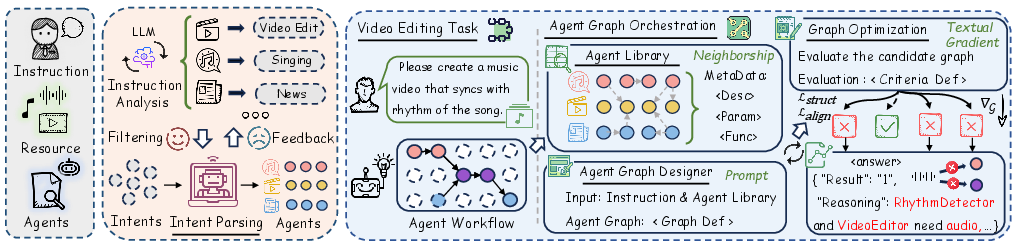
- How can it coordinate many different editing tools (like subtitle generation, beat matching, voice-over, style transfer, face swap, etc.) in the right order without human help?
3) How does VideoAgent work? (Simple explanation)
Think of VideoAgent as a movie director with a big toolbox and a smart scheduler.
- “Director” part: It plans the story as a sequence of shots.
- “Toolbox” part: It includes 30+ specialized “agents” that do specific tasks (audio analysis, lip sync, voice generation, style filters, and more).
- “Scheduler” part: It figures out which tools to use and in what order to meet your goal.
Here are the main pieces:
Shot planning: Turning ideas into a storyboard
- The system looks at your instruction (e.g., “make a calm travel vlog with nature scenes and gentle music”).
- It also scans the available materials (video clips, audio tracks) and summarizes what’s in them.
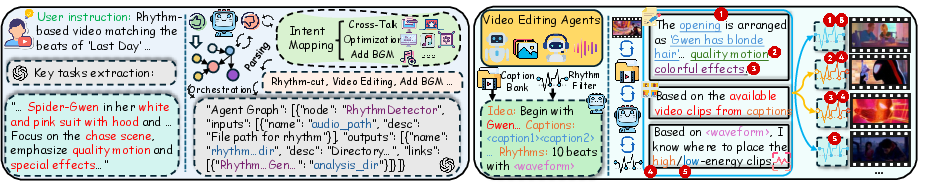
- It then writes a shot-by-shot plan in plain language—similar to a storyboard: Shot 1, Shot 2, Shot 3… so the final video has a coherent flow.
Analogy: It’s like a chef reading your request (“a light, fresh dinner”), checking what’s in the pantry, and writing a course-by-course plan.
Finding the right clips: Matching words to visuals
- VideoAgent turns both the shot descriptions and video frames into “embeddings,” which you can think of as numeric fingerprints that capture meaning.
- It compares these fingerprints to find which clips best match each shot description.
- This is called cross‑modal retrieval: matching text (“a red car speeding through a tunnel”) to visuals (frames with a red car in a tunnel).
Analogy: It’s like searching your photos by typing “sunset beach” and your phone finds the right images.
Precise trimming: Fitting the rhythm and timing
- After choosing a clip for each shot, VideoAgent trims the exact moments to fit the target timing—like syncing a cut to a drumbeat or matching the length of narration.
- This step ensures the final video feels smooth and professional, not choppy or off-beat.
Analogy: Like a DJ lining up songs so the beats and transitions land perfectly.
Orchestrating many tools: Building and fixing the workflow graph
- VideoAgent contains 30+ tools (agents) for tasks like:
- Music beat detection
- Voice synthesis with different emotions
- Lip sync and face swapping
- Transcribing audio and adding subtitles
- Style transfer and visual effects
- Scriptwriting and content adaptation
- It first picks relevant tools based on your intent (intent parsing), then builds a “graph” (a flowchart) showing the order tools should run in.
- It improves this graph in rounds using a clever method the authors call “textual‑gradient graph optimization.” In simple terms:
- The system checks its own plan for problems (like steps in the wrong order or missing tools),
- Gets feedback in natural language (“this step depends on output from that step—swap them”),
- Then updates the plan and repeats until it’s solid.
Analogy: It’s like planning a road trip and adjusting your route after noticing detours or missing gas stations—each round makes the route better.
4) What did they find? Why does it matter?
The team tested VideoAgent on their new VideoEdit benchmark and other public datasets. Key results:
- High success at workflow orchestration:
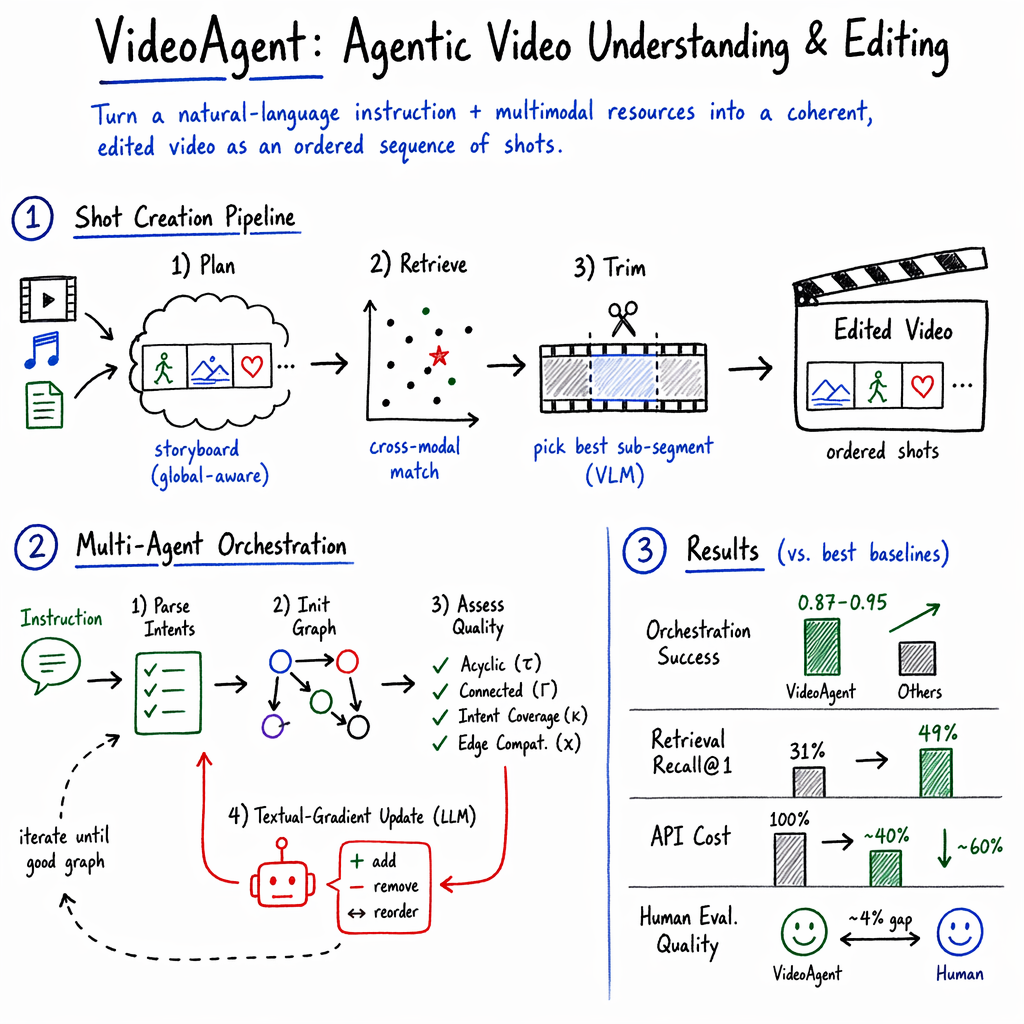
- VideoAgent succeeded 87–95% of the time at building correct editing pipelines, beating other AI systems by 2–25%.
- Better video retrieval:
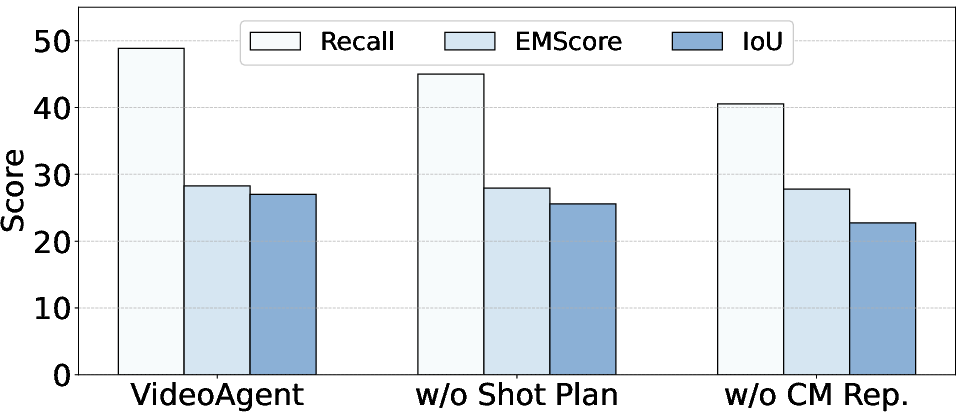
- It improved how well the system finds the right scenes for each shot across several base models (for example, Recall for GPT‑4o jumped from 31% to 49%).
- Lower cost:
- It cut API usage costs by about 60% thanks to smarter planning and targeted retrieval.
- Near human-level quality:
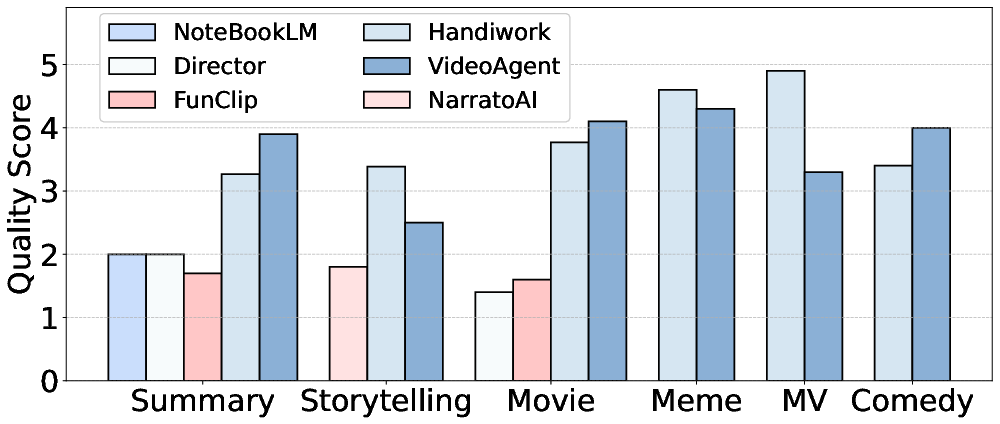
- In a human study across six video categories, videos made by VideoAgent were only 4% lower in quality than videos made by people.
- Reliable self-checking:
- When comparing AI evaluations to human judges, the system’s judgments aligned well (high accuracy and recall), suggesting it can reliably assess its own plans.
Why it matters:
- VideoAgent can help non-experts make professional-looking videos quickly.
- It scales to longer, story-driven content, not just short edits.
- It shows how many specialized AI tools can be coordinated effectively to do complex creative work.
5) What’s the impact and what comes next?
Impact:
- For creators: Faster production of trailers, vlogs, music videos, explainers, and more—without deep editing skills.
- For teams and studios: Automated pipelines that reduce time and cost, especially for routine editing tasks.
- For education and communication: Easier creation of clear, engaging video content from simple instructions.
Limitations and future directions:
- The system currently depends on the quality of available footage. If the right clips don’t exist, results are limited. Future versions could plug in generative video models to create missing shots.
- Like any powerful editing tool, there’s a risk of misuse (e.g., making misleading content). The authors encourage responsible use and content moderation.
Quick recap
- VideoAgent plans a story, finds the best clips, trims them to fit the rhythm, and coordinates 30+ editing tools to produce polished videos from plain language.
- It performs better than many existing systems, costs less to run, and gets close to human-level quality.
- It could make high-quality video creation accessible to many more people, while raising important questions about responsible use.
Knowledge Gaps
Below is a single, consolidated list of specific knowledge gaps, limitations, and open questions that remain unresolved by the paper. Each item highlights what is missing or uncertain and points to actionable directions for future work.
- [Objective/Optimization] The instruction–graph alignment loss is referenced but not formally defined or operationalized (metrics, normalization, supervision), leaving its computation, thresholds, and contribution to optimization unclear.
- [Convergence] No theoretical or empirical convergence guarantees for the “textual-gradient” graph optimization are provided; sensitivity to LLM non-determinism, prompt drift, and initialization remains unstudied.
- [Search Alternatives] The framework is not compared against principled discrete search/planning methods for workflow construction (e.g., MCTS, ILP, reinforcement learning over DAGs, evolutionary search), leaving open whether textual-gradient descent is optimal or efficient.
- [Scalability] The scalability of orchestration to much larger tool libraries (e.g., 100–300+ agents) and longer pipelines is untested; there is no complexity analysis of graph search time, memory, or cost as library size grows.
- [Typing/Interfaces] Edge compatibility is approximated via “shared capabilities” overlap; there is no formal, typed I/O schema or static type checking to guarantee data-format compatibility and prevent runtime mismatches across agents.
- [Capability Ontology] The capability mapping function Ψ for each agent appears hand-crafted; methods for automatically learning, verifying, and updating a capability ontology as tools evolve are not explored.
- [Failure Handling] The system lacks a documented error-handling and self-repair strategy when individual agents fail, produce malformed outputs, or violate constraints (e.g., automatic retries, substitutions, or graph repairs).
- [Resource-Aware Scheduling] Workflow optimization is agnostic to resource constraints (latency, GPU/CPU memory, monetary budgets); scheduling, parallelization, and budget-aware graph construction are not addressed.
- [Long-Video Scale] Despite “long-video” claims, the empirical evaluation does not test hour-scale projects end-to-end; memory, context management, and retrieval quality for multi-hour footage remain open.
- [Retrieval Temporal Semantics] Keyframe-based retrieval may miss temporal dynamics (actions, transitions) and identity continuity; integrating spatiotemporal encoders (e.g., video-language transformers, tracking/person re-ID) is left unexplored.
- [Audio-/Text-Conditioned Retrieval] Although inputs may include audio tracks and textual documents, retrieval is evaluated primarily on text–visual alignment; audio-conditioned or narration-conditioned retrieval quality is not studied.
- [Trimming Accuracy] The fine-grained trimming agent’s temporal precision is not benchmarked against objective synchronization metrics (e.g., beat-hit rate, phoneme/word-boundary alignment, edit-point accuracy).
- [Narrative Consistency] There is no mechanism or metric to enforce/evaluate narrative coherence across shots (character identity, lighting/color continuity, transitions, visual style consistency).
- [Hybrid Retrieve–Generate] The paper notes adding generative video models but does not propose decision policies for when to retrieve vs. generate, how to fuse both under budget/quality constraints, or how to keep visual continuity across modes.
- [Style-Conditioned Pacing] Shot-length decisions are rule/agent-driven but not learned from style exemplars or user preferences; learning pace/structure from references or editor feedback is an open direction.
- [Cost–Quality Trade-offs] While API costs are reduced, there is no systematic analysis of cost–quality–latency trade-offs, energy consumption, or how hyperparameters impact total cost at production scale.
- [Multilingual Robustness] Claims of cross-cultural/style transformations are not matched with multilingual evaluation (instructions, captions, scripts); cross-lingual retrieval and planning accuracy remains unquantified.
- [Safety/Moderation] Content moderation, harmful-edit detection, and provenance/watermarking (e.g., C2PA) are acknowledged but not implemented; concrete safeguards for deepfakes (face swap, lip-sync) are missing.
- [Copyright/Compliance] The system does not include license checking, source-media provenance verification, or fair-use-aware clip-length constraints to guide legally compliant outputs.
- [Privacy] There is no privacy-preserving design (on-device processing, encryption, access control, differential privacy) for user-supplied media processed by third-party models/APIs.
- [Reproducibility] Many agents appear to rely on proprietary APIs; reproducibility under model/version drift, availability, and rate limits is not addressed, nor are standardized fallbacks documented.
- [Benchmark Transparency] The new VideoEdit benchmark lacks detailed public documentation on task diversity, annotation protocols, release status, licenses, and bias assessment; replication and community comparability are limited.
- [LLM Judge Validity] Orchestration “success rate” partially relies on LLM judgments; the study uses small samples and does not report inter-annotator agreement, Cohen’s κ, or significance testing for human–LLM agreement.
- [Human Study Rigor] Human evaluation (26 raters, 18 videos) lacks details on blinding, randomization, cultural diversity of raters, and statistical significance tests; potential confounds (different source assets) are unaddressed.
- [Metric Coverage] Final video quality is not assessed with standard objective metrics (e.g., VMAF/SSIM for visuals, MOS-like measures for audio, rhythm sync scores), impeding reproducible comparisons.
- [Task Success Definition] “Success rate” for orchestration is not operationalized with precise task-level criteria; continuous quality grading of pipeline design (beyond binary success) is absent.
- [Interactive Editing] The system is fully automated; mechanisms for human-in-the-loop revision cycles, preference learning, and interactive constraint injection during graph optimization are not explored.
- [Large-Scale Indexing] The “compressed visual summary C” approach does not address scaling to millions of assets; vector-database indexing, incremental updates, and memory-bound retrieval policies are open.
- [Ambiguity Handling] There is no dialog-based disambiguation for underspecified or conflicting instructions, nor a policy for asking clarifying questions vs. making assumptions.
- [Explainability/Auditing] There is no user-facing provenance of decisions (why a clip was chosen, why an agent was inserted), nor audit logs for post-hoc analysis and compliance audits.
- [Type-Rich Compatibility] The edge-compatibility ratio χ based on shared capabilities may accept semantically invalid connections; richer data typing (modalities, sampling rates, codecs, sample formats) and static validation are needed.
- [Robustness to Domain Shift] Generalization to niche or highly specialized genres (e.g., sports analytics, scientific videos) is not tested; robustness under domain shift and low-resource settings remains unclear.
- [Hardware/Throughput] The system’s throughput, batching, and GPU/CPU utilization strategies are not characterized; real-time or near-real-time editing feasibility is unknown.
Practical Applications
Immediate Applications
Below are actionable, deployable uses of VideoAgent’s framework that can be implemented with today’s models, APIs, and creative toolchains. Each item lists likely sectors, the tools/products/workflows enabled, and key assumptions or dependencies.
- Media and Entertainment (studios, streamers, creators)
- Uses: automated teasers/trailers from catalogs; rhythm-synced music videos; B-roll retrieval; episodic recaps; clip packages for social distribution.
- Tools/products/workflows: Shot Planning Agent + cross-modal retrieval for catalog search; Fine-grained Trimming for beat-aligned cuts; Agent Graph Orchestrator for multi-step pipelines; NLE plug-ins for Premiere/Final Cut/Resolve; “Auto-Trailer” SaaS.
- Dependencies: rights to source media; accurate keyframe captions; access to CLIP/ImageBind-like encoders; human review for editorial quality/brand voice.
- Marketing and E-commerce
- Uses: product promo reels from asset libraries; automated 15–30s listing videos; A/B variants with different hooks/CTAs; style-consistent brand videos.
- Tools/products/workflows: intent parsing to select toolchains (scriptwriting, style transfer, logo/CTA insertion, loudness normalization); batch pipelines with textual-gradient graph optimization to minimize API spend.
- Dependencies: brand guideline ingestion; licensed fonts/brand elements; guardrails for claims/compliance; consent for UGC.
- Sports and Live Events
- Uses: highlight reels, player spotlights, event recaps; tempo-synced edits for hype content; social shorts from long broadcasts.
- Tools/products/workflows: beat extraction + trimming; shot retrieval guided by storyboard prompts; templated agent graphs for different sports.
- Dependencies: basic event indexing/metadata; latency budget if near-live; broadcast rights; human QA for controversial moments.
- Newsrooms and Digital Publishing
- Uses: explainer videos with aligned B-roll; rapid foreign-language versions; standardized intros/outros; safe soundtrack swaps.
- Tools/products/workflows: audio transcription; multi-emotional TTS; lip-sync generation; content packaging workflows orchestrated as acyclic agent graphs.
- Dependencies: editorial standards; fact-check review; watermarking/disclosure for synthetic voice; newsroom CMS integration.
- Education and Training (academia, corporate L&D)
- Uses: lectures to microlearning modules; topic-wise compilations; language-localized lessons; accessibility packs (captions, audio descriptions).
- Tools/products/workflows: Shot Planner to outline lesson segments; retrieval from lecture archives; transcription + TTS + visual overlays; LMS-ready export.
- Dependencies: FERPA/GDPR compliance; instructor consent; terminology glossaries; domain-specific pronunciation models.
- Customer Support and Product Enablement (software/hardware)
- Uses: how-to videos from docs/screencasts; release-note highlight reels; regionalized support videos.
- Tools/products/workflows: creation prompts for scriptwriting; screen capture trimming; voiceover and subtitles; packaged toolchains per product line.
- Dependencies: up-to-date documentation; platform UI changes tracked; localization QA.
- Accessibility and Inclusion
- Uses: auto-captions; audio description tracks; sign-language insert windows (paired with external models); loudness normalization.
- Tools/products/workflows: foundational multimodal tools (ASR, TTS, normalization); agent graphs that add/verify accessibility layers at the end of any workflow.
- Dependencies: ASR/TTS accuracy; standards (e.g., WCAG, broadcast loudness); human verification for sensitive content.
- Enterprise Communications
- Uses: town-hall recaps; executive summaries; policy update videos; culture content from internal libraries.
- Tools/products/workflows: intent parsing to select corporate templates; privacy-preserving orchestration; centralized governance for tool access.
- Dependencies: data classification and access control; on-prem or VPC deployment options; internal approvals.
- Localization and Dubbing Studios
- Uses: cross-lingual dubbing with lip-sync; regionalized humor/meme adaptation; voice matching where licensed.
- Tools/products/workflows: multi-emotional voice synthesis; lip-sync; culturally adapted scriptwriting agents.
- Dependencies: voice rights; locale style guides; disclosure and watermarking; legal review in regulated markets.
- Archival and Asset Management
- Uses: automated compilation from large archives (film, public records, museum footage); thematic reels for exhibitions.
- Tools/products/workflows: cross-modal indexing; storyboard-driven retrieval; cost-optimized agent graph search.
- Dependencies: metadata quality; storage/API throughput; provenance tracking.
- Research and Academia
- Uses: VideoEdit benchmark adoption; reproducible agent-graph baselines; studies of LLM-human evaluator agreement; curriculum video generation for studies.
- Tools/products/workflows: open-source code; benchmark tasks; agent ablation utilities; graph quality metrics (acyclicity, coverage, edge compatibility).
- Dependencies: stable model APIs; dataset licensing; IRB for user studies.
- Daily Life (creators/consumers)
- Uses: travel vlogs auto-edited to music; family event compilations; social-ready edits with captions and stickers.
- Tools/products/workflows: “Personal Auto-Editor” mobile app using shot planning + retrieval from camera roll; presets for platforms (TikTok, Reels, YT Shorts).
- Dependencies: device compute or cloud offload; privacy controls; opt-in face handling.
Long-Term Applications
These concepts likely require additional research, scaling, or policy and infrastructure development before broad deployment.
- Generative Completion When Footage Is Missing
- Vision: seamlessly blend retrieval-based editing with text-to-video generation to fill gaps (scenes, transitions, B-roll).
- Tools/products/workflows: hybrid agent graphs that switch between retrieval and generation; quality gates and harmonization agents.
- Dependencies: high-fidelity generative video; temporal/identity consistency; compute budgets; strong safety filters.
- Real-Time and On-Device Editing
- Vision: live highlight creation for events; edge/on-device pipelines for privacy and low latency.
- Tools/products/workflows: streaming keyframe captioning; incremental graph updates; lightweight encoders.
- Dependencies: efficient VLMs; hardware acceleration; bandwidth and power constraints.
- End-to-End Creative Co-Pilots for Professionals
- Vision: interactive, multi-turn assistants embedded in NLEs that co-plan, audition, and revise edits with textual-gradient optimization.
- Tools/products/workflows: “Agent Graph Optimizer (AGO) SDK” with versioned graph diffs, rollback, and explainability panels.
- Dependencies: editor integration; UI/UX for graph edits; collaborative multi-user control.
- Broadcast Automation and Control Rooms
- Vision: autonomous multi-camera selection, lower-thirds, highlight packages, and compliance checks during live shows.
- Tools/products/workflows: intent-aware graph templates for newsroom rundown items; real-time quality metrics.
- Dependencies: robust latency guarantees; integration with broadcast standards and playout systems.
- Compliance and Safety Toolchains for Regulated Sectors
- Vision: automatic insertion of disclosures, risk disclaimers, and removal/masking of sensitive visuals (PHI/PII).
- Tools/products/workflows: “Compliance Guard” agents that scan and amend outputs; policy-aware intent parsing.
- Dependencies: domain-specific detectors; legal approval loops; audit logs.
- Provenance, Watermarking, and Rights Management
- Vision: end-to-end content provenance (C2PA), AI-watermarking, and rights-aware retrieval/generation.
- Tools/products/workflows: rights-check agents; watermark insertion/verification nodes in graphs.
- Dependencies: industry standards adoption; platform verification APIs; robust watermark resilience.
- Culturally Nuanced Global Localization at Scale
- Vision: beyond translation—humor, idioms, and regional storytelling patterns adapted per market.
- Tools/products/workflows: cultural adaptation agents with feedback from local reviewers; preference learning.
- Dependencies: locale datasets; bias/safety reviews; regional governance.
- Autonomous Long-Form Documentary/Instructional Assembly
- Vision: multi-hour stories constructed from vast archives with coherent arcs, narrations, and source attribution.
- Tools/products/workflows: hierarchical shot planning (acts/sequences/scenes); retrieval across knowledge graphs; fact attribution.
- Dependencies: long-context LLM/VLM reasoning; robust narrative evaluation metrics; licensing.
- Sector-Specific Ops Training and Safety Simulation (Energy, Manufacturing, Robotics)
- Vision: generate and continually update training videos from equipment logs, procedure changes, and inspection footage.
- Tools/products/workflows: domain ontologies + intent parsing; scenario generation; simulation-to-video bridges.
- Dependencies: secure data connectors; hazard/safety validation; union/worker council approvals.
- Finance and Investor Relations
- Vision: earnings-call and KPI-driven video summaries with compliant overlays and commentary variants.
- Tools/products/workflows: data-to-visual agent chains; disclosure enforcement; audience-segment-specific cuts.
- Dependencies: strict compliance gates; latency around market events; data accuracy guarantees.
- Standardization and Ecosystem Growth
- Vision: marketplaces for specialized editing agents; shared benchmarks; interoperable agent schemas.
- Tools/products/workflows: open agent registries; capability taxonomies; cross-vendor orchestration protocols.
- Dependencies: community governance; security sandboxes; sustainable monetization models.
Notes on Cross-Cutting Assumptions and Risks
- Legal/ethical: source media rights, voice likeness permissions, disclosure for synthetic media, and adherence to platform policies.
- Safety/misinformation: potential misuse of lip-sync/face-swapping; require watermarking, consent verification, and moderation agents.
- Technical: quality of keyframe captions and embeddings; model/API stability; cost/latency budgets; compute and storage scaling.
- Organizational: human-in-the-loop checkpoints, brand/style guides, and audit trails for regulated environments.
Glossary
- Acyclicity indicator: A function that returns whether a graph has no cycles (1) or has cycles (0), used to ensure executability of workflows. "where τ is the acyclicity indicator returning 1 if \mathcal{G} admits a valid topological ordering and 0 otherwise"
- Agent graph: A graph structure whose nodes are agents and edges encode their dependencies for execution. "An agent graph is a directed acyclic graph \mathcal{G}=(\mathbb{A}, E)"
- Agent library: The full set of available tool/agent modules from which a task-specific graph is composed. "let A={A_1, A_2, \ldots, A_n} denote the agent library."
- Agentic framework: A system built around autonomous agents that coordinate to perform complex tasks. "We propose VideoAgent, an all-in-one agentic framework"
- Connected components: Maximal subgraphs in which any two nodes are connected by a path, used to assess graph fragmentation. "\Gamma(\mathcal{G}) denotes the set of connected components in \mathcal{G}"
- Cosine similarity: An angle-based similarity metric between vectors, commonly used for retrieval in embedding spaces. "and \cos(\cdot, \cdot) denotes cosine similarity."
- Cross-modal representation: A shared embedding space that aligns different modalities (e.g., text and images/videos). "employs cross-modal representation methods (i, ImageBind~\citep{Girdhar2023ImageBindOE} and CLIP~\citep{radford2021learning}) to generate embeddings"
- Cross-modal retrieval: Retrieving items in one modality using queries in another, enabled by a shared embedding space. "cross-modal retrieval for aligned visual content."
- Directed acyclic graph (DAG): A directed graph with no cycles, enabling a valid execution order of agents. "An agent graph is a directed acyclic graph \mathcal{G}=(\mathbb{A}, E)"
- Edge compatibility ratio: The proportion of edges whose incident agents have compatible/shared capabilities. "\chi measures edge compatibility ratio, averaged over all edges"
- Embedding Matching score (EM): A metric that evaluates how well embeddings match between predictions and ground truth. "Embedding Matching score (EM) (\%)"
- Graph Quality Assessment: The process of evaluating a candidate agent graph against structural and semantic metrics. "Graph Quality Assessment."
- Graph topology: The structural configuration of nodes and edges in a graph, considered as a search/optimization space. "iterative optimization problem over graph topology space"
- Graph transformation operator: An operator that applies structured modifications to a graph during optimization. "where \otimes denotes the graph transformation operator"
- Intent coverage ratio: The fraction of required intents that are covered by the selected set of agents. "\kappa measures the intent coverage ratio"
- Intent parsing: Extracting the set of actionable intents from a natural language instruction. "Given instruction I, an intent parsing mechanism extracts a set of required intents \mathcal{T}"
- Intersection over Union (IoU): An overlap metric between predicted and ground-truth segments, used for localization quality. "Intersection over Union (IoU) (\%)"
- KeyFrames method: A technique for extracting representative frames from videos to index and retrieve visual content efficiently. "using the KeyFrames method mentioned above"
- Knowledge graphs: Structured graphs of entities and relations used to support reasoning over content. "combining knowledge graphs with multimodal encoding"
- LLMs: Large neural networks trained on massive text corpora for language understanding and generation. "LLMs"
- Multi-agent orchestration: Coordinating multiple specialized agents and their data flow to execute a complex workflow. "multi-agent orchestration framework integrating over thirty specialized editing agents."
- Recall@1: A retrieval metric indicating the percentage of queries for which the correct item is ranked at the top. "Recall@1 (\%)"
- Shot planning agent: An agent that produces structured shot-level descriptions (storyboards) to guide retrieval and editing. "we develop a shot planning agent that produces structured shot-level storyboards"
- Storyboard: A textual description of the intended content for a shot, guiding retrieval and trimming. "shot-level storyboards in natural language"
- Structural loss: A loss term penalizing invalid graph structures such as cycles and disconnected components. "The structural loss is formally defined as:"
- Temporal alignment: Synchronizing visual and audio content with target timing (e.g., beats, dialogue durations). "achieves precise temporal alignment between visual content and narrative requirements."
- Textual gradient descent: Iteratively refining a graph using natural-language feedback that acts like a gradient signal. "through textual gradient descent."
- Textual-gradient graph optimization: An optimization method that refines agent graphs using language-based gradient signals. "textual-gradient graph optimization assembles complex editing pipelines."
- Topological ordering: An ordering of nodes in a DAG such that all edges point forward, enabling valid execution sequences. "valid topological ordering"
- Vision LLMs (VLMs): Models that jointly process visual and textual inputs for tasks like understanding and editing. "Vision LLMs (VLMs)"
- Visual style transfer: Modifying the stylistic appearance of visuals while preserving content. "visual style transfer."
- Workflow orchestration: Designing and executing the sequence of tools/agents to accomplish an end-to-end task. "workflow orchestration with high-quality video creation instructions"
Collections
Sign up for free to add this paper to one or more collections.