- The paper introduces a state-space guided adaptive attention mechanism (SSGAA) that dynamically fuses visual, language, and action cues for improved long-horizon manipulation.
- It achieves state-of-the-art performance on simulation and real-world benchmarks using a compact 2B parameter model while reducing cumulative errors.
- The methodology leverages a recursively updated belief state and parallel action decoding to ensure scalable, phase-aligned, and efficient task execution.
S2-VLA: State-Space Guided Vision-Language-Action Models for Long-Horizon Manipulation
Introduction
The S2-VLA framework addresses fundamental limitations in current Vision-Language-Action (VLA) models for robotic manipulation, particularly their reduced efficacy in long-horizon tasks due to cumulative error propagation. Traditional VLA models rely on static multimodal feature fusion with fixed combination weights for vision, language, and action representations, rendering them incapable of adjusting attention as task phases evolve. This design flaw leads to suboptimal perceptual or planning focus at critical moments and causes errors in early execution stages to amplify, degrading final task success.
To overcome this, S2-VLA introduces State-Space Guided Adaptive Attention (SSGAA), which maintains a compact, dynamically updated belief state that provides phase-aligned guidance for the fusion of visual, semantic, and temporal action information streams. Despite its modest 2B parameter count, S2-VLA demonstrates state-of-the-art results, outperforming existing 7B-scale models on standard long-horizon manipulation benchmarks, and thereby shifts the VLA development focus from backbone scaling to architectural adaptivity.
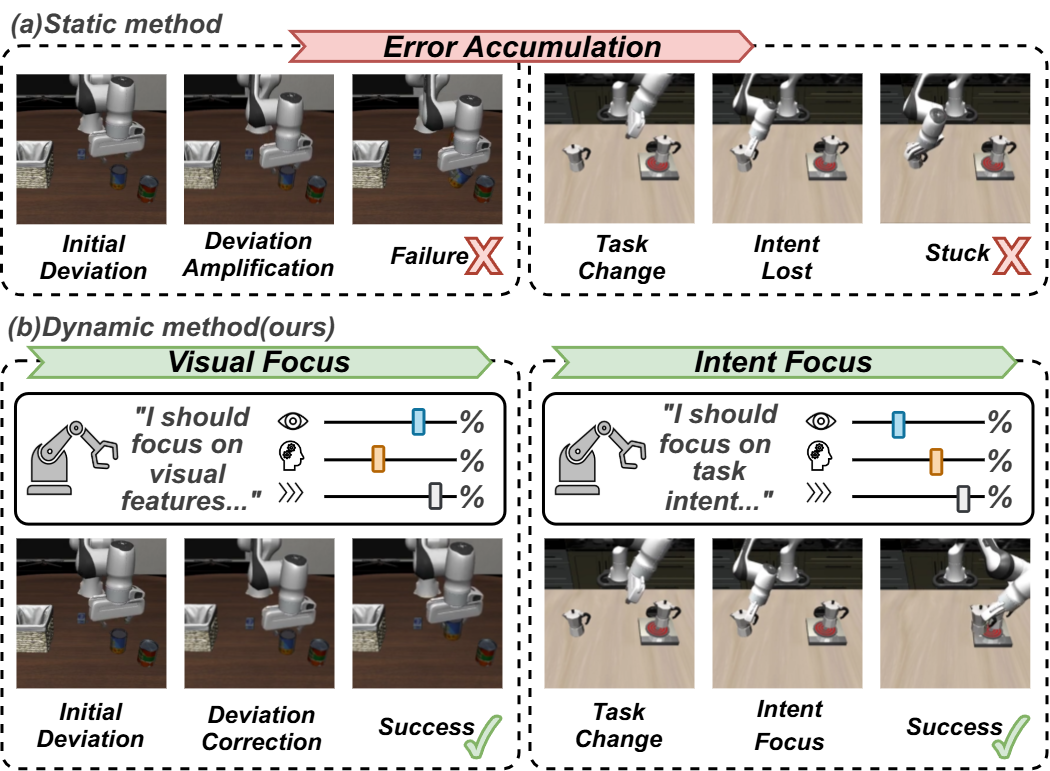
Figure 1: Illustrative examples contrasting S2-VLA and static fusion models, demonstrating reduced early-stage bias via state-space guidance.
Architectural Overview
S2-VLA centers around three design principles: maintaining an explicit belief state for task progress, dynamic phase-aware information fusion, and parallel action decoding for efficient execution. The overall workflow integrates multi-view visual observations, natural language instructions, and proprioceptive feedback into a unified Transformer-based backbone built on Qwen3-VL. The belief state, updated via a lightweight GRU across the sequence of past actions and feedback, serves as the core latent variable providing temporal context for all inference and decision processes.
The SSGAA mechanism, applied around the action head, implements three parallel attention pathways: (1) low-level visual cross-attention for spatial details, (2) high-level intent cross-attention for semantic planning, and (3) action sequence self-attention for temporal consistency. Crucially, gating weights for the fusion of these branches are adaptively generated from the current belief state, enabling the model to focus on the most relevant modality depending on the instantaneous phase of task execution.
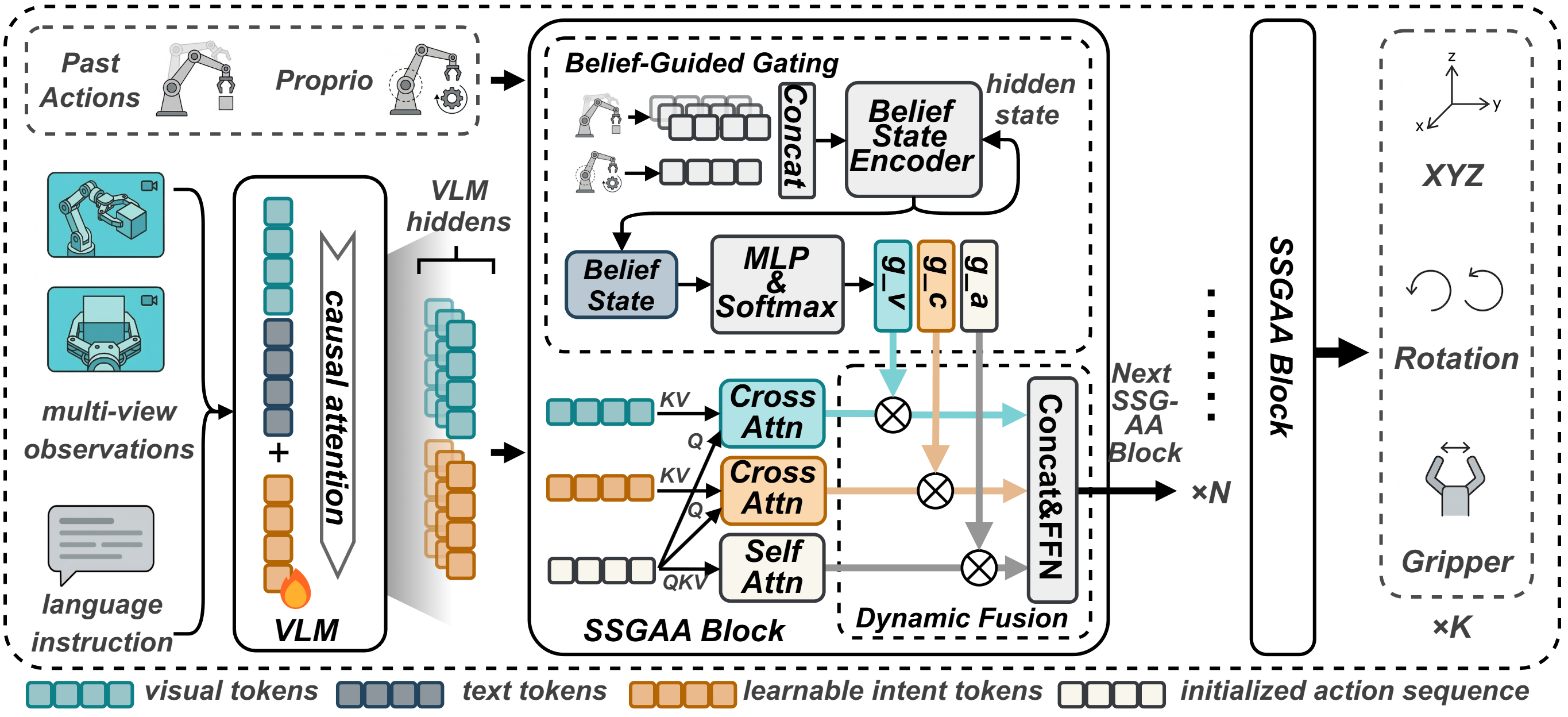
Figure 2: Architectural diagram showing the state-space-guided adaptive fusion of visual, language, and action features within S2-VLA.
Methodological Advances
Belief State Modeling:
S2-VLA formalizes long-horizon VLA manipulation via a recursively updated belief state bt, which is end-to-end learned solely through action prediction loss. This variable efficiently summarizes phase, history, and deviations in execution, and serves as the conditional input for policy generation, contrasting with standard snapshot-based models that lack explicit temporal tracking.
Adaptive Attention via SSGAA:
The innovation in SSGAA lies in routing fused representations through soft, belief-state-driven gating. During policy execution, this enables on-the-fly re-weighting of visual, semantic, and action-sequence features at each transformer layer. Ablation studies show significant performance gains when gating is applied to semantically rich middle layers (notably layer 12), and that adaptivity degrades if gating weights are decoupled from the belief state.
Parallel Decoding:
The unified multimodal representation output from SSGAA is decoded in parallel (not autoregressively), predicting a sequence of future actions for immediate execution. This improves inference throughput and mitigates latency drawbacks observed in token-based autoregressive approaches.
Experimental Results
Simulation Benchmarks
Comprehensive evaluation on the LIBERO and SimplerEnv platforms demonstrates that S2-VLA sets new state-of-the-art results across all key subsets—Spatial, Object, Goal, and Long. With an average success rate of 98.2% on LIBERO, S20-VLA not only surpasses all static-fusion and parameter-scaled models but also exhibits robustness against error accumulation in challenging, extended activities.
Real-World Transfer
On the ALOHA dual-arm system, S21-VLA exhibits effective real-world transfer, achieving superior success rates in diverse, multi-stage physical tasks compared to ACT and 22-FAST models. Its compact memory footprint (requiring only 7GB VRAM) and high throughput enable practical deployment on hardware-constrained systems.
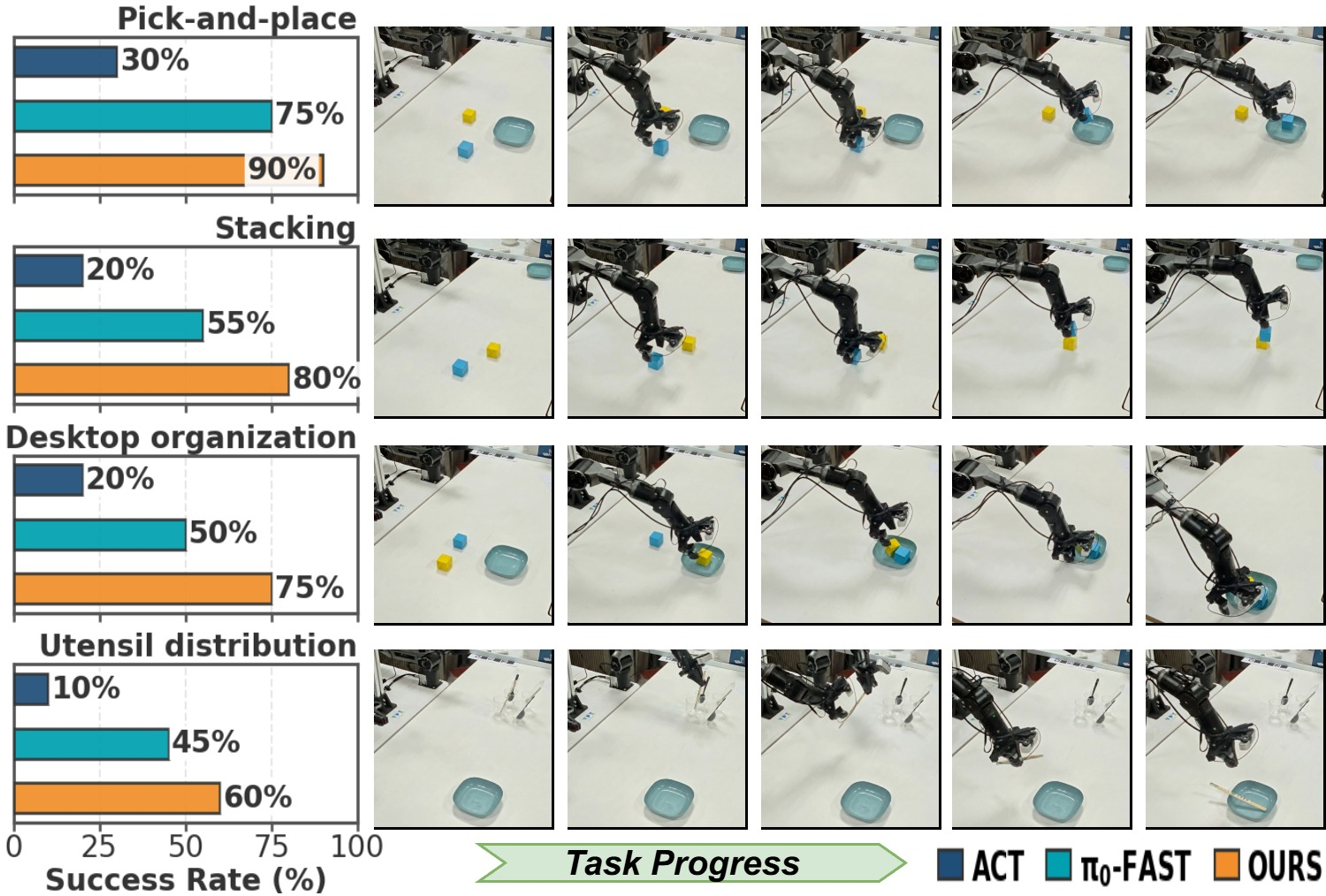
Figure 3: Real-world manipulation success rates for S23-VLA relative to ACT and 24-FAST; S25-VLA demonstrates comprehensive improvement across all tested tasks.
Ablation and Efficiency Analysis
Ablation results indicate:
- Depth-sensitive gating: Gating at intermediate layers (especially layer 12) is optimal, providing a 1.4% improvement over non-gated baselines.
- Belief-state guidance: Static gating—even at optimal layers—incurs a significant performance drop compared to dynamic, belief-state-driven gating.
- Parameter efficiency: S26-VLA (2B) matches or outperforms baselines using 3B/4B backbones (QwenVL+FAST/OFT/GR00T) and surpasses Qwen3-VL+Adapter-Pro.
In terms of execution efficiency, S27-VLA achieves dominant inference throughput, reaching 80.8 Hz, a substantial gain over prior large-scale baselines.
Mechanistic Interpretability
Visualization of SSGAA gating weights during LIBERO-Long task rollouts reveals highly interpretable dynamics: the model prioritizes visual attention during object alignment, semantic intent when switching subgoals, and action-sequence attention during transport, supporting phase-aligned robustness absent in static-fusion architectures.
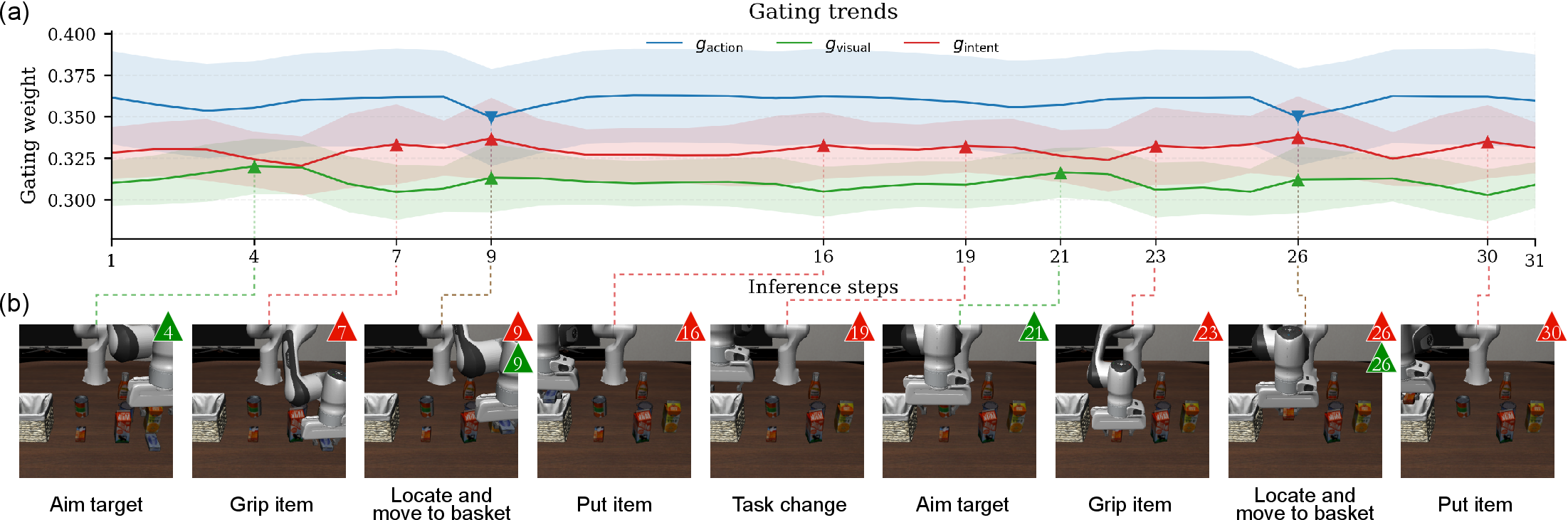
Figure 4: Dynamic gating weight trajectories for S28-VLA, illustrating stage-aligned shifts among spatial, semantic, and temporal feature pathways throughout a long-horizon task.
Implications and Future Directions
From a theoretical standpoint, the SSGAA-designed S29-VLA demonstrates that adaptive, belief-driven information fusion is fundamentally more scalable for long-horizon manipulation than static, backbone-scaling approaches. By leveraging latent task-phase and execution-fidelity representations, such architectures can suppress error propagation, enable phase-specific focus, and maintain temporal coherence.
Practically, this enables more compact, resource-efficient manipulation agents that do not forfeit generality or robustness, thereby lowering deployment barriers for real-world robotic systems.
Looking forward, extending belief-state-guided fusion strategies into more general action generation paradigms—such as diffusion or flow-matching models—and scaling the architecture to even more diverse multimodal tasks may yield further improvements in general-purpose robotic intelligence. Integrating richer task-phase self-supervision, or coupling the belief state with explicit environment models, are also promising directions to expand controllability and transfer.
Conclusion
S20-VLA sets a new performance and efficiency standard for vision-language-action models in robot manipulation, primarily due to its state-space-guided adaptive attention mechanism. This architectural innovation decouples long-horizon learning performance from backbone size, and directly addresses error accumulation in multi-stage tasks through dynamic, phase-aware multimodal fusion. Its success establishes belief-state-modulated adaptivity as a principled cornerstone for future developments in generalist AI agents.
Reference: (2606.27872)