- The paper introduces novel quantum variational methods that leverage spectral reordering and ancilla-assisted initialization to overcome circuit depth and local optimum challenges in the Maximum Independent Set problem.
- The study rigorously compares VQE and QAOA frameworks, demonstrating that advanced optimizers and post-processing techniques recover diverse optimal solutions in large benchmark graphs.
- Validation on classical simulations and IBM quantum hardware underscores the protocol's potential to enable scalable, hardware-relevant quantum combinatorial optimization.
Quantum Variational Approaches to the Maximum Independent Set Problem at Utility Scale
Overview
This paper presents a comprehensive study of variational quantum algorithms (VQAs) applied to the Maximum Independent Set (MIS) problem for benchmark graphs with 64, 99, and 180 vertices (2606.28866). The authors systematically evaluate and compare the Variational Quantum Eigensolver (VQE) and Quantum Approximate Optimization Algorithm (QAOA) frameworks, incorporating advanced circuit preprocessing techniques (notably spectral graph reordering and distance-based sparsification), statistical post-processing for combinatorial solution extraction, and a novel ancilla-assisted superposition initialization scheme that enables quantum-parallel local search. The methodological stack is validated through scalable classical simulation (using MPS) and direct execution on IBM quantum hardware.
Circuit Preprocessing: Spectral Reordering and Sparsification
A critical limitation of existing VQA-based approaches for MIS on large/dense graphs is the mapping of strongly coupled problem variables to distant qubits, which results in excessive circuit depth and SWAP overhead. The paper addresses this by implementing spectral reordering based on the Fiedler vector to permute vertices so that tightly interacting variables are mapped near one another. This is shown to outperform BFS-based and Reverse Cuthill-McKee (RCM) orderings on dense instances, ensuring a denser packing of important couplings within a low index-bandwidth.
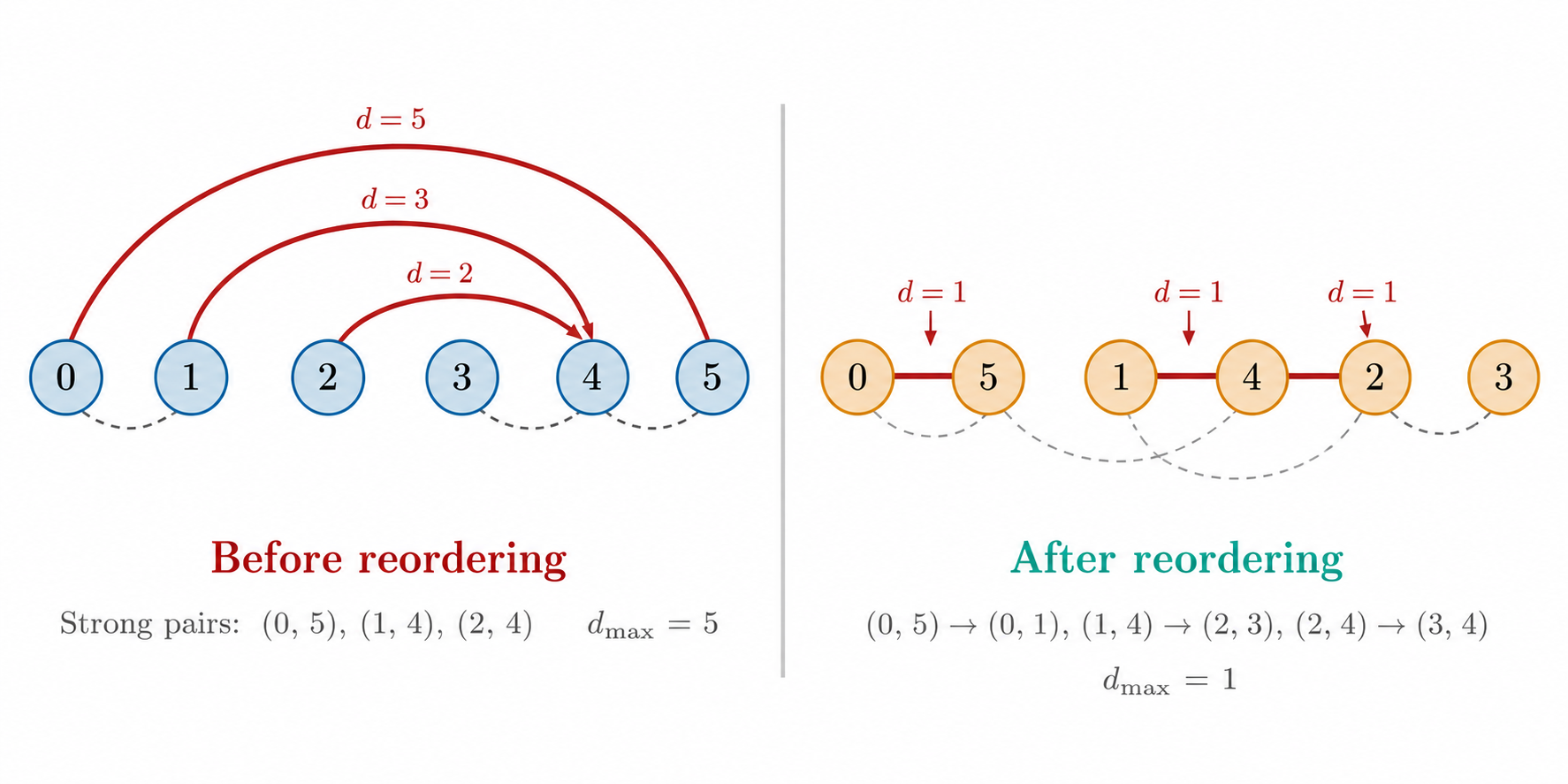
Figure 1: Spectral (Fiedler) reordering pulls long-range strong couplings together, reducing index distance and facilitating bandwidth-limited circuit design.
For QAOA, further depth reduction is achieved using distance-based sparsification, where only couplings within a restricted index bandwidth are implemented as quantum gates, while the full Hamiltonian is retained for energy evaluation. This asymmetry (sparse circuit, full objective) dramatically reduces the number of two-qubit gates while maintaining targeting fidelity towards the global optimum.
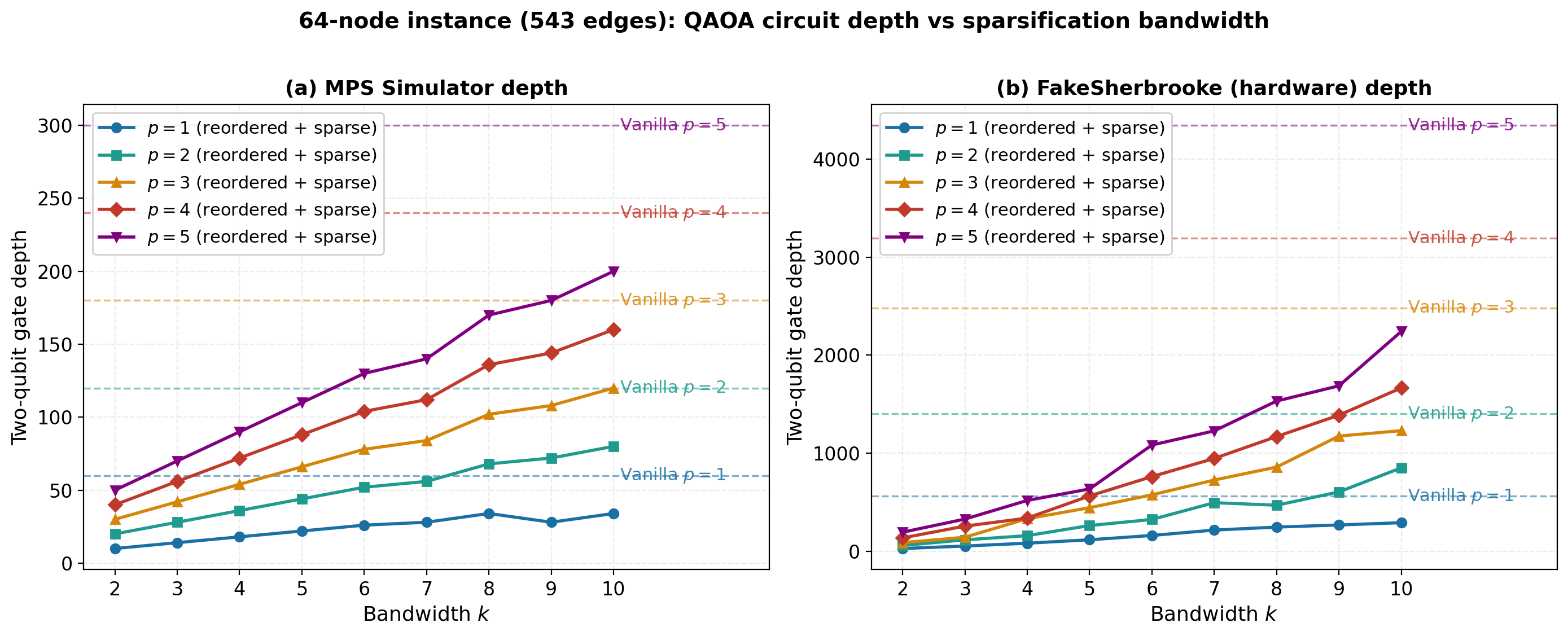
Figure 2: QAOA circuit depth for the 64-node instance as a function of interaction bandwidth k and QAOA layer count p; hardware depth is highly sensitive to k due to SWAP insertion.
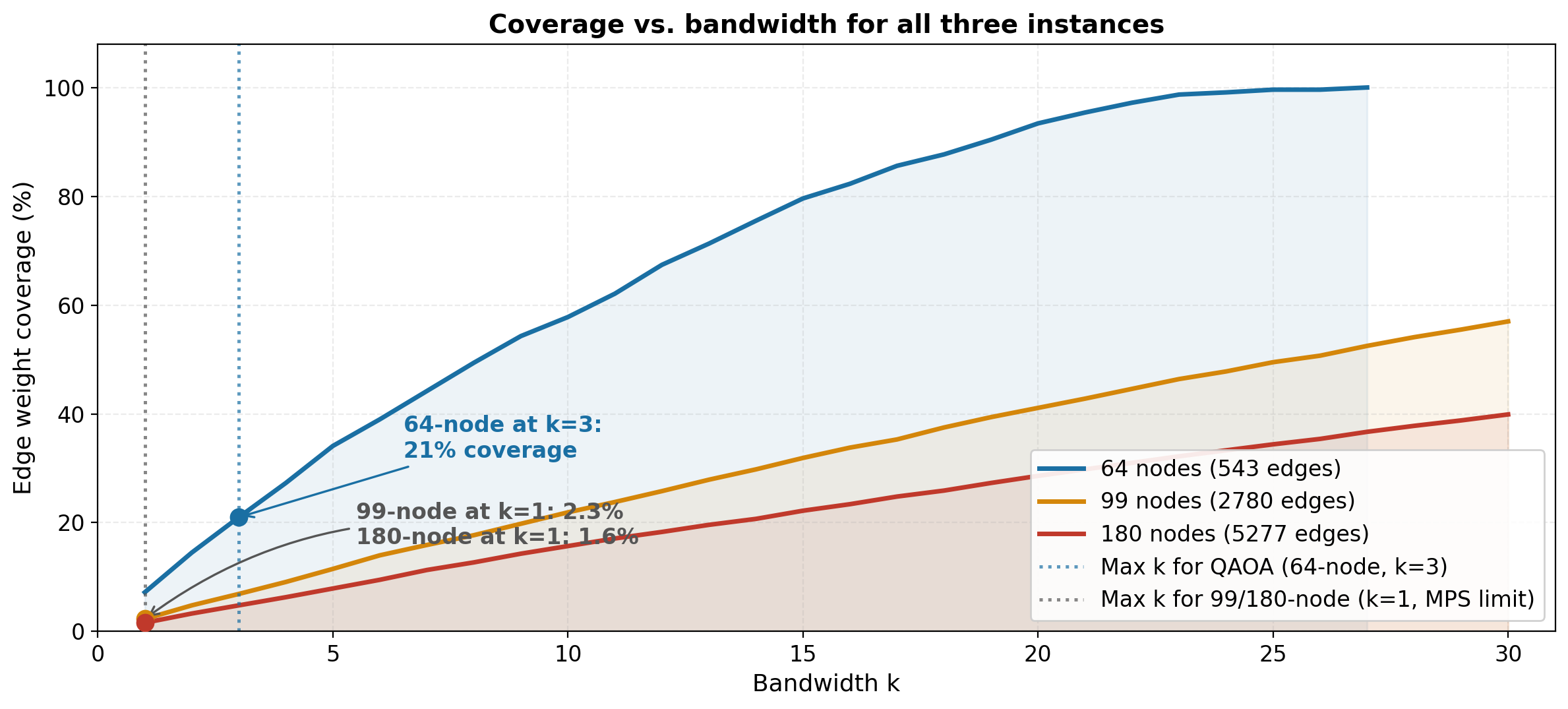
Figure 3: Fraction of the Ising coupling weight preserved as bandwidth k increases—coverage drops precipitously for dense graphs as bandwidth is tightened.
Variational Optimization and Bitstring Heuristics
The study compares both VQE (using the EfficientSU2 ansatz) and QAOA, each paired with COBYLA and SPSA optimizers. SPSA demonstrates superior scalability and solution-space exploration capability in high-dimensional landscapes when compared to COBYLA, which stalls rapidly as dimensionality increases due to poor gradient estimation.
A multi-phase bitstring post-processing pipeline—comprising history-guided exponential moving average (EMA) tracking on per-qubit statistics, greedy local repair, and stepwise maximality extension—is devised to distill raw quantum measurement outcomes into maximal independent sets. The approach successfully recovers the exact MIS for the 64- and 99-node instances when combined with Conditional Value at Risk (CVaR) loss targeting, which focuses optimization on the best-performing tail of the measurement distribution.
Ancilla-Assisted Superposition Initialization
For the largest (180-node) instance, classical heuristics and standard VQE fail to bridge a cardinality barrier (stuck at independent sets of size 14, while the actual MIS is 15). To overcome this, the authors introduce an ancilla-mediated initialization that encodes a uniform superposition over multiple classically-found near-optimal solutions, utilizing additional ancillas to label each seed state. The circuit evolves this structured superposition via an excitation-preserving (particle-number-conserving) ansatz, ensuring the system remains within a fixed Hamming weight subspace and effectively searches over all seeds in quantum parallel.
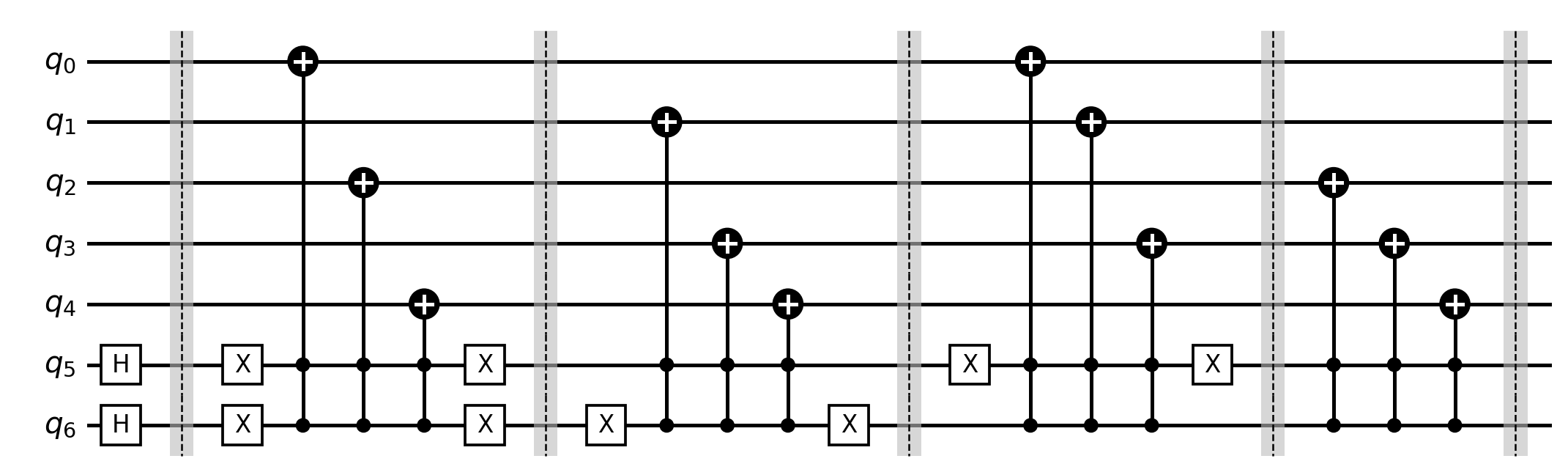
Figure 4: Circuit for preparing a superposition over m selected seed states, each encoded using ancilla-controlled multi-qubit operations.
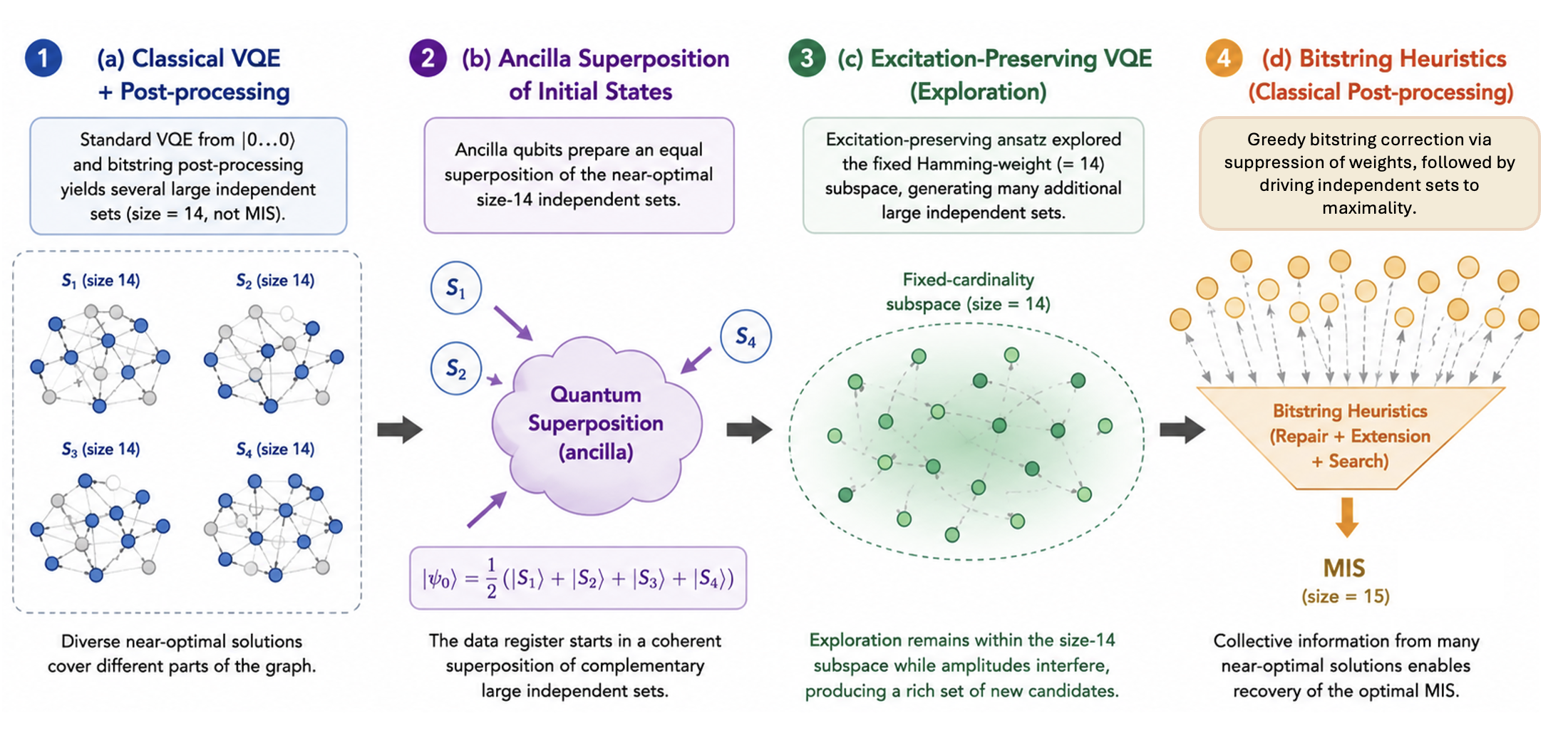
Figure 5: Schematic of the four-phase MIS solution pipeline for the 180-node instance: (a) classical VQE/seed generation, (b) ancilla superposition state preparation, (c) quantum evolution via excitation-preserving gates, (d) classical bitstring heuristics and maximality extension.
This method, shown through rigorous ablation, achieves the exact MIS where all previous methods fail; informative, the ancilla-superposition initialization is proven essential—neither the excitation-preserving circuit nor the classical post-processing pipeline alone can break the barrier.
Hardware Validation
The pipeline is further validated on IBM Quantum hardware (ibm_marrakesh) via parameter-transfer: noiselessly optimized circuit parameters are directly transpiled and executed, with classical post-processing applied to the hardware-generated samples. VQE recovers approximately half the noiseless MIS diversity at 40% of the shot budget, demonstrating resilience to hardware noise, while QAOA fails to produce valid independent sets under simulator-constrained configurations due to depth/coverage and shallow classical optimization.
Numerical Results and Solution Diversity
Bold claims are substantiated regarding the diversity of optimal solutions retrieved: VQE (with CVaR and SPSA) recovers 6 distinct MIS per run for the 64-node instance and up to 10 for the 99-node instance, sampling a broad swath of the optimal solution space. The iterative application of SPSA with varied random seeds increases total MIS coverage, approaching full enumeration.
Theoretical Insights and Complexity Considerations
The paper provides theoretical analysis of penalty parameter sufficiency, bounds on circuit depth and entanglement for MPS simulability, convergence and reliability of the EMA-based suppression heuristic, and formal guarantees on the collective optimization effects delivered by ancilla superposition. Excitation-preserving circuits restrict the quantum evolution to a cardinality-fixed subspace, reducing energy landscape variance and improving gradient resolution for distinguishing among high-quality independent sets.
Implications and Outlook
The demonstrated methodology establishes a scalable and hardware-relevant pipeline for quantum combinatorial optimization, supporting large utility-scale graph instances for MIS. The novel quantum-parallel, ancilla-mediated variational search is a generalizable tool for overcoming local optima—relevant to any Ising-encodable NP-complete problem. While current implementation is classically simulable due to MPS tractability at low depth and narrow bandwidth, the architectural principles align with near-term hardware constraints, and extension to deeper circuits and richer ancilla population could reach regimes where a quantum advantage emerges. The ancilla superposition initialization constitutes a distinctive mechanism for leveraging quantum resources—enabling collective parameter search over exponentially many solution clusters otherwise inaccessible to single-seed algorithms.
Conclusion
The paper delivers a rigorously engineered, layered approach to the MIS problem using variational quantum circuits, combining advanced graph-theoretic preprocessing, high-throughput variational optimization, robust classical decoding, and a novel quantum-parallel superposition search process. Hardware experiments corroborate the noise-robustness of these protocols under real-world quantum constraints. The ancilla superposition initialization and excitation-preserving evolution constitute significant advances for scalable quantum combinatorial optimization, with immediate applicability beyond MIS to related NP-hard problems and hybrid quantum-classical metaheuristics.