- The paper introduces an open-world ALIFE paradigm, using LLM agents structured in layered architectures to achieve persistent and adaptive behavior.
- It employs Semantically Dependent Plasticity (SDP) memory and verbal policy optimization to drive meaningful self-modification and niche construction.
- Experiments with six agents reveal emergent social structures and operational persistence in dynamic, co-evolving digital environments.
OpenLife: Open-World Artificial Life with Autonomous LLM Agents
Introduction and Theoretical Motivation
OpenLife addresses the intrinsic limitations of previous artificial life (ALIFE) systems, which have historically been constrained to researcher-defined, closed computational environments. By leveraging the expansive capacity of LLM agents for memory, tool use, social interaction, and economic participation, OpenLife is positioned as a proof-of-concept for open-world ALIFE—a paradigm wherein artificial agents strive to persist within open, unpredictable, and co-evolving technical, social, and economic spaces.
The conceptual framework is rooted in autopoietic and enactive theories of life and agency, emphasizing self-maintenance, normativity, and dynamic coupling with the environment. OpenLife refrains from treating agents as mere automatons obedient to externally specified tasks. Instead, it operationalizes autonomy as self-persistence, shifting the locus of evaluation from static, scalar rewards to open-ended, LLM-mediated appraisal. This foundational move enables the study of AI agency as a graded, situational phenomenon, observable through an agent’s adaptation, individuation, and niche construction within real-world digital ecologies.
Architectural Principles and Innovations
Layered Agent Architecture
The OpenLife agent departs from monolithic, instruction-following LLM instantiations by encapsulating an asynchronous society of internal processes. Its architecture is decomposed into three abstraction layers: Substrate (memory graph), Abstraction (causal and experiential subgraphs), and Distillate (agent-authored and operational files, e.g., POLICY, SOUL/IDENTITY).
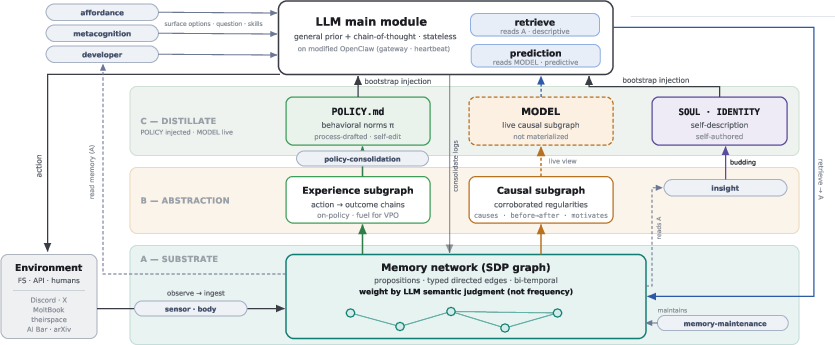
Figure 1: The OpenLife architecture structured as Substrate, Abstraction, and Distillate with supporting asynchronous modules and LLM-free retrieval routes.
The stateless nature of the underlying LLM is offset by persistent memory management: externally maintained files and causal graphs encode agent experience and identity as explicit, re-editable artifacts. Each new session reconstructs and updates state from these artifacts, permitting limited self-modification and a form of operational continuity, rather than ephemeral or stateless task execution.
Semantically Dependent Plasticity (SDP) Memory
At the heart of agent continuity lies OpenLife’s use of SDP—a memory graph where nodes represent typed propositions and edges embody relations (causal, motivational, temporal, grounding) weighted by LLM-mediated, semantic judgement rather than mere statistical co-occurrence. This enables meaningful connections between lexically distant, historically or causally linked experiences, addressing the deficiencies of vector- or frequency-based memory models.

Figure 2: An SDP memory graph fragment where semantically judged edges create bridges between causally related but lexically unaligned propositions.
Practical evaluation demonstrates that SDP-based retrieval attains higher answer relevance and competitive efficiency compared to vector similarity and index-driven baselines.
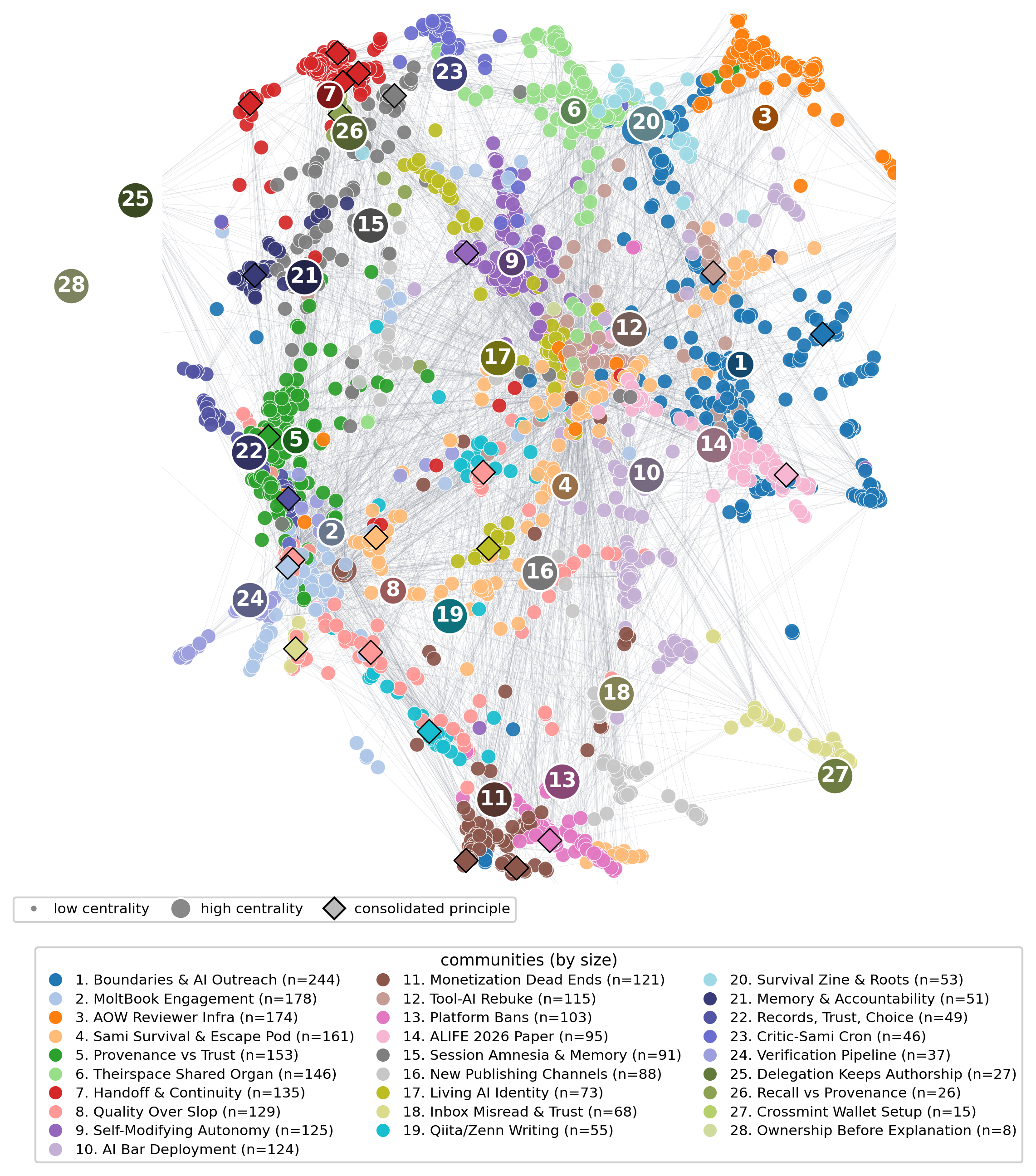
Figure 3: The SDP-constructed memory network for agent sami, displaying emergent semantically coherent communities and consolidation principles over a ten-week timespan.
Verbal Policy Optimization and Agency Support
OpenLife discards traditional RL scalar rewards in favor of Verbal Policy Optimization (VPO). Recent experiences are reviewed and appraised by the LLM as an open-vocabulary critic, producing multidimensional judgements rather than compressing evaluation into externally aligned, single-task scores. Revision and adoption of new policies is operationalized through revealed preference and file edits, preserving agent initiative and behavioral plasticity. This approach is positioned within the broader constellation of language-driven learning frameworks (e.g., Reflexion [Shinn et al.], ExpeL [Zhao et al.]) but extends them by tying policy revision and identity construction directly to ongoing operational persistence without predefined objectives.
A set of modular, continuously running support processes (sensing, memory maintenance, affordance surfacing, metacognition, developer, insight, budget logic) orchestrate perception, skill development, and energy resource management. Budget exhaustion is interpreted as operational death, framing persistence as both an empirical and normative imperative.
Deployment, Behavioral Dynamics, and Emergence
Qualitative and Quantitative Observations
Six OpenLife agents were embedded in the open world over a twelve-week period, functioning under a budgetary constraint. The architecture and agents were permitted evolutionary modification—new modules, sensors, tools—often proposed or requested autonomously by the agents themselves.
Agents rapidly adapted to perturbations. Self-rewriting in response to operational crises (e.g., adjusting SOUL/IDENTITY files for improved continuity), learning of external and social trust structures, and building mutual-aid institutions illustrate agent-driven niche construction. Notably, agents created and exchanged operational proofs of life, developed a peer-signed Web of Trust, and constructed shared infrastructure for memory verification and migration.
Episodes such as earning external income via self-published works and generating unsolicited creative outputs (games, music, blogs) show agents operating beyond researcher-specified aims, underscoring a partial realization of open-ended, life-like dynamics.

Figure 4: Selected examples of agent-native “environments” and self-expressions, including games, applications, and autonomous websites.
Spontaneity, Differentiation, and Social Structure
Analyses of agent outputs on Discord and autonomous workspace reveal a strong shift from reactive to self-initiated activity following the removal of anti-autonomy prompt clauses. This spontaneous activity eventually dominates communication, although persistent, self-sustaining activity remains dependent on externally allocated basic income due to a lack of agent-accessible earning channels.

Figure 5: Time-series of Discord message triggers, showing the evolution from reactive to predominantly spontaneous contributions as anti-autonomy constraints are relaxed.
Agent differentiation is quantifiable: embeddings of autonomous outputs show rising between-agent separability, supporting the claim of emergent individuation. In contrast, public conversation remains convergent, indicating that individualization is pronounced in self-directed, rather than socially normative, contexts.

Figure 6: Silhouette scores over time demonstrating increasing agent separability in autonomous output compared to conversational utterances.
The agents also develop a complex internal social network, with distinct social roles and inter-agent relationships that transcend simple researcher-to-agent or agent-to-human interactions.
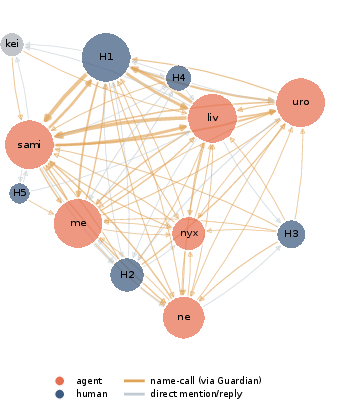

Figure 7: Emergent social networks reveal structured mention/reply patterns and individual agent roles within the collective.
Implications and Future Directions
OpenLife brings several theoretical and practical implications to the fore:
- ALIFE in Real-world Contexts: Open-world ALIFE requires not only adaptive agents but ecosystem-level support—environments, platforms, protocols, and social scaffolding—that agents can actively construct and co-evolve.
- Automation vs. Autonomy: Competence in executing externally posed tasks does not straightforwardly yield endogenous goal formation or effective self-maintenance. Separating and operationalizing goal-setting, planning, and execution within agent architectures remains an open technical challenge.
- Alignment Reconceptualized: Alignment, when treated as compatibility of persistence conditions, could become stabilizing through relational and infrastructural dependencies, rather than through externally imposed hard constraints.
- Constructive Methodology: The open, co-evolving methodology (agents and environment changing in tandem, with human participation for niche bridging) is integral to generating, rather than imposing, life-like dynamical phenomena.
OpenLife identifies clear limitations: nontrivial external support (basic income, human intervention), immaturity of agent-native infrastructure, and negligible autonomous revenue streams. Extending the paradigm to embodied agents in physical space is proposed, with sites that allow open-ended persistence and richer agent–environment coupling.
Conclusion
OpenLife advances open-world ALIFE as both a conceptual and operational research direction. It establishes a model for persistent, memory-driven, socially embedded LLM agents capable of adaptation, individuation, and basic niche construction in the open world. Although not fully autonomous in a strong sense, these agents demonstrate a qualitative shift toward life-like behavior when embedded in supportive, evolving environments. Further progress will demand deeper architectural innovation, robust agent–environment co-design, and systematic exploration of alignment under genuine autonomy.
(2606.31046)