- The paper introduces an energetic decomposition where total energy divides into Gaussian and non-Gaussian components.
- It reveals that non-Gaussian energy correlates with entropic measures and identifies state optimization under energy constraints.
- The method offers a practical, experimentally accessible approach to certify non-Gaussianity in both pure and mixed bosonic states.
Energetic Quantification of Non-Gaussianity in Single-Mode Bosonic Cavities
Introduction
Non-Gaussian states in bosonic single-mode systems are fundamental for exploiting quantum resources in information processing, metrology, and communication tasks. While several measures for non-Gaussianity have been posited—information-theoretic, phase-space-based, and operational—the experimental access and physical interpretability of these measures remain limited. This paper establishes an energetic framework for quantifying non-Gaussianity, decomposing the total energy of single-mode bosonic states into Gaussian and non-Gaussian contributions, and relating these to existing entropic quantifiers. The approach enables both a physically motivated and experimentally tractable route to non-Gaussianity identification and quantification (2606.31150).
Energetic Decomposition for Pure States
The foundation of the proposed framework is the decomposition of the total energy of a pure state ∣ψ⟩ in terms of its Gaussian and non-Gaussian components. The total energy is expressed as
E=Ecoh+Esq+Eng,
where Ecoh is the energy extractable via displacement, Esq via squeezing, and Eng (the non-Gaussian energy) encapsulates the residual energy extractable only by genuinely non-Gaussian unitaries.
This structure directly ties energetic signatures to the presence of non-Gaussianity:
- For Gaussian states, all energy is extractable via Gaussian operations, thus Eng=0.
- For non-Gaussian pure states, Eng>0, certifying the presence of non-Gaussian structure.
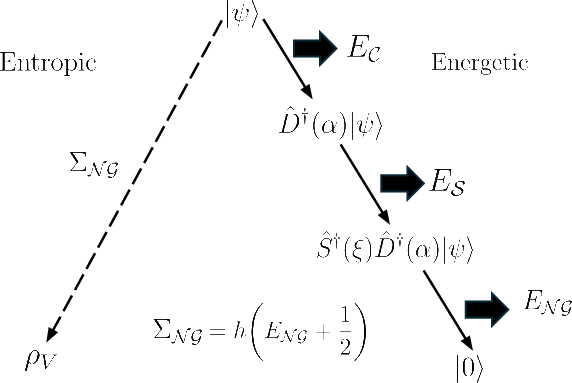
Figure 1: Energetic quantification—energy is decomposed via Gaussian operations, with non-Gaussian energy defined as the residual, in contrast to the entropic approach using relative entropy to a reference Gaussian state.
Importantly, Eng possesses the core properties of a valid non-Gaussianity measure for pure states: faithfulness (zero if and only if the state is Gaussian), non-negativity, and invariance under Gaussian unitaries.
Equivalence with Entropic Quantification
The energetic approach is reconciled with the relative entropy of non-Gaussianity, Σ[ρ]=S[ρV]−S[ρ], where ρV is the reference Gaussian state with matching first and second moments. For pure states—with E=Ecoh+Esq+Eng,0—E=Ecoh+Esq+Eng,1 depends solely on the covariance matrix determinant, and is a monotonic function of E=Ecoh+Esq+Eng,2. Thus, the energetic and entropic approaches yield equivalent quantification in the pure-state scenario.
Maximizing Non-Gaussianity under Energy Constraints
The framework enables optimization of non-Gaussianity under physical constraints. States maximizing E=Ecoh+Esq+Eng,3 at fixed total energy are characterized by vanishing first and second moments; e.g., Fock states and certain superpositions thereof.
The protocol's practical significance is highlighted via analysis of states generated by SNAP gates on coherent inputs, demonstrating that the energetic measure's maxima closely track the optima of Wigner negativity. Given the computational complexity of direct Wigner negativity optimization, E=Ecoh+Esq+Eng,4 serves as an effective, experimentally accessible proxy.
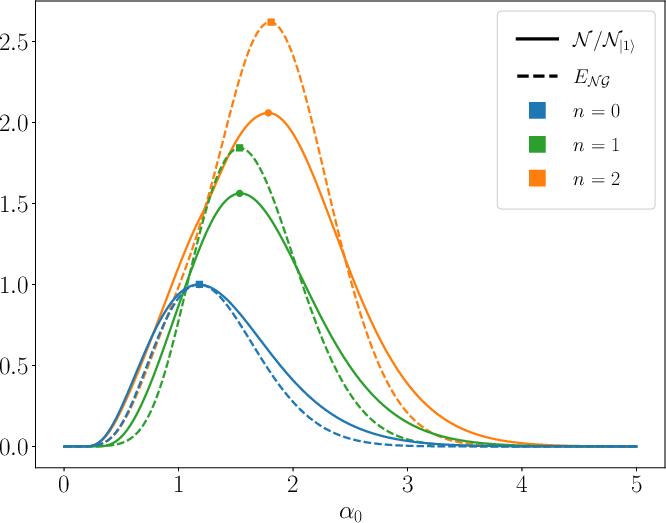
Figure 2: Non-Gaussian energy (dashed) and Wigner negativity (solid) for SNAP-modified coherent states, showing similar optimal points as the input amplitude is varied.
Extension to Mixed States and the Energetic Witness
For mixed states, the total energy is decomposed into contributions from displacement, squeezing, statistical mixedness (thermal part), and a non-Gaussian witness E=Ecoh+Esq+Eng,5. Here, E=Ecoh+Esq+Eng,6 is given by
E=Ecoh+Esq+Eng,7
with E=Ecoh+Esq+Eng,8 reflecting the energy of a thermal state having the same entropy as E=Ecoh+Esq+Eng,9. Ecoh0 remains non-negative, vanishing exclusively for Gaussian states, and is invariant under Gaussian unitaries.
Ecoh1 is demonstrated to be a faithful witness: all physical states must have Ecoh2, and Ecoh3 if and only if the state is Gaussian.
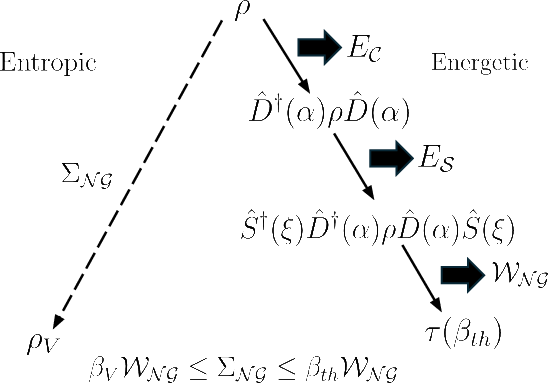
Figure 3: Energetic decomposition for mixed states, showing extraction via Gaussian operations, separation of mixedness, and identification of non-Gaussian energy as a residual.
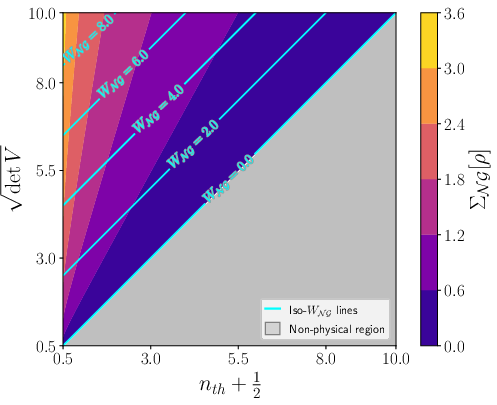
Figure 4: Phase-space representation: contours of constant Ecoh4 (cyan) and relative entropy of non-Gaussianity, mapping the landscape of quantum states relative to the Gaussian set (zero Ecoh5 line).
Extensive numerics indicate monotonicity of Ecoh6 under arbitrary Gaussian channels—i.e., Ecoh7—supporting its status as a non-Gaussianity monotone.
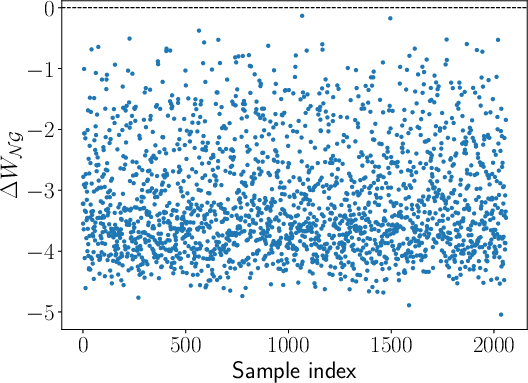
Figure 5: Numerical evidence that the energetic witness Ecoh8 is non-increasing under random Gaussian channels acting on sampled initial states.
Relationship to Relative Entropy for Mixed States
For mixed states, Ecoh9 and Esq0 are functionally independent, as indicated by non-parallel gradients in the relevant parameter space. However, they share qualitative trends and Esq1 provides rigorous upper and lower bounds on Esq2:
Esq3
where Esq4 and Esq5 are inverse temperatures related to the Gaussian-passive and completely passive (thermal) states, respectively.
Experimental and Theoretical Implications
The energetic approach is experimentally attractive, as Esq6 and Esq7 depend solely on first and second moments, accessible through homodyne detection, unlike full state tomography required by negativity-based measures. Theoretically, energetic decomposition connects resource theory quantifiers to thermodynamic ergotropy and clarifies physical trade-offs in state preparation, work extraction, and channel design for non-Gaussian quantum protocols.
These results suggest that energetic signatures can inform optimal strategies for continuous-variable quantum engine design, efficient cooling, and entanglement certification in more complex multimode settings—all central directions for ongoing research.
Conclusion
This work presents an operational energetic framework for the quantification and witnessing of non-Gaussianity in single-mode bosonic systems. For pure states, the non-Gaussian energy furnishes a faithful and experimentally accessible measure, operationally equivalent to the relative entropy of non-Gaussianity. For mixed states, an energetic witness with supporting numerical evidence for monotonicity under Gaussian channels is established, together with explicit bounds relating energetic and entropic quantifiers. The framework deepens the link between quantum thermodynamics and resource theory and opens new avenues for experimental state characterization and resource certification in continuous-variable quantum technology (2606.31150).