Determining stress-based bending mode limits for the Vera C. Rubin Observatory M1M3 active mirror system
Published 30 Jun 2026 in astro-ph.IM | (2606.31849v1)
Abstract: The Vera C. Rubin Observatory Simonyi Survey Telescope's primary-tertiary mirror (M1M3) is an actively supported, 8.4-m cast borosilicate optic controlled by 156 pneumatic actuators. This work presents a rapid stress-estimation methodology based on the root-sum-square (RSS) combination of Finite Element Analysis to derive pre-computed unit bending mode stresses. Since the stress is proportional to strain, and strain is proportional to displacements, we theorized that since the bending mode displacements can be combined RSS, that the peak stresses would also combine by RSS. We validate the RSS-based major principal stress predictions against NASTRAN simulations for representative bending mode combinations, demonstrating agreement within a few percent for peak Principal major stress across the mirror glass substrate. Unit displacement and corresponding unit stress fields for the first 20 natural bending modes of the M1M3 system are generated using NASTRAN. Representative multi-mode corrections including combinations that include astigmatism, coma, and spherical modes of higher order are then analyzed to compare the resulting peak principal stresses with RSS-based predictions. The method enables near instantaneous evaluation of stress margins for active optics corrections, safety-limit checking, and actuator-force optimization during telescope operations. This paper outlines the formulation, implementation workflow, validation results, and practical use cases for integrating RSS-based stress prediction into the Vera C. Rubin Observatory's M1M3 active optics system.
The paper introduces a rapid RSS estimator that predicts peak principal stresses with errors typically within ±5% compared to detailed FEA results.
It pre-computes unit-normalized stress fields for the first 20 bending modes, enabling quick lookup for active optics corrections.
The methodology supports real-time safety checking and actuator optimization with negligible computation, ensuring conservative stress estimates.
Rapid Stress-Based Bending Mode Limits for the Rubin Observatory M1M3 Mirror
Introduction
The Vera C. Rubin Observatory’s M1M3 monolithic primary–tertiary mirror is supported by 156 pneumatic actuators and is an integral component of its active optics system (AOS). Ensuring the structural safety of this irreplaceable glass optic under dynamic actuator corrections is a critical operational challenge. Traditional Finite Element Analysis (FEA) offers high-fidelity stress estimates but is computationally prohibitive for real-time correction cycles. The paper (2606.31849) presents an efficient Root-Sum-Square (RSS) methodology to predict peak principal stresses in response to arbitrary actuator-driven bending mode combinations, validated extensively against FEA. This approach supports real-time safety checking and actuator optimization, streamlining AOS operations.
Methodological Framework
The methodology capitalizes on the linear elastic response of the M1M3 borosilicate substrate. Since both stress and displacement are linear functions of applied actuator forces and the operational regime is strictly confined to elastic deformations, bending mode displacements can be constructed as orthogonal basis vectors. The RSS principle posits that if the displacement modes are orthogonal, then their corresponding stress fields, although spatially complex, combine quadratically in a first-order approximation.
For each of the first 20 elastic bending modes (excluding rigid body modes), unit-normalized displacement and stress fields are pre-computed via NASTRAN FEA. The major principal (tensile) stress at 1 μm RMS surface deformation is stored for both positive and negative senses, yielding a lookup table (LUT) of 40 unit stress values. For a given correction vector with coefficients {ci}, the predicted peak stress σRSS is:
σRSS=i=1∑20(ci⋅σiunit)2
where σiunit is selected based on the sign of ci. This approach has negligible computational cost and is suitable for integration into the real-time AOS control logic.
The FEA validation also included an alternative direct summation estimator, which assumes worst-case spatial constructive interference across all stress fields. Results demonstrate that direct summation grossly overestimates peak stresses across all scenarios.
Bending Modes and Unit Stress Characterization
The paper’s initial FEA characterized 20 elastic bending modes spanning low-order (e.g., astigmatism, spherical, coma) and higher-order geometric deformations. Each mode’s unit stress field was normalized and analyzed for spatial orthogonality and peak stress concentration regions.
Figure 1: M1M3 bending modes normalized to 1 μm RMS, with removal of tip, tilt, and piston via plane fitting, highlighting spatial and modal diversity.
Modes 3 (Focus/Spherical) and 12 (2nd Spherical) are rotationally symmetric and exhibit stress peaks along the same radial loci, representing cases where RSS underprediction is most probable due to constructive stress overlap.
Validation Against FEA
Two sets of validation trials were executed:
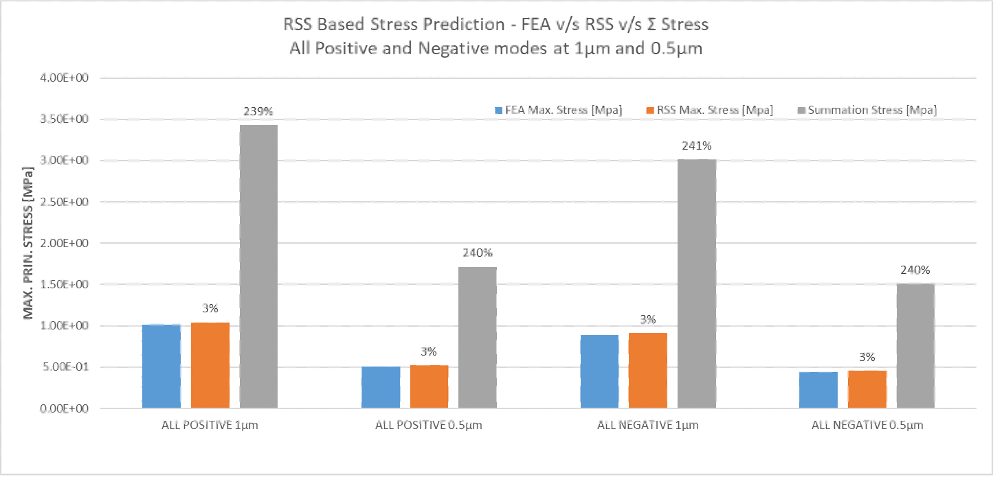
All-Modes Simultaneous Activation: All 20 modes were excited simultaneously at uniform amplitude (1 μm and 0.5 μm RMS). The RSS estimate matched FEA within +3%, while direct summation overestimated by 239–241%.
Figure 2: RSS-based peak stress prediction vs. FEA for simultaneous all-mode activations, showing agreement within 3% for RSS and >200% overprediction for summation.
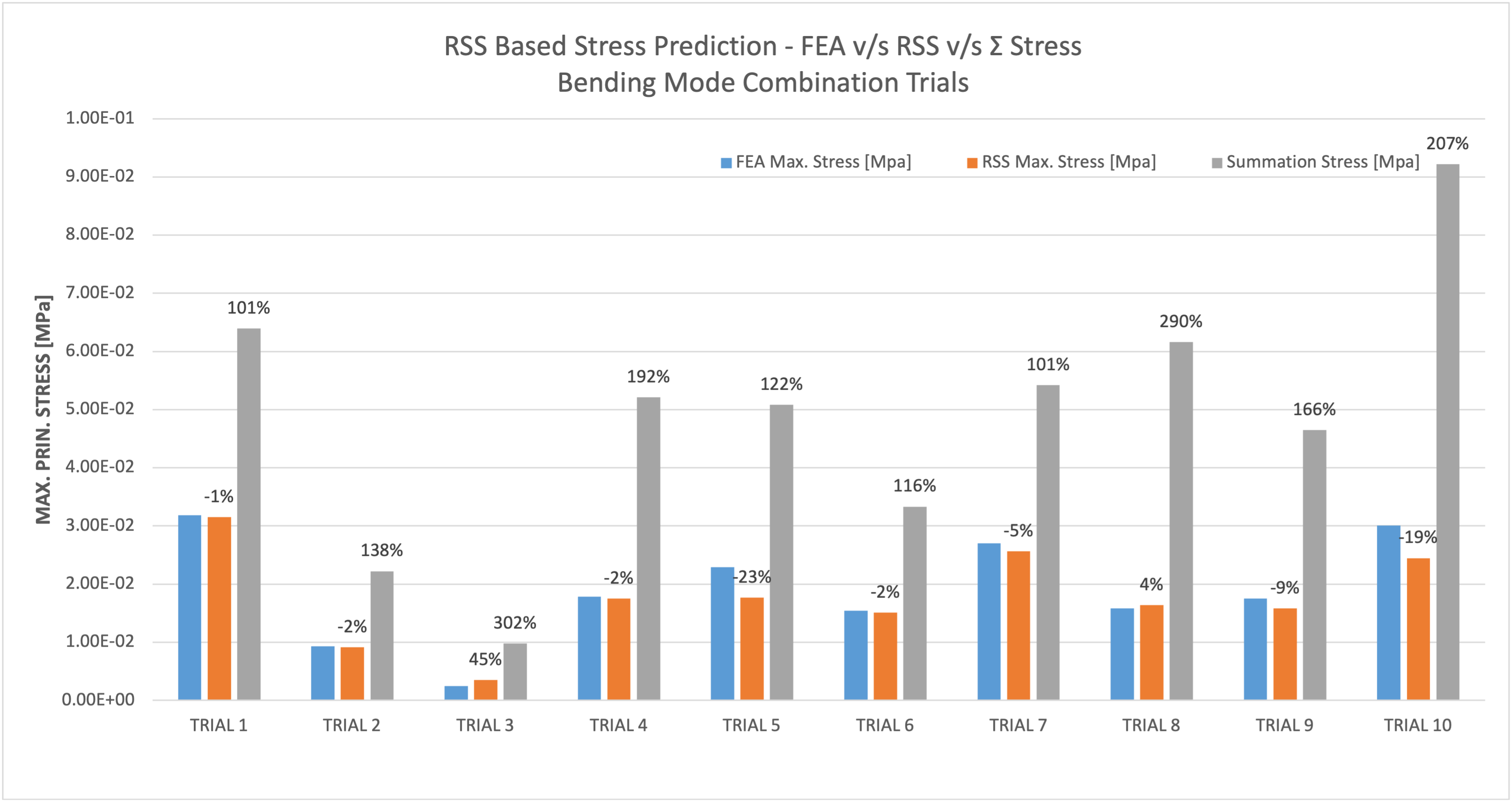
Realistic Multi-Mode Corrections: Ten multi-mode scenarios ranging from single dominant to dense multi-modal spectra were analyzed. RSS predicted FEA stresses to within –23% to +45% across all trials, and within ±5% for 7 out of 10 cases. Notably, when corrections were dominated by a single mode, RSS yielded near-exact predictions due to construction.
Figure 3: RSS-based peak stress prediction vs. direct FEA for ten realistic multi-mode bending trials; RSS error is within ±5% for the majority of cases, while summation overpredicts in all scenarios.
Overprediction by RSS occurred when the spatial patterns of active modes resulted in net cancellation at stress maxima, while underprediction was noted in cases of strong spatial overlap between modal stress peaks.
Operational Implementation and Practical Implications
Integration of RSS-based prediction in the AOS pipeline offers:
Real-Time Force Safety Checking: Immediate evaluation of actuator commands for stress violations using a pre-computed LUT.
Constraint for Actuator Optimization: Inclusion of RSS as a hard or soft constraint in actuator force optimization is feasible due to its negligible computational burden.
Lookup Table (LUT) Design and LUT Stress Minimization: Enables comprehensive off-line stress envelope analysis as a function of mode coefficient limits, supporting robust LUT design for various pointing configurations.
To safeguard against systematic underprediction in correlated modes, a constant multiplicative safety factor (1.25×) is recommended, ensuring all operational corrections remain within conservative glass strength limits while maintaining practicality in command throughput rates.
Theoretical and Future Prospects
The RSS prediction framework is generalizable to other large optics in telescope systems. The approach leverages modal orthogonality, which is inherent to most high-quality, well-designed mirrors with actuator arrays. Its application to the Rubin M2 secondary mirror is in scope, providing a pathway for a cohesive, system-level rapid stress prediction methodology.
The theoretical basis rests on the linear superposition of modal stress fields. Its efficacy is bounded by the degree of orthogonality between modal stress maxima, with the primary failure mode manifesting in rotationally symmetric, spatially coincident shapes. Empirical calibration addresses these outlier cases.
Conclusion
The RSS-based methodology for peak stress prediction in the M1M3 glass substrate provides a computationally efficient, physically justified, and operationally conservative alternative to repeated FEA during active optics corrections. It enables real-time safety monitoring and actuator command optimization, with demonstrated errors of less than ±5% against detailed FEA for most operational correction vectors. The operational protocol is fundamentally improved compared to direct modal summation, which leads to unacceptably high conservatism (>100% overestimation). With a minor calibration, the RSS estimator can fully support robust and efficient AOS operations, and the methodology is adaptable to future upgrades and analogous large-aperture optical systems across astronomy.