- The paper demonstrates that integrating semantic communication across perception, cognition, control, and networking significantly improves multi-agent coordination.
- The JSCCC case study shows 100% success in block-grasp tasks across all SNR conditions, outperforming traditional bit-level pipelines.
- The study highlights challenges like Sim-to-Real transfer and semantic extraction robustness, outlining key research frontiers for embodied intelligence.
Semantic-Based Internet of Embodied Intelligence: Visions and Frontiers
Introduction
The paper "Semantic-based Internet of Embodied Intelligence: Visions and Frontiers" (2607.00342) advances the concept of SIoEI (Semantic-based Internet of Embodied Intelligence). SIoEI integrates semantic communication and reasoning mechanisms across perception, task planning, control, and networking to support collaborative embodied agent systems at scale. The authors systematically delineate the four core dimensions underpinning embodied intelligence—environmental perception, cognition and task planning, action generation and robust control, and communication and networking—and argue that semantics should be the unifying metric throughout the agent-environment interaction lifecycle.
By reframing the IoEI (Internet of Embodied Intelligence) through a semantic lens, this work identifies the fundamental limitations of current architectures: excessive multimodal data transmission, decoupling of logical inference from physical constraints, and emergent bandwidth and convergence bottlenecks under large-scale multi-agent settings. The SIoEI paradigm is posited as essential for intent-driven, context-resilient, and scalable embodied collective intelligence. The discussion is reinforced through technical reviews, a representative case study, and the articulation of research frontiers.
Four Dimensions of Semantic Empowerment in IoEI
The transition from traditional disembodied AI to SIoEI is analyzed along four technical dimensions: perception, intelligence, control, and communication. The semantic empowerment of each is summarized below.
Environmental Perception: Traditional sensor-based approaches passively capture raw modalities without incorporating affordances or physical common sense. SIoEI instead aligns multimodal sensory streams (vision, LiDAR, tactile, language) into unified semantic representations that encapsulate object attributes, affordances, and actionable context. This transition shifts agents from static measurement to active, task-driven understanding of environments.
Cognition and Task Planning: Symbolic AI and current LLMs achieve statistical inference in abstract spaces but lack grounding in physical causality. Semantic reasoning in SIoEI is anchored in generative world models and environmental feedback, enabling robust subtask decomposition, commonsense reasoning, and anticipation of environmental/network state evolution via generative diffusion models.
Action Generation and Robust Control: Model-based controllers in classical robotics exhibit fragility in unstructured domains. By contrast, SIoEI agents use semantic policies to map task-intent tokens to motor policies, with provisions for dexterous, compliant, and adaptive behaviors. Closed-loop semantic feedback ensures ongoing correction and self-healing beyond rigid trajectory following.
Communication and Network Coordination: Shannon-style communication architectures optimize for bit-accurate transmission, resulting in inefficient coupling with task needs and severe network congestion. SIoEI shifts toward semantic coding, wherein only salient task-relevant features, intents, and action symbols are communicated, leveraging the robust noise tolerance and pragmatic synergy enabled by semantic-aware resource scheduling.
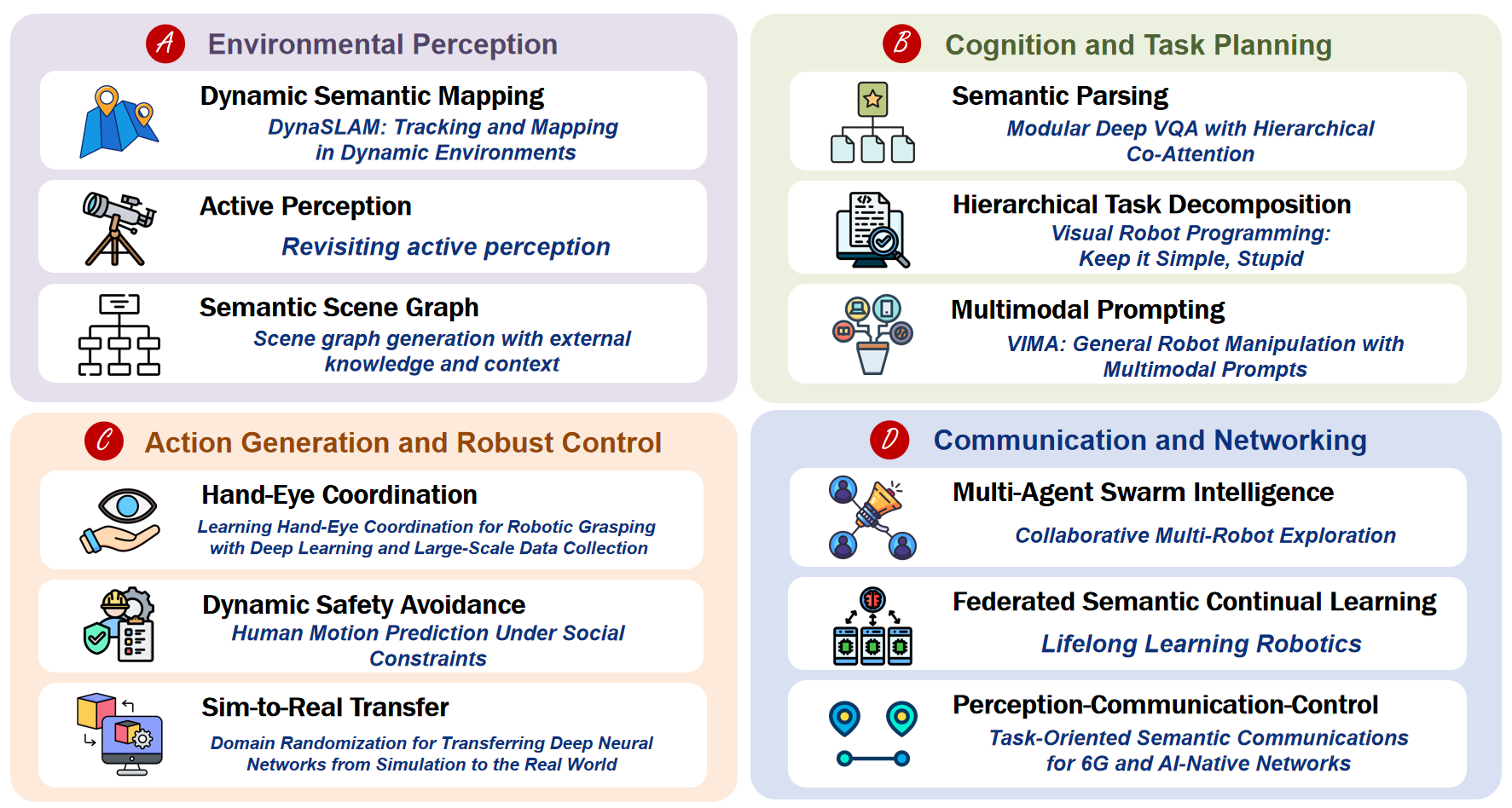
Figure 1: Representative semantic-empowered technologies across the four EI dimensions: including environmental perception, cognition and task planning, action generation and robust control, and communication and networking.
Semantic Technologies and Methods
Each EI dimension is supported by specific semantic technologies and methodological advances:
- Environmental perception employs cross-modal alignment, affordance-driven attention, and open-vocabulary object recognition via LLMs.
- Cognition and planning utilize hierarchical semantic parsing, plan decomposition, commonsense retrieval, and world model-based predictive reasoning.
- Control exploits agentic architectures that transform semantic tokens into executable motor actions, guarantee dynamic safety, and enable Sim-to-Real transfer via invariant semantic feature extraction.
- Communication and networking realize intent-aligned swarm collaboration, federated semantic continual learning, and semantic-based resource slicing for robust operation over resource-constrained and heterogeneous channels.
The deep integration of these methods enables unified semantic loops spanning sense-model-act-communicate cycles, maximizing task relevance and minimizing redundant computation and transmission.
Case Study: Semantic Communication and Control in Robotic Manipulation
The critical role of semantic integration is demonstrated in a simulated closed-loop robotic control scenario over bandwidth-limited wireless channels. The study contrasts three approaches: a traditional bit-level (JPEG+LDPC)-VGR pipeline, a SemComm system using SwinJSCC, and the JSCCC (Joint Semantic Cognition-Communication-Control) framework which tightly integrates semantic extraction, transmission, and actuation.
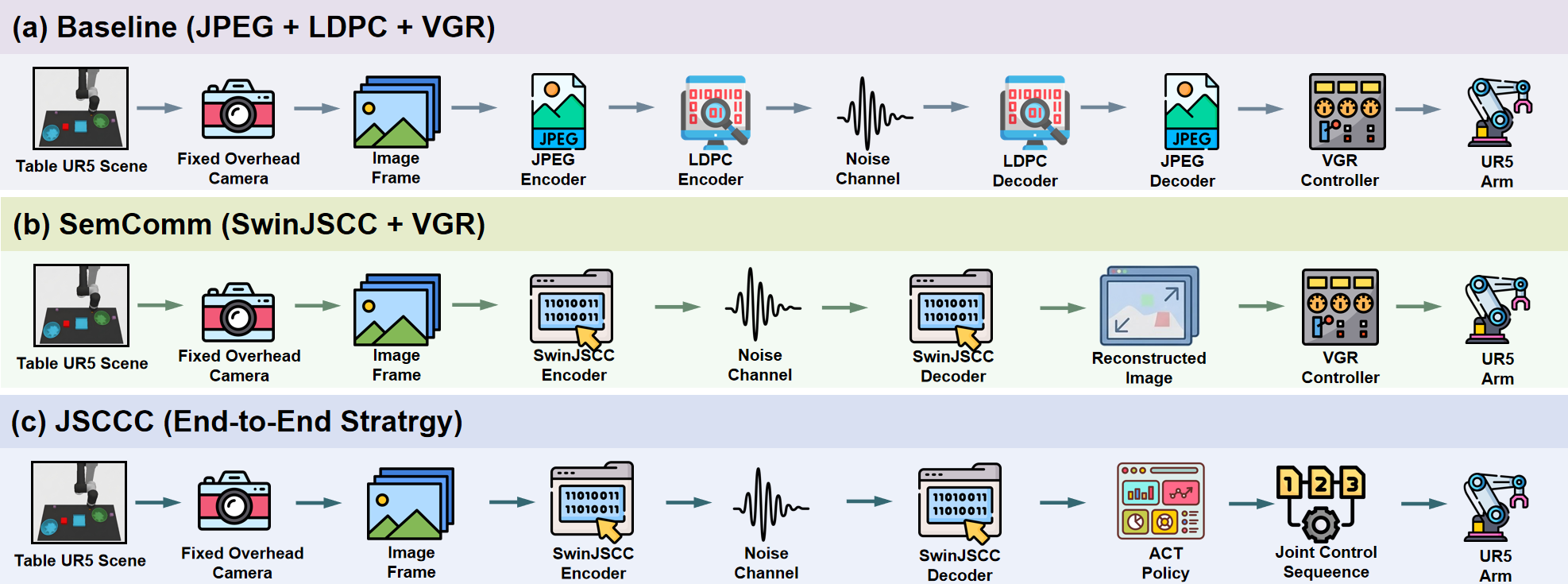
Figure 2: Block diagrams of the three embodied-agent communication pipelines. (a) Baseline (JPEG+LDPC+VGR). (b) SemComm (SwinJSCC+VGR). (c) JSCCC.
Simulation shows that both semantic pipelines (SemComm and JSCCC) maintain near-perfect success rates in a block-grasp task across all SNR conditions, with JSCCC achieving 100% success at all tested SNRs, even as traditional bit-by-bit pipelines collapse at modest degeneration (10 dB and below).
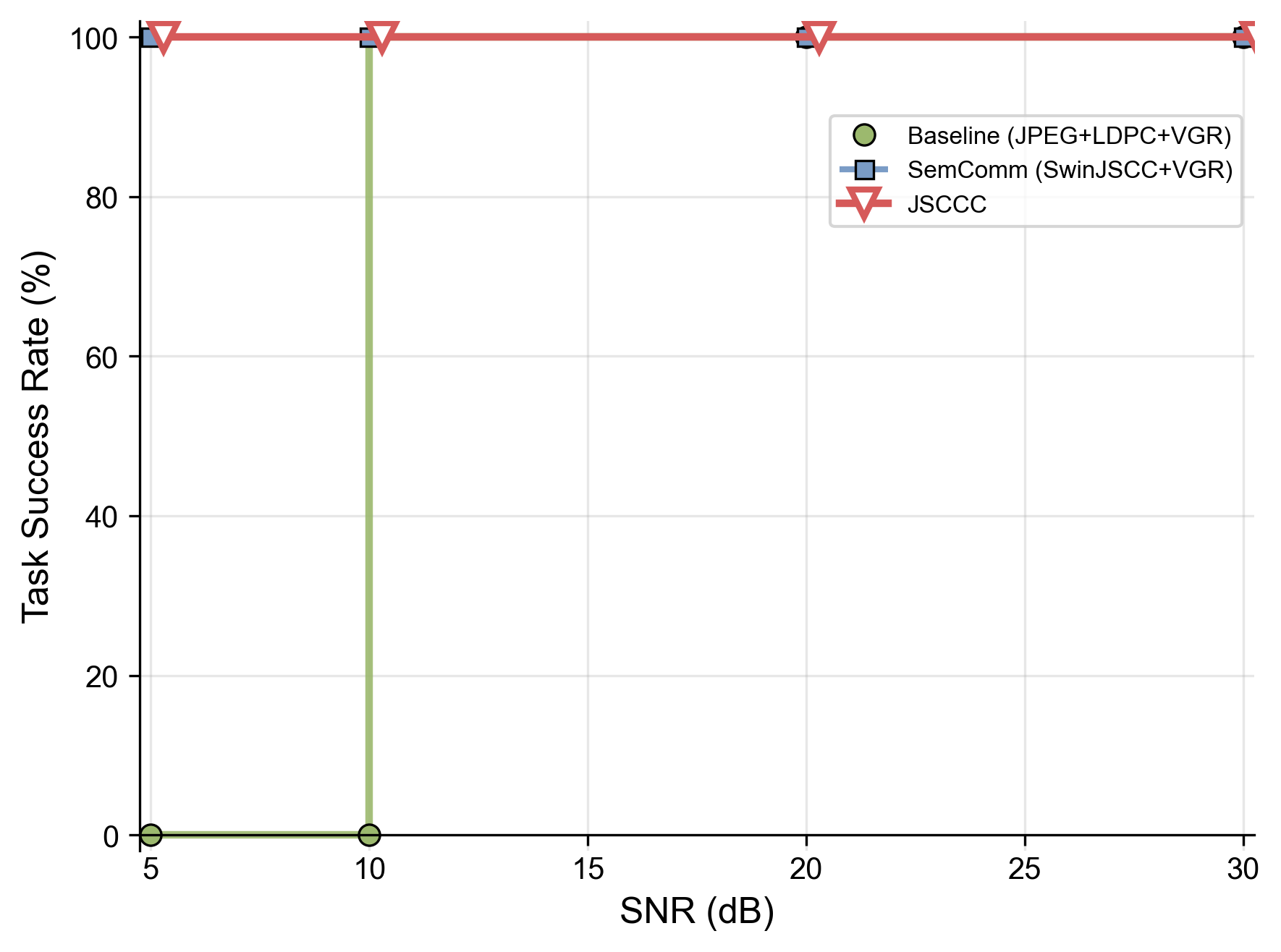
Figure 3: Task success rate of the three schemes across SNR = 5, 10, 20, 30 dB.
Semantic-based pipelines reduce end-to-end latency, a consequence of bypassing channel coding and pixel-level recovery in favor of succinct semantic feature transmission.
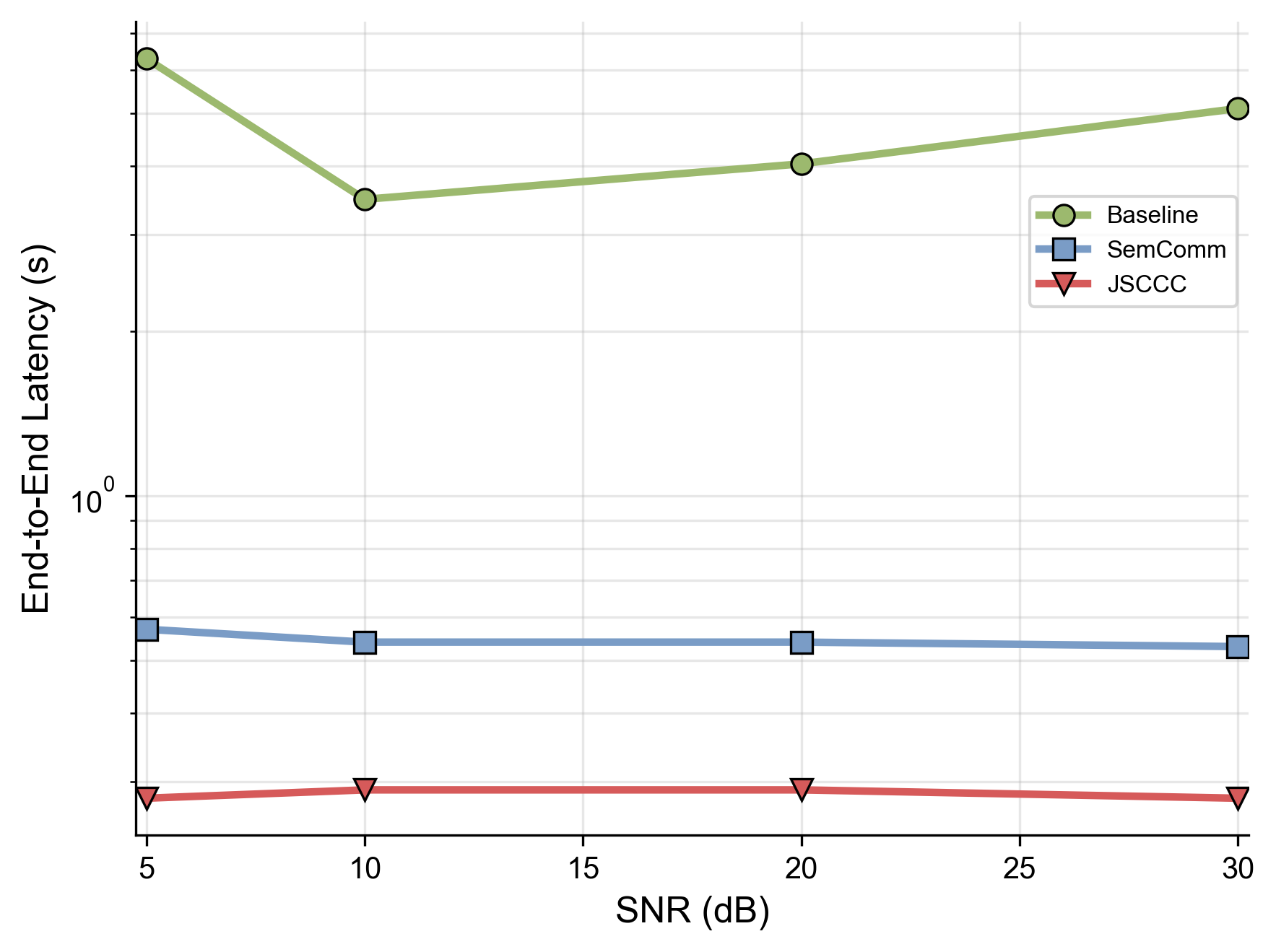
Figure 4: End-to-end latency of the three schemes across SNR = 5, 10, 20, 30 dB.
Nevertheless, the study acknowledges simulation-bound limitations: fixed camera parameters, idealized semantic extraction, and absent multi-agent or nontrivial manipulation complexity. Real-world extensions must address safety, Sim-to-Real gaps, dynamic occlusions, and emergent failure modes.
Research Challenges and Future Directions
The SIoEI paradigm, while enabling scalable, intent-aware multi-agent systems, exposes several open research challenges:
- Sim-to-Real Transfer: Bridging the domain gap so that semantic features and learned policies remain robust when migrating from simulation to physical hardware.
- Semantic Extraction Robustness: Mitigating error amplification from imperfect semantic reasoning modules, especially in unstructured or adversarial settings.
- Safety and Verification: Defining and enforcing semantic-level safety envelopes to prevent network-propagated policy aberrations.
- Semantic Consensus and Protocols: Developing dynamic protocols for agreement, conflict resolution, and role assignment in heterogeneous agent networks.
- Resource Scheduling and Privacy: Implementing real-time semantic-aware resource allocation while guaranteeing privacy in federated multi-agent knowledge sharing.
- Benchmarks and Ontologies: Establishing standardized ontologies, quantitative benchmarks, and large-scale testbeds to enable reproducible evaluation and empirical progress.
Conclusion
SIoEI represents an architectural shift for embodied AI, treating semantics as the primary invariant spanning perception, reasoning, action, and communication. This unification yields agents that are more context-sensitive, efficient, and collaborative than traditional modular systems. Empirical results in the JSCCC case study highlight the resilience and efficiency gains of semantically unified pipelines for closed-loop autonomous control under realistic channel constraints. However, addressing domain transfer, safety, and system-level integration in large-scale deployments remains crucial for the practical realization of SIoEI-driven collective intelligence systems.

