- The paper introduces an asymmetric mutual variational framework that aligns inference-time and training-time latent reasoning via bidirectional KL regularization.
- It eliminates manual latent supervision and mitigates answer leakage, ensuring robust and expressive continuous visual reasoning.
- Empirical results across high-resolution and spatial tasks demonstrate significant performance gains over both discrete and existing continuous methods.
Multimodal Continuous Reasoning via Asymmetric Mutual Variational Learning
Introduction and Motivation
Multimodal LLMs (MLLMs) operating within the vision-language domains have persistently faced the "language-space bottleneck"—a structural constraint where intermediate visual reasoning is forced to pass through discrete textual tokens, leading to substantial perceptual information loss and fragile grounding for complex visual reasoning tasks. Discretization through text not only degrades fine-grained spatial logic and abstraction but also contributes to increased hallucination and drift from visual context, particularly in high-resolution or strongly spatial tasks. Recent methods introducing continuous latent reasoning modules (e.g., LVR, Mull-Tokens, Monet) improve expressiveness but remain reliant on hand-designed supervision signals, often decoupled from the core multimodal reasoning process.
This paper proposes a rigorous variational probabilistic framework, Asymmetric Mutual Variational Learning (AMVL), to address the fundamental train-inference mismatch in multimodal latent reasoning. By designing a duality of forward and reverse KL regularization between the target-aware posterior and the target-agnostic prior in continuous latent space, AMVL combines inference-time compatibility with training-time expressiveness, fully removing the need for hand-crafted latent supervision and mitigating answer-dependent shortcut leakage.
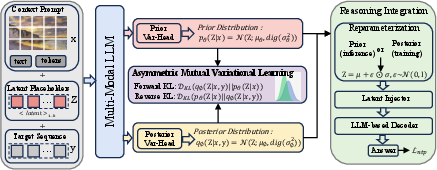
Figure 1: Overview of AMVL for multimodal continuous reasoning. Given a multimodal prompt, the model inserts k latent slots into the autoregressive sequence and uses their hidden states to parameterize a target-agnostic prior pθ(Z∣x) and a target-aware posterior qϕ(Z∣x,y) over latent sequences Z, with bi-directional KL regularization.
AMVL models the intermediate reasoning trajectory as a continuous latent variable sequence Z, inserting k latent slots between the input context x and answer y. In the conditional generative model, the prior pθ(Z∣x) parameterizes inference-time reasoning, while the posterior qϕ(Z∣x,y) is conditioned also on pθ(Z∣x)0, providing access to answer-dependent hindsight during training.
The conventional ELBO maximization framework is fundamentally limited by train-inference mismatch:
- The KL regularizer only aligns the prior with a posterior contaminated by answer leakage (posterior uses pθ(Z∣x)1), causing the prior to absorb answer-dependent biases that are unavailable at test time.
- Pure forward KL alignment is provably insufficient for eliminating this contamination—forward KL alone delivers a contaminated optimum and does not update the posterior to be more inference-compatible.
AMVL resolves these limitations by introducing a bidirectional calibration objective:
- Forward KL (Prior Alignment): The prior is trained to fit the current posterior, but with the posterior branch stop-gradiented to avoid co-adaptation.
- Reverse KL (Posterior Regularization): The posterior is regularized using a KL from the prior, with the prior parameters stop-gradiented, which directly penalizes answer-dependent posterior drift and collapse into regions not supported by the prior.
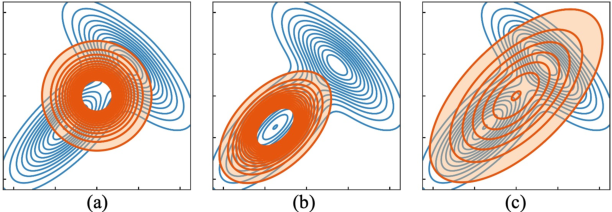
Figure 2: Geometric illustration of the two KL directions in AMVL. (a) Initial mismatch; (b) forward KL yields mode-seeking fit; (c) reverse KL encourages support coverage for inference compatibility.
This asymmetric mutual learning calibrates both the prior and posterior, reducing prior contamination and answer leakage—explicitly demonstrated via closed-form analyses in the diagonal Gaussian case and formalized by equilibrium shrinkage under bidirectional KL (see Propositions and ablations in the appendix).
Implementation: Latent Architecture and Efficient KL Computation
The latent variables are realized by injecting pθ(Z∣x)2 dedicated latent placeholders into the MLLM input sequence; their final-layer activations are then projected (via RMSNorm+SwiGLU heads) into means and log-variances for both the prior and posterior distributions (factorized diagonal Gaussians, pθ(Z∣x)3 dimension). During training, the answer token is available for posterior computation; during inference, only the prior is used.
Closed-form KL expressions ensure efficient and numerically stable optimization for both losses. The loss schedule employs a warmup for the forward KL to stabilize early alignment, with delayed and weaker ramp-up for the reverse KL to prevent over-regularization before the prior is reliable.
Numerical Results and Empirical Analysis
AMVL achieves robust, strong, and consistent gains over both discrete (e.g., Vision-R1, PAPO, PixelReasoner, DeepEyes) and continuous (LVR, Mull-Tokens, Monet) baselines on high-resolution perception (V*, HRBench4K/8K) and complex spatial reasoning (BLINK) tasks.
- On BLINK, AMVL scores a +10.83 average gain and +32.00 improvement on the Jigsaw task, which fundamentally stresses topology-heavy chain-of-thought. On V*, AMVL outperforms Qwen2.5-VL-7B by +7.85.
- Out-of-distribution generalization is validated on VisualPuzzles, where AMVL leads in overall and deductive/analogical reasoning with a 7B parameter model.
Ablation studies confirm:
- Bidirectional calibration (using both forward and reverse KL) is strictly superior to single-directional matching, both numerically (accuracy/statistics) and in latent geometry.
- Latent configuration studies demonstrate an optimal pθ(Z∣x)4, pθ(Z∣x)5 configuration—the high density of continuous representation allows efficient reasoning with fewer, more information-rich tokens compared to discrete trajectories.
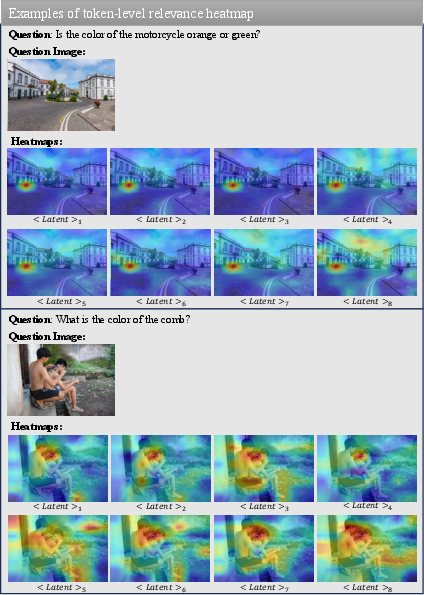
Figure 3: Token-level relevance heatmaps indicate strong, query-specific visual grounding and progressive abstraction across latent slots.
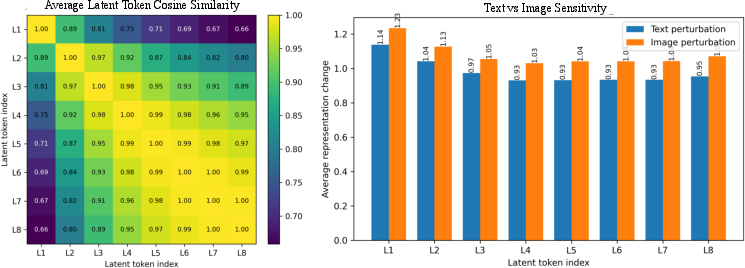
Figure 4: Quantitative latent analysis: left—banded token-wise cosine similarity structure; right—higher sensitivity to visual than textual perturbations, confirming robust image grounding.
Comprehensive geometric analysis (spread, alignment, mean shift) shows AMVL achieves favorable prior-posterior alignment and compactness without collapsing useful variability.
Implications and Future Directions
AMVL establishes a principled approach for inference-compatible latent reasoning in MLLMs, and the demonstrated generalization under distribution shift substantiates the efficacy of bi-directional variational regularization over hand-crafted latent supervision. The efficiency of slot-based continuous space reasoning suggests that future MLLMs can forego discrete language chains for perceptual logic, particularly for tasks requiring high-dimensional or algorithmic reasoning.
Potential future work includes scaling to larger architectures, further architectural innovations aligned with the latent path (e.g., recurrent or hierarchical latent stacks), more sophisticated posterior regularization (e.g., dynamic support constraints), and exploration of the emergence of structured latent logic in open-domain settings.
Conclusion
AMVL provides a robust and theoretically sound solution to the train-inference gap in multimodal latent reasoning. By jointly aligning the target-agnostic prior and regularizing the answer-aware posterior through asymmetric mutual KL, it couples inference-time compatibility with training-time expressiveness, eliminating the need for hand-crafted latent supervision. Empirical results show clear and systematic superiority over both discrete and prior continuous paradigms, with strong perceptual grounding, generalization, and latent stability. The framework marks a significant advance towards continuous, inference-compatible, and highly expressive reasoning in future large multimodal models (2607.00461).