- The paper introduces two new gradient flow renormalization schemes (A and V) that avoid backward flow requirements and ensure stable operator normalization.
- It leverages two-point correlators and flow-time evolution to nonperturbatively match lattice results with the continuum MS scheme.
- The approach is validated through precise strange quark mass renormalization, offering robust results across various lattice spacings and quark masses.
Gradient Flow Renormalization Schemes for Composite Fermion Operators
Introduction and Motivation
This work develops and systematizes gradient flow (GF) renormalization schemes for composite fermion operators on the lattice, introducing two novel prescriptions based on the normalization of the partially-conserved axial charge (A scheme) and conserved vector current (V scheme). These schemes provide an alternative to the computationally involved ``ringed'' scheme, which requires backward or adjoint flow and mitigates challenges associated with direct nonperturbative extraction of the flowed fermion wavefunction renormalization factor.
The motivation for these developments stems from the demand for nonperturbative, practical, and numerically stable approaches for renormalizing fermion bilinears, especially in situations where the full cancellation of wave-function renormalization factors in correlator ratios is not possible or when absolute operator normalization (e.g., for anomalous dimensions or quark mass determination) is required.
Gradient Flow and Operator Renormalization Framework
Gradient flow provides a map from the original gauge and fermion fields to smoothly evolved fields, parameterized by the flow time τ. For composite fermion operators constructed from n flowed fields, the normalization reads:
OGF(τ;x)=Zχn/2(τ)O(τ;x)
where Zχ(τ) is the wavefunction renormalization of a flowed fermion field.
The crucial technical challenge is the definition and computation of Zχ(τ):
- The ringed scheme relies on the expectation value of a local operator, $\langle \bar\chi(\tau,x)\,\overleftrightarrow{\slashed D}\,\chi(\tau,x)\rangle$, but is expensive due to required backward flow.
- The A and V schemes normalize the flowed operator such that the physical (projected) matrix element of either the axial or vector current is invariant under flow-time evolution.
Specifically, for operator V0, correlator ratios at large time separation,
V1
are used to construct the renormalization factors:
V2
where V3 and V4 are the conventional matching factors for the (partially) conserved lattice currents.
These definitions utilize zero-momentum, large Euclidean time two-point correlators projected onto the lowest-lying state, ensuring contamination from excited states is exponentially suppressed.


Figure 1: V5 (top) and V6 (bottom) determined using V7-correlators as a function of the physical flow time V8 (in V9).
Matching to Continuum Schemes and Flow-Time Evolution
The τ0 and τ1 schemes are shown to admit a mass-dependent, but nonperturbative, matching to the standard τ2 scheme in the small τ3 limit via the short-flow-time expansion (SFTX). The associated SFTX matching coefficients are already extensively studied for the ringed scheme; these are transferable to the τ4 and τ5 constructions.
For an operator τ6, the conversion reads:
τ7
with the SFTX coefficient τ8 given by the ratio of ringed-scheme SFTX coefficients.
Nonperturbative Determination of Anomalous Dimensions
A central result is the prescription for the nonperturbative running of composite operators via the anomalous dimension, formulated directly in terms of the τ9-dependence of the renormalization factors:
n0
This flow-time anomalous dimension enables the construction of an evolution factor connecting operators defined at different n1:
n2
This is used to transfer renormalized quantities from long to short flow times, bridging nonperturbative and perturbative domains in a way that is compatible with the RG flow and can be matched at any scale where perturbation theory is trustworthy.

Figure 2: n3 as a function of n4 for connected n5 correlators.

Figure 3: n6 vs. n7 for three ensembles of different lattice spacings, indicating consistent nonperturbative running.

Figure 4: Dependence of n8 on the valence quark mass, confirming suppression of mass effects in the small n9 regime.
Application: Nonperturbative Strange Quark Mass Renormalization
The methodology is concretely demonstrated with the renormalization of the strange quark mass. On physical-mass domain-wall ensembles, the ratio OGF(τ;x)=Zχn/2(τ)O(τ;x)0 yields the flowed (GF-scheme) quark mass; flow-time evolution is then applied using the nonperturbatively computed OGF(τ;x)=Zχn/2(τ)O(τ;x)1, and the result is matched to OGF(τ;x)=Zχn/2(τ)O(τ;x)2 via SFTX coefficients.

Figure 5: Renormalized strange quark mass for the M1 ensemble, comparing nonperturbative (pink) and perturbative (NLO/NNLO, yellow/green) improvement of RG evolution, highlighting the flattening effect on OGF(τ;x)=Zχn/2(τ)O(τ;x)3-dependence.

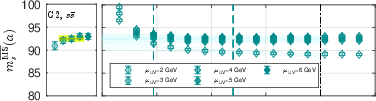


Figure 6: Strange quark mass extracted for all ensembles using the A-flow scheme and nonperturbative OGF(τ;x)=Zχn/2(τ)O(τ;x)4, for various OGF(τ;x)=Zχn/2(τ)O(τ;x)5 choices.
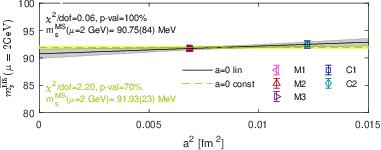
Figure 7: Continuum limit extrapolation of the renormalized strange quark mass at reference scale OGF(τ;x)=Zχn/2(τ)O(τ;x)6.

Figure 8: Demonstration of robustness of the strange quark mass extraction with respect to the matching flow time OGF(τ;x)=Zχn/2(τ)O(τ;x)7.
Consistency Checks and Scheme Independence
High-precision determinations of the ratio OGF(τ;x)=Zχn/2(τ)O(τ;x)8 from GF correlator ratios are presented, agreeing with independent, established lattice computations within percent-level uncertainties. Statistical and systematic stability across lattice spacings and quark masses is documented, confirming the validity and universality of the GF-based approach.
Practical and Theoretical Implications
The OGF(τ;x)=Zχn/2(τ)O(τ;x)9 and Zχ(τ)0 schemes bypass the requirement for backward flow in the wavefunction renormalization and rely on numerically stable two-point functions. These constructions extend the reach of GF renormalization to:
- Absolute normalization problems (e.g., computation of anomalous dimensions),
- Robust nonperturbative RG evolution,
- Universally applicable renormalization protocols in diverse lattice computations.
By enabling systematic transport between lattice-accessible and perturbative regions in RG space, the framework dissolves ad-hoc procedures for SFTX matching and provides a roadmap for renormalization and running quantities of interest, including but not limited to meson bag parameters, quark masses, and matrix elements where the operator normalization is critical.
Outlook and Future Developments
Full universality and scheme independence (apart from expected mass-dependent corrections at finite flow time) will require (and are feasible with) chiral, infinite-volume, and continuum limit studies of the evolution factor Zχ(τ)1 and anomalous dimensions. Applications to non-scalar operators and additional matching, e.g., in BSM contexts, are immediate.
Future simulations at finer lattice spacings will allow extension to even shorter flow times and stronger control of continuum limits. The modularity of the framework provides a foundation for integrating nonperturbative RG evolution into automated lattice analyses.
Conclusion
The proposed gradient flow renormalization schemes grounded on the normalization of axial and vector currents provide a practical, nonperturbative, and numerically effective alternative to the ringed scheme for composite fermion operators. This work demonstrates their viability in precision strange quark mass determination and sets a template for future application in high precision lattice QCD and related composite operator studies, with broad applicability across the domain of lattice quantum field theory.