- The paper introduces a dual prior-anchored framework (PriOrGen) that effectively mitigates both visual and textual biases in long-tailed, multi-organ pathology report generation.
- It employs Visual-Prototype Anchored Bottleneck and Meta-Report Anchored Bank modules to enhance feature retention and ensure clinically valid report generation across diverse organ classes.
- Empirical results on the ML-Path dataset demonstrate significant improvements in BLEU-Mean and other metrics, particularly for underrepresented tail classes.
Prior-Anchored Debiasing for Long-Tailed Multi-Organ Pathology Report Generation
Introduction and Motivation
Automated pathology report generation from Whole Slide Images (WSIs) is a central challenge in computational pathology, requiring the integration of gigapixel-level visual information with expert-level linguistic priors. Most existing approaches are restricted to single-organ settings and neglect the multi-organ scenarios typical in real-world clinical practice, where a pronounced long-tailed distribution of organ types is observed. This long-tailed distribution introduces two critical biases: visual representation bias (the encoder overfits to head-class morphologies, missing rare visual cues in tail classes) and textual decoding bias (the decoder defaults to recurring narrative patterns of head classes, reducing clinical validity for underrepresented organs).
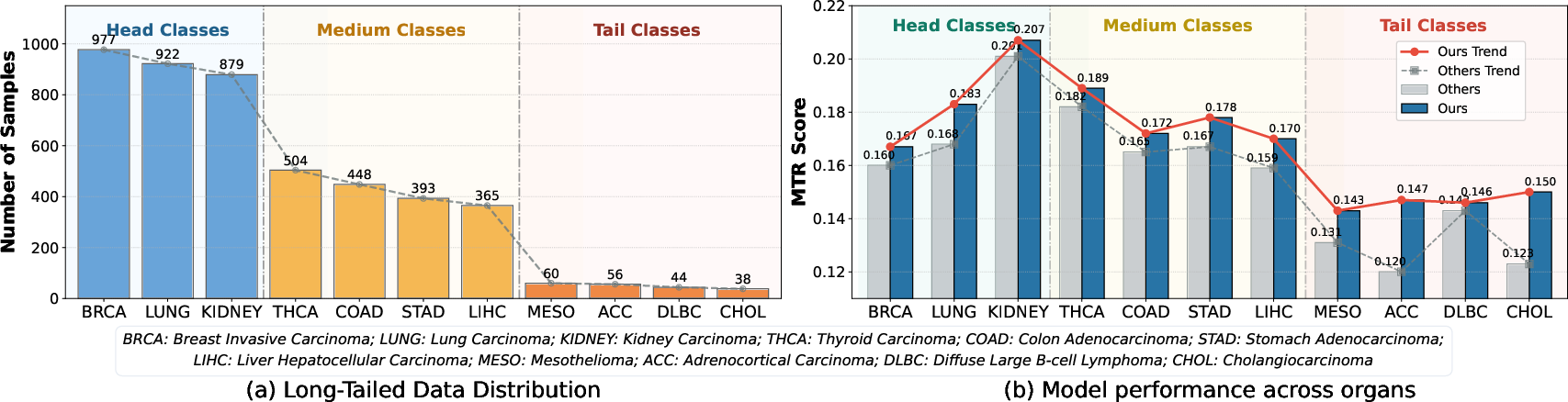
Figure 1: (a) The sample count per organ type shows a heavily long-tailed distribution. (b) MTR scores reveal that PriOrGen consistently outperforms alternatives, especially on tail classes.
This paper proposes PriOrGen, a framework that jointly targets both types of bias through dual prior anchoring at visual and textual levels, establishing a new paradigm for pathology report generation under long-tailed multi-organ distributions.
Methodology: Dual Prior-Anchored Architecture
PriOrGen integrates two major modules—Visual-Prototype Anchored Bottleneck (VPAB) and Meta-Report Anchored Bank (MRAB)—in a unified generative architecture. The pipeline begins with patch-level feature extraction from WSIs, followed by anchor-guided selection and filtering, knowledge bank retrieval, and cross-modal report generation.
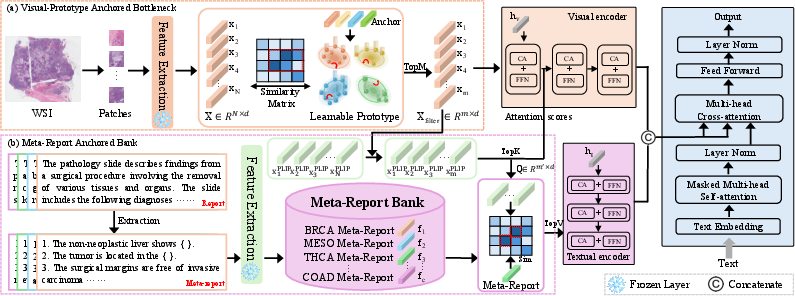
Figure 2: Schematic of PriOrGen, depicting the interaction between the Visual-Prototype Anchored Bottleneck and the Meta-Report Anchored Bank modules within the cross-modal generation process.
Visual-Prototype Anchored Bottleneck (VPAB)
VPAB addresses visual representation bias by compressing patch features through an information bottleneck framework, with compression guided by a set of learnable diagnostic prototypes. These prototypes are initialized using k-means centroids on patch features derived from diverse organ types and refined via KL regularization toward anatomical priors. This ensures retention of diagnostic patterns even for underrepresented tail classes and suppresses redundant or spurious signals. Patches are scored by their maximum cosine similarity to sampled prototypes and only the top-m are propagated, yielding task-relevant, compact representations agnostic to class imbalance.
MRAB mitigates textual decoding bias by constructing a per-organ meta-report bank distilled from in-distribution training reports using a LLM (Gemini-3 Pro) and dual semantic ranking (BioSimCSE and BGE). Retrieved meta-reports serve as faithful priors and are encoded by a PLIP text encoder. During inference, diagnostic visual patches (filtered by VPAB) serve as queries to retrieve semantically aligned textual templates from MRAB, which are then cross-attended with the filtered visual stream in the downstream decoder.
Report Generation
The bi-modal encoder compresses the concatenated visual (from VPAB) and textual (from MRAB) representations via cross-modal attention, resulting in a compact joint feature set. A transformer decoder auto-regressively generates structured pathology reports, supervised by negative log-likelihood and the VPAB compression objective. Training and evaluation take place on the ML-Path dataset, a curated 11-organ multi-cancer corpus exhibiting authentic long-tailed properties in both visual and textual spaces.
Empirical Results
Extensive experiments demonstrate that PriOrGen achieves superior performance on both head and tail organ classes, outperforming established LSTM, Transformer, and specialized clinical generative baselines (including BiGen and Wsicaption) in BLEU-Mean, METEOR, and ROUGE-L metrics. Notably, PriOrGen exhibits pronounced gains on the most underrepresented tail categories without sacrificing head or medium class performance. For example, on cholangiocarcinoma (CHOL), BLEU-Mean improves by 15.8% compared to report-guided retrieval methods.
Ablation studies confirm the orthogonality and complementarity of VPAB and MRAB: removing either component leads to statistically significant performance degradation, particularly for tail classes. Parameter sensitivity analysis shows optimal BLEU-Mean at a VPAB patch selection ratio ρ=0.4, two retrieved meta-reports per query, and four VPAB prototypes.
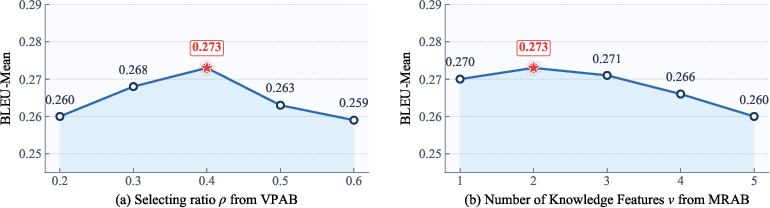
Figure 3: BLEU-Mean varies with the VPAB patch selection ratio and MRAB template retrieval count, highlighting the effect of these hyperparameters on generation quality.
Implications and Outlook
This work establishes a generalizable approach for addressing both visual and textual long-tail bias in multi-organ generative pathology. The introduction of learnable prototypes for prototype-guided information bottlenecking and the explicit retrieval of organ-faithful textual priors represent robust, modality-agnostic strategies extendable to other biomedical generation domains (e.g., radiology, multi-disease captioning). The empirical gains on rare classes underscore the clinical importance of mitigating overlooked diagnostic signals in minority data.
Theoretically, PriOrGen validates that decoupled prior anchoring—at both feature and output levels—systematically overcomes data imbalance in structured medical text generation tasks. Practically, it enables scalable deployment of automated reporting tools in heterogeneous multi-organ settings, directly supporting more reliable digital pathology workflows.
Future research will likely investigate: (1) unifying prototype and meta-report banks within multi-modal foundation models, (2) adaptation to zero-shot or open-vocabulary organ types, and (3) integration with self-supervised and retrieval-augmented LLMs, further closing the gap toward clinically deployable, unbiased medical AI.
Conclusion
PriOrGen pioneers a dual prior-anchored debiasing methodology for long-tailed, multi-organ pathology report generation, achieving strong, statistically significant improvements over established baselines, particularly in underrepresented classes. This framework offers an extensible blueprint for long-tail-aware medical text generation, with clear implications for robust, scalable AI in computational pathology and beyond.