- The paper introduces PRISM, a prototype-based language model that integrates sparse, non-negative prototypes for inherently interpretable and attributable predictions.
- It employs clustering and a block-diagonal Hessian structure to achieve over 500× speedup in attribution computations compared to traditional dense methods.
- Empirical results on models up to 1.6B parameters show competitive performance, enabling targeted safety controls and practical workflows for model auditing.
Prototype LLMs: Architectures for Interpretable, Attributable Prediction
Introduction and Motivation
The paper "Prototype LLMs" (2607.00510) introduces PRISM (Prototypes for Interpretable Sequence Modeling), an architectural framework for LLMs that exposes the contribution of specific neighborhoods of training data to individual predictions. Existing approaches to Training Data Attribution (TDA) in LLMs typically rely on post hoc gradient-based methods, suffering from severe computational overhead, ill-conditioned Hessians, and statistical misspecification due to the stochastic training of large models. This work advances a fundamentally different premise: rather than explaining a dense model post hoc, LLMs can instead be designed to produce attribution signals by construction, using a sparse, non-negative prototype mixture for each prediction.
Prototype-Based Prediction and Architecture
PRISM preserves a standard Transformer decoder backbone but replaces the conventional dense output head with a learned bank of sparse prototypes. For each next-token prediction, PRISM activates a small subset of prototypes through non-negative gating, reconstructing the hidden state (and therefore the logits) as an additive mixture of these prototypes plus an explicit residual term.
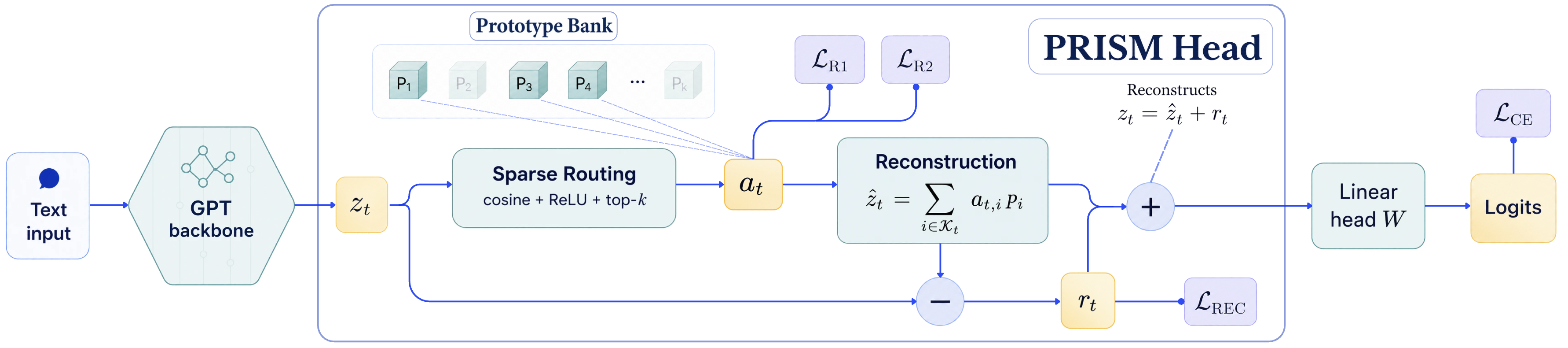
Figure 1: PRISM replaces the standard output pathway with a sparse, interpretable prototype bank, reconstructing the predictive hidden state from learned prototype vectors and exposing a residual term for unexplained capacity.
The architectural details are as follows:
- Let zt∈Rd be the final hidden state at position t.
- Let P=[p1,...,pK]∈Rd×K be the prototype bank.
- Each zt selects the top-k prototypes (typically k≪K) via cosine similarity, activating them with non-negative weights, yielding
z^t=∑i∈Ktat,ipi
- The output logits are then computed as:
ℓt=Wzt=Wrt+i∈Kt∑at,i(Wpi)
where rt=zt−z^t is the residual.
The loss combines standard next-token cross-entropy, a residual reconstruction loss to encourage prototypes to explain as much of zt as possible, and clustering losses (t0, t1) that enforce that each prototype and each token embedding is close to at least one real example. This pushes prototypes onto the data manifold, unlike generic sparse dictionaries.
Attribution and Interpretability via Prototypes
This design enables each output token's predictive probability to be decomposed into contributions from specific interpretable prototypes, each itself linked to recurring neighborhoods in the training corpus. Crucially, this yields both intrinsic interpretability and efficient attribution:
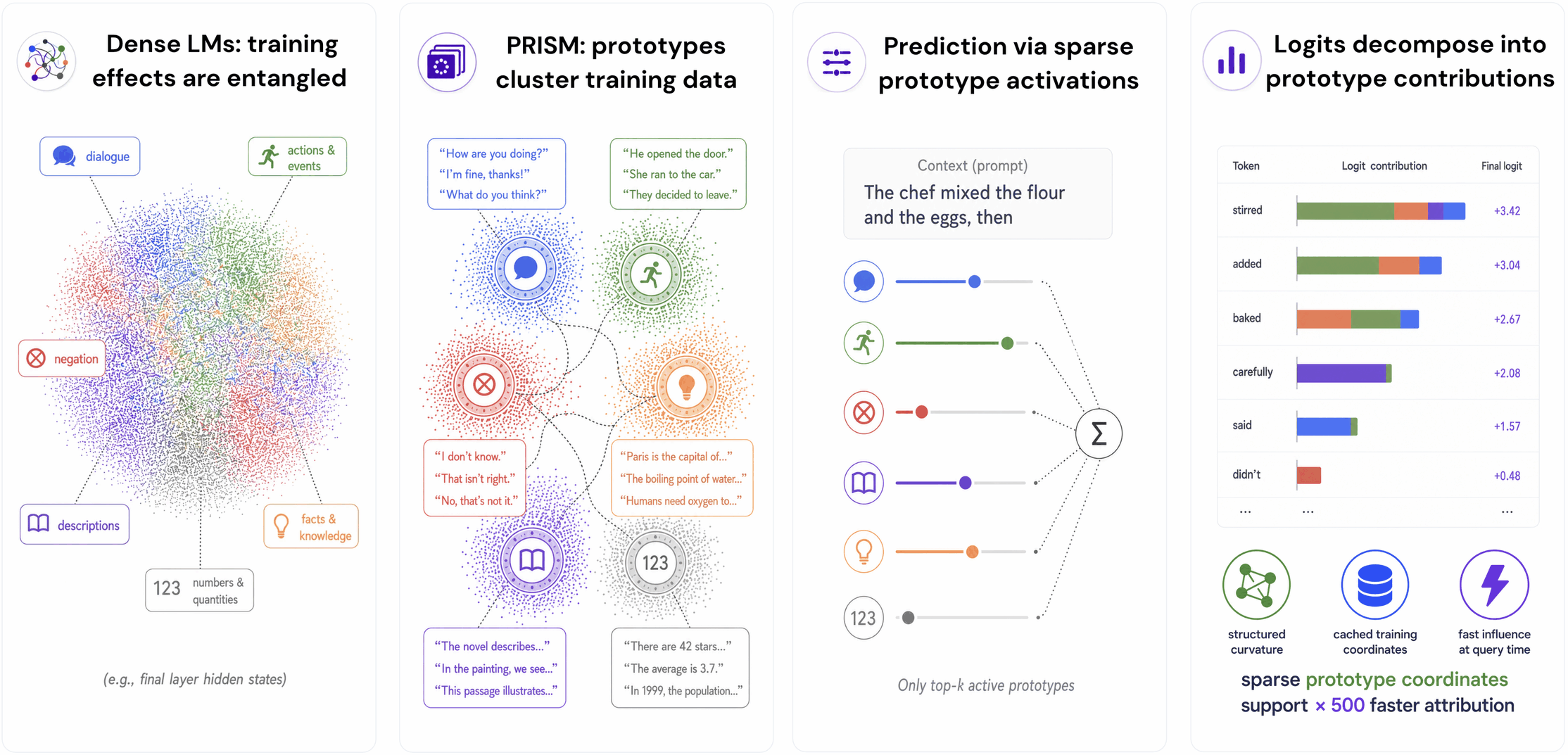
Figure 2: For a given prompt, PRISM activates a sparse set of prototypes at the prediction step, enabling direct traceability from output token probabilities to underlying prototype contributions and training data clusters.
This supports fine-grained analysis—e.g., determining which prototypes favored a given token and tracing their activation to training contexts.
The interface is exemplified with an explicit breakdown for a continuation in the TinyStories benchmark:
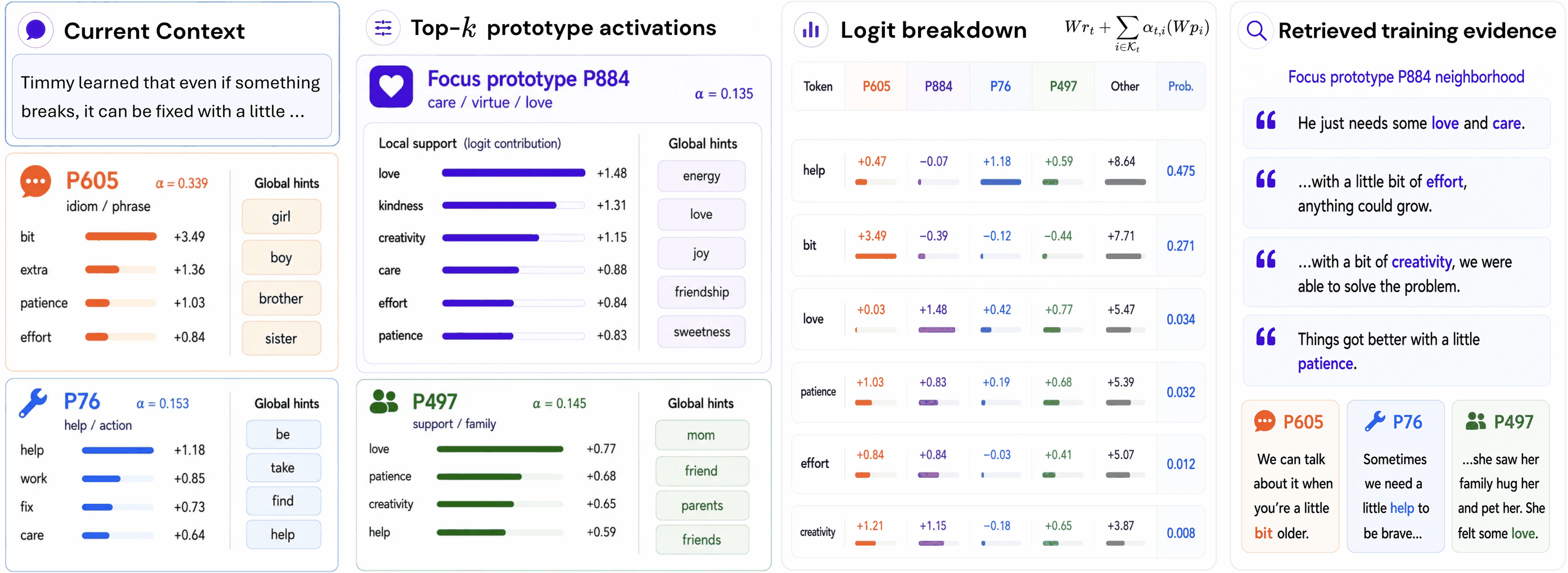
Figure 3: Anatomy of prototypical prediction: token logits can be explained by additive contributions of the most active prototypes, each annotated by their supporting training data patterns.
Impact on TDA: Localizing Curvature and Enabling Scalable Attribution
A central theoretical insight is that the introduction of prototype-based prediction, with explicit clustering, fundamentally alters the structure of the loss landscape. The curvature (Hessian) of the prototype subspace is shown to be approximately block-diagonal under strong clustering, so attribution computations (i.e., tracing influence through an inverse Hessian-vector product) become both tractable and well-conditioned.
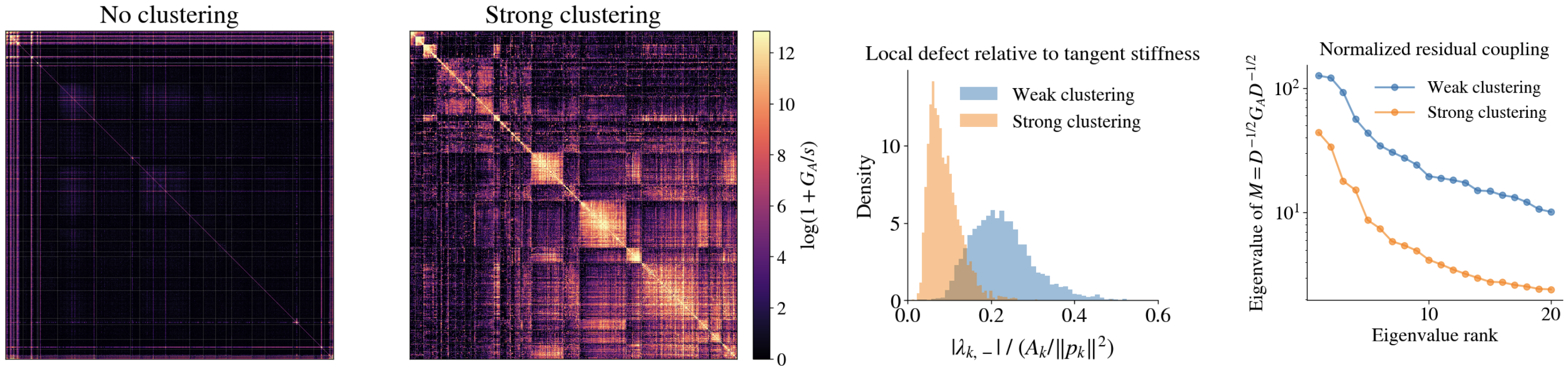
Figure 4: Clustering for interpretability converts the prototype co-usage matrix from dense, hub-like connectivity to locally structured blocks, reducing global cross-coupling and improving condition numbers for fast, stable attribution calculations.
This enables an efficient, cacheable influence function: instead of contracting full parameter gradients, attribution can be carried out using compact, sparse prototype records. The result is a t2 speedup in computing attribution relative to standard dense methods, while retaining meaningful signal for scoring the influence of training points on predictions.
Ablation studies show the loss of interpretability and poor geometric separation when clustering or sufficient prototype coverage is not enforced.
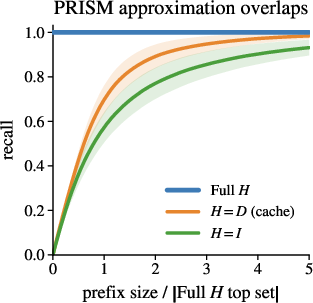
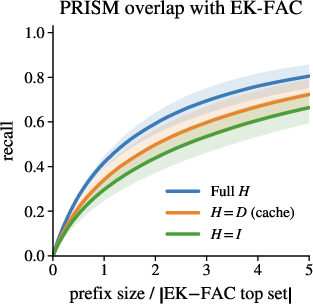
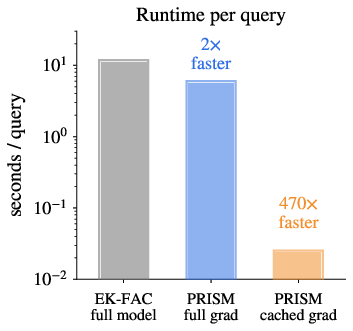
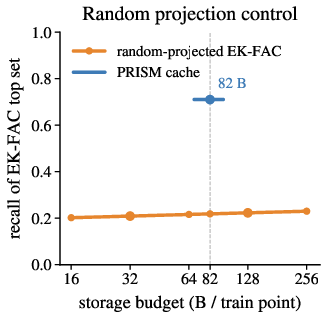
Figure 5: Prototype-space attribution rankings preserve much of the full-model attribution signal at orders-of-magnitude lower computational and storage cost compared to dense baselines.
PRISM scales successfully, with models from 130M to 1.6B parameters trained on up to 50B tokens. Across settings, prototype models either match or remain within 2.5 absolute points of dense GPT baselines in validation and downstream performance. The prototype path accounts for most of the predictive evidence, with minimal accuracy loss and competitive cross-entropy.
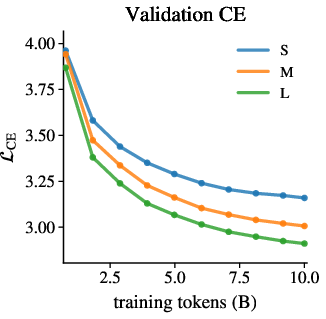
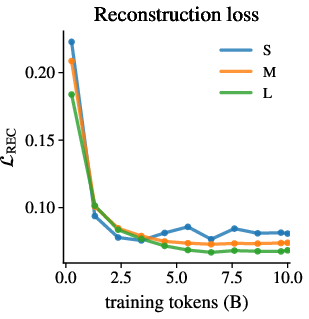
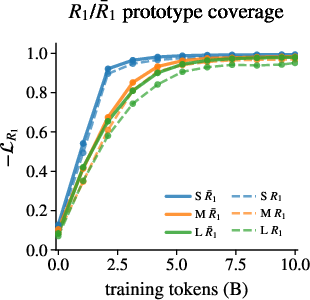
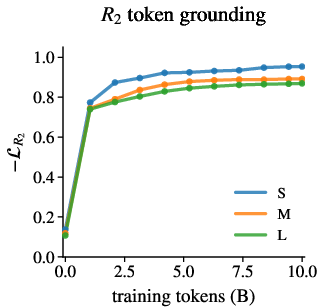
Figure 6: Prototype objectives train stably at scale, with CE, reconstruction, prototype coverage, and residuals all behaving favorably at increasing model sizes.
PRISM's additional parameters, memory needs, and training speed penalties are marginal, allowing its deployment on large-scale LM backbones.
Interpretable Dictionary Learning and New Control Workflows
The learned prototype bank serves as an explicit dictionary of recurring linguistic and conceptual patterns, with each prototype mapped to salient training clusters and associated vocabulary continuations.

Figure 7: UMAP visualization of the full prototype bank reveals clusters corresponding to scientific, medical, institutional, temporal, and web/boilerplate patterns; detailed inspection of single prototypes shows high semantic alignment between their training neighborhoods and token output signatures.
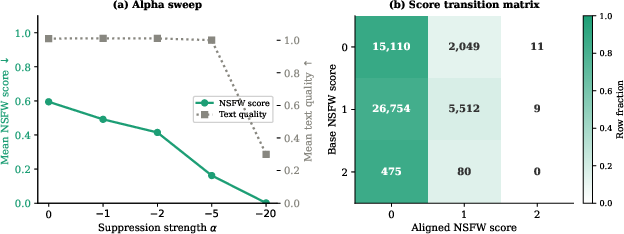
Such interpretability enables several practical workflows:
Theoretical and Practical Implications
The PRISM framework demonstrates that intrinsic model interpretability and efficient attribution can be systematically achieved by architectural design, not only by post hoc tools. The explicit connection between model output and well-localized, on-manifold prototypes provides new causal handles for targeted interventions, fast auditing, and instance-level data control. This directly supports downstream applications in attribution-driven data governance, rapid deployment of safety measures (e.g., content alignment), and the tracing of model predictions to legal or ethical data sources.
Furthermore, the detailed Hessian analysis motivates future architectures for even deeper interpretability—e.g., incorporating prototype objectives into intermediate transformer layers, or training explicit source-level or sequence-level prototype footprints.
Limitations and Future Directions
The current PRISM instantiation applies prototypes only to the output head, exposing token-level attributions. Open challenges include extending the prototype principle throughout the model's depth for circuit-level interpretability, integrating with document-level attribution and citation workflows, and developing more advanced Hessian-aware training objectives that further localize curvature, enabling still more efficient and accurate attribution.
Conclusion
"Prototype LLMs" establishes a new direction in language modeling: making the prediction interface inherently explainable by routing evidence through sparse, data-grounded prototypes. PRISM achieves efficient and accurate attribution at negligible accuracy cost and negligible engineering overhead. The explicit, interpretable prototype basis enables auditability, targeted model control, safety alignment, and new theoretical analysis of deep model generalization and bias. This paradigm is likely to become foundational for future architectures aiming for both operational transparency and fine-grained model control.