- The paper introduces a unified 1PN framework mapping proper time to various celestial reference systems including BCRS, GCRS, LCRS, and MCRS.
- It employs harmonic coordinates and null geodesic modeling to compute microsecond-level clock rate offsets and corrections for lunar and Martian systems.
- The study provides operational constants and chain-based documentation essential for high-precision interplanetary navigation and time dissemination.
Motivation and Context
The unification, definition, and operational use of time scales within the solar system has transitioned from an exclusively geocentric focus to encompass cislunar and planetary (notably Martian) operations, especially driven by long-baseline radiometric tracking and global navigation deployments beyond Earth. This work presents a formal, metric-consistent framework up to first post-Newtonian (1PN) order for mapping proper time (τ) along arbitrary world lines to coordinate times in the Barycentric Celestial Reference System (BCRS), Geocentric Celestial Reference System (GCRS), Lunar Celestial Reference System (LCRS), and Mars Celestial Reference System (MCRS), explicitly connecting these to DSN observables.
The authors address the limitations of existing conventions (IERS, Moyer) and recent lunar timekeeping work, which scatter essential metric, clock rate, and radiometric corrections across disparate references. The central contribution is a unified, operationally explicit chain that merges harmonic Christoffel symbols, IAU time-scale transformations, Fermi normal coordinates, and null-geodesic-based observable modeling for both lunar and Martian reference systems.
General Relativistic and Post-Newtonian Foundations
The analysis starts from the exact mapping between proper time τ and coordinate time t along a world line in a metric gμν, retaining the necessary accuracy up to O(c−4). The spacetime background is constructed in harmonic coordinates with the PPN metric for N-body solar system dynamics, explicitly including vector (gravitomagnetic) potentials Vi, with PPN parameters constrained by current bounds, e.g., ∣γ−1∣≲10−5.
Tabulated Christoffel symbols are given through O(c−4), enabling direct computation of four-accelerations, Fermi normal coordinates, and geodesic deviation—all essential for clock comparison, time dissemination, and observable calculations.
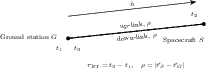
Figure 1: Coherent Two-Way DSN Geometry (t1 transmit, τ0 turnaround, τ1 receive), illustrating the path for light-time, Shapiro, and Sagnac corrections in 1PN DSN modeling.
The coordinate-time hierarchy is systematically constructed: TCB (BCRS), TCG (GCRS), TT, TDB, and their body-centric analogues TCL (LCRS) and MCG (MCRS), with explicit rescaling parameters (τ2, τ3, τ4, τ5) and the associated periodic terms detailed. The transformation between these scales is shown as an integral of kinematic and potential terms (velocity squared, monopole and tidal potentials) along the relevant world lines, with harmonics derived from ephemeris data.
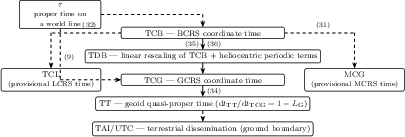
Figure 2: Solar-System Time-Scale Hierarchy, mapping the IAU transformations and extensions to lunar and Martian coordinate times, including the documented chains linking proper time, coordinate times, and operational standards.
Null Geodesics, Light-Time Solutions, and Two-Way DSN Observables
The model for electromagnetic signal propagation utilizes null geodesics in the PPN metric, resulting in a 1PN light-time functional corrected for gravitational delay (Shapiro effect), Sagnac effect via exact τ6, and periodic modulations due to orbital motion. A key operational equation is the expansion of the two-way geometric range rate, τ7, expressing how metric parameters, gravitational potentials, and the kinematics of both station and spacecraft (or lander) contribute to relativistic corrections in Doppler and range observables.
Results: Mars and Lunar Body-Centric Reference System Implementation
Mars Areoid–Geoid and Lunar Selenoid–Geoid Rates
For the Mars case, the areoid--geoid clock-rate offset is analytically determined. Using the Mars mass and equatorial radius, the instantaneous monopole difference is found to be τ8, corresponding to τ9 μs/day. The periodic amplitude imposed by orbital motion is subdominant (t0). The Mars Sagnac and gravitomagnetic terms are found to be negligible for current DSN tracking. The full expression for MCG is constructed analogously to TCG, specifying the open tasks of fixing t1 for an IAU standard realization.
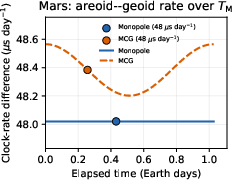
Figure 3: Mars areoid–geoid instantaneous clock-rate difference over one Martian sidereal day, showing the constant monopole rate and schematic effect of periodic modulation.
For the Moon, the analogous offset relative to a geoid-referenced clock is t2 (57.4 μs/day); using nested TCG–TCL coefficients from clock comparison literature, the leading rate is t3 (58.7 μs/day). The periodic band, mainly due to the lunar orbital phase and Earth-tide potential, induces instantaneous rate modulations. The work benchmarks these rates against published coefficients.
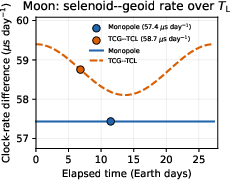
Figure 4: Lunar selenoid–geoid instantaneous clock-rate difference over one synodic month, depicting the monopole rate and the periodic modulation captured by the full time transformation series. Data points reflect published clock-transform coefficients.
The transformation chains for ground and spacecraft clocks (transmitting in TAI/UTC, onboard proper time, TCL/MCG, and back to TCB/TT) are made explicit, with each reference system’s coordinate time defined by a documented integral along the appropriate barycentric/tidally-perturbed world line. The work emphasizes that multi-CRS consistency is achieved through the explicit, documented transformation chains, not by appealing to a single master clock.
Observable Impact
Neglecting the metric-based areoid--geoid and selenoid--geoid offsets in merged, cross-agency tracking leads systematically to microsecond-level errors in range and Doppler, exceeding present carrier-phase and event-timing uncertainties for Chang’e- and Tianwen-class missions. The Mars Shapiro-rate correction terms reach t4–t5, which is comparable to the tracking residuals at interplanetary baselines.
Theoretical and Practical Implications
From a theoretical standpoint, this work operationalizes the geometry of time transformation in the solar system in a way that is directly compatible with modern ephemerides, clock comparison protocols, and navigation standards for both terrestrial and planetary missions. The chain-based documentation offers a consistent and extensible blueprint as new IAU standards for cislunar, Mars, and outer-planetary timescales are established.
Practically, the results define the minimal set of corrections required to achieve unbiased measurement at the microsecond level for future cross-body radiometry, frequency transfer, and global time dissemination efforts. The explicit formulas for the Mars and lunar offsets, together with their periodic modulations, provide critical input for mission planning, navigation, and planetary network buildup.
The body-centric extension of IAU time scales outlined here is an essential prerequisite for high-precision planetary clock synchronization, coordinated navigation (e.g., for relay constellations and surface infrastructure), and for multi-agency interoperability across the expanding domain of space operations.
Prospects and Future Directions
Several directions are highlighted for continuing this line of work:
- Extension of the metric and Christoffel documentation through t6 corrections to address next-generation optical clock deployments and ranging at picosecond levels.
- Fixing of the IAU constants t7 and t8 for operational TCL and MCG definitions enabling unified, traceable time dissemination.
- Deployment and calibration of lunar (LTC) and Martian time scales via atomic and optical standards and robust cross-link protocols.
- Incorporation of outer-planet (Jovian, etc.) CRS/coordinate-time definitions in preparation for future missions and navigation requirements.
Conclusion
By providing a metric-consistent, 1PN-accurate framework for mapping between proper time and all operational coordinate times used in solar-system metrology, this work delivers a directly applicable standard for present and future planetary missions. The cross-validated Mars and lunar clock-rate offset results are crucial for high-precision time transfer and navigation. The chain-based approach ensures interoperable, bias-free joint operations as exploration and infrastructure expand beyond Earth, and anticipates the evolving standards and models required for deep-space metrology.