- The paper presents a novel iterative graph lifting method that refines path-complete graphs to design stability certificates with reduced computational complexity.
- The method leverages dual optimality certificates by analyzing tight subgraphs to verify when no further lifting can improve the joint spectral radius approximation.
- Experimental results show that the approach produces significantly smaller graphs and faster computation compared to classical De Bruijn-based constructions.
Iterative Graph Lifting for the Automatic Design of Path-Complete Stability Certificates
Introduction
The analysis of the stability of switched linear systems under arbitrary switching is closely tied to the joint spectral radius (JSR) of a finite set of matrices. The JSR provides a sharp characterization of worst-case asymptotic growth, but computing or tightly approximating the JSR is notoriously intractable in general. The path-complete Lyapunov framework synthesizes stability certificates in the form of path-complete labeled directed graphs, which encode sets of coupled Lyapunov inequalities. The upper bound provided by solving the associated optimization problem depends crucially on the structure of the graph.
This work introduces a data-driven, optimization-guided algorithm for constructively refining path-complete graphs in a principled manner, iteratively approaching exact JSR bounds with significantly reduced graph size and computational complexity relative to classical constructions (e.g., the De Bruijn hierarchy).
Path-Complete Lyapunov Functions and Graph Lifting
Given a finite set of matrices A={A1,…,AM} and a path-complete graph G=(S,E), the path-complete Lyapunov approach associates to each node a∈S a candidate Lyapunov function (usually quadratic), and to each edge (a,b,i)∈E the Lyapunov inequality
Vb(Aix)≤Va(x),∀x.
For practical purposes, Va(x)=x⊤Pax, with Pa≻0. The smallest γ>0 such that
γ2Pa⪰Ai⊤PbAi
for all (a,b,i)∈E provides an upper bound on G=(S,E)0.
It is well-known that richer graph structures generally tighten the JSR bound, but established memory-based constructions (such as the De Bruijn graphs) become rapidly impractical as the required tightness increases, since the graph size scales exponentially in memory.
The main contribution in this work is a systematic procedure—forward graph lifting—for refining path-complete graphs locally through node splitting, rather than globally increasing memory. This local refinement preserves path-completeness and allows scalability beyond classical approaches.
The Forward Lift Operation
Given a node G=(S,E)1 in a labeled directed graph, the forward lift splits G=(S,E)2 into as many distinct nodes as it has out-neighbors (including itself for self-loops), preserving the outgoing transition structure while refining the graph locally. This operation is defined so that path-completeness is guaranteed to hold after the lift (i.e., every switching sequence is still expressible in the graph).
The construction allows the selective application of memory only when warranted by the underlying system, instead of a brute-force, uniform increase as in standard De Bruijn graphs.
Tight Subgraph Analysis and Optimality Certificate
The approach goes beyond mere graph manipulation by leveraging dual information from the solution of the graph-based Lyapunov optimization. The tight subgraph is constructed by identifying those edges for which the corresponding Lyapunov inequalities are active (i.e., the associated matrix LMIs are tight).
The tight subgraph provides valuable structure:
- If every node in the tight subgraph has at most one outgoing edge, then every strongly connected component is either a cycle or an isolated node. In this case, the current bound matches the true JSR.
- If a node has more than one outgoing edge in the tight subgraph, a forward lift at such a node is potentially beneficial.
This structure provides a stopping certificate—the procedure can ascertain, without oracle information about the true JSR, that no further lifting will improve the bound.
Iterative Graph Lifting Algorithm
The main algorithm initializes with an arbitrary path-complete graph (e.g., a De Bruijn graph of order 1). At each iteration, the algorithm solves the graph-based semidefinite program, analyzes the tight subgraph, and selects a node with at least two tight outgoing edges for lifting. The process continues until certification of optimality (no node with more than one tight outgoing edge).
This results in a parsimonious graph that is automatically adapted to the "hard" switching sequences of the system, as identified by the dual solution of the SDP.
Experimental Evaluation
Numerical experiments are conducted on ensembles of randomly generated switched systems, systematically comparing the proposed method with the De Bruijn hierarchy for path-complete graphs. The results indicate the strategy consistently produces substantially smaller graphs (often by orders of magnitude) and drastically reduced computation time, especially when high-order De Bruijn graphs are required for comparable accuracy.
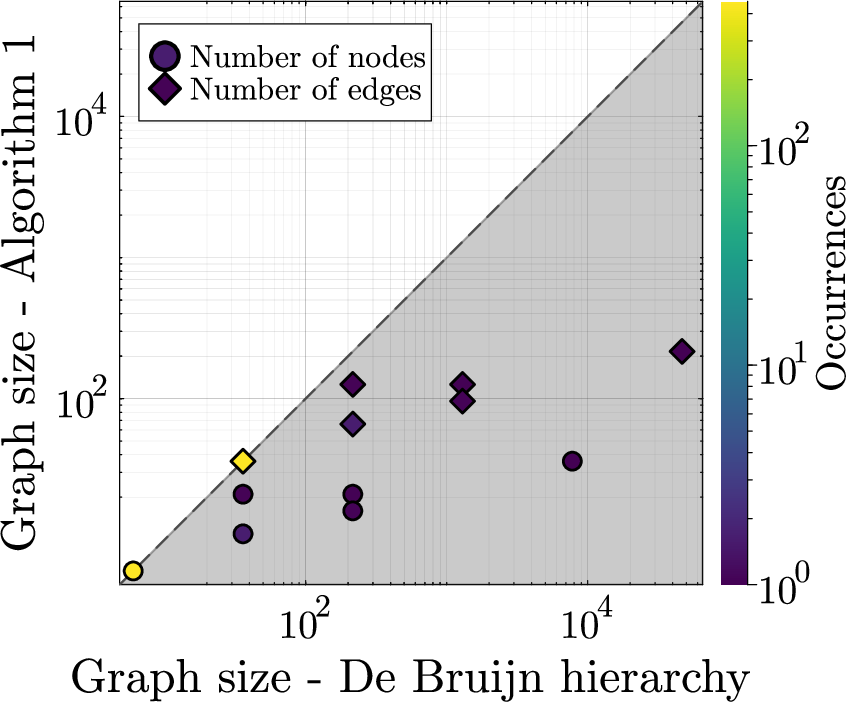
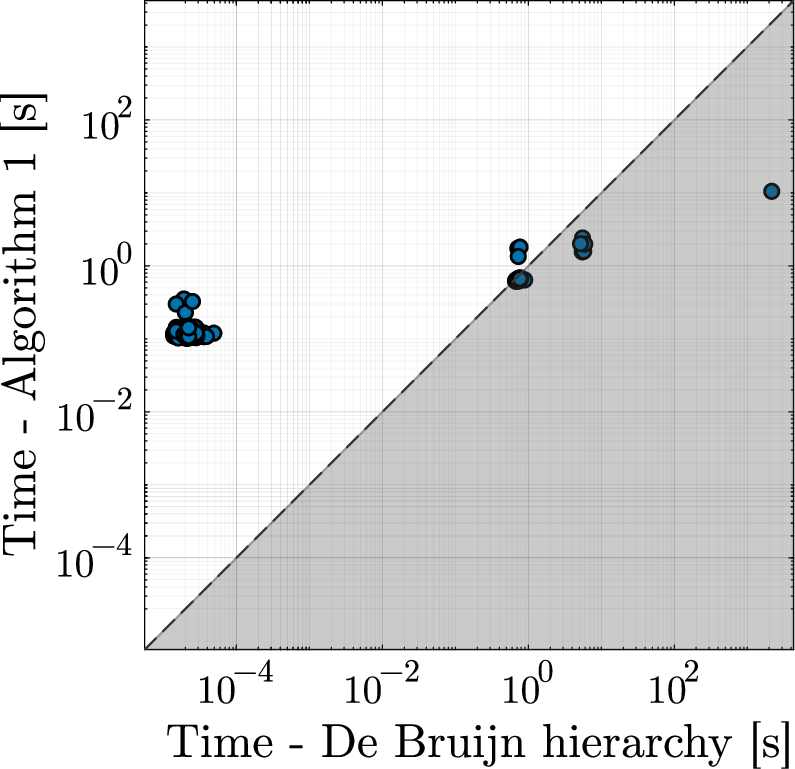
Figure 2: Number of nodes and edges in the constructed path-complete graphs demonstrates the scalability of the proposed lifting approach relative to the standard De Bruijn hierarchy.
The method adapts the graph structure specifically to the dynamical system, typically identifying compact certificates for stability that general-purpose constructions would miss without massive complexity overhead.
Implications and Future Prospects
This research makes several impactful advances in the Lyapunov-based approximation of the joint spectral radius:
- It enables adaptive, data-driven construction of path-complete graphs using only local graph operations and LMI optimization dual certificates.
- It provides a verifiable optimality certificate, eliminating redundant refinement.
- The procedure consistently outperforms classical memory-based constructions in both scalability and accuracy, making the path-complete framework viable for systems with higher numbers of switching modes.
Theoretically, the work exposes a deep connection between the graph-based representation of Lyapunov inequalities and the underlying set of active constraints, opening the way for further optimization-guided or learning-based graph design. Practically, this approach substantially improves the feasibility of stability analysis for complex, high-dimensional switched systems.
Future directions include combining alternative lifting operations, developing enhanced node selection heuristics, and integrating graph-theoretic and combinatorial optimization tools for more general classes of systems.
Conclusion
The iterative graph lifting approach enables automatic, principled construction of minimal path-complete graphs for switched system stability certificates. By exploiting the structure of tight dual constraints, the method adaptively and efficiently refines graph topology, achieving optimal JSR bounds orders of magnitude faster and with significantly smaller certificates than established De Bruijn-based methods. The interplay between optimization, duality, and combinatorial graph refinement establishes a promising paradigm for scalable stability analysis and synthesis in switching systems and related hybrid dynamical models.

