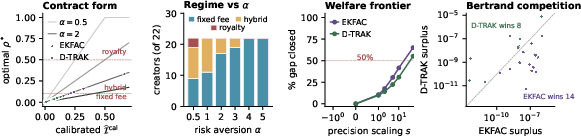
- The paper's main contribution is a formal market framework integrating attribution informativeness into optimal contract design for generative music.
- It demonstrates that high attribution precision shifts compensation towards royalty-based models while low precision favors fixed-fee structures.
- Empirical evaluations reveal that current attribution methods are too imprecise for royalty-based compensation, underscoring a need for improved calibration.
A Market Framework for Attribution-Aware Compensation in Generative Music
Motivation and Problem Statement
The proliferation of generative AI in music production creates unprecedented challenges for fair compensation of the underlying rightsholders whose catalogs power model training. Traditional licensing mechanisms—flat catalog fees or blanket licenses—are agnostic to the differential value contributed by individual catalogs and fail to align payments with platform revenue derived from generated outputs. This problem is accentuated as AI-generated music increasingly saturates commercial platforms, displacing traditional licensing revenue streams and raising legal, economic, and social stakes for stakeholders.
Framework Overview
The paper develops a formal market framework for compensation in generative music, coupling explicit data attribution methods with contract theory primitives. The central departure from prior art is the explicit modeling of attribution informativeness—quantified as signal-to-noise ratio (SNR) of attribution scores—and its integration as a control variable in optimal contract design. Attribution is computed at the catalog (not per-song) granularity, consistent with the grouping of training data per licensing counterparty, and for each creator, payment splits between fixed-fee and royalty components depend endogenously on attribution informativeness and risk aversion.
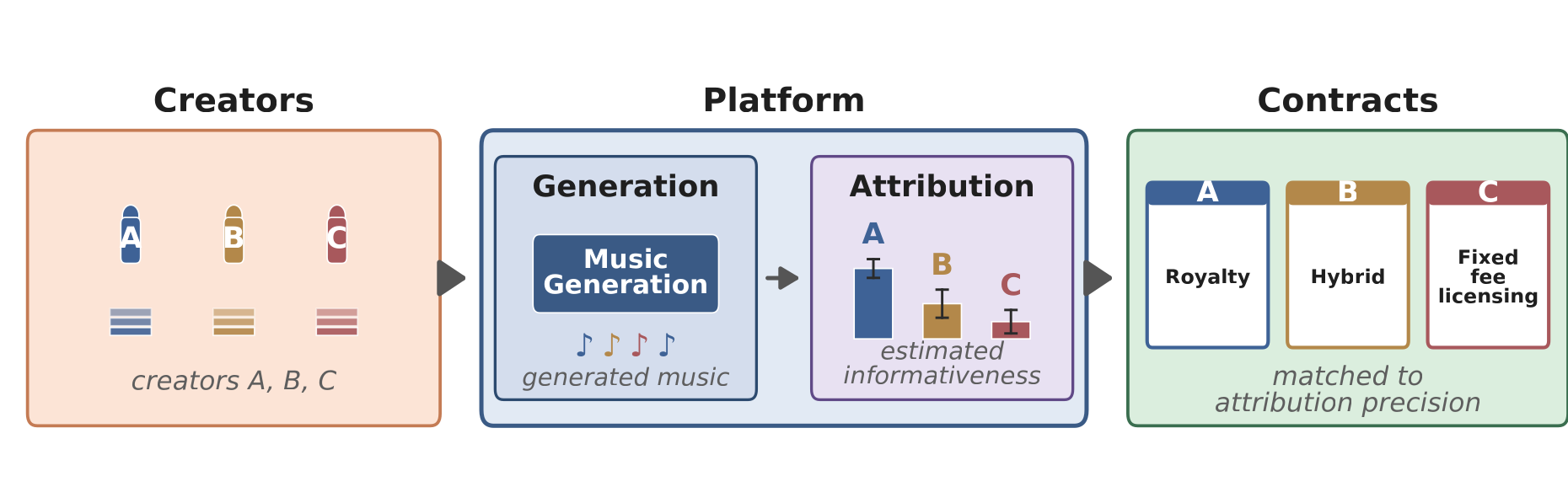
Figure 1: The attribution-aware compensation framework for generative music. Each creator's contract form follows from how precisely their contribution can be attributed to a generated output.
Formally, for creator j, the informativeness Ij is defined as the OLS slope of the true value aj∗ on the measured attribution a^j. Contracts take linear form (fj,ρj), mixing a fixed payment with a royalty on attributed value, incentivized under mean-variance utility reflecting creators’ liquidity constraints. The main theoretical result is a closed-form expression for the welfare-optimal royalty rate:
ρj∗=clip(αjIj,[0,1])
with αj capturing risk aversion.
Theoretical Contributions
The framework establishes a regime-dependent split between fixed-fee and royalty payments—precision (i.e., high SNR) yields royalty-dominant contracts, while noisy attribution (low SNR) favors fixed-fee compensation. Theoretical results yield explicit formulas for welfare loss Lj due to erroneous attribution, which is quadratic in (1−Ij), concentrating the welfare gap among creators whose contributions are poorly measured.
A multi-platform Bertrand-competition model is introduced, demonstrating that only the platform with the most precise attribution can internalize welfare gains from increasing attribution fidelity; trailing competitors have no incentive to improve attribution until they overtake the leader. This strategic bottleneck—a quantified attribution moat—predicts systematic underinvestment in attribution improvement except from market leaders.
Market and Welfare Impacts
The analysis identifies two robust failure modes in status-quo compensation: (1) uniform compensation disproportionately excludes distinctive creators with unique styles—whose contributions cannot be replaced by other catalogs—leading to superlinear collective welfare loss; (2) high royalty rates, when coupled with poor attribution, can perversely reduce effort or even drive exit among high-value creators due to excessive risk loading. These considerations position attribution informativeness as an operational and policy-critical primitive, with explicit formulas identifying where institutional intervention or policy oversight is necessary.
Empirical Evaluation
Measurement uses two model families: latent audio diffusion (Stable Audio Open) and symbolic LLMs (Anticipatory Music Transformer), each combined with scalable attribution methods (EKFAC, D-TRAK, LoGra, TRAK). For audio, 22 artist catalogs are evaluated; for symbolic, 100 commercial catalogs.
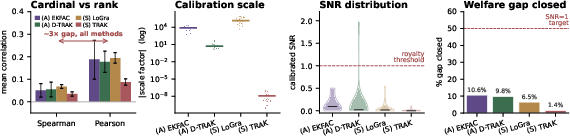
Figure 2: Attribution measurement on two settings, showing that nearly all current attribution estimates lie below the threshold needed for royalty-based compensation to beat fixed-fee licensing.
Empirical diagnostic reveals:
Diagnostic and Differential Analysis
Detailed per-creator diagnostics confirm high variance in attribution signal calibration and significant cross-method disagreement in absolute scale, though not in ranking. Notably, larger catalogs display higher ground-truth signal variance, inducing higher informativeness, reinforcing the theorized link between catalog size, distinctiveness, and attribution-based welfare impact.
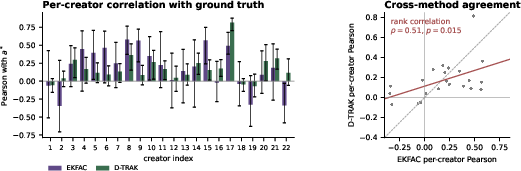
Figure 4: Per-creator Pearson correlation statistics with confidence intervals, confirming the high uncertainty in detected attribution signal at the individual level.
Further, the framework yields actionable water-filling rules for prioritizing attribution-R&D investment: the marginal welfare return is maximized for creators occupying the mid-informativeness regime, strongly supporting targeted rather than uniform improvement efforts.
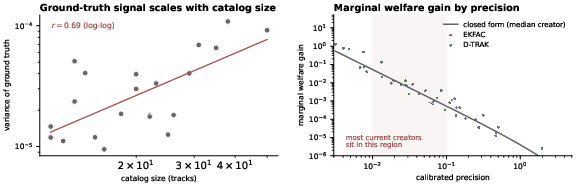
Figure 5: Ground-truth signal variance scales with catalog size; the marginal welfare return from precision improvement peaks in today's dominant precision range.
Competitive Dynamics and Institutional Implications
Bertrand competition simulations using two attribution methods (EKFAC vs. D-TRAK) empirically instantiate the theory: for most creators, surplus differences between platforms are negligible (representing dead zones for underinvestment), whereas outlier catalogs drive the strategic advantage for a leading platform.
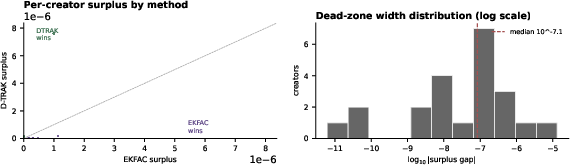
Figure 6: Bertrand competition shows winner-take-all surplus allocation and wide variation in dead-zone gap sizes, confirming the attribution moat.
The analysis demonstrates the limitations of contract-mediated solutions: (1) risk-averse creators can always smooth reported attribution scores to game the linear contract with impunity, unless attribution computation is centralized; (2) asymmetric information about attribution accuracy produces irreducible welfare losses that no contract can fix.
Conclusion
This paper delivers a comprehensive contract-theoretic and empirical framework for attribution-aware compensation in generative music. Its principal contribution is to operationalize attribution precision as a first-class economic and design variable, with metrics and benchmarks tailored to the realities of generative AI music platforms. The main practical impact is to anchor industry and policy discussion around measurable attribution calibration, clarify the conditions under which royalty-based compensation is feasible, and outline both contract-theoretic and institutional boundaries for sustainable compensation.
Extensions include dynamic contracts, cross-media modeling, and multi-stage data value chains involving synthetic training reuse, as the framework is modular and contract design separable from attribution technology.
Key explicit findings include the claim that currently no scalable attribution method achieves sufficient precision for royalty regimes to be welfare-optimal, reinforcing the empirical necessity of fixed-fee compensation for today’s music AI platforms and identifying explicit, measurable targets for attribution improvement.