- The paper introduces a weak-coupling TCI impurity solver that overcomes the sign problem of CT-QMC, extending feasible real-time simulation scales.
- It employs tensor-train decompositions and cross interpolation to efficiently approximate high-dimensional Keldysh integrals with controlled accuracy.
- Benchmark tests on Falicov-Kimball and Hubbard models confirm energy conservation and capture dynamical transitions and thermalization with high fidelity.
Weak-Coupling Tensor Cross Interpolation Impurity Solver for Nonequilibrium DMFT
Introduction and Motivation
Simulating nonequilibrium dynamics of strongly correlated quantum many-body systems is fundamentally constrained by the exponential computational complexity of real-time quantum evolution. Nonequilibrium dynamical mean-field theory (DMFT) is a nonperturbative framework that is exact in the limit of infinite dimensions and has enabled progress in the theoretical description of correlated lattice models under time-dependent protocols. However, the accuracy and timescales accessible to nonequilibrium DMFT are dictated primarily by the performance of the underlying impurity solver. Traditional numerically exact approaches such as continuous-time quantum Monte Carlo (CT-QMC) methods are fundamentally hampered by a severe dynamical sign problem, especially away from particle-hole symmetry and for long-time simulations.
This work introduces a weak-coupling impurity solver based on tensor cross interpolation (TCI) and tensor-train decompositions, enabling controlled evaluation of high-dimensional Keldysh-contour integrals without suffering from sign cancellations intrinsic to stochastic methods. The solver is integrated into nonequilibrium DMFT and systematically benchmarked, including situations where established QMC solvers fail due to prohibitive sign problems.
Theoretical Methodology
Weak-Coupling Expansion and Tensor-Train Representation
The DMFT mapping reduces a lattice model to an effective single-site quantum impurity problem with a hybridization bath. Perturbative expansion in the local interaction produces high-dimensional integrals—over all insertion times of interaction vertices on the Keldysh contour—whose integrands acquire complicated nonlocal structure.
The TCI method considers the discretized integrand as a high-dimensional tensor and constructs a compact tensor-train (i.e., matrix-product state) decomposition adaptively, selecting grid points by a cross approximation/cross interpolation scheme. This sidesteps direct storage or enumeration of the full tensor, which is intractable at high dimensionality. The lack of stochastic sampling means the sign/phase averaging problem of QMC is mitigated, and the cost instead scales with the complexity (bond dimension) required to approximate the integrand with a given fidelity.
By analyzing the integrand structure and exploiting symmetries, the method achieves efficient truncation in perturbation order and tensor-train rank, especially in physically relevant regimes (e.g., for short to moderate real times or weak coupling).
Nonequilibrium DMFT Integration
The impurity solver is embedded into full nonequilibrium DMFT self-consistency, targeting two main protocols: (i) real-time dynamics after an interaction quench, and (ii) steady-state regimes enabling direct computation of real-frequency observables without analytic continuation.
Benchmarks and Key Numerical Results
Benchmarking Against an Exactly Solvable Model
A Falicov-Kimball impurity structure is used as a controlled benchmark. The TCI solver reproduces exact results for major Green's function components with high accuracy—errors fall rapidly as a function of perturbation order nmax and tensor-train bond dimension. Notably, even demanding benchmarks away from particle-hole symmetry, which are inaccessible to CT-QMC solvers due to sign problems, are accurately handled at modest computational cost.
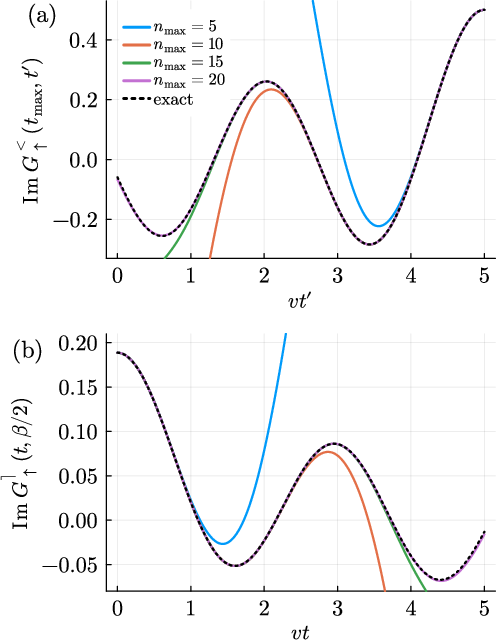
Figure 1: Weak-coupling nonequilibrium TCI impurity solver output for the impurity model; TCI systematically converges to the exact results as nmax is raised.
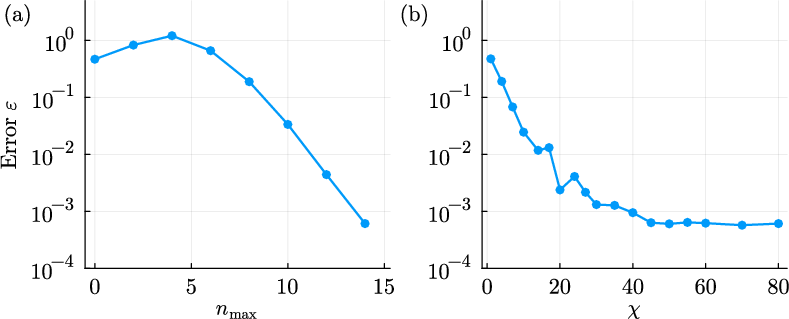
Figure 2: Error in the lesser Green’s function decays rapidly with increasing nmax and saturates with increasing tensor-train bond dimension.
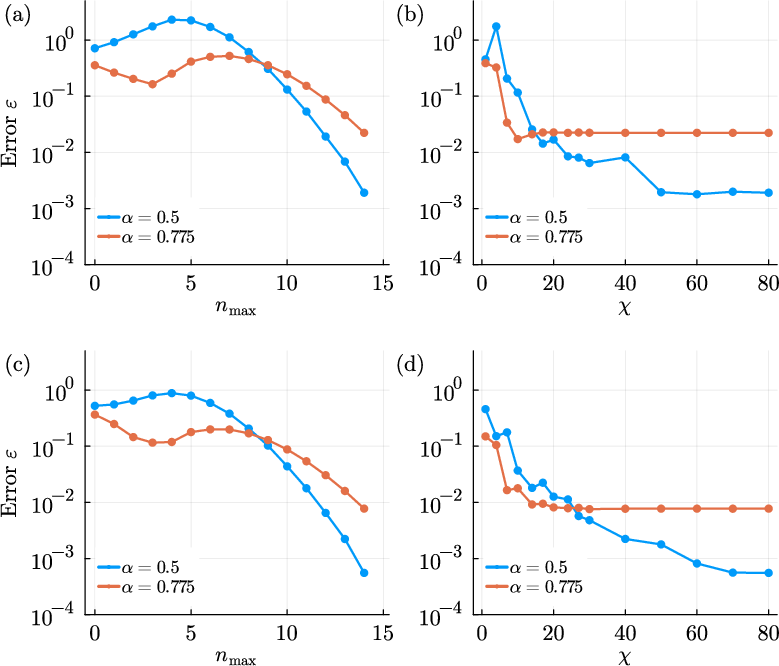
Figure 3: Convergence behavior of both lesser and greater Green’s function errors further illustrates the role of bond dimension and expansion order, including off-symmetric cases.
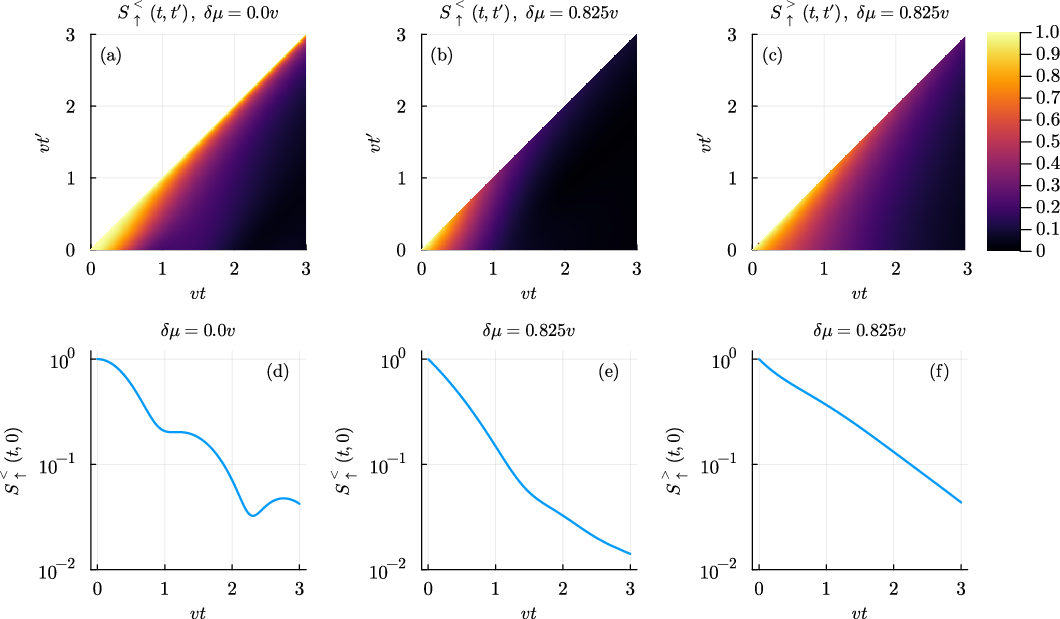
Figure 4: The “average-sign” diagnostic S↑ quantifies cancellations in the deterministic TCI evaluation, revealing that manageable sign problems persist even for strong phase-fluctuation regimes.
Nonequilibrium DMFT: Dynamics of the Hubbard Model
At half filling, the solver quantitatively reproduces prior DMFT + CT-QMC results for post-quench real-time evolution, including the rapid thermalization/transient regime and the long-time approach to equilibrium. Crucially, it is demonstrated that the same method continues to perform robustly away from half filling, where the sign problem disables CT-QMC. Energy conservation is confirmed at all stages as an internal check.
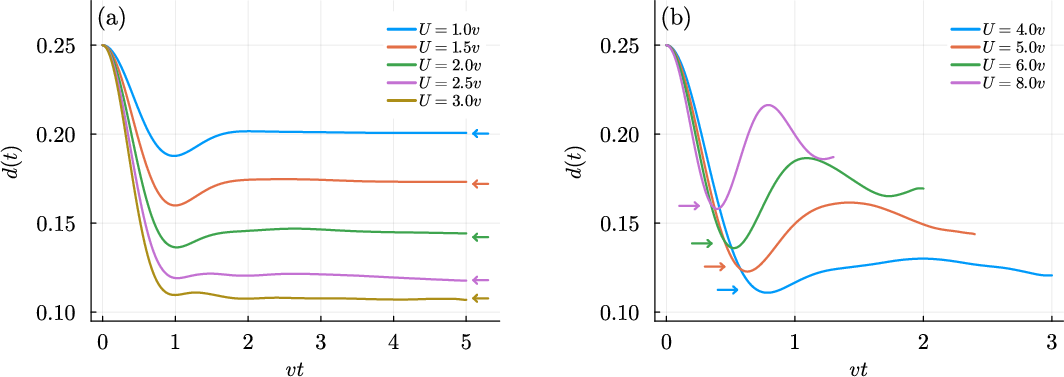
Figure 5: Double occupancy d(t) dynamics for various quench protocols in the half-filled Hubbard model, confirming agreement with previous DMFT results.

Figure 6: Time evolution of potential, kinetic, and total energies with exact energy conservation after the interaction quench—an internal consistency validation.
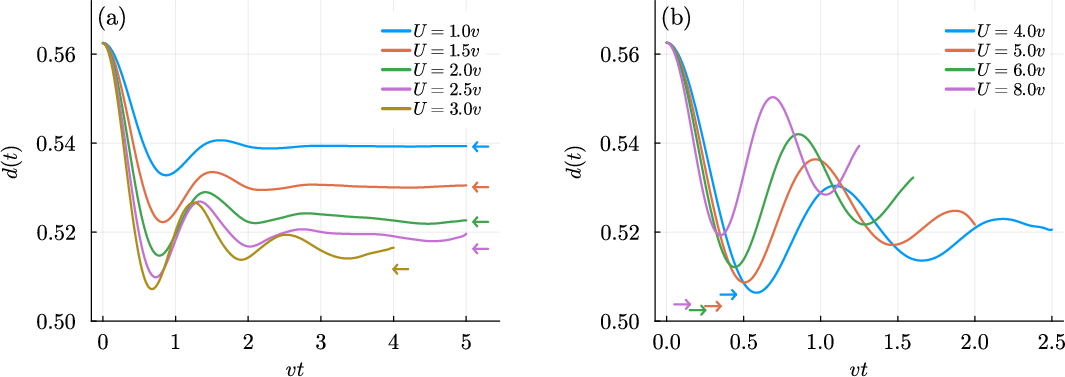
Figure 7: Double occupancy for the $3/4$-filled Hubbard model, showing controlled nonequilibrium dynamics away from particle-hole symmetry.

Figure 8: Energetics for $3/4$-filled systems retaining strict conservation laws, demonstrating the lack of a severe numerical “sign catastrophe” for TCI.
Thermalization, Doping Dependence, and Dynamical Transition
The solver is further leveraged to analyze the approach to equilibrium at various fillings and interactions. At half-filling, the system exhibits a sharp dynamical transition—fast thermalization and a vanishing deviation from the thermal distribution near critical U. As doping increases, this sharpness is lost and the transition is replaced by a smooth crossover; no fast thermalization occurs at accessible couplings.
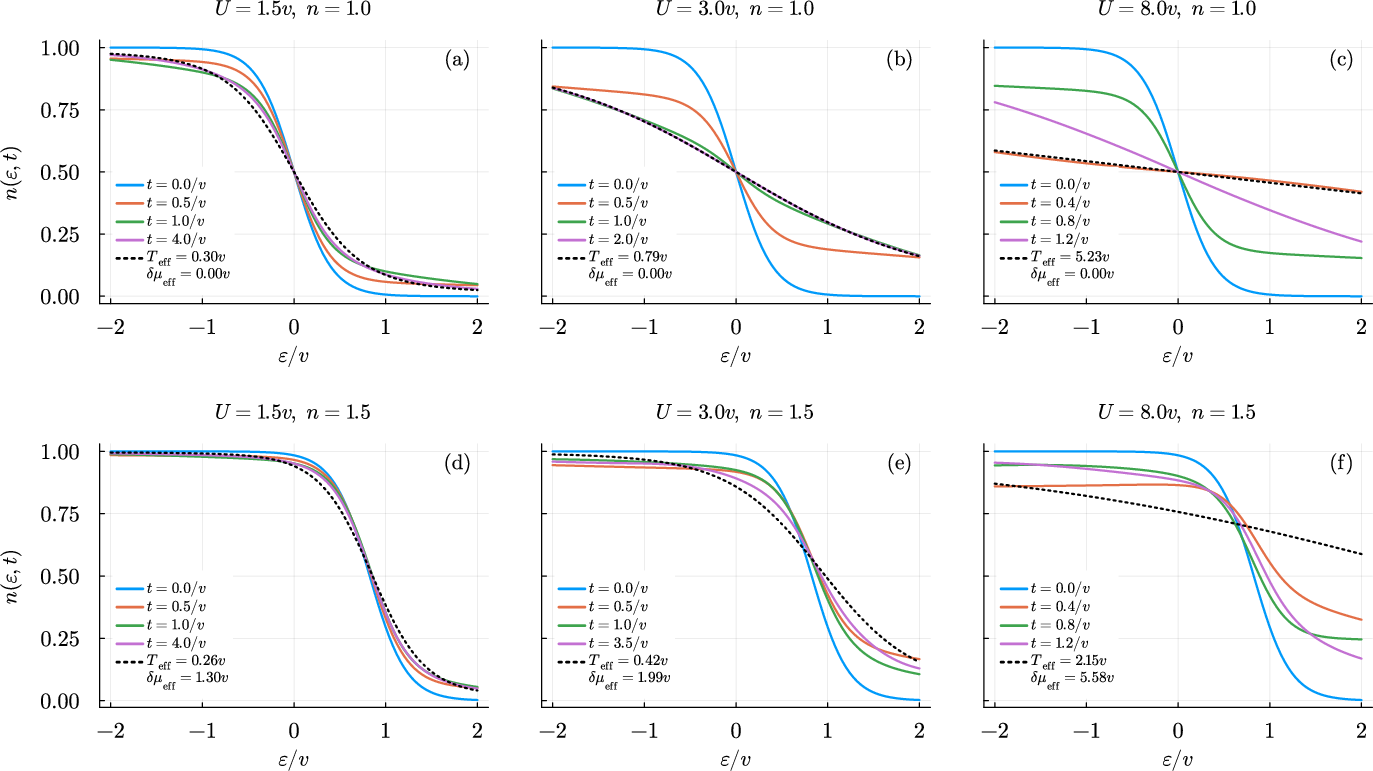
Figure 9: Time evolution of the nonequilibrium distribution function; at half-filling the system rapidly thermalizes near U=3v, which is not seen away from half-filling.
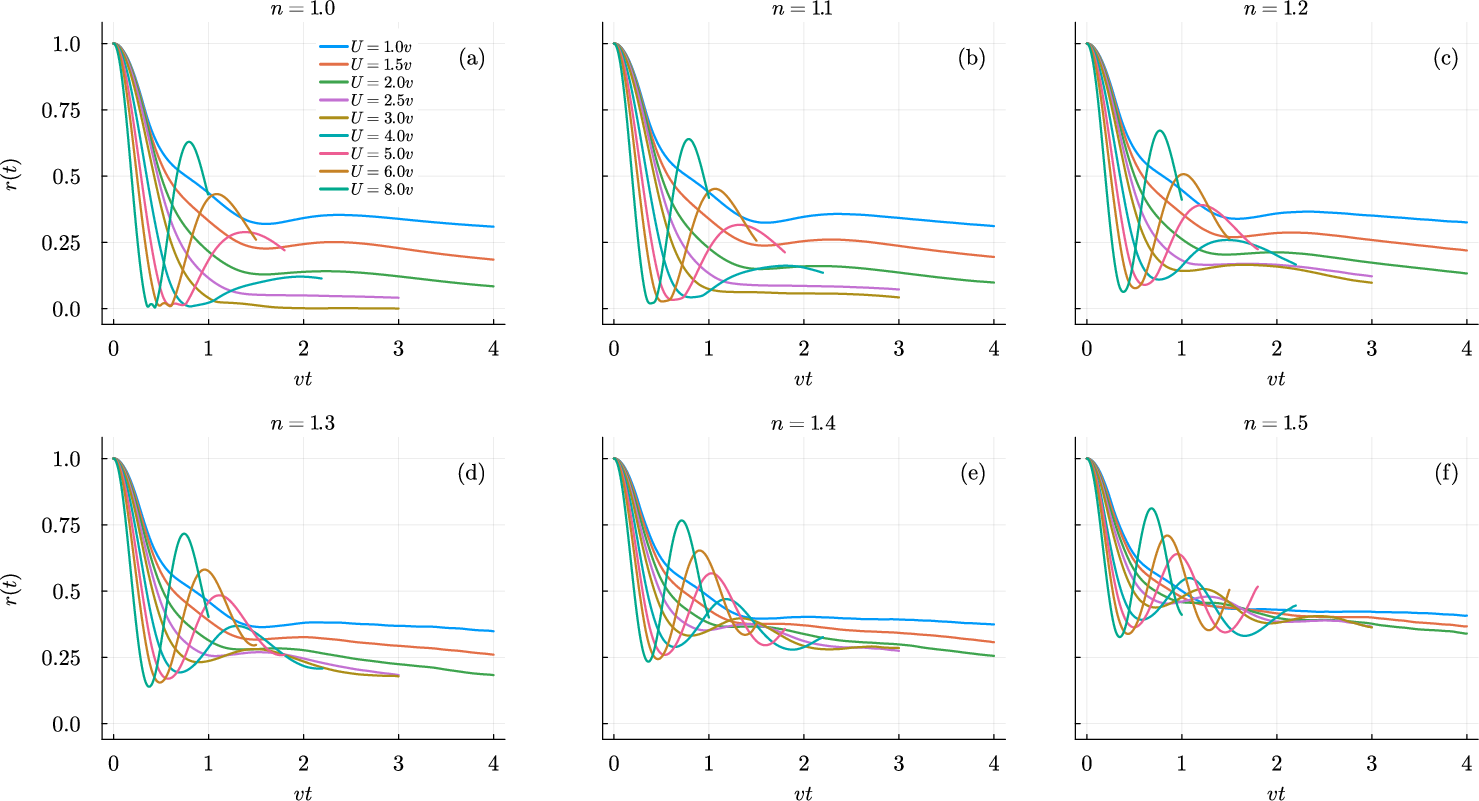
Figure 10: The normalized deviation from thermal distribution r(t) vs time for different fillings; only half-filling shows vanishing deviation, indicating fast thermalization.
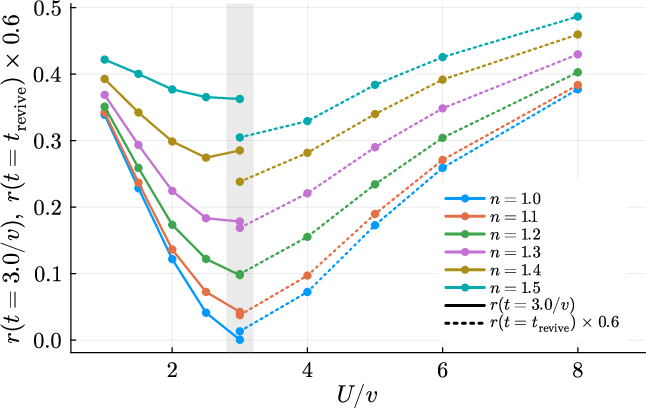
Figure 11: nmax0 as a function of interaction strength for several fillings; the critical dip is suppressed as doping increases.
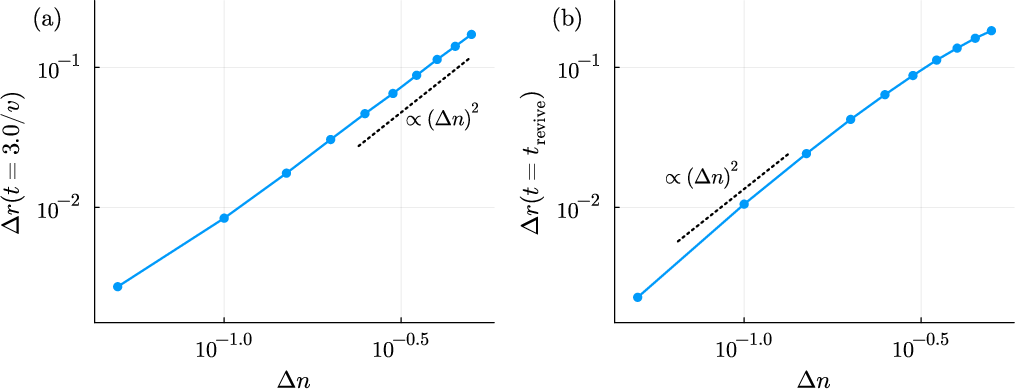
Figure 12: Doping dependence of nmax1 deviates quadratically from its half-filled value, quantifying the smearing of the dynamical transition.
Steady-State DMFT and Real-Frequency Spectra
The TCI solver directly evaluates real-frequency spectral functions in the steady-state limit, bypassing the need for analytic continuation. In the metallic regime, the spectrum shows expected Fermi-liquid behavior and precursors of Hubbard bands at moderate interaction strengths.
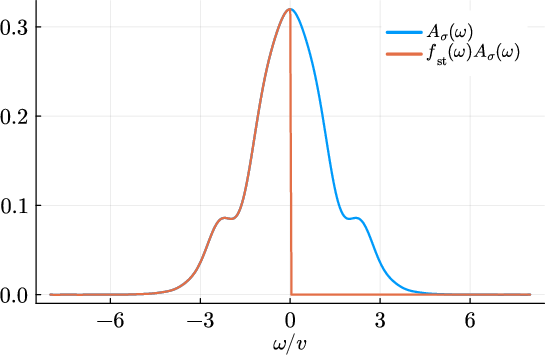
Figure 13: Steady-state DMFT spectral function nmax2 and occupation directly from the TCI solver, with no analytic continuation.
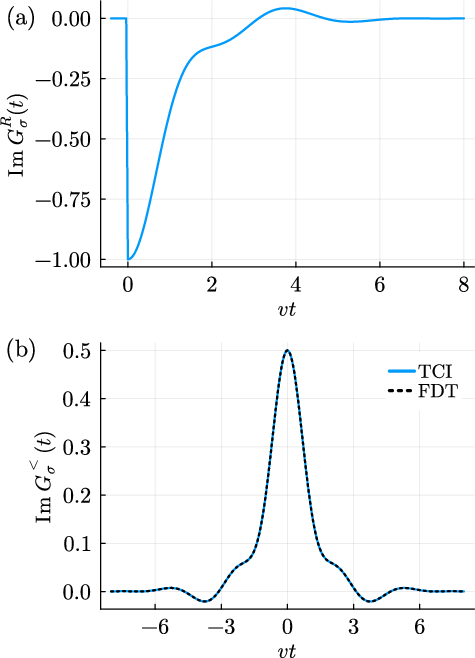
Figure 14: Time-domain retarded and lesser Green’s functions compared between TCI and fluctuation-dissipation evaluation, confirming internal consistency.
Implications and Future Directions
Practical Implications: The main practical consequences are the removal of a fundamental computational bottleneck for nonequilibrium DMFT, notably for doped correlated systems and long-time simulations where QMC methods become infeasible. As the sign problem is converted into a tractable tensor-approximation problem, a much larger physical parameter space becomes accessible.
Theoretical Implications: The results furnish numerically exact evidence that the sharp dynamical transition in the half-filled Hubbard model evolves into a smooth crossover under doping. The method robustly supports the analysis of fast thermalization, Mott physics, and long-time relaxation in correlated systems from a nonperturbative perspective.
Outlook and Speculation: Key obstacles remain, notably the explicit summation over Keldysh indices, which currently results in exponential scaling with perturbation order. Future progress may be achieved through advanced variable transformations or by compressing Keldysh correlations within the tensor network. Extending this approach to cluster impurity solvers or multiorbital systems is anticipated to be fruitful, especially for exploring nonlocal or Hund-related dynamical phenomena. The method is complementary to strong-coupling TCI solvers and influence functional tensor network methods, suggesting a future landscape rich in deterministic, sign-problem-free solvers for quantum dynamics.
Conclusion
This work establishes weak-coupling TCI as a powerful impurity solver for nonequilibrium DMFT, enabling controlled, sign-problem-free access to the real-time dynamics and steady-state spectra of correlated systems for physically relevant times and dopings. The approach overcomes key barriers of CT-QMC and is verified across benchmarks, providing a rigorous basis for further theoretical and methodological developments in out-of-equilibrium many-body physics.