- The paper presents a Bayesian data fusion approach that integrates multi-agent sensor data into a spatial occupancy grid for enhanced situational awareness.
- It implements a hybrid validation methodology combining CARLA simulation with vehicle-in-the-loop experiments, achieving significant improvements in FoV coverage and occupied-cell recall.
- The approach quantifies uncertainty through online reliability indices, supporting robust autonomous vehicle certification and explainable safety assessment.
Hybrid Validation of V2X Collective Perception in Complex Traffic Scenarios
Introduction
The paper "Beyond Line of Sight: Hybrid Validation of V2X Collective Perception in Complex Scenarios" (2607.00874) presents a probabilistic framework and a hybrid validation methodology for evaluating Collective Perception (CP) in connected and autonomous vehicles (CCAVs). The work addresses the interpretability, robustness, and certification challenges of V2X-enabled CP, proposing a Bayesian data fusion scheme implemented atop both simulated (CARLA-based) and vehicle-in-the-loop environments. The methodology enriches the situational awareness of CCAVs by synthesizing heterogeneous sensor observations and quantifying both coverage and uncertainty, and includes mechanisms for online reliability assessment.
Probabilistic Bayesian CP Architecture
The CP module architecture integrates multi-agent sensory data within a spatial probabilistic occupancy grid framework. Each grid cell in this representation encodes the occupation likelihood and associated uncertainty, providing both local and global quantification of environmental awareness and its trustworthiness.
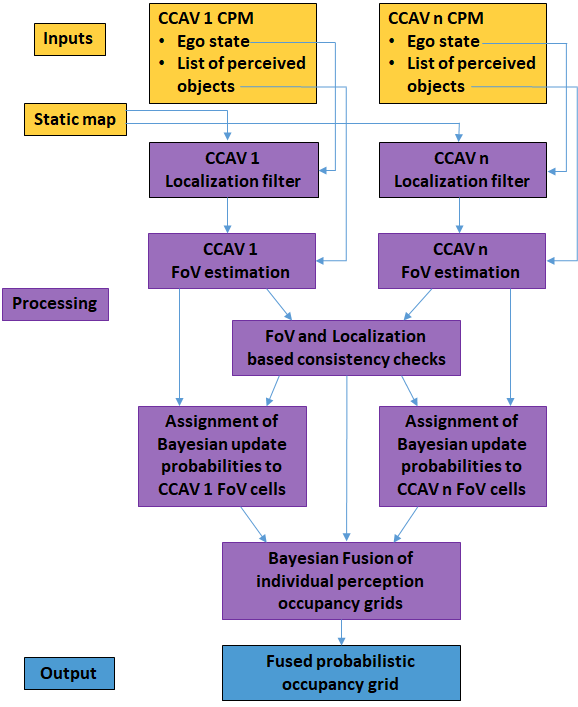
Figure 1: The architecture of the proposed CP module, illustrating the flow from perception data dissemination to fusion and grid formation.
CCAVs disseminate, in real time, ego state (position, velocity, heading), FoV parameters, and observed object information. The grid-based scene modeling is maintained by a multi-step algorithm: (1) vehicle localization via particle filtering, (2) geometric FoV estimation per CCAV, (3) recursive Bayesian fusion of individual agent cell-wise observations using forward sensor models, and (4) temporal tracking of grid cell dynamics.
Vehicle localization employs a kinematic motion model using the ego's own sensor measurements, with full independence from other agents' localizations to maintain reliability and avoid degenerate data association in noisy or ambiguous scenes.
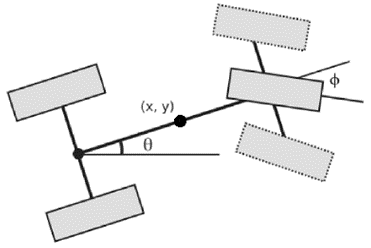
Figure 2: Kinematic vehicle model utilized for localization and dynamic prediction.
Geometric FoV estimation employs a CUDA-accelerated process to delineate visible grid cells given real-time position and sensor suite configuration per agent. Figure 3 demonstrates FoV boundaries for three distinct CCAVs, capturing the aggregation of their unique perspectives.
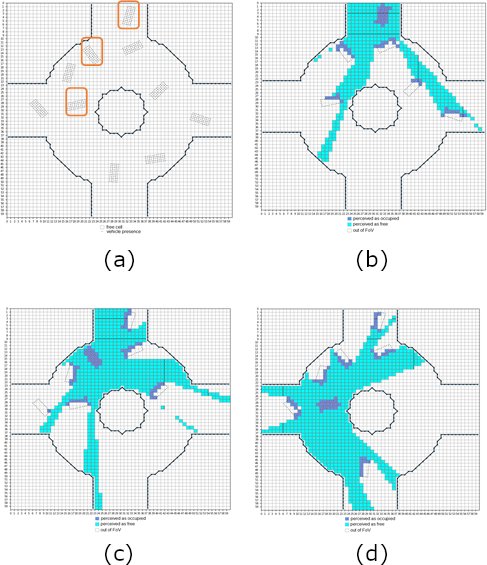
Figure 3: Visualization of FoV estimation for three CCAV agents in a roundabout context.
Agent observations are recursively fused in a cell-wise manner via Bayes' theorem, permitting both explicit uncertainty propagation and transparent evaluation of information consistency and contradiction across agents.
Reliability Assessment
The probabilistic CP scheme facilitates localized online reliability indices:
- Localization reliability is quantified using the posterior covariance of the particle filter, with context-sensitive thresholds for uncertainty.
- FoV consistency involves intra- and inter-agent plausibility checks. Self-contradictory CCAV perception reports (claimed objects outside local FoV) are flagged as untrustworthy. Inconsistent occupancy assignments in overlapping FoV regions are also detected, supporting both misbehavior detection and system-level robustness evaluation.
- Probabilistic occupancy output: Grid cells with uncertain or contradictory fusion results (posteriors near 0.5) are explicitly identified, highlighting locations of perception risk—a feature essential for traceable safety guarantees in AV systems.
Hybrid Simulation-Physical Validation
To overcome the gap between simulation-based algorithmic evaluation and physical deployment constraints, the paper employs a hybrid approach: CARLA simulation is combined with vehicle-in-the-loop experimentation. The main scenario explores roundabout navigation with both connected and non-connected agents, leveraging real-time scenarios and synthetic ground truth to quantify system performance comprehensively.
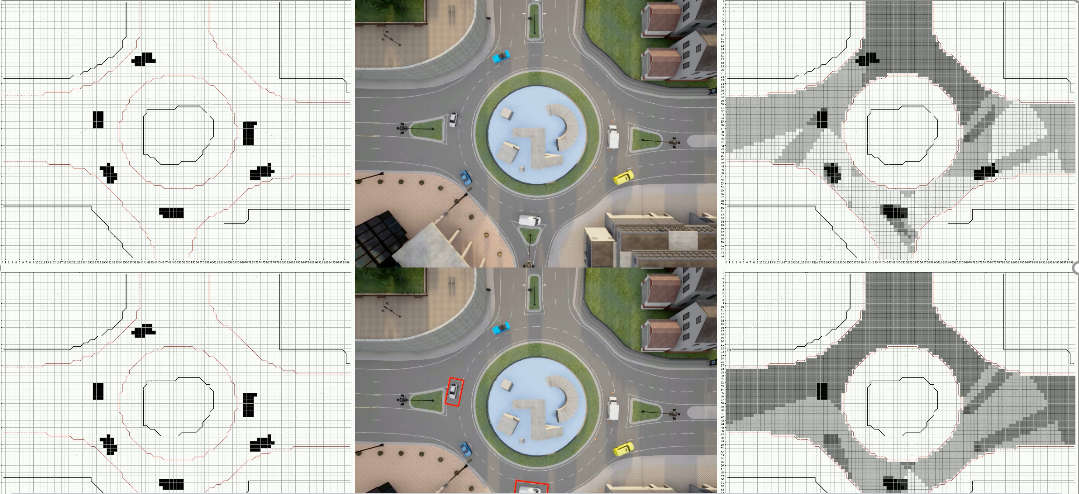
Figure 4: Left—scene ground truth; Middle—CARLA-based BEV visualization; Right—probabilistic occupancy grid output from the CP module.
The framework is evaluated under three perception configurations (ego-only, CP with three agents, CP with six agents) and across a range of localization noise conditions (0, 0.5, 1, 1.5, 2 m stdev). Notable empirical findings include:
- Field-of-View (FoV) coverage increased by 260% from ego-only to full CP (0.236 → 0.856).
- Occupied-cell recall improved from 0.82 (ego-only) to 0.94 (six agents) under zero localization noise, and sustained at 0.80 under 2 m noise.
- Precision mildly decreased with CP scale (from 0.94 to 0.87 with six agents at no noise), attributable to fusion conflicts and FoV overlap, but remained within operationally robust ranges.
- Stability under noise: CP configurations demonstrated resilience; even with 2 m localization perturbations, performance degradation was modest.
These results emphasize the strong gains in spatial awareness, fault tolerance, and detection completeness enabled by the Bayesian fusion framework.
Implications and Theoretical Context
The research aligns with the transition in CP from connectivity-centered protocols to perception-centric probabilistic reasoning. By encoding and quantifying local uncertainties, the methodology enhances system-level explainability and supports the derivation of traceable reliability metrics, which are increasingly critical for AV safety certification. The locality-aware uncertainty quantification offers insight not just into overall system confidence but also into per-cell risk, which is essential for robust motion planning and risk assessment.
The explicit focus on hybrid validation overcomes a persistent limitation in CP benchmarking—the absence of standardized cross-domain testing protocols—by integrating both physical and synthetic agents in a reproducible setting. The use of scenario-based validation within CARLA and vehicle-in-the-loop systems positions this approach for scalable, certifiable, and scenario-driven safety evaluation. The direct connection to V2X communication and CP message standardization (e.g., ETSI CPM) ensures relevance for future C-ITS deployments.
Prospects for Future Work
Prospective research directions include integrating dynamic Bayesian fusion that explicitly models communication delay, message loss, and varying trust weights per agent. This would further bolster resilience to adversarial or faulty agent behavior and support the development of certifiable, explainable, and robust multi-agent robotic platforms. The modularity of the proposed method invites its extension to more heterogeneous agent mixes (including vulnerable road users) and more complex urban scenarios. Ultimately, this work provides a reproducible foundation for the certification pipeline of cooperative automated driving systems.
Conclusion
This paper delivers a mathematically principled, practically implementable, and empirically validated framework for V2X-enabled CP, substantiated by strong numerical evidence of improved perception coverage and robustness even under noisy localization. The hybrid testing methodology bridges simulation and reality, enabling scenario-driven, explainable, and certifiable CP fusion. The approach notably advances the state of the art in uncertainty-aware cooperative perception and sets the groundwork for standardized, interpretable, multi-agent perceptual validation in autonomous vehicle systems.

