- The paper introduces high-performance parallel algorithms for CCSDT, CCSDT(Q), and CCSDTQ that significantly reduce memory requirements.
- It employs compact triangular amplitude storage and optimized tensor contractions to enhance computational efficiency.
- The distributed-memory strategy achieves near-ideal scaling on thousands of cores, enabling large-scale benchmark quantum chemistry calculations.
The paper "High-performance parallel implementation of high-order coupled-cluster theories" (2607.00981) presents the design, implementation, and performance of efficient parallel algorithms for canonical high-order coupled-cluster (CC) methods, particularly CCSDT, CCSDT(Q), and CCSDTQ, on both shared and distributed-memory architectures. These developments substantially extend the computational reach of canonical high-order CC for quantum chemical applications and provide a robust, open-source reference implementation within the PySCF package.
Motivation and Challenges in High-Order Coupled-Cluster Methods
High-order CC methods such as CCSDT (iterative triples), CCSDT(Q) (perturbative quadruples), and CCSDTQ (iterative quadruples) offer near-exact correlation treatments and are required for benchmark thermochemistry, weak π-stacking interactions, and metallic/near-metallic systems where post-CCSD(T) effects are non-negligible. Their application, however, has historically been limited by extremely high computational and memory requirements: O(N8) for CCSDT, O(N9) for CCSDT(Q), and O(N10) for CCSDTQ, with amplitude tensors scaling as O(N6) or higher. The largest canonical calculations prior to this work were constrained to small systems (e.g., molecules with <30 correlated electrons and <200 orbitals) and often required point-group symmetry or reduced-scaling approximations.
Efficient Tensor Storage and Parallel Algorithms
Compact Triangular Amplitude Storage
The implementation introduces an efficient storage format for high-rank amplitude tensors, exploiting the full column-permutation symmetry of non-orthogonal spin-adapted CC amplitudes. For triples (T3), only upper-triangular occupied-index blocks (i≤j≤k) are stored, which reduces memory consumption by a factor of ∼6 for CCSDT; for quadruples (O(N8)0), the analogous principle yields a O(N8)124-fold reduction for CCSDTQ. Off-triangular blocks are generated on-the-fly during contractions using explicit permutation reconstruction.

Figure 1: Compact storage of the O(N8)2 amplitudes in RCCSDT: the upper triangular region is stored; off-triangular blocks are reconstructed on-the-fly via permutations.
This scheme is not only compact but also computationally efficient, as only the necessary blocks are computed and updated per iteration, thereby reducing unnecessary floating-point and memory operations.
Computational bottlenecks in CCSDT and CCSDTQ stem from high-order tensor contractions. The implementation utilizes pytblis (a wrapper around TBLIS) for high-performance, multi-threaded contraction of arbitrarily-strided tensors without explicit data transpositions. For contractions that require blocks outside the compactly stored upper-triangle, a tile-based unpacking scheme is implemented to reconstruct only the minimal data necessary for a given computational batch.
Strong thread-scaling was observed up to 90 physical cores (AMD Genoa platform), enabled by optimized tensor contraction, minimal memory allocation overhead, and parallelism in post-processing steps (e.g., spin summation and amplitude symmetrization). For small molecules, the full-tensor storage is often faster due to favorable cache locality, but for larger molecules the compact approach prevails due to memory constraints.
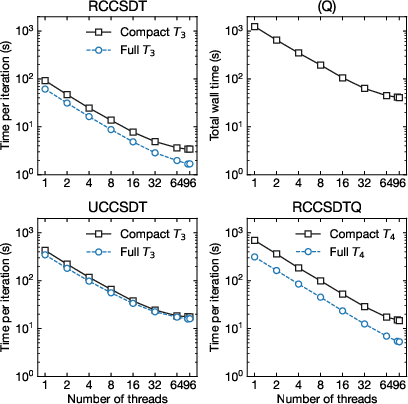
Figure 2: Wall time per iteration as a function of thread count for RCCSDT, RCCSDT(Q), UCCSDT, and RCCSDTQ; near-linear scaling is observed to 90 threads.
Distributed-Memory Parallelization
Distributed Tensor Partitioning
To scale to large molecular systems, the highest-rank amplitude tensors (O(N8)3 or O(N8)4 and their residuals) are distributed across MPI ranks by partitioning the upper-triangular occupied index tuples. Lower-rank tensors, ERIs, and intermediates are replicated as their overall memory contribution is negligible for system sizes justifying distributed execution.
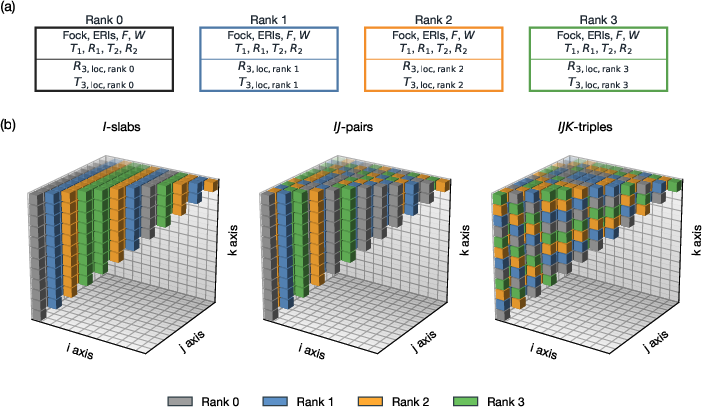
Figure 3: Data distribution for distributed RCCSDT; O(N8)5 amplitudes are distributed across ranks by upper-triangular occupied triples. Three strategies (I-slabs, IJ-pairs, IJK-triples) are compared with the latter chosen for optimal load balance.
Overlapping Communication and Computation
Communication overhead is managed by non-blocking MPI collectives: communication of amplitude data (MPI_Iallgatherv) overlaps with computation of local residual contractions. Batching of contractions is implemented to balance computational load and avoid network congestion. Near-ideal strong scaling is obtained up to 32 nodes (approx. 3,000 CPU cores).
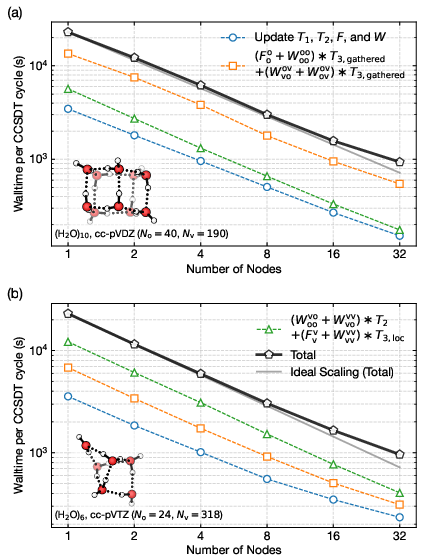
Figure 4: Strong scaling of distributed RCCSDT: per-cycle wall time as a function of node count for water clusters, with detailed breakdown by computational step.
Distributed (Q) Correction Algorithm
The demanding CCSDT(Q) energy correction is distributed by decomposing the calculation over tiles of virtual index quadruples; only the necessary O(N8)6 fragments are communicated to each rank for its set of tasks. This task decomposition allows nearly perfect parallel efficiency, as computation dominates communication for realistic system sizes.
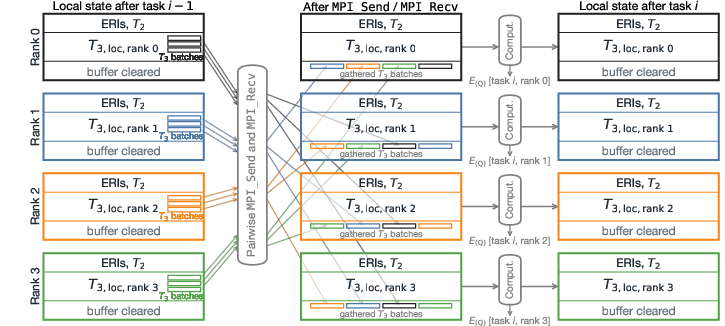
Figure 5: Distributed (Q) correction task: each MPI rank gathers only its required O(N8)7 data to compute its local energy contribution.
The implementation enabled the largest reported canonical CCSDT(Q) and CCSDTQ calculations to date. Application examples include:
- Exact CCSDT/CCSDT(Q) interaction energies for O(N8)8-stacked benzene and naphthalene dimers, validating previous approximate or reduced-rank results and revealing that post-CCSD(T) corrections can be a substantial fraction of the total interaction energy.
- A systematic study of polyene dimers revealing partial cancellation of iterative triples and quadruples corrections as system size increases.
- Transition-metal association (Cr(CO)O(N8)9) with a significant iterative triples contribution, shifting the computed energy closer to experiment.
- Iterative quadruples (CCSDTQ) for the semibullvalene Cope rearrangement barrier, showing the necessity of full iterative quadruples for sub-kJ/mol benchmarks.
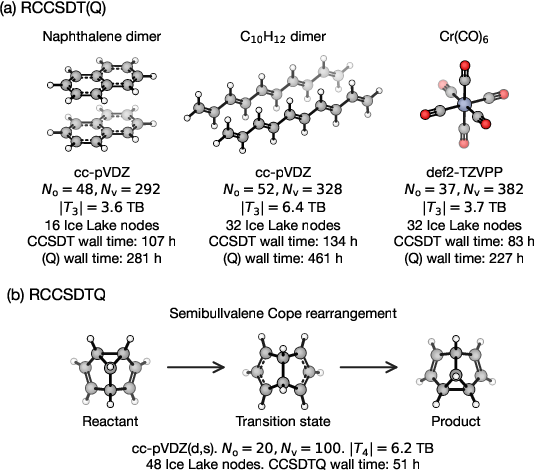
Figure 6: System size, computational resources, and compact tensor storage requirements for the largest calculations reported: up to 6.4~TB for O(N9)0 (CCSDT/Q), 6.2~TB for O(N9)1 (CCSDTQ).
Implications and Future Prospects
Practical Reach
The combination of compact storage and scalable parallelization allows canonical CCSDT/Q calculations for systems with up to O(N9)2100 correlated electrons in 450 orbitals, and CCSDTQ for up to 50 electrons in 115 orbitals, all without reliance on point-group symmetry or reduced-scaling approximations. Wall times are reduced—by orders of magnitude relative to previous state-of-the-art (e.g., MRCC, CFOUR)—and scaling overheads are minimized.
Theoretical Significance
Robust access to high-order canonical CC data provides gold- and platinum-standard benchmarks for correlated electronic structure, supporting the development and validation of approximate CC methods (e.g., local natural orbitals, FNOs, DLPNO, stochastic contractions), density functional methods, and emerging approaches in material science. The implementation demonstrates that high-level reference data are attainable for realistic molecules and reactions relevant to organic, bioinorganic, and transition-metal chemistry.
Future Directions
Key avenues for methodological expansion include:
- Distributed, spin-unrestricted CCSDT/Q for open-shell systems and strongly correlated problems.
- Extension to O(N9)3 equations and response properties, enabling analytic gradients and excited-state calculations.
- Periodic boundary conditions for solids with k-point sampling, as well as embedding and subsystem approaches.
- Integration with rank-reduction, stochastic, and local orbital techniques to further extend tractable system sizes.
Conclusion
This work delivers an efficient and scalable (shared and distributed-memory) implementation of high-order canonical coupled-cluster methods, facilitating routine CCSDT(Q) and CCSDTQ reference calculations on system sizes well beyond the traditional limits. The combination of compact tensor storage, optimized multi-threaded contractions, cost-balanced distributed batches, and latency-hiding communication strategies sets a new baseline for canonical high-order coupled-cluster performance and accessibility in quantum chemistry (2607.00981).