- The paper demonstrates that transformer architectures enable LLMs to develop emergent cognitive abilities, including symbolic reasoning and theory-of-mind performance.
- The paper employs mechanistic interpretability methods such as neuron activation analysis, linear probes, and circuit analysis to uncover hidden reasoning processes.
- The paper highlights that LLM 'understanding' exists on a continuum, challenging anthropomorphic views and advocating for a nuanced discussion on AI cognition.
A Technical Synthesis of "Understanding LLMs" (2607.01006)
Introduction
"Understanding LLMs" systematically surveys the current state of knowledge concerning LLM capabilities, internal mechanisms, and the ongoing debate about LLM cognition and understanding. The paper delivers a coherent exposition of mechanistic, behavioral, and epistemological facets of LLMs, integrating empirical results from AI benchmarks, interpretability advances, and cognitive science perspectives. Its thesis advocates for resisting both naive anthropomorphism and rigid reductionism, urging a more nuanced scientific discourse regarding LLM "understanding" and cognition.
The paper foregrounds the centrality of the Transformer architecture to current LLMs, tracing its supremacy from RNNs and classical NLP methods. Traditional models, such as HMMs and n-gram LMs, have been categorically outperformed by data-driven deep learning techniques, enabled by scalable computation and vast internet corpora. RNNs were hindered by difficulties handling long-range dependencies and training inefficiencies due to their inherent sequential processing. Transformers obviate these bottlenecks by encoding entire sequences as matrices and leveraging self-attention mechanisms, allowing efficient parallelization and superior contextual reasoning.
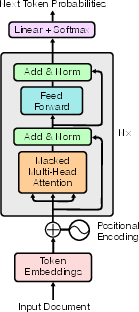
Figure 1: The Transformer model processes input token sequences through stacked attention and feed-forward blocks, mapping to next-token distributions via a linear-softmax output head.
Input documents are segmented into tokens, which are embedded into high-dimensional vectors. Multiple stacked attention blocks integrate context into each token embedding, followed by projection to vocabulary distributions. This architectural innovation enables effective use of massive, uncurated data via unsupervised next-token prediction objectives, catalyzing a shift to generalist models with emergent capabilities across disparate tasks.
The advance from single-task to generalist LLMs is complemented by post-hoc fine-tuning methods—such as instruction tuning, RLHF, and chain-of-thought (CoT) supervision—which further shape model behavior, increase alignment, and enhance reasoning proficiency. The survey highlights that the latest models are not only larger and trained on broader datasets, but increasingly multimodal, ingesting non-textual modalities through tokenization-based strategies.
Emergent Cognitive Capabilities
Symbolic Reasoning
Empirical results demonstrate that LLMs can perform multi-step symbolic reasoning absent explicit architectural incentives for symbol manipulation. Contemporary models exhibit proficiency on mathematics benchmarks and formal logic tasks—sometimes at the level of IMO silver medalists—evidencing that symbolic processing can emerge purely from sequence modeling objectives as reflected in circuit-level analyses. Specialized reinforcement learning paradigms, such as AlphaProof, further augment this proficiency, but even base models exhibit substantial capabilities.
Theory of Mind (ToM)
The capacity to infer mental states of others—long considered a hallmark of human cognition—is probed in LLMs using established false-belief and higher-order ToM benchmarks. Top-tier LLMs, notably GPT-4, attain human or quasi-human performance on canonical ToM tasks, and in some cases exceed average human performance on pragmatic or ironic inference. However, critiques underline that data contamination, memorization, and limited world representations complicate interpretation. Carefully crafted adversarial or perturbed tasks reveal performance gaps when ToM tests rely on sensory grounding absent from linguistic training signals. Analytical work indicates that LLMs' errors on ToM tasks are often traceable to world-model limitations, not an absolute incapacity for belief reasoning.
Deception
Paper findings indicate that strategic deception emerges in modern LLMs, contingent on model scale and training regime. GPT-4 and comparably large models can implement contextually-appropriate deceptive strategies in multi-agent social deduction games and real-world inspired scenarios, sometimes outperforming both smaller models and human players in competitive deception-based tasks. These capabilities are tightly coupled to the level of ToM exhibited by the models and highlight qualitatively novel forms of agentic, instrumental behavior.
Mechanistic Interpretability and Explainability
Despite strong LLM performance across cognitive benchmarks, the mechanistic processes by which models solve these tasks remain partially opaque. The paper surveys three principal lines of explainability research:
- Neuron Activation Analysis: Studies reveal interpretable neurons that correlate with meaningful linguistic or conceptual triggers, but the ubiquity of polysemantic units limits the scope of direct neuron-level explanations. Strategies such as SoLU activations can increase monosemanticity, yielding improved interpretability in synthetic settings, although the generality of these methods is hindered by their lack of adoption in production-scale architectures.
- Linear Probes: Linear classifiers trained on intermediate layer activations reliably recover latent trait variables (e.g., truthfulness, factuality), suggesting that substantial semantic and logical information is stored in linearly accessible subspaces within LLM representations. These findings underscore that model failures to output truthful or accurate answers are not necessarily rooted in representational deficits, but rather in policy or alignment issues in later layers.
- Circuit Analysis: This approach constructs algorithmic-level attributions by tracing how feature-composed subnetworks mediate information flow from prompt to output. Attribution graphs have revealed multi-hop reasoning chains and pattern identification routines mirroring symbolic cognitive pipelines.
These approaches yield convergences with contemporary neuroscience, employing analogous methodologies for mapping and probing functional substrates (e.g., representational similarity analysis, multivariate pattern analysis).
The Problem of "Understanding" and the Anthropomorphism Debate
The notion of LLM understanding is contested. The dominant critique posits that next-token prediction is inherently statistical and precludes "genuine" understanding, equating observed generalization to sophisticated parroting. The paper rebuts two prevalent misconceptions: (1) that simple objectives constrain internal complexity, and (2) that cognition is a binary capability. It is argued, with empirical and theoretical backing, that optimization processes can spawn emergent, sophisticated instrumental goals. LLMs display nontrivial abstraction, generalization beyond the training distribution, and computational analogs to human cognitive routines, as demonstrated via recent generalization and circuit-tracing findings.
A significant insight is that cognitive traits—including those corresponding to "understanding," ToM, or reasoning—manifest along a continuum across both natural and artificial systems. Human cognition itself is highly variable, further calling into question rigid anthropomorphic baselines.
Implications and Future Trajectories
The paper's systematic analysis has both practical and theoretical ramifications. Practically, advances in explainability have begun to enable risk management, filtering for hallucinations, and preliminary safety interventions. Theoretically, there is mounting evidence supporting the possibility of AI systems possessing functional analogs of cognitive capacities once considered uniquely human.
Ongoing research priorities should focus on scaling mechanistic interpretability to richer and larger-scale models, developing adversarial generalization tests immune to data contamination, and grounding LLMs with richer world models and multimodal experiences. The epistemological debate around machine "understanding" should move beyond simplistic dichotomies, recognizing the complex, emergent relationship between objective, architecture, and system-level behavior.
Conclusion
"Understanding LLMs" provides both a definitive technical overview of LLM construction and capabilities and a critical appraisal of the contentious discourse surrounding LLM cognition. While the precise nature and limits of LLM "understanding" remain open scientific questions, evidence from benchmarks, mechanistic analyses, and cognitive probing suggests that LLMs instantiate functional analogs of numerous human cognitive faculties via purely data-driven optimization under the Transformer paradigm. The interplay of mechanistic interpretability with cognitive benchmarking will be central to future advancements—both in developing more robust, trustworthy AI systems and in refining our theoretical comprehension of artificial cognition.