- The paper demonstrates that midspectrum eigenstates in interacting integrable models are efficiently represented by random superpositions of O(N) fermionic Gaussian states.
- It reveals that one-body purity, non-Gaussianity, and entanglement entropy scale polynomially in integrable regimes and exponentially in nonintegrable systems.
- The findings suggest potential for efficient classical simulations and shallow quantum circuit protocols for state preparation in many-body integrable systems.
One-Body Purity, Non-Gaussianity, and Entanglement in Interacting Integrable Models
Introduction
This work investigates the structural complexity of highly excited eigenstates in one-dimensional interacting spinless-fermion lattice systems, with a focus on distinguishing features in integrable versus nonintegrable regimes. The study explores the statistical properties of one-body purity, non-Gaussianity, and bipartite entanglement entropy, and introduces a unifying framework that characterizes eigenstates in terms of random superpositions of fermionic Gaussian states. The contrasting scaling behavior of these superpositions with system size serves as a diagnostic for the integrability and ergodicity of the underlying quantum system.
Gaussian and Non-Gaussian Structure of Eigenstates
In noninteracting or quadratic Hamiltonians, all eigenstates are by construction fermionic Gaussian states. For integrable many-body systems (Bethe ansatz solvable), the eigenstates are non-Gaussian but share several statistical similarities with random Gaussian states when evaluated on local observables and entanglement. Conversely, in nonintegrable, ergodic systems, eigenstates more closely resemble Haar-random pure states.
The paper's central claim is that typical midspectrum eigenstates of interacting integrable models are well described by random superpositions of a polynomial number, M=O(N), of fermionic Gaussian states, yielding a polynomial (rather than exponential) Gaussian/Slater rank (Figure 1).
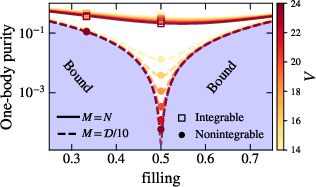
Figure 1: One-body purities versus filling n=N/V in diverse lattice sizes and regimes, delineating the analytic lower bound and the scaling of purity with M=O(N) (integrable) and M=O(D) (nonintegrable).
In contrast, eigenstates of quantum chaotic (nonintegrable) Hamiltonians require exponential superpositions, M=O(D), to replicate their properties. Extensive comparisons between analytic calculations for random superpositions and numerically exact diagonalization of many-body Hamiltonians validate this scenario.
One-Body Purity and Non-Gaussianity
The one-body purity is defined as
P=V1Tr(J2),
where J is the linear complex structure capturing one-body correlators. For Gaussian states, P=1, and lower values indicate deviation from Gaussianity. Analytic results yield a general expression for purity in random superpositions, whose value decreases polynomially (integrable) or exponentially (nonintegrable) with system size, subject to the scaling of M (Figure 2).
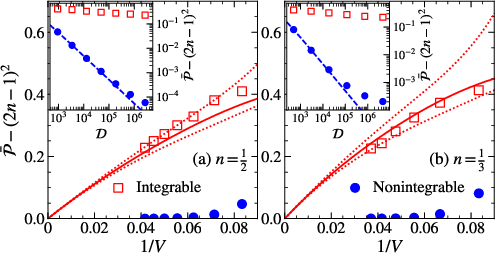
Figure 2: Average one-body purity in integrable (M=O(N), open squares) and nonintegrable (n=N/V0, filled circles) eigenstates, compared to analytic predictions; purity in integrable systems saturates polynomially above the minimal bound.
A complementary diagnostic is the non-Gaussianity, measured as the entropy difference between a state and its Gaussian reference: n=N/V1
with n=N/V2 and n=N/V3 the eigenvalues of n=N/V4. For a true Gaussian state, n=N/V5; for generic eigenstates, n=N/V6 features a characteristic scaling and saturation bound n=N/V7, the binary entropy at filling n=N/V8 (Figure 3).
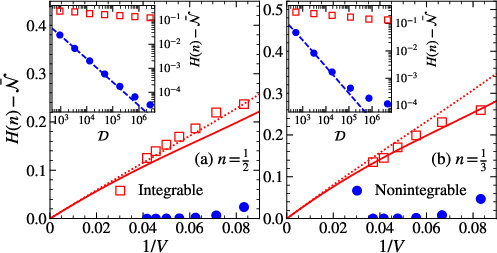
Figure 3: Volume-normalized non-Gaussianity n=N/V9 for integrable and nonintegrable regimes, confirming that integrable eigenstates require only polynomially many Gaussian basis states for near-maximal mixing.
Entanglement Structure and Volume Law
The bipartite entanglement entropy is computed for contiguous subsystems in typical midspectrum eigenstates. Haar-random pure states impose the canonical "Page curve," with entropy maximizing in nonintegrable systems and deviating submaximally in integrable regimes. Recent analytic expressions for the entanglement entropy of Haar-random fermionic Gaussian states with M=O(N)0 symmetry quantitatively capture the observed submaximal scaling in integrable models (Figure 4).
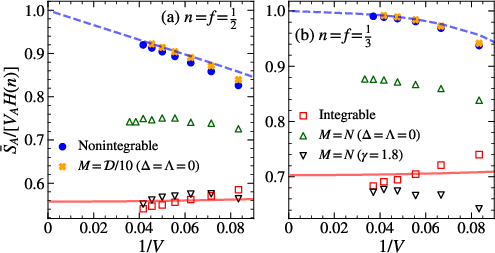
Figure 4: Normalized average entanglement entropy M=O(N)1 for eigenstates of integrable and nonintegrable models; the integrable curve falls below the Haar-random Page value, tracking the random Gaussian prediction.
Crucially, the entanglement entropy of integrable eigenstates is bounded between that for Haar-random Gaussian states and for superpositions of fractal Gaussian states from the Rosenzweig-Porter model, the latter exhibiting a fractal dimension M=O(N)2 and accurately matching eigenstate entanglement in the integrable regime.
Ergodicity Indicators and Transition to Chaos
The work presents a systematic scan of ergodicity indicators (level spacing statistics, entanglement, non-Gaussianity, purity) across the Hamiltonian's integrability-breaking parameter, confirming the abrupt transition to the regime described by exponential Gaussian superpositions and random matrix theory (Figure 5).
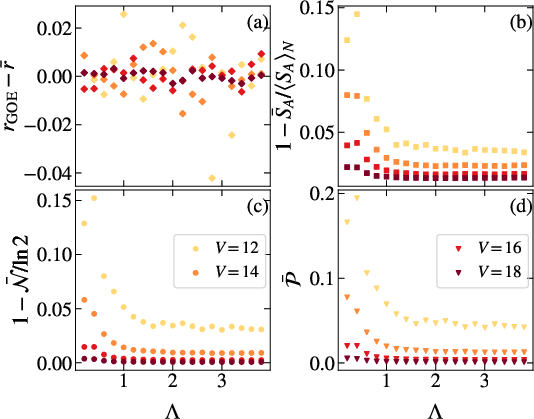
Figure 5: Ergodicity diagnostics as a function of the integrability-breaking parameter M=O(N)3, highlighting the transition from integrable (polynomial) to chaotic (exponential) scaling regimes in both spectral and state properties.
Implications and Outlook
This framework implies that highly excited eigenstates in interacting integrable models, despite their volume-law scaling and strong non-Gaussianity, admit compact polynomial-rank representations using superpositions of Gaussian states. Practically, this points to the possibility of efficient classical simulation methods and shallow quantum circuit protocols for state preparation in these systems. The analytic structure also clarifies the origin of polynomial versus exponential suppression in eigenstate fluctuations of few-body observables, linking the entanglement structure to the breakdown of ETH and the random matrix paradigm.
A significant open direction, as highlighted by the entanglement results, is a refined statistical theory of "fractal" fermionic Gaussian states, expanding current analytic approaches to cover the submaximal entanglement entropy scaling in the thermodynamic limit observed in integrable interacting systems.
Conclusion
This study provides analytic and numerical evidence that the structure of midspectrum highly excited eigenstates in interacting integrable models is characterized by random superpositions of polynomially many Gaussian states. The scaling distinctions in one-body purity, non-Gaussianity, and entanglement entropy elucidate the mechanism by which integrable systems circumvent full ergodicity, and point to new representational paradigms and simulation approaches for quantum many-body states between the Gaussian and GUE/GUE ensembles. The quantitative matching with fractal-phase Gaussian states signals novel directions in the theory of quantum complexity in integrable and near-integrable matter.