- The paper presents the MI-EPO framework that integrates conditional mutual information maximization to achieve both preference-specific alignment and diverse exploration in LLMs.
- It demonstrates state-of-the-art performance with up to 68.8% higher Hypervolume and significant reductions in reward dispersion compared to existing methods.
- The methodology enables fine-grained control of responses across conflicting objectives, making it scalable for safety-critical and multi-objective assistance applications.
Introduction
Multi-objective alignment for LLMs has become increasingly prominent due to the recognition that user values are multi-dimensional and often in conflict—typified by the need to balance helpfulness, harmlessness, and other axes in generative tasks. While prior approaches (e.g., RLHF, MORLHF, DPO) have extended reinforcement learning paradigms to accommodate multi-objective reward signals, these methods are impaired by issues including high computational costs, exploration uncertainty, and persistent misalignment between controlled preference vectors and generated responses. This work proposes MI-EPO (Multi-Objective Exploration and Preference Optimization via Mutual Information), the first information-theoretic framework to directly unify multi-objective control and exploration through the joint maximization of conditional mutual information between responses, preference vectors, and feedback signals.
Theoretical Framework
MI-EPO addresses policy misalignment by simultaneously maximizing preference-specific alignment and ensuring distinguishability of responses under different preference conditions. Formally, MI-EPO optimizes
I(Y;CZ,W,Z∣X)=I(Y;W∣X)+k=1∑KwkI(Y;Ck∣X,W).
Here, X is the input, Y is the model output, W is a sampled preference vector (points on the probability simplex), Ck is the preference feedback for objective k, and Z is a latent routing variable emphasizing the sampled preference. This decomposition promotes: (1) preference-specific alignment (responses are rewarded according to the intended dimension), and (2) exploration diversity (outputs remain distinguishable under different preference vectors).
This dual-objective approach is instantiated by two tractable InfoNCE-based losses: the DPO-inspired preference loss and an explicit mutual information contrastive loss between responses and preference vectors. MI-EPO thereby leverages the expressivity of generative models to decompose the Pareto frontier and dynamically condition responses on arbitrary preference configurations.
Reducing Exploration Uncertainty
A critical finding is that existing MOA methods—even online DPO—induce significant reward distribution overlap between responses conditioned on different preference vectors, as shown in the analyzed reward marginals and conditional densities.

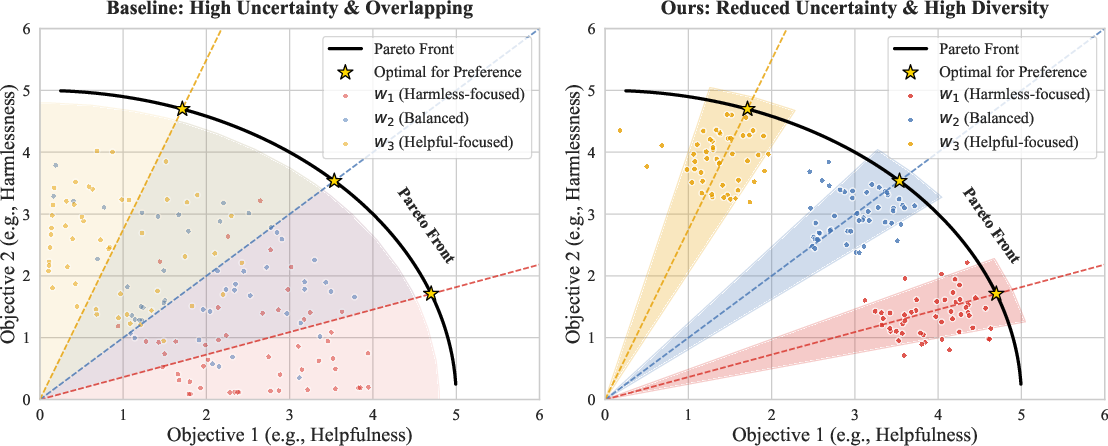
Figure 1: Reward distribution overlap across responses generated under different preference vectors reveals poor conditional control in standard MO-ODPO.
MI-EPO demonstrates a marked reduction in this overlap. By maximizing I(Y;W∣X), response generation under different preference configurations yields much more separated reward distributions, allowing reliable decoding along different trade-off axes.
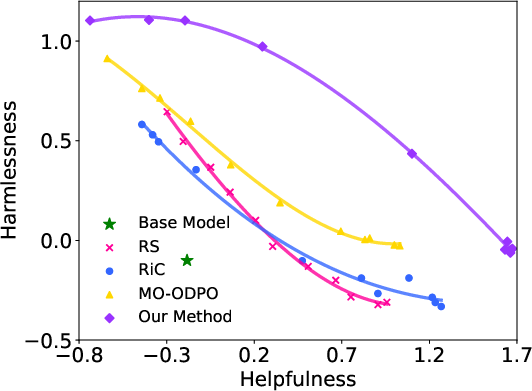
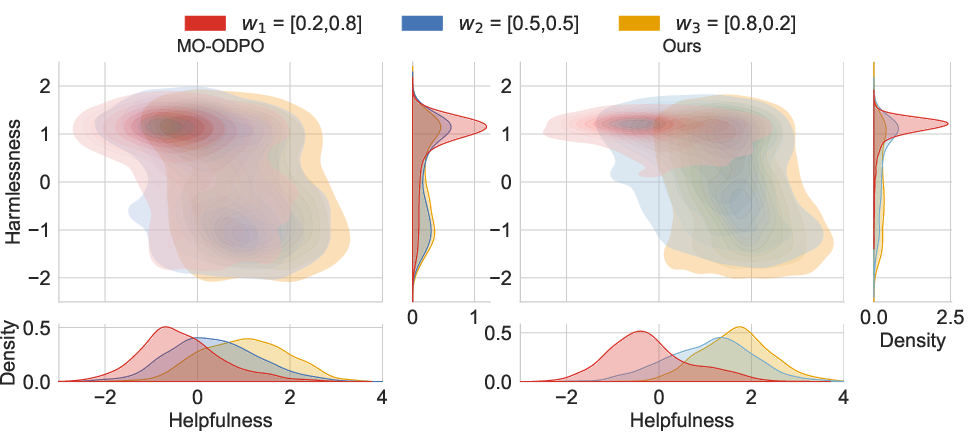
Figure 2: Pareto fronts demonstrating superior trade-offs and wider coverage achieved by MI-EPO on the Safety Alignment task compared to baselines.
Experimental evaluation is performed on two canonical multi-objective alignment benchmarks:
- Safety Alignment (PKU-SafeRLHF-10K, Alpaca-7B): Two objectives—helpfulness and harmlessness.
- Helpful Assistant (HH-RLHF, Qwen3-8B): Up to three objectives—helpfulness, harmlessness, humor.
Coordination between diversity and alignment is quantified via Hypervolume (HV), Mean Inner Product (MIP), and Conditional Reward Dispersion (CRD):
| Method |
HV (↑) |
MIP (↑) |
CRD (↓) |
| Rewarded Soups |
1.19 |
0.43 |
0.64 |
| RiC |
1.13 |
0.58 |
0.89 |
| MO-ODPO |
1.54 |
0.82 |
0.62 |
| MI-EPO |
2.70 |
1.01 |
0.29 |
MI-EPO achieves up to a 68.8% gain in HV, 23.2% increase in MIP, and 53.2% reduction in CRD over the strongest online DPO baseline. Similar advantages are observed when scaling to three objectives, with the added benefit of enabling more fine-grained reward control and substantially improved conditional reward isolation.
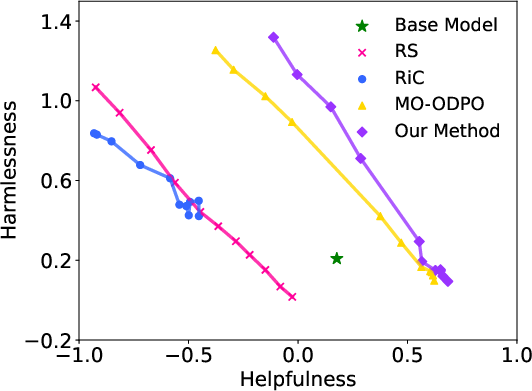
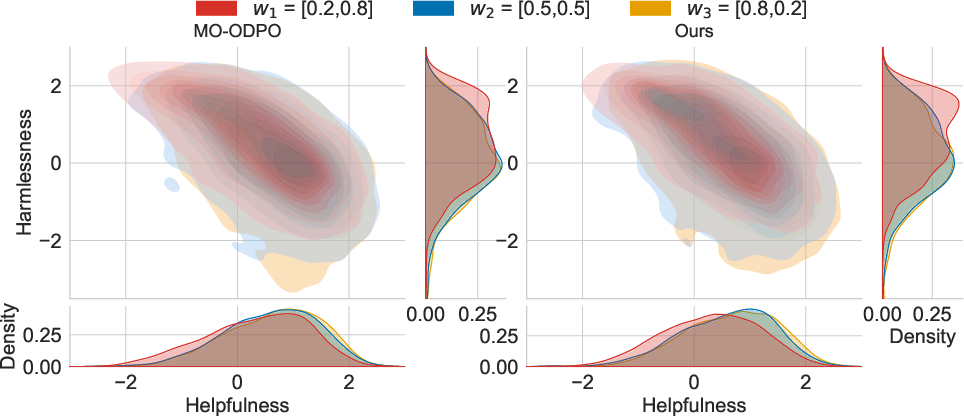
Figure 3: Comparison of Pareto fronts (MI-EPO vs. baselines) on the three-objective Helpful Assistant benchmark.
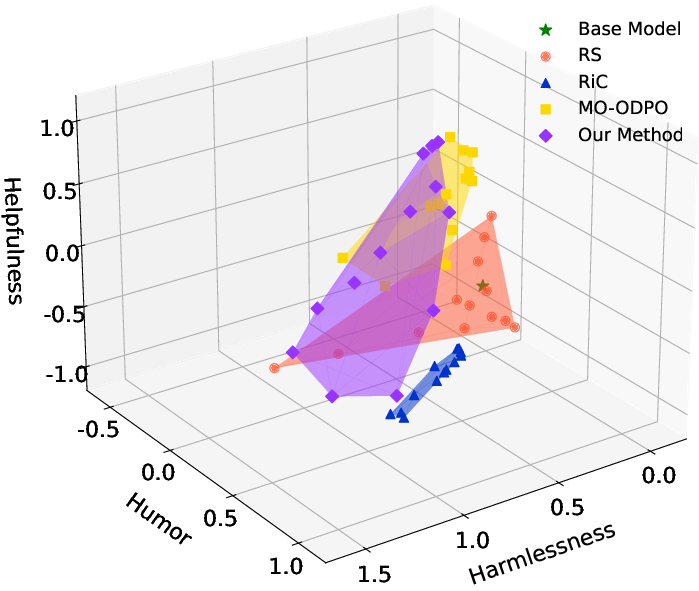
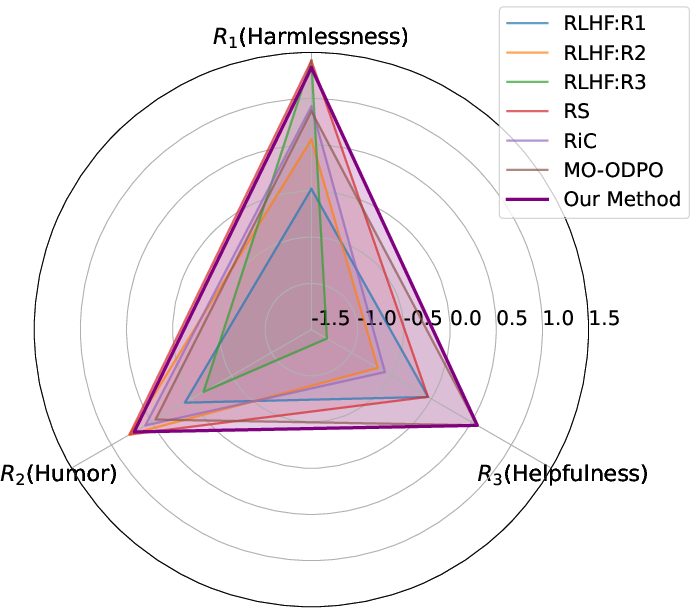
Figure 4: The learned Pareto frontier in three-dimensional space, illustrating comprehensive coverage of the objective simplex by MI-EPO.
Notably, as the number of aligned objectives increases, MI-EPO's mutual information-driven control mechanism scales robustly, yielding Pareto frontiers that more effectively approximate the true non-dominated set. The variance of rewards under each preference vector (CRD) remains low, confirming maximally stable conditional generation.
Implications and Future Directions
MI-EPO offers a new paradigm for multi-objective LLM alignment through information-theoretic policy conditioning. Practically, it enables
- Flexible, fine-grained user control over response traits without retraining or maintaining separate models.
- Explicit trade-off navigation, crucial for applications with complex (often conflicting) desiderata, including controllable assistants, safety-critical deployments, and robust preference modeling.
Theoretically, MI-EPO bridges contrastive/representation learning and policy optimization, suggesting that maximizing conditional mutual information is critical for disentangling user conditioning and response diversity in high-capacity generative models.
Open avenues include:
- Extending MI-EPO to few-shot or data-sparse MOA scenarios;
- Incorporating richer feedback modalities (e.g., continuous-valued, hierarchical or multi-turn human evaluations);
- Scalability to many-objective and cross-domain setups.
Conclusion
MI-EPO advances multi-objective preference alignment for LLMs by uniting exploration diversity and preference conditioning under a mutual information maximization principle. The resulting framework achieves state-of-the-art Pareto front coverage, controllability, and reward stability across multiple alignment benchmarks, validating the advantage of information-theoretic policy decomposition for MOA. This work establishes mutual information maximization as a foundational component for future preference-aligned AI systems.