- The paper introduces a framework that extends the quantum geometric tensor by encoding many-body effects through interacting vertex correlations.
- It employs diagrammatic expansions—including reducible and irreducible vertex corrections—to capture fluctuation and deformation impacts on quantum geometry.
- Applications to collective bosonic fluctuations and Jahn-Teller distortions showcase its ability to describe complex correlations in advanced quantum materials.
Generalized Quantum Geometry via Interacting Vertex Correlations
Introduction
The conventional formulation of quantum geometry, underpinned by the quantum geometric tensor (QGT), is central to understanding the geometric properties of electronic wavefunctions in solids. Typically, quantum geometry is encoded in the parameter space of crystal momentum, where its real and imaginary components represent the quantum metric and Berry curvature, respectively. This framework has elucidated various phenomena, such as nonlinear transport, enhanced superconductivity, and optical responses arising from the interplay of band topology and geometry [qgeomcm-liu:2025, qgtguide-gao:2025]. However, quantum geometry in this traditional sense is fundamentally limited when considering many-body and collective effects arising from interactions and deformations not captured by crystal momentum alone.
This work establishes a comprehensive extension of the quantum geometric framework by constructing the QGT through correlations of interacting vertices, thereby incorporating generic adiabatic parameters, including collective bosonic fields, structural distortions, and external fields. The manuscript demonstrates that arbitrary interacting vertex correlators encode the generalized QGT, forming a unified approach to quantum geometry in the presence of many-body effects.
Extension Beyond Bloch-Band Quantum Geometry
The manuscript generalizes the QGT by identifying the role of interacting vertex correlators conjugate to generic deformation parameters. When a manifold M is parametrized by a set of adiabatic parameters λ—which could represent Bloch momentum, field amplitudes, or structural coordinates—adiabatic changes induce transformations of the ground state, and the QGT is defined in this generalized parameter space.
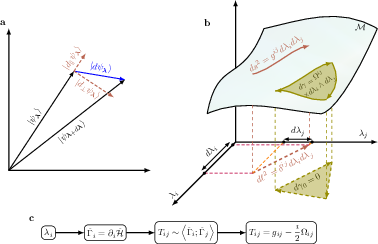
Figure 1: Infinitesimal adiabatic variations of generic parameters λ define the quantum geometric tensor via their effect on the wavefunction manifold, with the perpendicular component quantifying the geometric distance and curvature.
The projection formalism in Figure 1 encapsulates how infinitesimal changes in parameter space yield the QGT, with both metric and curvature elements. The work rigorously constructs the QGT,
Tij(λ)=gij(λ)−2iΩij(λ),
from gauge-independent overlaps within the Hilbert space of deformed ground states.
Vertex Correlation Approach and Diagrammatics
The central claim is that the generalized QGT is encoded in correlation functions of self-consistently determined interacting vertices Γ^i(λ). These are the derivatives of an effective (possibly interacting) Hamiltonian with respect to the adiabatic parameters. This approach naturally extends previous treatments of quantum geometry, which are specific to current vertices in the electromagnetic limit, to include arbitrary collective modes and external deformations.
The connection between physical observables and quantum geometry is clarified: the susceptibility and conductivity tensors become special cases of generic response functions derived from vertex correlators. The symmetric and antisymmetric components of these correlators yield the quantum metric and Berry curvature, respectively. Analytical continuation and Kramers-Kronig relations relate Matsubara and real-frequency response functions.
A diagrammatic expansion for the vertex correlation functions is provided, including reducible and irreducible diagrams, particle-hole bubble corrections, and the self-consistent Bethe-Salpeter construction of many-body vertex corrections.
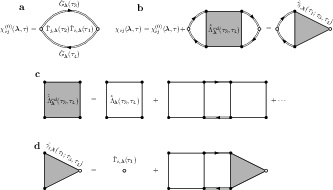
Figure 2: Diagrammatic expansion of the parametric vertex correlation bubble diagram χij, demonstrating the hierarchy of mean-field, bubble, and irreducible interaction effects essential for the generalized QGT.
The mean-field and interaction-corrected expansions highlight the impact of fluctuations and correlations on the geometric structure of the ground-state manifold.
Applications: Collective Fluctuations and Jahn-Teller Distortions
To demonstrate the formalism, the manuscript treats two prominent physical scenarios:
- Collective Bosonic Fluctuations: The deformation manifold is constructed from collective boson amplitudes ϕα(q,ω), with the corresponding vertices Γ^α determined via Hubbard-Stratonovich decoupling. Vertex correlators encode fluctuation-driven quantum geometric curvature in systems where many-body fluctuations are significant, such as unconventional superconductors and charge-ordered systems [berryjt-minarro:2026].
- Jahn-Teller Structural Distortions: Here, deformation parameters are the coordinates of ionic motion in the space of normal modes (e.g., Qθ, Qϕ for tetragonal and orthorhombic distortion axes). The vertex formalism correctly reproduces the conditions under which quantum geometric curvature vanishes (e.g., in the presence of time-reversal symmetry and isotropic couplings), distinguishing between local electron-vertex correlations and nuclear holonomies responsible for topological Berry phases [streltsov2020jahn, bersuker2013jahn].
The approach recovers the electromagnetic and semiclassical limits as particular cases while highlighting the essential role of many-body vertex dressing for full quantum geometric characterization in correlated systems.
Implications and Theoretical Impact
This generalization of the QGT to interacting vertex manifolds addresses a major theoretical deficiency in the standard quantum geometry literature by naturally incorporating many-body contributions. The formalism provides a route for integrating quantum geometry with generic response theory, opening prospects for the study of geometric effects in correlated metals, unconventional superconductors, fluctuating charge or spin-ordered systems, and multifunctional quantum materials.
Importantly, the tensorial structure allows explicit separation and classification of contributions from different physical manifolds (e.g., electronic, phononic, orbital degrees of freedom), capturing manifold coupling effects. The approach has immediate implications for the interpretation of spectroscopic measurements, nonlinear optics, and collective mode detection in strongly correlated systems [kim2025direct, kang2025measurements, ghosh2024probing].
On the practical side, it enables the development of ab initio and model-based computational protocols that extract the QGT—including both quantum metric and Berry curvature—directly from vertex-resolved many-body calculations, as can be implemented within dynamical mean-field theory and response function techniques [sukhachov2025effect, guan2026exploring].
Future Perspectives
The framework enables a systematic analysis of the interplay between quantum geometry and emergent phenomena, such as collective electronic orders, topological matter, nonreciprocal transport, and optical activity beyond simple band-structure effects. Extensions to open quantum systems, dynamical fields, and out-of-equilibrium protocols are conceivable, especially since the underlying correlator structure is compatible with time-dependent and nonequilibrium Green’s function approaches.
Furthermore, the proposed formalism lays the groundwork for the study of interactions between different geometric manifolds, the emergence of multipole moments, and novel functional responses in complex quantum materials.
Conclusion
This work achieves a rigorous and unified extension of quantum geometry by formulating the QGT via interacting vertex correlations. The resulting theory incorporates generic many-body deformations far beyond the scope of conventional band-structure approaches, positioning vertex correlator expansions at the heart of quantum geometric response theory. The versatility of the framework portends substantial progress in understanding, computing, and measuring quantum geometric effects in collective and correlated quantum matter (2607.01434).