- The paper shows that KW duality is implemented with logarithmic-depth circuits that reduce the depth from O(N) to O(log N) for nonlocal quantum hardware.
- It introduces recursive construction methods in both one and two dimensions using nonlocal CNOT gates and ancilla qubits to enforce charge-neutrality and topological constraints.
- The work generalizes to Zₙ dualities, demonstrating coherent mapping of short-range entangled states to long-range entangled states with direct applications in quantum simulation and state engineering.
Shallow Unitary Circuits for Kramers-Wannier Dualities: An Expert Assessment
Introduction
The Kramers-Wannier (KW) duality is a foundational transformation in quantum many-body physics, mapping short-range entangled (SRE) states to long-range entangled (LRE) states and facilitating insights into phase transitions and topological order. Traditional implementations of the KW duality as local quantum circuits require circuit depth that scales linearly with system size due to the constraints of locality and Lieb-Robinson bounds. However, the availability of quantum hardware with nonlocal connectivity—such as Rydberg atom arrays and trapped ion systems—calls for a reevaluation of these depth bounds within nonlocal unitary circuit paradigms. This paper constructs explicit, logarithmic-depth, spatially nonlocal unitary circuits that implement KW dualities in one and two spatial dimensions and generalizes these results to arbitrary Zn (abelian discrete) dualities, while preserving complete coherence and eliminating measurements and feedforward.
Explicit Construction of Logarithmic-Depth Unitary Circuits
The primary technical contribution is a recursive construction of nonlocal unitary circuits that realize the full KW duality in both $1d$ and $2d$. The circuits use a combination of single-site and two-site nonlocal gates (primarily CNOTs and generalized versions for Zn), achieving O(log2N) circuit depth where N is the number of qudits, a reduction from the O(N) depth required with strictly local unitaries.
In one dimension, the circuit is constructed inductively for system sizes N=2p. Each recursive step expands the system by a factor of two, introducing layers of nonlocal CNOT operations and parallelizing sub-circuits wherever possible. The construction preserves KW duality not just for fixed-point ground states but for all SRE input states within the charge-neutral sector, mapping them to their corresponding LRE duals.
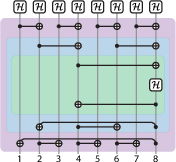
Figure 1: The 1d KW duality circuit for N=8, with depth 2log2N+2=8, delineating the recursive circuit structure.
In two dimensions, the circuit architecture is similarly recursive, with additional induction on the number of rows. The operator mapping for $1d$0 is more complex due to the transformation of qubits from vertices to edges of the dual lattice. Ancilla qubits are introduced as needed to enforce flux-free (topologically nontrivial) constraints after the duality transformation. The circuits ensure that generic SRE states in the charge-neutral sector are coherently mapped to LRE states such as toric code ground states.
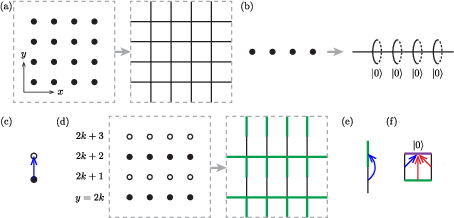
Figure 2: Realization of two-dimensional $1d$1 KW duality, illustrating the geometry, the recursive step structure, and the implementation of necessary ancillae.
Generalization to $1d$2 Dualities
The methodology is systematically extended to $1d$3 KW dualities, where each site hosts an $1d$4-level qudit. The role of Pauli $1d$5, $1d$6, and CNOT gates is taken over by their $1d$7 generalizations: clock and shift operators, the quantum Fourier transform, and generalized controlled-$1d$8 gates. The resulting circuits retain logarithmic depth and nonlocality property, and the operator mapping explicitly recovers the standard $1d$9 KW transformations in both $2d$0 and $2d$1, given charge-neutral initial states.
Key features in the $2d$2 construction include:
- Use of controlled-$2d$3 gates for duality mapping,
- Fourier transforms replacing Hadamard layers,
- Explicit operator conjugation tracking to ensure faithful transformation rules.
Fundamental and Practical Implications
A significant theoretical implication is the establishment of a tight speed limit for coherent KW duality implementation in the regime where spatial nonlocality is allowed but projective measurements and classical feedforward are excluded. While prior work demonstrated constant-depth KW dualities via adaptive protocols, this work demonstrates that $2d$4 is optimal for purely unitary circuits, even with all-to-all connectivity.
Practically, the construction provides efficient circuits for the preparation of LRE states (e.g., GHZ, toric code) from trivial SRE states, with direct applicability to quantum simulation and state engineering on current hardware architectures featuring flexible qubit/qudit interconnectivity.
The circuits’ ability to map generic (non-fixed-point) SRE states to LRE duals, while exactly preserving operator algebra and charge sector constraints, enables the exploration of finite-correlation-length properties and localized excitations (e.g., mapping local excitations to anyons). This opens coherent, measurement-free pathways to directly study dualities and topological phase transitions on quantum devices.
Discussion and Outlook
The authors argue that their approach generalizes to higher spatial dimensions, as many exotic topologically ordered states can be constructed from layered applications of $2d$5 and $2d$6 KW dualities plus ancilla initialization, modulo finite-depth local circuits. Extending this paradigm to nonabelian KW dualities remains an open problem, especially given the absence of any known sublinear-depth protocols, even for adaptive circuits.
Notably, the circuits do not merely prepare special entangled states but implement full duality maps, preserving correlations and topological defects under explicit transformations. This capability is essential for simulating quantum critical points and anyonic dynamics on quantum hardware.
Conclusion
This work closes a longstanding gap in the quantum simulation of dualities by providing explicit, logarithmic-depth, spatially nonlocal unitary circuits for KW dualities in both $2d$7 and $2d$8, as well as for all abelian $2d$9 generalizations. The circuits are optimal in depth for the unitary-only setting and eliminate the need for costly mid-circuit measurement and feedforward. These results have immediate implications for the efficient, purely coherent realization of topological matter and dualities in emerging quantum architectures, and lay the foundation for further generalizations to nonabelian symmetries and higher dimensions.