- The paper introduces the Observer-Checker-Corrector (OCC) framework to iteratively refine captions and eliminate hallucinations in audiovisual data.
- It employs a high-density human interaction dataset and the TCA-Bench diagnostic to meticulously evaluate cross-modal and temporal coherence.
- Experimental results reveal that TCA-Captioner achieves SOTA performance with notable gains in AV Binding (73.2) and AV Temporal (76.9) metrics, outperforming closed-source models.
Temporal and Cross-Modal Alignment in Audiovisual Video Captioning: An Expert Analysis
Audiovisual video captioning remains a focal research area within the trajectory of Multimodal LLMs (MLLMs). Despite considerable progress, the domain continues to wrestle with two persistent challenges: audio-visual cross-modal binding—the precise attribution and association of auditory events to visual entities—and audio-visual temporal coherence, which demands correct modeling of chronological and causal relationships across modalities. Existing MLLM-based video captioners (e.g., Qwen3-Omni, Gemini-3-Pro, AVoCaDO) often exhibit modality detachment and temporal incoherence, resulting in disjointed or hallucinated associations between sound events and their physical or contextual sources.
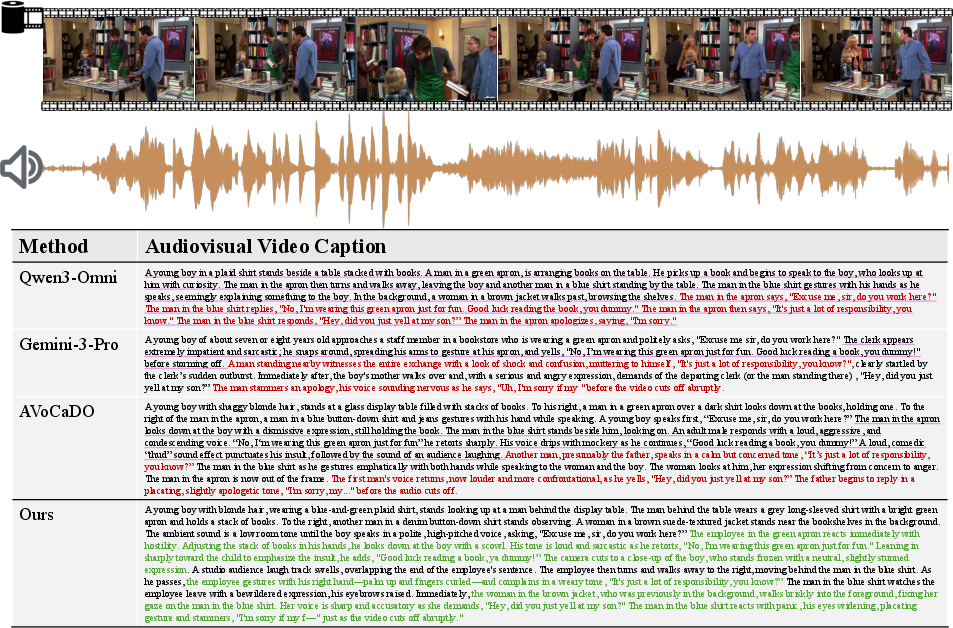
Figure 1: Existing models’ output failures in cross-modal binding and temporal coherence compared to TCA-Captioner’s synchronized, grounded descriptions.
These issues are not just theoretical; they systematically degrade the representational quality and downstream utility of captions in tasks such as VideoQA, action recognition, and generative video synthesis.
The Observer-Checker-Corrector Framework
To address these deficiencies, the authors introduce the Observer-Checker-Corrector (OCC) framework, a rigorous, iterative data synthesis and annotation pipeline designed to systematically eliminate factual hallucinations and enforce fine-grained grounding.
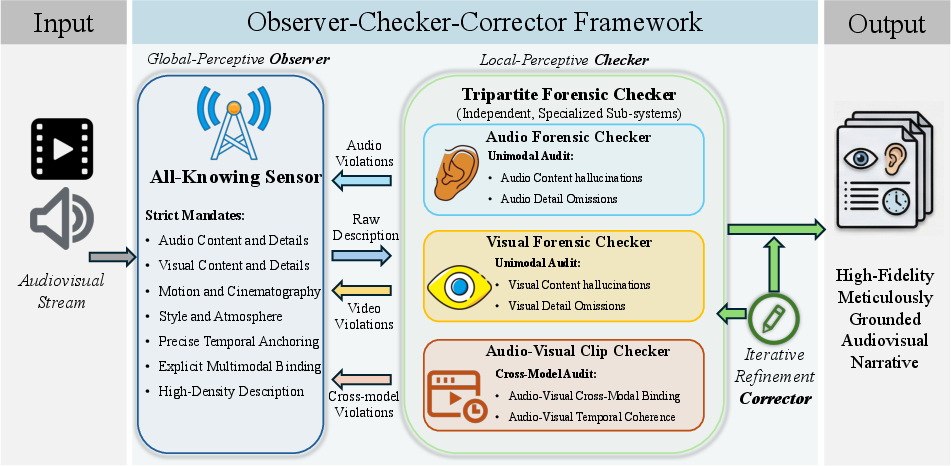
Figure 2: Overview of the OCC pipeline architecture, detailing the Observer’s global audiovisual scan, Checker’s unimodal and cross-modal audits, and the Corrector’s iterative refinement.
Within the OCC, the Observer produces a high-density, strictly timestamped description emphasizing objective multimodal reporting. The Checker component is split into three decohered subsystems:
- Audio Forensic Checker: Detects hallucinations, transcription errors, and auditory omissions, focusing on phonetic and prosodic fidelity.
- Visual Forensic Checker: Recovers granular visual details, corrects entity-action misattributions, and validates temporal logic on silent video data.
- Audio-Visual Clip Checker: Core to cross-modal binding, precisely localizes diegetic/off-screen/narrator sounds, identifies lip-sync issues, and employs fine temporal slicing for clip-based verification.
The Corrector performs violation-driven refinement, synthesizing inputs from all Checkers to output a maximally faithful caption. This pipeline is computationally expensive (e.g., ~22k tokens per 10s video), but it delivers highly structured, erroneous detail-minimized data for supervised fine-tuning.
Dataset Curation: High-Density Human Interaction
Recognizing the limits of extant datasets, the authors curate a High-Density Human Interaction (HDI) Dataset. These clips feature frequent multi-party speech, rapid environmental actions, and complex, intertwined causal chains, providing the necessary "hard cases" for robust model training under fine-grained alignment constraints. They supplement the dataset with curated samples from FineVideo and TikTok-10M, streamlining annotation for lower-density content.
TCA-Bench: Diagnostic Benchmark for Cross-Modal and Temporal Entanglement
Assessment of cross-modal capabilities necessitates more than global detail recall. The TCA-Bench is proposed as a diagnostic benchmark that shifts beyond unordered "bag-of-events" paradigms. Its curation pipeline leverages automated entity detection (YOLOv8) and speech activity detection (Silero VAD) for clip selection, followed by dense LLM-assisted, human-validated annotation.
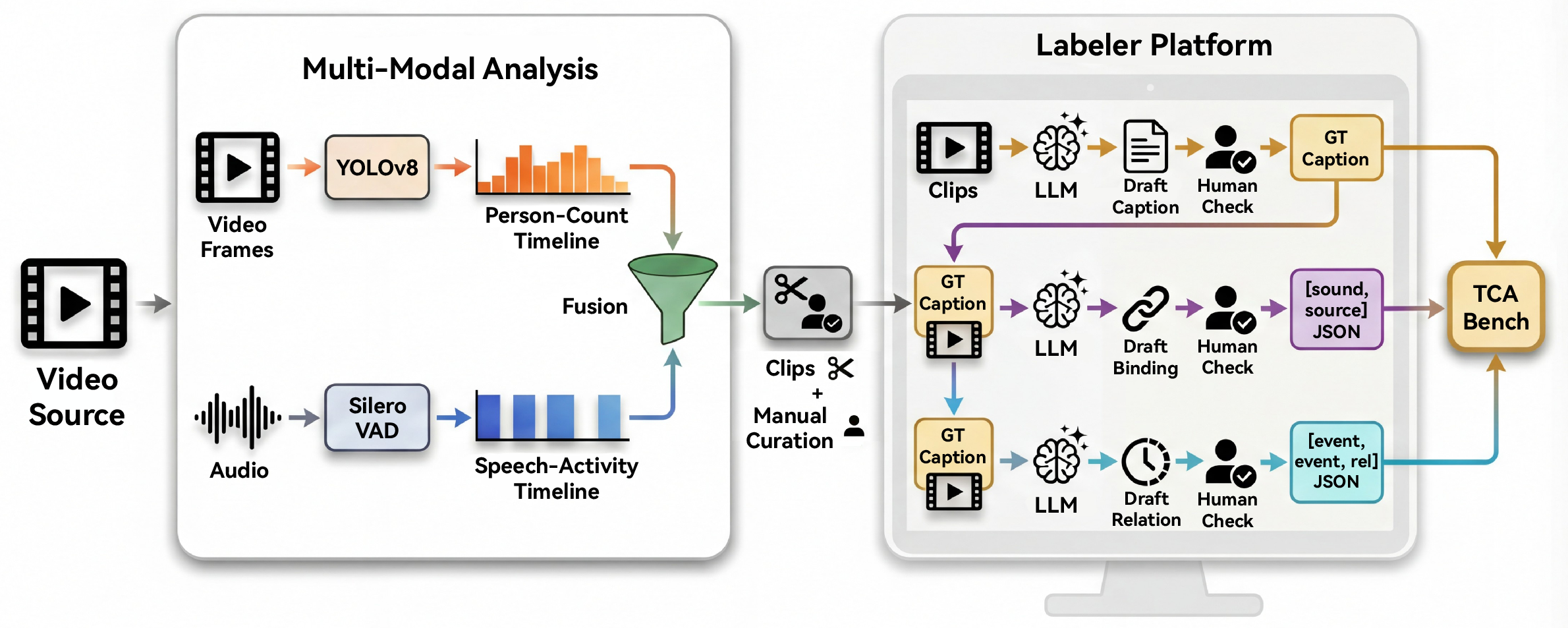
Figure 3: The TCA-Bench curation and annotation pipeline, integrating parallel visual and auditory analyses for dense event selection.
Its annotation schema comprises:
- Exhaustive ground-truth captions detailing visual and auditory observations.
- JSON-based Binding Lists mapping each sound event to its visual source (character, off-screen, or environment).
- Temporal Relational Lists encoding the precedence and simultaneity of cross-modal events (e.g., A→V, A⇌V).
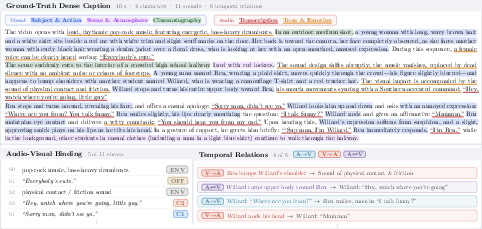
Figure 4: TCA-Bench annotation showcase with dense caption, binding pairs, and temporal triples to enable decoupled metric evaluation.
The evaluation protocol is decoupled: base perception (unimodal) is scored via LLM-based comparison to GT, whereas cross-modal metrics—Binding Accuracy and Temporal F1—are computed through targeted checklist verification, isolating integration performance from content/retrieval errors.
Experimental Results and Ablations
TCA-Captioner is realized by LoRA-finetuning Qwen3-Omni on the OCC-refined dataset, with optional DPO preference alignment. On public benchmarks (Video-SALMONN-2, UGC-VideoCap), TCA-Captioner achieves state-of-the-art (SOTA) performance among all open-source models and remains highly competitive against top-tier closed-source systems.
On TCA-Bench, experimental results reveal that TCA-Captioner dramatically reduces the gap with closed-source models in the critical AV Binding (73.2) and AV Temporal (76.9) dimensions versus Qwen3-Omni (42.5, 47.9 respectively), and even surpasses Gemini-3.0-Flash in all evaluated dimensions, validating the effectiveness of multi-stage error correction (Table 2, main paper). Specific ablations confirm the essential role of each OCC component: the audio checker boosts audio scores, the visual checker enhances visual fidelity, and the A/V-Clip-Checker is uniquely necessary for cross-modal and temporal reasoning gains.
Implications and Future Directions
This work provides an actionable methodology for engineering robust multimodal alignment in LLM-centric video captioning, combining systematic annotation, error decoupling, and bench-level evaluation. TCA-Captioner’s empirical superiority in temporal and cross-modal alignment demonstrates that fine-grained, structure-aware data curation is indispensable for transcending modality detachment.
Practically, the TCA-Bench protocol will catalyze future efforts in:
- Isolated diagnosis and targeted mitigation of cross-modal failure modes,
- Advancement of omni-modal LLM architectures with stronger, benchmarkable grounding of complex, real-world audiovisual phenomena,
- Downstream tasks—multi-modal QA, controlled video generation—that require temporally and semantically integrated representations.
Theoretically, this framework points towards hierarchically structured supervision as a necessary condition for scalable, generalizable multimodal reasoning, with the OCC paradigm representing a promising blueprint for future data-centric approaches.
Conclusion
The presented work advances audiovisual video captioning by formalizing and addressing the fundamental obstacles of cross-modal binding and temporal alignment. Through the OCC iterative annotation pipeline and the TCA-Bench benchmark, it sets new standards for both model capability and evaluation rigor. The data-centric methodology and diagnostic infrastructure herein are poised to inform further innovation in multimodal learning, enabling more coherent and contextually valid narrative generation across research and practical deployments.
References:
"Temporal and Cross-Modal Alignment for Enhanced Audiovisual Video Captioning" (2607.01667)